




Like many, I saw and enjoyed the recent film adaptation of The Odyssey. Like many others, I have made a heroic resolve to read Homer’s epic itself. And though not normally one to dwell on book-to-film incongruities — nor one of those insufferable sorts who must always insist the book is better than the movie — one discrepancy gives pause: Book 5 and Odysseus’ experience on the island of Ogygia.
In Christopher Nolan’s film adaptation, the nymph Calypso feeds the shipwrecked Odysseus the lotus flower to blur his sensation of time and memory — memory of success and of home but also of his tragic fortunes, away now from wife, child, kingship, and kinship. The lotus is given not altogether maliciously but to ease his suffering.
Yet despite the doping by the goddess — and despite an arguably very nice life now in the sphere of a nymph — Odysseus’ longing for home remains so strong that he, portrayed by Matt Damon, lives continually in a mumbling misery, a wretch seemingly made more ragged by the draught. Calypso eventually realizes that his heart remains fixed elsewhere and ceases giving him the lotus tincture. Odysseus’ full memory returns, and with nary a delay he sets sail.
But in Homer there is no doping on Ogygia. Odysseus plainly retains his memory and sense of time from the moment he drifts onto the island until seven years later when he leaves. Throughout his unwanted island embrace, he knows and longs for Ithaca, for Penelope, for everything bound to his life before his world was ruptured by the Trojan War.
Living now in a patience born of surrender — a posture foreign to the master strategist — while surrounded by almost anything a man might desire, beauty, food, ease, security, even the promise of immortality, Odysseus lacks the thing his cleverness here cannot manufacture: agency. He has no means to leave, unwillingly subjected to futility.
Hermes then arrives, sent by Zeus at Athena’s urging, and tells Calypso that she must give Odysseus the means to depart. Unable to oppose the decree, she equips him with tools, shows him the grove from which he may cut timber for his craft, and supplies food and drink for the renewed voyage. Calypso’s love for Odysseus seems real. Her desire to care for him tenderly remains present even now — “man and god as one” (Book 5, line 215, Fagles translation) — perhaps as unselfish as it was selfish. Forced to surrender her own choice, Calypso must finally hand choice back to Odysseus. Her yearning emerges as resentment, though resentment still mixed with gentleness, as she attempts to persuade him to remain.
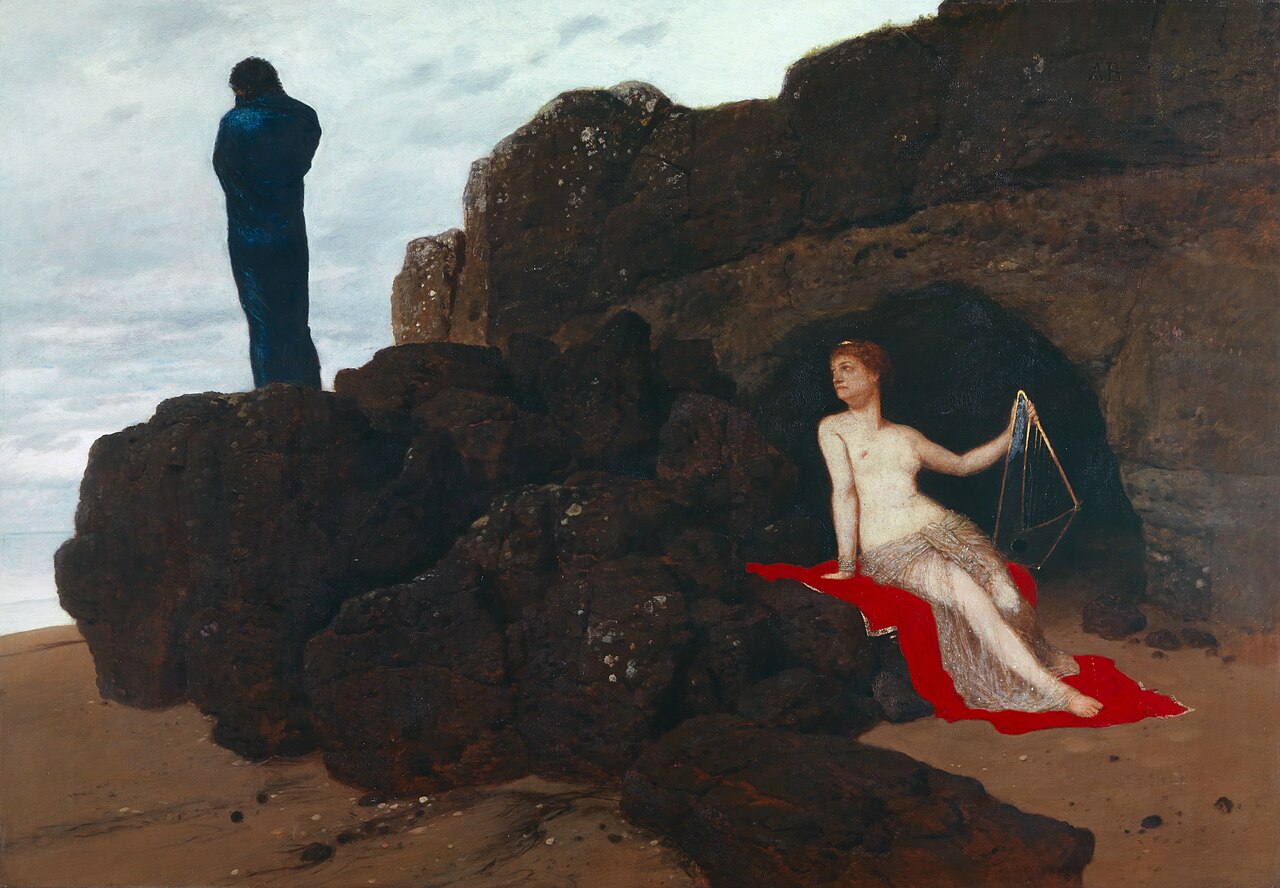
HxB: 103.5 x 149.8 cm; Öl auf Mahagoniholz; Inv. 108
Odysseus, first acknowledging the paradisial life Calypso offers, is gentle too in rebuff, knowing where his bonds, his promises, and his true heart lie:
“Nevertheless I long — I pine, all my days —
to travel home and see the dawn of my return.
And if a god will wreck me yet again on the wide-dark sea,
I can bear that too, with a spirit tempered to endure.
Much have I suffered, labored long and hard by now
in the waves and wars. Add this to the total —
bring the trial on!”
(Book 5, lines 243–249, Fagles translation)
Nevertheless. That cresting adverb transforms an already remarkable chapter into lyrical and thematic greatness, making Odysseus’ heart as clear as his memory. He remembers home because his heart remains there.
The contrast here is not meant as a criticism of Christopher Nolan’s storytelling or cinematic construction. The lotus flower does appear in Homer’s Odyssey, though not until Book 9; Nolan’s relocation of the flower to Ogygia perhaps gives the film a way to dramatize forgetting and then a remembrance that propels a cinematic telling.
Nevertheless, Odysseus’ amnesia is imperfectly placed. The contrast allows us, by juxtaposing the two tellings, to discover something richer in Homer. For Nolan’s Odysseus, the wonder is that he remembers again. For Homer’s Odysseus, the wonder is that he never forgets.
Perhaps this imperfectly placed amnesia can also help us see the wonders of something richer in the Christian life. What is the Christian wonder? What is the Christian nevertheless? In the amnesia bound up with our fallen state, what remains within us that still yearns homeward in hope? And how might that amnesia — our own imperfect amnesia — be overcome? What about a parabolic nevertheless?
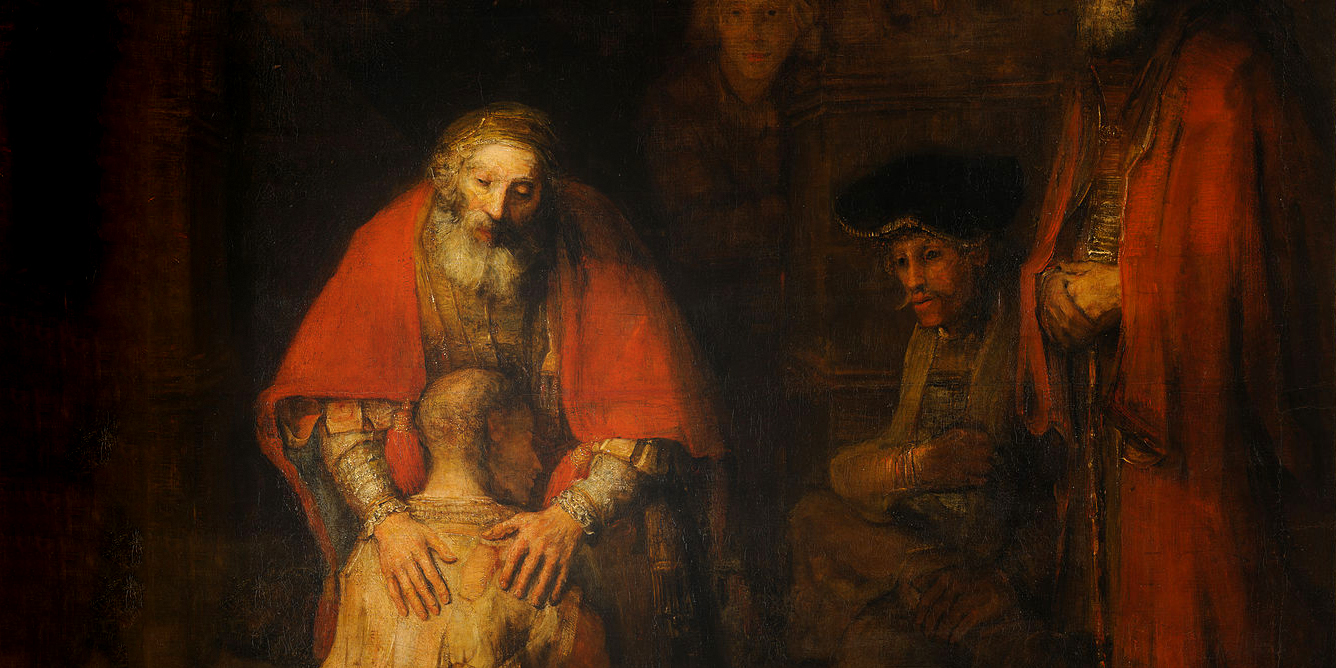
Jesus’ parables offer one route to remembrance, one poultice against the fallen world’s lotus-like lure into self-sufficiency. Jesus once told a parable of a younger son who resolutely leaves his home and family — less like a duty-bound Odysseus and more like a jaded youth — and descends into misery. Then, at last, he “comes to himself,” changed (Lk 15:17). He remembers. Or perhaps more precisely, he recovers enough to remember home and begins to travel toward it.
Like Nolan’s Odysseus, the younger brother of the parable forgets and then remembers. But the parable does something neither Nolan nor Homer does. The son begins to travel home only to discover that home itself is running toward him. The father sees him “while he was still a long way off” and runs. Here scripture introduces what The Odyssey cannot provide: the father runs to meet the exile. Read christologically, it is Christ who meets us. Christ goes into the distant country to bring us home.
More than an invitation to find our way back to God, the gospel announces God’s actual homecoming in real history: first in the incarnate Christ, then in the Spirit, within the now-inaugurated new creation until the all-in-all of God’s final homecoming. Perhaps that is one way of speaking of home already: we are home when we are caught up in God’s purposes, though not finally home — not yet. Christian homecoming courses both ways: we travel toward God, and God toward us — the Word became flesh (Jn 1:14). The Christian hope is not an escape from earth to some disembodied state but an embodied hope: God dwelling with humanity (Rev 21:3–5), creation renewed, the dead raised, heaven and earth conjoined in Christ (Eph 1:10), until at last, “the dwelling place of God is with man” (Rev 21:3). Then we will see the dawn of our return to the Father, to our homeland with him among the communion of saints, among those brought to life again.
And yet we forget, seemingly every day. Much of our spiritual restlessness arises because the fallen world continually teaches us to forget what is most fundamental: that we, and all creation, live by dependence upon God. We forget creatureliness. We forget dependence. We forget Fatherhood. We imagine the deluge of waters receding not to reveal God’s good creation (Gen 8:6–12) but an island of our own construction, where self-sufficiency masquerades as freedom, where self-indulgence calls itself fulfillment. And so, we forget home and settle for a false Ogygian one, where the circling birds become merely the wheels of our own minds.
But the amnesia remains imperfect like a glazing of rain. And so much depends on God’s grace. Dependence itself is elemental, fundamental — simple enough that the poet William Carlos Williams could write, “So much depends / upon / a red wheel / barrow,” glazed with rainwater, beside white chickens. Creation’s dependence upon God, and God’s loving grace toward creation, extend even to the unclean raven: “He gives to the beasts their food, and to the young ravens that cry” (Ps 147:9). The very raven Noah once sent out over the waters becomes, in Christ’s teaching, an image of dependence: “Consider the ravens: they neither sow nor reap, they have neither storehouse nor barn, and yet God feeds them. Of how much more value are you than the birds!” (Lk 12:24). God’s grace ever remembers.
And Isaiah deepens this remembrance, helping to awaken us from our own lotus-like “drunken stupor” (1 Cor 15:34): “Can a woman forget her nursing child? … Behold, I have engraved you on the palms of my hands” (Is 49:15–16). We may forget God. But God answers: I have not forgotten you. That may be the deepest answer to our imperfect amnesia: our remembrance is imperfect; nevertheless, God’s remembrance is whole. Our frailty finds home in God’s grace. Even our cry “Why remember God at all?” is itself a form of remembering.
Which moves us away from dependence on information accumulation. Because perhaps Christian remembrance is not chiefly a matter of retaining information. What sticks? What remains? Almost nothing. Perhaps only that of which we partake. To remain merely in a knowledge mode is ultimately … to fade. Formation, though … forms. Scripture heard. Prayers made. Bread received. Wine received. Failings confessed. Mercy practiced. Neighbors loved and what we sow through a variety of vocations. We remember home by rehearsing home. Signs of homecoming are here — perched all around — even if we remember our true home imperfectly.
Which returns us to the nevertheless of the gospel. Unlike Odysseus, our surrender is not without hope, nor set before idols that cannot answer. We are home in and through Christ, renewed and raised — newly clothed in garments Calypso could not provide.








Spot on article, thank you.
The Nevertheless Principle- Marie Bond West, Guidepost writer.
What a great read this was! Thank you for sharing it Matthew. I enjoyed the relation between Homer and Christianity. Very thought provoking! I just read parts of the Odyssey so I could follow along well. I think you captured it really well.