




Several Sundays ago, during church service, I found myself thinking about Johnny Appleseed.
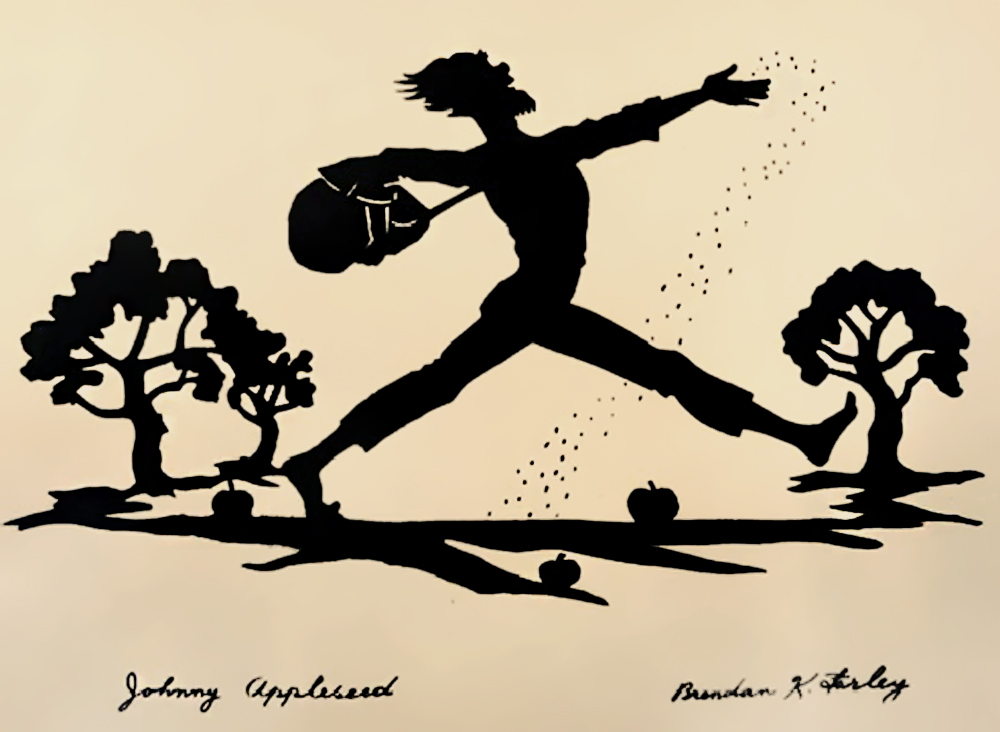
You know, the folk hero some of us hear about in elementary school. More specifically, I found myself thinking about a silhouette lithograph that has been in our home for several years. My wife found it at an estate sale, and I liked it immediately.
Depicted by black shapes against a beige background, Johnny Appleseed strides purposefully across the scene, one hand holding a sack of apples while the other is outstretched, scattering seed. Apple trees, set slightly in the background so that Johnny seems to tower above them, frame the scene, and apples lie on the ground, a gift. Even the tracing of earth beneath him seems alive: a dark, rootlike form reaching into creation, like fingers outstretched in praise for God’s grace given through the soil.
The figure has a quality at once dynamic and still. One could almost superimpose upon him the image of an archer, bow drawn and aimed slightly upward, waiting for the moment of release. Except here, instead of an arrow, one hundred tiny black seeds fall from his open hand. By the time they reach the ground, Johnny is already half a step beyond the point where he released them, seemingly unconcerned with precisely where each one will land.
The whole picture exudes joy, nearly exaggerated yet still believable. Despite its minimalism, or perhaps largely because of it, it may be the happiest picture I have ever seen.
Let’s rewind a moment. When we lived in our previous house, the print hung in the dining room. At the time, that seemed fitting enough. Apples. Trees. Harvest. Yeah … hang it by the dining table. Then, after a move, it sat in the basement for seven years, largely forgotten.
Until the recent church service, when the lectionary lent some light.
Only at that point did I begin to see not only the lithograph’s full detail but something more. The Gospel reading that Sunday was Jesus’ Parable of the Sower in Matthew 13. As part of the lectionary, so also to the congregation came Isaiah 55: “For as the rain and the snow come down from heaven … giving seed to the sower and bread to the eater, so shall my word be that goes out from my mouth; it shall not return to me empty.”
Johnny Appleseed, indeed!
Excited after the sermon at the unexpected conjuring of the lithograph, I told the pastor about it, and he smiled with interest. Driving home, I resolved to bring it out of the basement and ponder it some more, share it some more.
Because in the interim from dining room to basement to unexpected remembrance, the picture had not changed. Scripture had taught me to see it differently. And what struck me about the lithograph was both what Johnny was doing and what he was not doing.
He wasn’t looking back. He wasn’t counting seeds. He wasn’t checking for sprouts. He wasn’t measuring his success by the number of future orchards he could verify by metrics.
He simply walked, sowing as he went. The picture found a renewed home beside my desk, becoming a quiet place of reflection, its joy echoing the Song of Ascents in which those who sow “reap with songs of joy” (Ps 126:5).
Still, can we live like this when our own work is on the line? Sowing is seldom without wonder and worry. As a teacher, I often consider what became of the seed of my effort. Did the lecture matter? Did the student remember? Years later, will something from class resurface when it is needed most? The same questions accompany my writing. Who read the article on meta-analytic methods? Did it encourage anyone? Was it useful? Or has it simply disappeared into the endless current of publication, buried in a digital soil of uncertain germination, among millions of articles indexed in the sediments of PubMed?
Parents, too, wonder whether years of guidance have taken root — will my child ever take my encouragements and admonishments to heart? Pastors may wonder whether Sunday’s sermon reached anyone beyond the first few pews, or past the first few minutes following the end of service. Friends wonder whether a conversation made any difference.
Because we naturally want to know what became of the seed. And that’s not inherently wrong. In many circumstances, there is both a need and a wisdom in evaluating our work. Paul reminds us in First Corinthians that we are stewards of what God has entrusted to us. And stewardship includes asking whether our vocational efforts are actually serving our neighbor as intended. This is right.
But in our still-fallen nature, we may turn stewardship into a burden we were never meant to carry, anxiously enlarging what has been entrusted to us by assuming responsibilities that rightly belong to others. We may sow one kind of seed, while someone else, through a different vocation or talent, sows another. This, too, is right. Loving our neighbor does not always mean doing everything ourselves. Sometimes it means trusting another person with what has been entrusted to them. It means trusting God to work through their hands as surely as through ours.
And beneath that trust lies a greater promise. Isaiah does not promise that we will always know, let alone fully understand, what God’s Word has accomplished. He promises that it will accomplish what he sends it to do: “My word … shall not return to me empty” (Is 55:11). Paul gives the same relief in simpler terms: “I planted, Apollos watered, but God gave the growth” (1 Cor 3:6).
The work was shared. The growth belonged to God. It is like the earth extending beneath Johnny Appleseed’s stride in the lithograph: beneath our trust in one another is our trust in God.
Similarly, as Jesus sat in a boat by the sea, he gave his parable without inviting the sower to inspect every patch of ground. Some seeds fall along the path, some among rocks, some among thorns, and some on good soil. And from the good soil comes a harvest. But fundamental confidence never rests in the sower: it does not rest in his capacity to follow every seed to its resting place, nor in our modern efforts at mastery by measuring what becomes of it.
It rests in the faithfulness of God. That is good news because the same God who sends his Word has fulfilled his promises in Christ. Before we ever bore fruit, before we ever loved our neighbor well, before anyone could point to the orchard our lives might someday become — before all of that, Christ bore our sin …
He carried it to the cross. He rose again. The Father’s verdict over us is not measured by the fruit we produce. In Christ it is simply this: forgiven.
That freedom, given through forgiveness, radically changes the nature of stewardship and vocation — and with it, all the various roles we are called on to fill. In that freedom, the Christian no longer labors to prove himself to God. In Christ, the Christian already belongs to God, and in that belonging he is free to teach, to write, to raise children, to serve clients, to comfort friends, to build, to repair, without carrying the impossible burden of controlling outcomes. We still sow as wisely as we can, and we still hope for fruit borne of a life in Christ. But ultimately we entrust both the seed and the harvest to the Lord who gives growth, and so the sower is free to keep walking.
Whenever I glance at the lithograph beside my desk, I remember that the seed was never mine to make grow. I scatter what has been entrusted to me, knowing I may never in my present life see the full orchard.
Christ has already secured something infinitely greater than an orchard. He has secured me.








Marvelous and encouraging reflection. Thanks!