




The recently released horror movie Longlegs has its outstretched fingers on the neck pulse of American culture. Osgood (Oz) Perkin’s fourth full-length film is a masterclass in how to strip modern obsessions bare and do it with the typical terrifying quirks that have acted as road markers along his directorial career. Perkins told Indiewire that all of his films, but most especially Longlegs, dealt with the secrets of his own celebrity parents (Psycho’s Anthony Perkins and model/actress Berry Berenson, who died in the first plane that hit the World Trade Center on 9/11). The film is “his most personal film yet. In its own strange way, it’s an ode to the precarious secret his mother maintained, and the generational tensions that bloomed out of lying for a long time to her children.”
Longlegs effectively teases out that the sins of the father/mother will not only be visited on the child, but often on the community that surrounds them. Something that is often lost in translation within a highly individualized society.
The film focuses on an upstart FBI agent Lee Harker (played brilliantly by Maika Monroe) as she follows the ciphers and trails of blood left in the wake of an occult-obsessed serial killer who goes by the name Longlegs (incarnated by the manic sincerity of Nic Cage). As Harker — who I cannot but allude to Mina Harker of Stoker’s Dracula in my mind — comes to find that Longlegs may have some tie to her family of origin. Don’t fret, even if you have an idea about where the film is going, you don’t. Not completely.
It makes too much sense why Perkins chose to focus the lens this time on serial murder of a variety seldom seen since Se7en and Silence of the Lambs. It may not have been his central intention, but the film enters into the cultural zeitgeist of a society that is obsessed with true crime. Pew did a study on true crime podcasts and who listens to them and found:
True crime is the most common topic among top-ranked podcasts — defined as those with the highest average daily rankings on Apple’s and Spotify’s lists of top podcasts in a six-month period in 2022. Almost a quarter (24%) of these top podcasts are primarily about true crime.
Meanwhile over at Netflix, true crime is becoming an increasing cash grab with its massive streaming numbers. The website The Ringer has been keeping an eye on the daily rankings since 2020 when Netflix incorporated their “Top Ten” feature.
Since then, eight Netflix true-crime docs have hit no. 1 and held that position for a total of 58 days — or more than 12 percent of the days available in the data set. Another four peaked at no. 2.
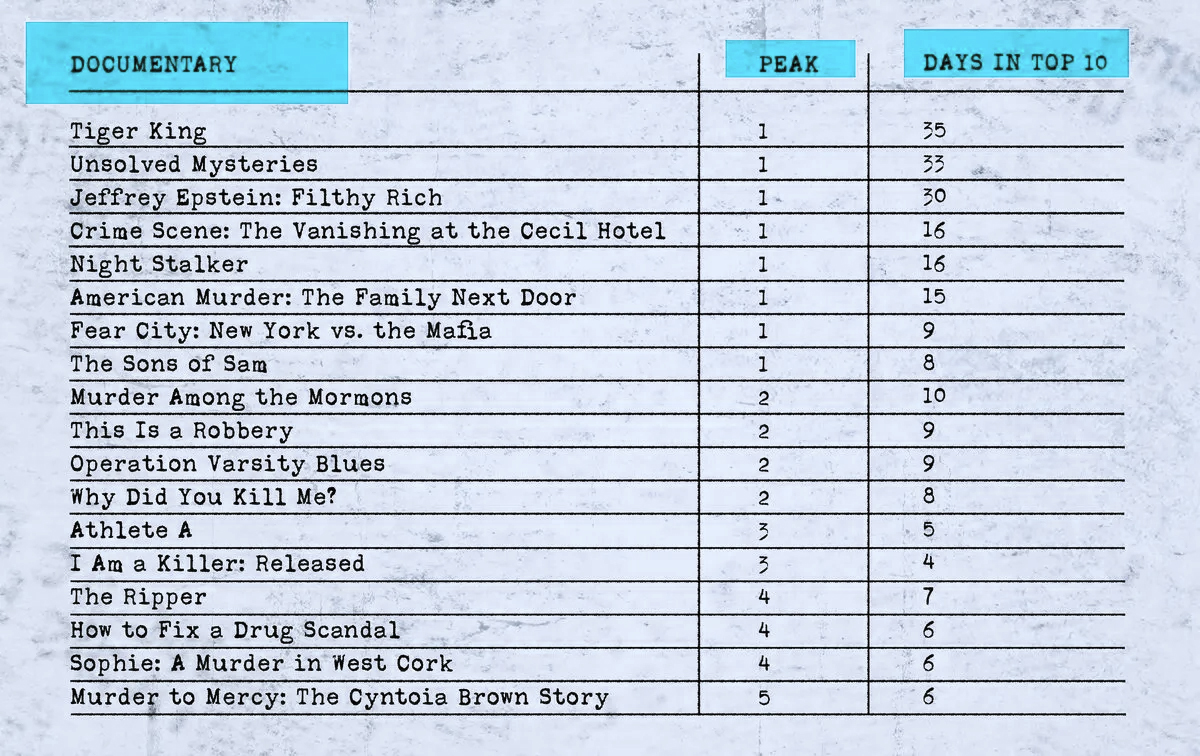
The above infographic from the above article is a singular image for one of our main obsessions. And this is just Netflix. One could probably copy and paste similar rankings on any of the other streaming services on offer. True crime is a juggernaut and has been since the This American Life spin-off Serial, real life tragedies repackaged as passive entertainment.
Yet when the trappings of true crime are brought into the fictional world, their inherent flaws are captured and projected back onto the reader or viewer. Silence of the Lambs singlehandedly brought the concept of utilizing an even more brilliant, but incarcerated, serial killer to capture a lesser one on the loose. Se7en invited the detective into the demonic maze of the killer and coerced to play his part.
Even Zodiac, which is meticulously reenacted on the screen, asks the viewer to not only consume the “facts” of the real life case, but asks them to live within the fear and suffocating intensity of 60s and 70s San Francisco area during the killer’s reign. With fiction, some of the consumptive aspects of our current true crime obsession can be transcended and reflected on. Here, there is a person grasping at something behind the script and screen that is more encompassing than just regurgitated facts, dates, and wounds that make up the sum total of true crime podcasts and documentaries.
Longlegs was initially inspired by a 90s true crime murder that captivated the attention of the entire country. Perkins, consequently, puts his own fictionalized “true” crime narrative into the ring, and it has successfully entered into the cultural zeitgeist for a reason, but the question it raises for us to answer is: Are we paying attention?
Not that any singular spoiler could ruin this film, nonetheless be aware that one is forthcoming.
The central mystery of the case that plagues Lee Harker and her boss Agent Carter (Blair Underwood) is how Longlegs is getting the families at the center of the crimes to massacre themselves. It does not appear that Longlegs is doing any of the actual dirty work — if he is, attempting to figure out the mechanics of how he is doing it is mystifying. A cue that recalls the infamous murders orchestrated by Charles Manson and his “family.”
As the case begins to unfold, we find that Longlegs is a doll maker that creates life-like doll versions of these families’ children and delivers them to their doors by the hand of a trustworthy messenger. Once the doll is in their house, the mechanics of Longlegs’ murder spree begins. What Harker comes to find out is each of these dolls contains a “brain” in the form of a silver metal orb invested with occult magic (which is ingeniously never fully explained by Perkins). Something in this “brain” places the family under a spell which ends in familicide.
On a surface level, this occult conceit questions the structure of the film’s (and our culture’s fixation upon) true crime trappings. No matter how complete Harker’s investigation into Longlegs is, there is still going to be the question mark of the “brain” at the end. We will never know why or how the perpetrator came into existence; how their brain works. We will never be able to broach the one element of true crime that, if we are totally honest with ourselves, we want to understand: how such evil is bred and created. Those answers are as mysterious and occluded from our understanding as the occultation that Longlegs incarnates his dolls with.
However, under the surface stratum of meaning is a confrontation with the viewer, a question of attention. Is our society’s mostly passive rumination on true crime the work of a “brain” that has been placed in our house by a deceptively trustworthy messenger? In the final moments of the film, Lee Harker fires a shot into the head of the messenger who delivered the brain to the families. It didn’t matter if she understood the full facts and mechanics of the crimes or how the “brain” worked. In order to save a young girl and herself, she knew that the middle man who delivered the evil to the doorsteps of our homes was the active agent in creating a passive family doomed to destroy itself. So, I wonder again along with Perkins, whether you or I are really paying attention.







[…] Please check out the rest of it here. […]