




1. First up, some fun news from the world of social media — we’re trying something different with our Facebook presence in an attempt to solve the riddle that is the algorithm. We’ve launched a new page “The MBird Daily,” where we’ll be posting all the latest updates, articles, news, podcasts, memes, goodies, etc. HEAD HERE to like and sign up to follow.

2. Gold-medal polemicist Freddie de Boer has been firing on all cylinders of late, which is fortunate, as there’s been no lack of grist for the proverbial mill. Last week, in response to the new book What Are Children For? by Anastasia Berg and Rachel Wiseman, Freddie turned his attention to the fertility crisis that’s facing the developed world. Needless to say, he touches on a wide variety of live wires. While Freddie acknowledges the reasonable hesitancy that more and more people feel about bringing new life into what they view as a dumpster fire, he refuses to discount entitlement and short-sightedness as contributing factors as well. For our purposes, I was struck by his forceful articulation of the (incredibly cruel yet incredibly potent) Law of Eternal Youth, AKA, the unquestioned commandment that Thou Shalt Never Age.
Our culture has abandoned any pretense of not worshipping youth, at this stage; go on social media and you’ll find 50-somethings lobbing insults at each other about being old, OK Boomer. There’s a complete collapse in the notion that aging is a natural and dignified thing, and a sweaty insistence on celebrating the young and instilling in them all of our hopes for renewal and justice, despite the fact that our actually-existing young people are afraid to talk to the cashier at McDonald’s. We’ve instilled our whole cultural space with the idea that to be old is shameful. So I’m not surprised that so many wander through life never contemplating the fact that, someday, they’re going to need to be taken care of again […]
Remaining physically attractive has become an all-encompassing obsession, one that generates billions of dollars of economic activity. Every social network and media platform is choked with content about how to stay hot forever. It’s profoundly cruel, given that there’s nothing in life more certain than that we will age. But I think we’ve generated a fear of losing our looks so profound that many people just remove the concept from their brains. I’m afraid, though, that it happens to everyone. It’s happening to me. And you can see the pathology in our ugly treatment of aging female celebrities, the most gorgeous women in the world, who have access to the most expensive technologies we have to ward off aging looks. If we aren’t saying “she looks so old,” we’re saying “God, look what she did to herself in her quest to look young.”
All of this stuff is a drag, and in its own way, these attitudes are expressions of what I defined before as eternal human problems. But what’s not eternal is our culture’s rabid commitment to treating aging as something to be hidden away in the dark corners of our mind, old people as troubling reminders of what we least want to be reminded of. That we could maybe work to change … Because hating aging as much as we do is so corrosive.
I would add that it is corrosive not only because it pits a person against the clock in a battle they cannot win, but because it keeps them from looking death square in the face. Which means a person never gets to Good Friday, let alone Easter. After all, if you’re never going to die, then of what use is a God who raises the dead? It’s a foregone conclusion that faith, to garner attention in such a death-denying culture, must be turned into a life-project (#flourishing) rather than a deliverance one. A spiritual means of avoidance instead of a tear-stained resource for coping with our eventual expiration. Alas, as Freddie makes clear, the maniacal avoidance of death only quickens and sharpens its eventual sting. “This culture of limitless self-involvement and the pursuit of nothing but absolute personal freedom is a road that leads only to the grave,” he writes.
Of course, when it comes to encountering the God of the universe, there are worse places to be than a graveyard. Age, I’m told, has no bearing on his regard for his children, regardless of how blinding their delusions/distractions may be.
3. Next, Christian Wiman delivered a magisterial essay on the life, art, and letters of the Seamus Heaney in Harpers. While the late, Nobel Prize-winning Irish poet remains the focus throughout, you don’t have to be familiar with the man’s work to appreciate Wiman’s reckoning with it–or his many fascinating digressions along the way. I was especially wowed by the stray observations on fame, technology and America, reproduced below. I was also unaware that Heaney’s final words were a text message sent to his wife reading “noli timere” or “do not be afraid”. As Wiman notes, “any cradle Catholic who says “noli timere” is quoting Jesus.”
Fame is a poison. For everyone, I think, which is one reason this country seems paralyzed in a kind of collective writhe: social media gives a dram of fame to all. It takes a hardy soul to remain a soul with one eye on this demanding hologram. Heaney seems to have been one […]
I’ve wondered if the internet, that concentration killer, might actually aid poetry in this regard. The unit of currency is becoming the poem, rather than the book. Individual poems often ricochet around the internet and gain a significant and diverse readership, whereas even prize-winning books are invisible beyond the poetry world. This is not necessarily bad, as I say, since the individual poem is actually the unit of currency in poetry. There’s something both liberating and terrifying about the nature of poetry’s “guild.” The bar for entry is very high, but a single poem can gain you access. […]
What if this new means of distribution is actually better for the art, brings it closer to its origins, which predate the book, of course, and ink, and even written language. […]
[America] is a prose country. The sheer sprawl of us, the maddening sanity of our suburbs and gridded cities: prose. Our endless fever for quantity and quantifying, the blob logic of big-box stores and factory farming and Facebook: prose. The weird rabid religious compulsion to read Scripture (or the Constitution) like a branch of mathematics, this ostensible allegiance to the Word that is actually terror of it: prose, prose, prose. Even our poetry is, quite often, prose.
4. “Does Love Make You Anxious?” asks Heather Havrilesky in a recent Ask Polly newsletter. The answer is yes, it more than likely does. What she’s getting at, I believe, is the intimate connection between love and pain. Just as grief can be a measure of love, so can fear. This may sound elementary but it goes a long way toward explaining why “Love Hurts” is more than just a brilliant song title. It is a theological truism of the highest order, a phrase that could’ve sat above Jesus’ head as he hung on the cross just as readily as the one Pilate put there. Here’s Polly:
In the weeks after my first daughter was born, I felt stronger and also more vulnerable than I’d ever felt before. It felt so good to care for someone so small, but it also felt terrifying to love someone so much. I told my husband that when he carried the baby around, I felt like he was carrying my liver. If he dropped my liver, I would die.
Looking back, I can see now that love ushers in anxiety for me. It wasn’t just the stress of keeping a small person alive. Being completely and fully invested in someone else makes me feel thrilled and happy and it also makes me feel small and powerless. In order to feel passionate love for someone, I also have to endure some pain and apprehension.
For some of us, understanding that love and pain are woven together feels emancipatory. Because it explains so much of how we experience others, and summarizes why we repeatedly try to divest from love without even noticing it. We step back from caring because caring makes us feel small and powerless.
But once you realize that feeling small and powerless is a side effect of FEELING LOVE for someone, you can start to understand that your sensations of smallness and powerlessness often aren’t coming from the other person … Instead of saying “You made me feel small” you wind up saying, “It’s easy for me to feel small when I love someone a lot.”
5. “Nic Cage Will Always Go Big” writes Matt Zoller Seitz for Vulture, and I thank God for it. Maybe it’s because I watched experienced Longlegs last night, or maybe it’s because no film made me laugh harder this past year than Dream Scenario, but I feel compelled to disclose my feelings about the man.
To me, Nicolas Cage is an avatar of grace. A strange one, clearly, but grace is always strange. Grace is always a surprise, too — and is there a more surprising human being on Earth than Nicolas Cage? I don’t think so. Like the Lord of Hosts, Cage gives far more than he has to, in every instance. Superabundance is the name of his game. Cage’s very existence feels gratuitous at this point, evidence that God’s world is not meager at bottom but shot through with uncalled-for beauty and hilarity and vitality. We don’t deserve the man, but what a joy to be alive to witness and receive the gifts he so reliably bestows.
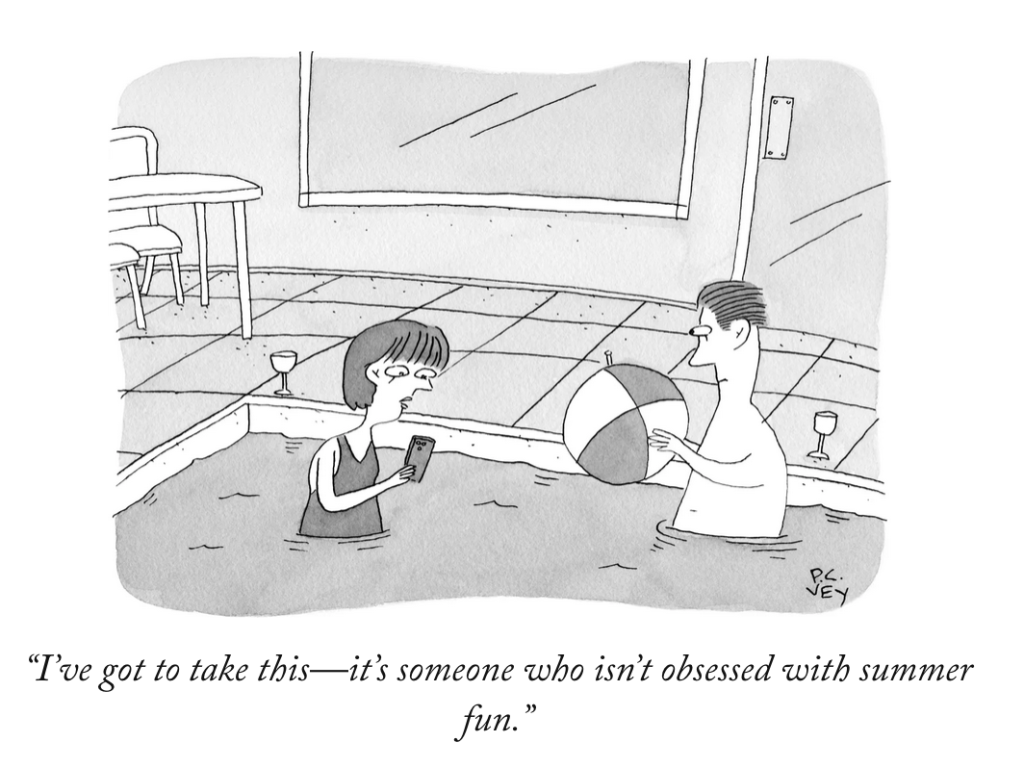
6. In humor, the New Yorker made me chuckle with “Human Recall Announcement” #lowanthropology. The Hard Times took aim at a familiar target (me!) with “Man On Day Two Of Meltdown After Being Asked Favorite Band.” But by far my favorite bit of humor unearthed this week would be this:
7. Following up on the tourism article CJ Green linked to last week (as well as the “Against Travel” one we discussed on the Mockingcast a while back), I greatly enjoyed Phil Christman’s “Adventures Close to Home” in the Hedgehog Review. He spends most of the essay playfully debunking the recent spate of attacks on capital-T Travel before making a case of his own for staying put. Going places can be wonderful, he suggests, so long as you keep in mind that there is more than enough going on in your own backyard — to say nothing of skull/ribcage — to keep a person occupied for a lifetime. If you look hard enough, that is:
The simple fact is that I don’t have to go anywhere at all in order to feel that nothing makes sense, that nothing is as I expected it to be. I am confronted by so much novelty just in being alive that I am dependent on routine to nail any of it in place, and then those routines can stand endless tinkering, to make room for me to learn more and more, so that the world won’t seem so incomprehensible — that old illusion. Of course, learning more just illuminates further the infinity that you don’t know. […]
Here I am, having an epiphany in the middle of my silly quotidian life. I am as absurd as Elizabeth Gilbert, or Alanis Morissette. I am realizing something obvious — that the quality of attention we bring to things is more important than the freshness of the things we bring attention to — and I had to go to so much trouble to do it. They had to visit Italy, and India. I had to live my whole life, and write this whole essay. Perhaps we are doing the same thing.
8. Finally, the Paris Olympics are officially underway. I for one could not be more excited, and Brad East captured some of the reason for that excitement in an excellent piece for Christianity Today, “Penalty or No, Athletes Talk Faith.” For some of us, it’s nearly as thrilling to hear athletes exuberantly and reflexively praising God as it is to watch them jump and run and swim (and skateboard, ptL!). It’s also pretty entertaining to watch the news media squirm a bit when that happens. (East rightly surfaces the awkward dynamic that “in many popular American sports, an increasingly privileged, irreligious, and still mostly white media writes about a mostly religious, mostly non-white league in which relatively few come from privilege.”). But the main thrust of the piece asks why it is that athletes talk so openly and enthusiastically about God — and why that still feels so natural — despite such rhetoric being frowned upon in so many other public settings.
Reporters may find it quirky or even bizarre, but athletes generally aren’t punished for religiosity. And even if they were, it’s clear they wouldn’t care. In a time when belief is belittled, ignored, or relegated to one’s private life, athletes are unapologetically faithful in public. But why?
The place to start, I think, is the nature of sports itself. Athletic discipline is rigorously controlled because, when the whistle blows, nothing is under control. It’s chaos, contingency, and chance all the way down. The skies fill with rain clouds; the court is slick with sweat; the track is spongy; your opponents are strategically unpredictable. […]
With good reason, therefore, do athletes turn to God. None but God is sovereign. I can’t control the weather, but he can. I can’t stop my body from failing, but he can. […]
Athletic contests are about nothing less than glory … Glory shines on the last man standing, the first woman to cross the finish line, the team with the winning score when time runs out. The victors are showered with status, fame, money, and applause. Yet what do the victors themselves seem to feel? A few of them strut and jaw, but many will drop to their knees and weep like children. Ask them their emotion and they’ll tell you: gratitude.
From a secular perspective, it makes no sense: Are you grateful to yourself? You’re the one who just did this!
But what athletes intuit is that, somehow, this accomplishment is well and truly theirs and a gift. So they thank their teammates, families, and parents — especially mom — but more than any worldly giver, they thank “the Father of lights,” since they know that “every good endowment and every perfect gift is from above” (James 1:17, RSV).
Beautiful, beautiful, beautiful. And while we’re talking gifts from above, I can’t think of a better tune to close out with than Adrianne Lenker’s stunning “Free Treasure”:
Strays:
- Don’t miss Nick Cave’s commentary on one of his most enduring (and deeply religious) compositions, “Brompton Oratory” (above) in the Red Hand Files.
- The finale of Season 3 of The Brothers Zahl drops first thing on Monday. It’s a plus-sized episode on “Parenting” featuring a special guest, and we’re really excited for you to hear it. We’ve been so encouraged by all the notes and reviews we’ve received this season. If you haven’t had the chance to review the show on Apple, by all means please do so. It’s a huge help.
- Lots of talk about The Chosen on Mbird of late, but how about some commentary on The Promised Land?








Re: Youthfulness and aging
Men over 50 live in mortal fear of losing their jobs at the height of their career and never finding a decent job afterward. They can’t afford to retire, have a decade or more of work before them, yet they are judged either too expensive to hire or too experienced to warrant a lesser role.
It’s a real problem, and it’s growing. But because it afflicts middle-class men over 50, few people expend effort to care. Sadly, the people least likely to care occupy HR departments everywhere, and they’re under no compulsion to do anything to address the age discrimination that runs amok.
Preach, DLE. You speak truth. I’ve been through my own version of this in the past several years. The challenge has been not only to try to regroup, but to find God’s grace in all of it. To lean on Him more heavily than on my career, status and stuff. To continue to be there for those around me who didn’t abandon me rather than be anxiously self-focused. I identify more now with those in scripture who were “screwed over”, particularly the psalmists, but struggle to mimic how they continue to seek God’s face. Yes, it’s a problem for sure, but maybe one of many that God grants us to yank us out of ourselves.
[…] in Christianity Today why athletes seem to be so vocal about their faith. We talked about his post before, but it’s worth revisiting now. Some think that an athlete touting their faith is an act of […]