In comedian Mike Birbiglia’s world, there are two types of people: those who are on-time and those who are late. While he prides himself as being an on-time person, Birbiglia bemoans the fact that he married a member of the opposition. “It’s an issue,” he admits. If they’re heading out the door and his wife asks him to wait for her, he can’t help but feel more allegiance to his on-time comrades. “What late people don’t understand about us on-time people … is that we hate you,” he explains to the audience. “The reason why we hate you is because it’s so easy to be on time.” All one needs to do to be on-time, he argues, is to be early. In other words, one must have a more accurate understanding of reality — it will take you longer to get ready than you think; there will probably be traffic; you will probably not catch every green light — and, perhaps, the humility to realize that the world does not revolve around your airtight schedule.
If cleanliness is next to godliness, punctuality is akin to piety. In all fairness, being punctual is not only a common courtesy, but a means of loving people, a way of valuing their time more than one’s own. For that most precious of commodities of which we all have a finite supply, showing up on time is an expression of another’s worth. If blessed are those who never make another wait, woe to those who show up late.
To the perpetually tardy, the law of timeliness heaps accusation with every tick of the secondhand. Just ask the White Rabbit who is scurrying off to God-knows-where, absolutely frantic that he is going to be late. In his regular column for the Atlantic, “An Ode to Being Late,” James Parker likens himself to the rabbit. “Me, I’m always late. Or about to be late. Or working very hard not to be late — barely overcoming lateness,” he writes. Racing against the clock leads to an acute case of anxiety as Parker jumps hurdle after hurdle in order to avoid what he calls “the serrated feeling of a pissed-off world.” To be running late is to both regret the past (“I should have left more cushion time!”) and dread the future (“Everyone is going to be mad at me.”). There is nothing like the shame of being marked tardy.
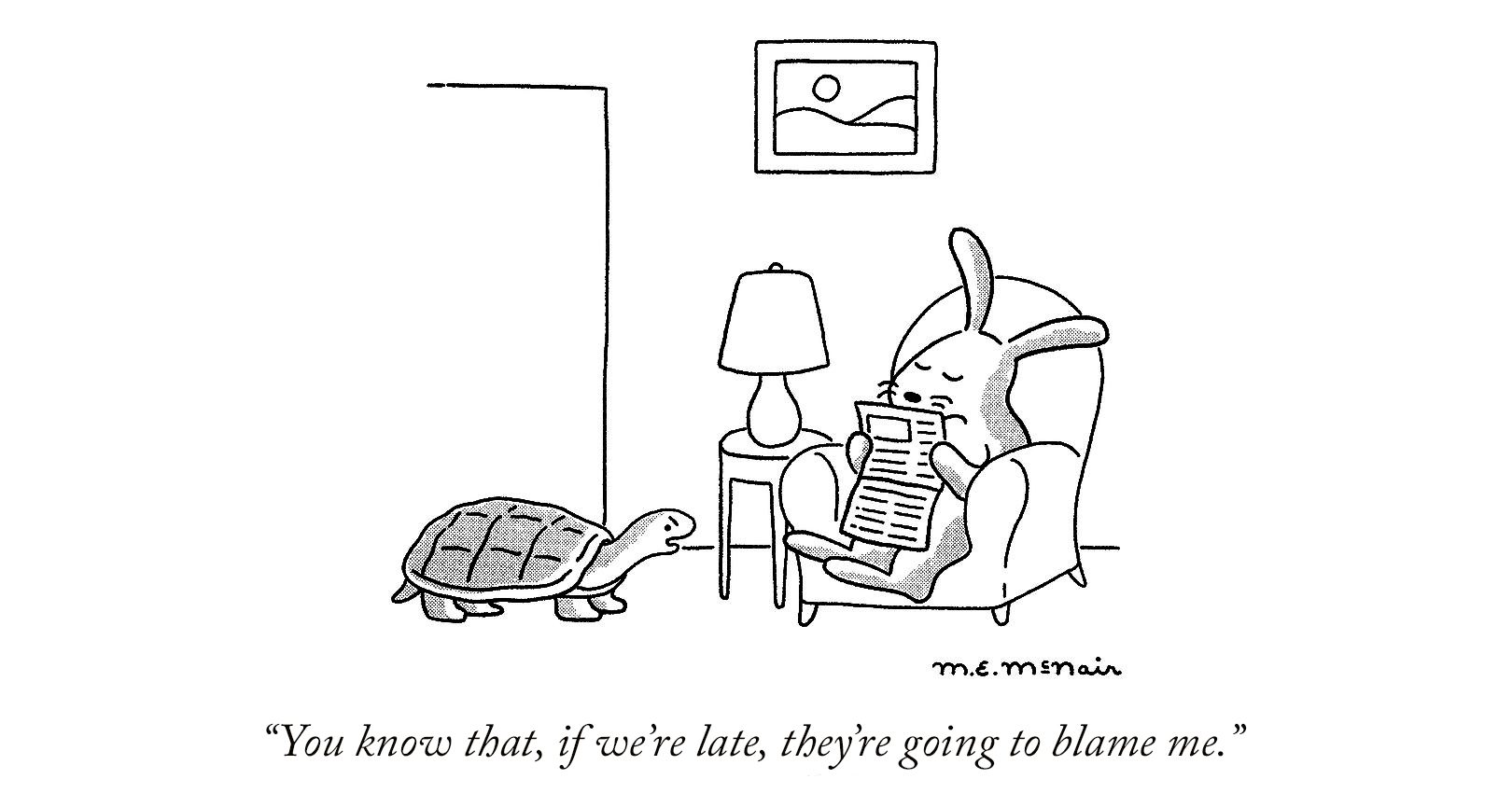
If punctuality is akin to piety, the relationship between on-time people and late people is proportional to the pharisee and the publican. Like every other law, in the hands of sinners the righteousness or unrighteousness of promptness becomes an enemy of love. One need only observe the next time a co-worker is five minutes behind for a staff meeting. There will be no sauntering, no triumphal entry. Rather, he will slink in, head bent low, tail between his legs before mouthing a silent, “Sorry!” while the rest of the room raises their eyebrows in mild indignation. Tardiness may not be a punishable offense, but that’s not to say it is ever justified. As Birbiglia says, “Late people try to rebrand by saying, ‘I’m fashionably late,’ which is like saying, ‘I’m stylishly racist.’” For those who are generally on-time, there is no excuse for being late.
As much as we might be obsessed with timeliness, whether the virtuously punctual or the unrighteous tardy, Jesus showed a shocking disregard for our veneration of the Father Time. To him, it was impossible to be too late. To him, the laborers who show up late are still paid the same as the early risers (Mt 20:1-16). The son who first refuses his father’s request and later changes his mind is the one who ‘enters the kingdom first’ (21:28-32). The thief who repents too late to save himself will still see paradise (Lk. 23:43). As Jesus was fond of saying, “the first will be last and the last will be first.”
For his part, Jesus repeatedly refused to be subjected to time; in fact, it’s more the other way around. He mysteriously delays his ministry until he turns thirty, an age that could be considered long past one’s prime. Once his ministry begins, he paces himself. He is not a slave to routine, nor does he bother to keep a calendar. He has no schedule to fit you into, nor is he interested in fitting into yours. He simply goes where the Spirit leads, always willing to drop what he’s doing for the sake of someone else. Likewise, he expects others to do the same for him. “Follow me!” he says, without slowing his pace. Just like he is Lord of the sabbath, he is the Lord of time. He repeatedly dodges death because “his time had not yet come.” He is the only one who can function both in and out of time, who can bend it however he deems fit.
From a worldly perspective, Jesus is hardly ever on schedule. Not once is he ever early. When he’s told that his friend Lazarus is on the verge of death, Jesus frustratingly takes his sweet time to arrive after the Reaper has beaten him to the punch. When Jairus tells him that his daughter is on death’s door, he leaves with him immediately. He doesn’t make a bee-line, however, but pauses when a woman touches his cloak and is healed. He makes conversation with her as if she is his primary concern. When the news comes that Jairus’ daughter has died, Jesus does not fret for having run late. After all, he is not constrained by the falling grains of sand. With a simple word — “Little girl, get up” — he turns back the clock on her life.
It undoubtedly worries us whenever Jesus appears to dawdle, but that just seems to be his way of doing things. As the old Irish saying goes, “When God made time, He made plenty of it.” If a thousand years are like a day to Jesus, the spinning clock is but an arbitrary measure, a judgment he has no time for. The resurrection and the life doesn’t believe in deadlines. We may feel like we are keeping him waiting while we scurry about, trying to make the most of our lives, but he is neither offended nor anxious. And so, whether we are early-birds or late-bloomers, perhaps God’s timeless grace is the one thing we can all schedule our days around.