




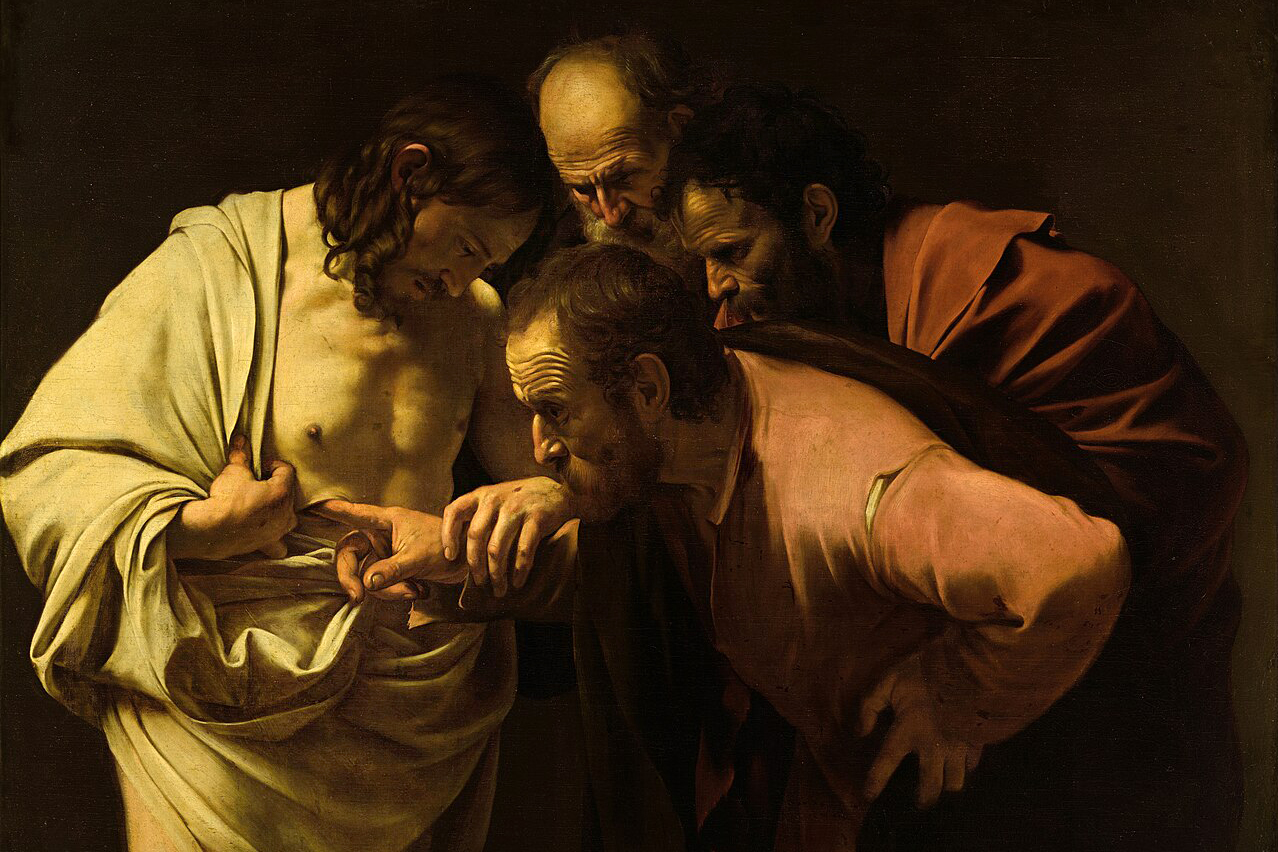
But Thomas (who was called the Twin), one of the twelve, was not with them when Jesus came. So the other disciples told him, “We have seen the Lord.” But he said to them, “Unless I see the mark of the nails in his hands and put my finger in the mark of the nails and my hand in his side, I will not believe.”
A week later, his disciples were again in the house, and Thomas was with them. Although the doors were shut, Jesus came and stood among them and said, “Peace be with you.” Then he said to Thomas, “Put your finger here and see my hands. Reach out your hand and put it in my side. Do not doubt but believe.” Thomas answered him, “My Lord and my God!” (Jn 20:24–28)
“Going home is hard,” she said to me.
It’s a feeling I’m familiar with after the Mockingbird Conference. Nine times out of ten, it’s raining on the last day of the conference, as if nature herself has packed her bags, checked out of the hotel, and prepared herself to do that long trip home.
Away from a place that feels undeniably Here and Now, toward every place that is begrudgingly Not Here and Not Yet.
“It’s good for us to be here.” But we can’t stay.
Going home is hard.
I’ve always been struck by the fact that in John’s Gospel, the post-resurrection Jesus retains the evidence — the scars — of the crucifixion.
It’s a detail that often doesn’t fit well with how Christians talk about the resurrection. New life. New bodies. Everything made right.
But Jesus has his scars?
I’m working through Revelation with my church Bible study group, so I’m currently immersed in thought experiments and questions about what the resurrection at the Last Day will be like. What will it be like? What will it feel like? What will we look like?
My old ladies have decided that the best resurrection would be if all of us get to decide which eternal, corporeal body we’ll have forever. Only our best — only our most favorite version of ourselves — would make the Resurrection feel like resurrection, they decided. And I get it.
If my knees don’t bend, and my hair is still thinning …
If my skin is crepey and my eyesight poor …
If everything that bothers me now isn’t made right at the Last Day, is it really a resurrection worth having?
“Maybe Jesus decided to keep the scars,” one woman said to me. “But maybe we won’t have to.”
One of the ever-present realities at Mockingbird is that it attracts people who are wounded — whose wounds are new and scars are not fully healed.
To that end, Mockingbird feels like an emergency department on a busy Friday night. Masses of wounded people, gathered together, looking for relief, looking for hope, looking for anything.
The balm they crave — the balm we crave — is grace. Applied to the wounds to stop the bleeding. Applied to the scars so they can start to heal. Applied to the dead and nearly dead so we can live.
“A lot can change in three years,” Tanner Olson said. And he’s right. But every year, new wounds and new unhealed scars come searching for a balm.
Scars tell a story. Never a good story, in the sense of happy, easy, fun, enjoyable. But they tell a story.
My scars, like many at Mockingbird, are well documented in talks, articles, and tear-filled recollections in between sessions with people I only see once a year, once every few years.
“How’s your oldest?” They ask in kindness, in interest, in a search for connection and hope.
“Amazing,” I’d like to say. “Becoming an incredible young woman,” I imagine. “The time goes so fast,” we’d smile knowingly.
But where that question would’ve poked the not-yet-healed wound six months, twelve months, a year and a half ago, this time it’s different.
“Let me show you a picture of our youngest since we can’t post him online yet.”
Dead bodies meeting Resurrected Bodies proclaiming a sure and certain hope.
Broken relationships met with new marriages. Lost church communities greeted with open arms in unexpected places. Difficulties with teenage children welcomed with joys over thriving young adults. Crushing experiences of death — literal, horrific, ugly tragedy — embraced by laughter, memory, and the dawning of another day that felt like it would never come.
Wounds that felt impossible to heal replaced by scars that tell an even more impossible story. Not a story that is easy or guaranteed. But each scar the story of a tiny miracle, a personal resurrection.
Once a year, for three days, we get the clearest answer to what life will look like after the Last Day. A church full of Resurrected Bodies. Bodies that bear the scars — or are bearing the scars. That will one day heal. Bodies that tell the same story.
“My Lord and my God.”








Didn’t know anyone else was having the same experience going home that I was having. Bittersweetly grateful that you’ve put my experience into words that I didn’t have.
Used to be a member of a Sovereign Grace Church, the artist formerly known as “People of Destiny”. They used to hold an annual conference called Celebration for a three day weekend. Leaving felt the same as your article just described; a mountain top experience. I hope the folks who attend go back to churches where the healing process described continues. Not many churches I’ve found like to help folks walk through the narrow place of personal transformation that is deep darkness, mentioned in Psalm 23. But they do seem to be growing in number, and that’s very encouraging.