From the summer I turned ten until well into my twenties, summer camp was a major part of my life, first as camper and then counselor. Summer camps can be amazing places, full of life-changing experiences, new learning, and deep friendships.
They also have swim tests.
In my first summer at camp, not long after my parents had waved goodbye and driven off, I remember my counsellor telling me, “OK, Jesse, put on your swim suit. It’s time for the swim test.”
“No sweat,” I thought. “I’m a great swimmer.”
I marched on down to waterfront, got in the water, ready to show off my great strokes — and promptly failed. Well, it wasn’t exactly a failure, but it wasn’t great either. My camp had three swim levels, named after positions in the church — bishop, priest, and deacon. We flipped the usual church hierarchy and bishops were lowest. The waterfront director who tested me on that first day made me a priest. I was devastated. It meant I couldn’t swim out where the water was over my head and was generally stuck with what I derisively thought of as the little kids (though I wasn’t all that old myself). It also meant — and this was the real devastation — that I wouldn’t be able to go sailing. Access to the boats was determined by swim levels. Bishops could only go in the row boats, priests in canoes, and deacons in all three. Sail boats were universally regarded as the coolest craft on the lake, and they were out of my reach.
The next summer I was determined to be a deacon. That first Sunday I marched down to the waterfront and — same result. Priest again. No sailing. I was stuck with the canoes or — ugh — row boats.
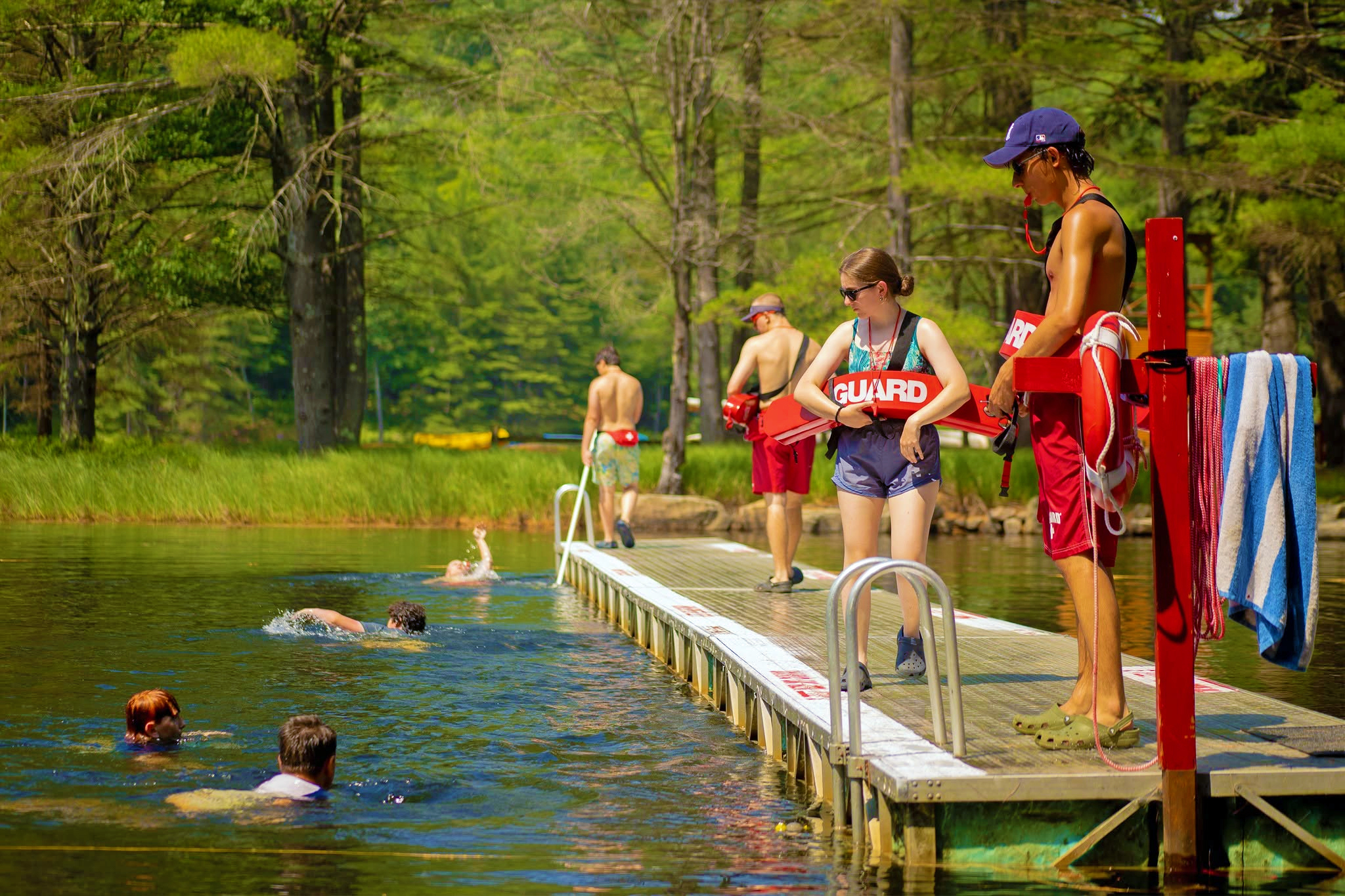
All of this came to mind recently when I drove one of my own children to summer camp for the first time. Although we had spent a long time prepping him for this, it was only about 15 minutes before we got there that he found out that swim tests were a thing and he was going to have do one not long after his arrival. At this camp, if he didn’t pass he would have to spend the week swimming in the lake in a life jacket. My son loves swimming. He hates swimming in a life jacket.
Cue the pre-camp anxiety-fest as he pleaded with me to talk to the director to get him out of the swim test so he could swim as he wanted. He was anxious about whether he could pass and he was devastated at the thought he would have to swim with a life jacket on. Underneath it all lay an unspoken fear that was easy to detect: what if I’m not good enough?
No Condemnation in Christ
The summer camp swim test may be one of the first times we encounter the limits of our abilities, and the real world impacts these limits have. We’re apart from our parents, often for the first time, so they can’t intervene to make things “right.” And if we fail or don’t do as well as we think we should, well, we’re stuck in the shallow end with the little kids, or in a canoe watching the sail boats zip past you, or with a life jacket, a kind of scarlet letter that shows everyone else just how incapable you are.
“What if I’m not good enough?” is a question that is never far off for many of us. What if I can’t perform? What if everyone suddenly realizes they made a mistake in letting me in? What if I try and try and try — and fall flat on my face? This is the human condition: to dream, to aspire, to desire — and sometimes, maybe oftentimes, not to succeed.
Churches that use the Revised Common Lectionary are this summer making their way through Paul’s letter to the Romans, including the famous passage where Paul confronts the vast gulf between what he wants to do and what he actually does: “I do not understand my own actions. For I do not do what I want, but I do the very thing I hate.” (Rom 7:15) As it happens, on the recent Sunday morning before my son and I headed to camp, we heard the clarion words that follow on from this passage and begin Romans 8: “There is therefore now no condemnation for those who are in Christ Jesus.” (Romans 8:1) We may not be good enough — but the good news of Jesus is that there is no condemnation of our not-good-enoughness. No matter how good a swimmer we are, there will always be a time when we’re in over our head and Jesus comes to our rescue, whether we’ve earned it or not. And when we’re stuck in the shallow end or longing to get out of our canoes, Jesus is there as well. “Wretched man that I am!” writes Paul. “Who will rescue me from this body of death? Thanks be to God through Jesus Christ our Lord!” (Rom 7:24-25)
Have you considered canoeing?
My own swim test story had several further ironic turns. I had thought canoeing was the consolation prize for those of us who couldn’t go sailing. But it turned out I loved it. Camp became one of the first places I learned how to do it well, lessons I still keep with me in my summertime paddles today.
In a further irony, after my swim ability caught up with my sense of myself, I later on in my summer camp career ended up as waterfront director, responsible for conducting the same Sunday-afternoon swim tests I had once approached with such dread. I learned there’s good reasons why camps want to know how their campers can swim, especially when you’re the one responsible for keeping them all safe. Still, I was now the one sorting people into their orders. It wasn’t always fun. I saw some crushed looks on campers’ faces that I recognized from my own childhood. But I also saw some of those same campers do something I never did and sign up for swim lessons during the week. Along the way, a couple of those bishops became priests and some of those priests became deacons.
And I made sure to remind campers that while swimming might be the first thing they do when they arrive at camp, it’s far from the only thing. There are lots of ways to have fun at camp without ever going in the deep end.
Had they considered canoeing?