




My seventeen-year-old self would be very upset to hear me say it, but I’ve grown very fond of Nicolas Cage in recent years. That frequently meme’d actor and stealer of the Declaration of Independence has undergone a journey in the last two decades or so, and I believe what we are seeing with Cage right now is Cage at his very best, and it’s mostly because Cage is just being himself.
Cage has seen himself in a wide array of films over the past decades including the wacky Coen Brother crime comedy, “Raising Arizona” (1987), the meta yet very self-aware, “Adaptation” (2002), the thrilling, gun-dealing, “Lord of War” (2005), and a whole host of… pretty abysmal movies like “The Wicker Man” (2006), “Ghost Rider” (2007), and “Left Behind” (2014) — to name only a few. Tragically, 2009 would mark the year of Cage’s father’s sudden death and the start of an enormous financial debt brought on by some pretty out-there financial decisions (like buying a stolen dinosaur skull he didn’t know was stolen)[1] that left him basically on the verge of declaring bankruptcy. Cage himself mentioned that this required him to make certain work choices that would aid him in getting out of that financial hole.[2]
I remember this Cage phase most clearly likely due to all the memes and YouTube clips of Cage’s facial expressions and frankly just some intense surrealist moments. Cage, despite choosing to star in some truly bad movies, insists that he “never phoned it in” or that he “was just doing it and not caring.”[3] And frankly, looking back on it, I think that’s true. You will be hard-pressed to find a film in which Cage isn’t at the very least sincere. Rogert Ebert even once wrote about Cage, “he always seems so earnest. However improbable his character, he never winks at the audience.”[4]
Cage himself has talked about how he does not view himself as so much an actor as it implies being “a great liar” but rather as a ‘thespian’ because “thespian means you’re going into your heart, or you’re going into your imagination, or your memories or your dreams, and you’re bringing something back to communicate with the audience.”[5] There is an earnestness and sincerity to Cage that very often feels uncomfortable in the context of his more bizarre films. We expect to see some moment in which Cage will “wink” at the audience and let us know he is in on the joke. But the meta-punchline never arrives. Cage is not an ironic actor. He is a thespian who seeks to bear it all so-to speak — even when some of his film’s overall mediocrity would almost have you expecting him to not take it so seriously. In a recent interview, Cage was asked about the interplay of sincerity and irony in his performances, and Cage said this:
I have gone out of my way not to be ironic and – with the risk of looking ridiculous – to be genuinely emotionally naked. And that gets uncomfortable. There were times where people saw “Mandy,” and I was having to break down in a scene, and people were laughing. They don’t know how to handle it. But that’s not ironic, that’s naked, which is embarrassing for people.[6]
Cage has seen a resurgence in the past couple years with his films “Mandy” (2018) and “Pig” (2021) — both of which are about a humble man losing the one thing he truly cares about and both of which take advantage of Cage’s innate sincerity. The scene Cage previously mentioned is undoubtedly my favorite scene of Cage’s acting career (if you’ve seen it you’ll know what I mean … yes it’s the bathroom scene). It’s an uncomfortable scene, and I can understand the urge to laugh firsthand, but at the bottom of it is a man who has lost it all. Frankly, it is embarrassing because it is honest. Cage’s “Pig” is one of my favorites in recent years as well. It is a beautiful and tender film, full of redemptive sorrow, and it is a complete reversal of the John Wick/Taken revenge genre — which, personally, I think are terribly cynical films.
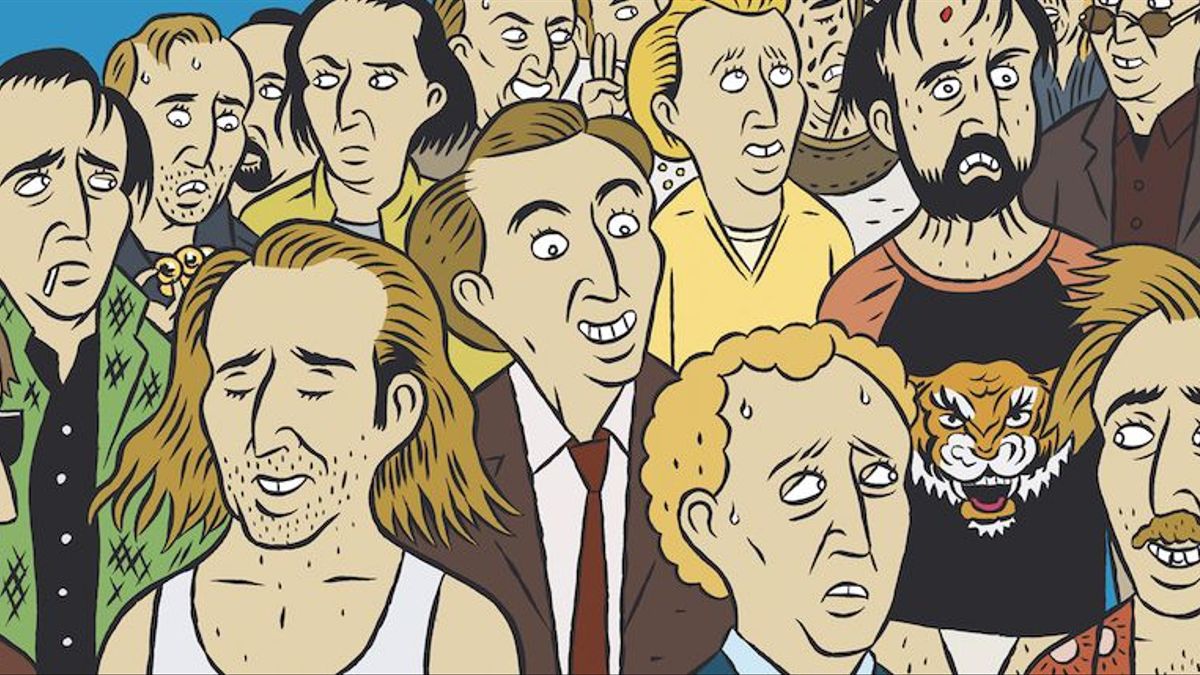
Cynicism and irony are trademark features of popular entertainment today. One doesn’t have to look to far to find shows like “Seinfeld” or “30 Rock” demonstrating this sort of irreverent cynicism. The novelist, essayist, and cultural commentator, David Foster Wallace (1962-2008), frequently spoke out against the damning effects of this widespread phenomenon. He once said,
Sarcasm, parody, absurdism and irony are great ways to strip off stuff’s mask and show the unpleasant reality behind it. The problem is that once the rules of art are debunked, and once the unpleasant realities the irony diagnoses are revealed and diagnosed, “then” what do we do? […] All we seem to want to do is keep ridiculing the stuff. Postmodern irony and cynicism’s become an end in itself, a measure of hip sophistication and literary savvy. Few artists dare to try to talk about the ways of working toward redeeming what’s wrong, because they’ll look sentimental and naïve to all the weary ironists. Irony’s gone from liberating to enslaving. There’s some great essay somewhere that has a line about irony being the song of the prisoner’s who’s come to love his cage.[7]
I’ve come to love Cage primarily because he’s not afraid of being seen as sentimental or overly sincere. Cage has no cage.
Recently, Cage has spoken out about his own frustrations for becoming the butt of jokes and being made into a meme for not only for some scenes in his movies but even during casual real-life outings.[8] Meme’ing Cage (and meme culture more generally), as I’ve come to see it, is an indictment against ourselves and our propensity towards cynical detachment. Cage’s sincerity is not easily digestible, and most of us would prefer to mock it then to respect it. It’s easier to meme Cage than it is to weep over our lives, or as the Danish philosopher, Søren Kierkegaard, said, “to grumble about the world and its unhappiness is always easier than to beat one’s breast and groan over oneself.”[9]
It reminds me of Jesus in Luke 18 who tells a parable to those “who trusted in themselves that they were righteous, and treated others with contempt” about two men going to the temple to pray: one an upstanding Pharisee and the other a tax-collector — a scourge upon society. The former stands by himself and prays to God in condescending reference to others; the latter stands far away and beats his breast over the sins of his own life and begs God for mercy. The former trusting in himself that he is righteous, the latter knowing no such illusion. Jesus would conclude that it was the humble man who went away justified rather than the self-exalted Pharisee. As Kierkegaard mentioned, it’s always easier to find something or someone else to comment upon than it is to assess ourselves honestly. Irony is good at exposing what’s wrong with the world, but very rarely is that exposure directed at ourselves in a way that leaves us naked and exposed, and that irony in itself is incapable of leading us to a redemptive end.
One writer, in an attempt to encapsulate Cage, wrote, “Perhaps the simplest idea that explains Cage is that he is a sincere man in an ironic world.”[10] I think this is why I like him so much. As I can see it, Cage is an honest actor and an honest man. He’s not a perfect actor or a perfect man of course. He’s eccentric and bizarre but sincere. And it’s that sort of honesty that I believe proves to be such fertile ground for the Gospel: real good news of a real savior come for bizarro sinners such as myself. The tax-collector walked away justified not for poking holes in things all the time or by standing detached from them but for noticing the holes in himself and laying himself exposed before God. Like Cage, he was no actor, but a man bringing himself honestly to bear.








[…] FYI, if you enjoyed Jeb Ralston’s latest article on Nicolas Cage, you’ll be delighted to know that Strohl’s book devotes an entire […]
Early in Cage’s career, his film with Jane Fonda’s niece, about winning the lottery- was easy and enjoyable; then as Cher’s love interest in Moonstruck is another example (there are others) of his lighthearted side, mainstream comical side, before he became more outrageous. A great actor, but aren’t they all to be studied?