




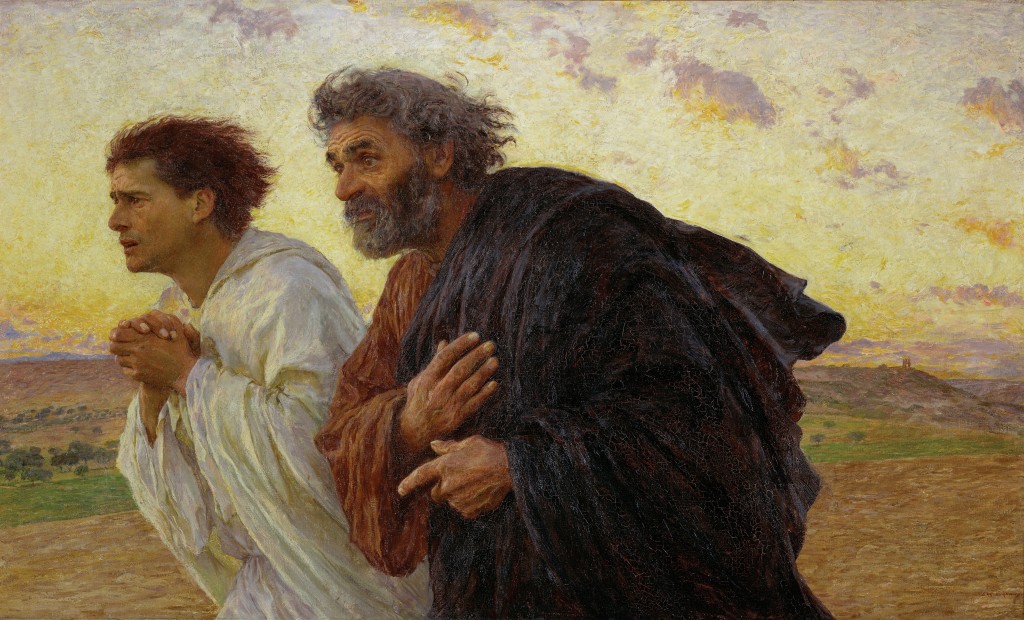
Perhaps the strangest detail there is in all of the accounts of Jesus’ resurrection is the result of a footrace between Peter and John rushing to the tomb. Having heard Mary tell of the disappearance of Jesus’ body, both drop everything and dash off to see for themselves. John tells us (twice!) how he runs a faster 40 than Peter. Think about it, while giving away news about the climax of human history, this guy wants us to know that he’s a little bit faster than his friend.
Why include such a petty detail here at the apex of the story? Some argue it adds a layer of forthrightness to the scriptures that make it more believable. In other words, while religious texts often seek to paint their followers in a positive light, this one doesn’t hide from seeing people as people. Perhaps the more youthful John can’t help but poke fun at Peter’s elderly pace.
Undoubtedly this type of honesty strengthens the trustworthiness of the text, but it still doesn’t answer the question of why it’s here – at such a pivotal moment in the story. There is an abundance of sight and sounds from the first Easter Sunday to choose from so why land on this offhanded, gloaty comparison?
One possible answer can be stated in the form of a question: instead of reading these words as John bragging, what if we consider them to be more of a confession of his own twisted priorities?
John has a front row seat to the most exciting event he’d ever witness and yet he’s still stuck thinking about himself. Imagine sitting courtside to watch Caitlin Clark break the NCAA all-time scoring record, but you don’t stand and clap because you’re trapped in your own head: gleefully at how you scored these inexpensive courtside seats, or perhaps even considering the ways you’ve made better life choices than your sister, or how that dumb friend from high school’s salary is double your own, or how the emotional intelligence of your supervisor could possibly be that low … or on and on we go. The scores we keep may be petty, but their grip on our thought life is undeniable.
And maybe that’s the point. John confesses that he made the dash to see the most significant event in human history: a competitive footrace. Sprinting down the steps, turning right on to the street, John looks back and sees Peter laboring his way down the hill. With every stride, John’s pride swells a little more. “Peter really should lay off the carbs, he’s going to twist his ankle on these cobblestones.” Or perhaps even, “This guy can walk on water, but running on dry land is his Achilles’s heel.” When John finally arrives at the tomb, he takes a quick peek inside before turning back to gloat at the now sweaty and gasping for breath Peter. Amid this friendly competition John forgets why they went to the garden. The joy that sent John running to Jesus is eclipsed by his desire to be better than Peter. John may have been victorious, but Peter is the first to actually go inside the tomb, the first to believe.
We often believe that by doing spiritual things we feel or become closer to God. That the spiritual life is like a ladder we ascend on the way to greater enlightenment or moral superiority. John’s approach here is to show how the doorway to things above, that is, holy (literally set apart) activity is never what we expect. If the kingdom of God is a competition at all, it is a race to the bottom. God is not saying to step up, or speed up, to moral high ground, but instead to step down from the ladder of our ideal versions of ourselves and back into reality – to look at who we actually are in the dark recesses of our own hearts. Christianity is all about acknowledging the things we actually think about because here is where we find our great need for rescue.
Jesus died on Good Friday to deliver us from our daily scorekeeping and petty comparisons. He passed us up in our race to self-deification and showed us the end of those things is only death, but he rose again to bring us into a new reality, never again to be marked by your place in relations to others. Freedom looks a lot like self-forgetfulness, and the surest way to forget about yourself is counterintuitive: confess the scores you keep and watch them lessen their grip because the last will be first. Jesus wasn’t in the tomb awarding John with a first place ribbon. Our races don’t flatter him, he’s never at the finish lines we expect, because he’s already out there working to find us apart from our best efforts.








“The joy that sent John running to Jesus is eclipsed by his desire to be better than Peter”
How apt that I read this today…Good post!