Throughout the first three seasons of The Bear, the viewer is often shown flashbacks to the worst time in Carmy’s life. Standing at the end of a long kitchen, Carmy prepares endless plates of food while a white-coated Chef David looms over his shoulder to inspect every step of his work. No matter what Carmy does, David hurls abuse at him. Beef with grated carrots? “You’re terrible at this.” Salmon with pine nuts and fish roe? “You’re talentless.” With each insult, Carmy winces before groveling in compliance. “Yes, Chef!” Powerless, he cannot dispute a boss who holds absolute power. Here, there is but one god and his name is David.
Chef David is an admittedly extreme version of a long-standing trope in pop culture, where bosses are commonly depicted as, well, bossy. From their prestigious corner offices down the hall, they expect the world of their employees with little care for the panic attacks they incite. Such depictions, of course, are not without a basis in reality: most everyone has had a terrible boss at some point in their lives.
But the trope simultaneously reflects a deep cultural distrust of authority figures more broadly, whether it be parents, coaches, politicians, or priests. As much as some might valorize the strongman entrepreneur, we are more circumspect about power when it comes to matters closer to home. Blurring the lines of influence and coercion, demands and edicts, administration and control, we tend to believe that authority is rarely used without misuse. We do not believe, as many cultures have, that hierarchy is inherently good or a reflection of the just and right ordering of the cosmos. We are far too democratic for that, far too wise to be fooled again by the wizard pulling levers behind the curtain.
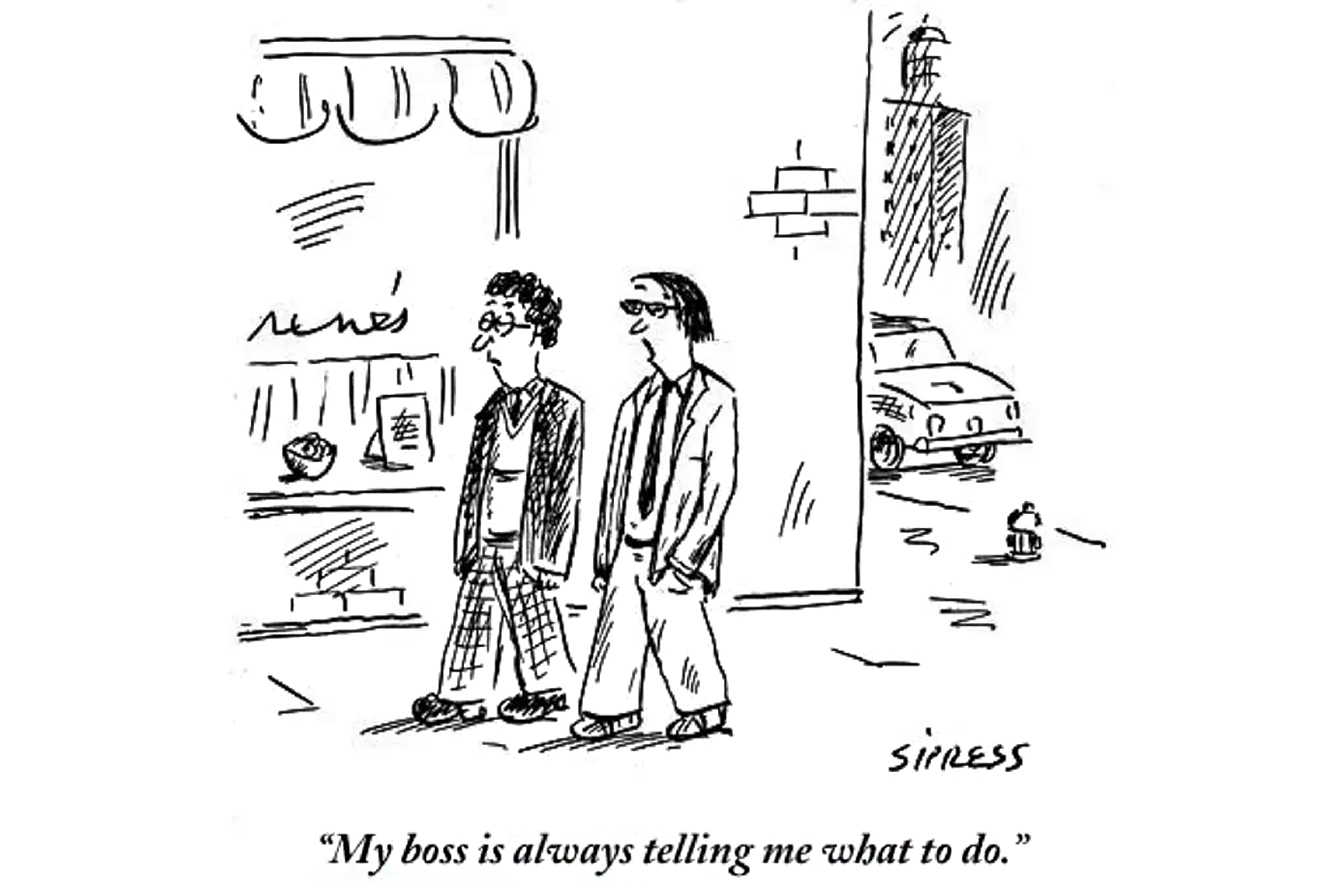
Amid the widespread suspicion of authority, it’s understandable why so many Christians go out of their way to present God and/or the church as anything but an unyielding head chef in the sky. It is a surprisingly ecumenical strategy that spans a diversity of theological frameworks. For Catholics, the Pope tries to appear like a normal person. Evangelicals prefer to stress how nice a guy Jesus was. And more mainline Christians see Jesus as the ultimate outsider, having little to do with notions of power, let alone lordship.
Notions of authority in Christianity cannot, however, be so easily dispensed with by hand-waving and a strategically winsome smile, most especially because the Bible itself is insistent upon maintaining a sharp distinction between the God who created all things and the all things that live contingently upon his continued provision. God is God and we are not. Throughout his life, it is clear that Jesus’ identity exceeds outward appearances. Angels announced the birth of the messianic king who is simultaneously the Lord. The demons proclaimed him the Son of the Most High God. Jesus walked on water and creation itself obeyed his command. The earliest writings of Christianity would succinctly sum up his identity as “the Lord.”
But if Jesus is a Lord, then what kind of lord is he? The answer to this question is anything but trivial.
If one were to define lordship in terms of worldly notions of power, one might be left to conclude that God and Jesus have a great deal in common with the authority figures in our lives that might give us panic attacks. Yet another theology of glory, with little by way of good news. Such a God created humans to worship him and obey his statutes. He is holy and righteous; his wrath is quickly kindled against evildoers. Such a God demands our fealty above all else, an uncompromising submission to his will. If Jesus is such a lord, then we are his humbled servants. When the structure of the divine-human relationship is strictly cast in competitive terms of power and authority, it runs the risk of turning God into a kind of pseudo-benevolent autocrat whose ring we must kiss if we wish to appease his wrath.
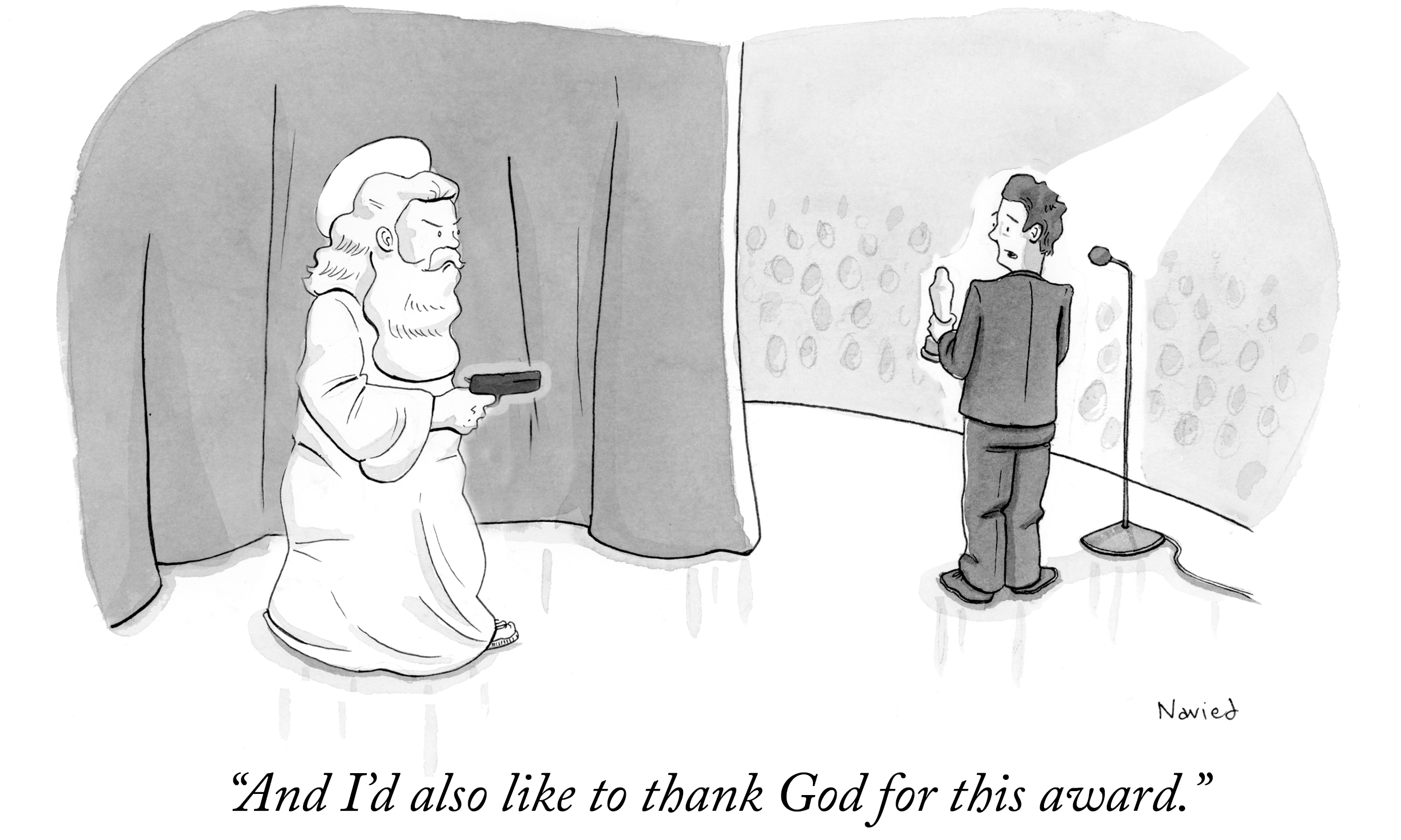
Such a lord has little to do with Jesus. But while the lordship of Jesus is so ubiquitous in early Christianity, its significance is easy to overlook. When the New Testament writers confessed Jesus as their Lord, they did so in a highly qualified way.
Jesus was, most obviously for these early Jewish believers, not a Lord like Caesar. But neither did they ascribe to Jesus everything they already believed to be true of God. Calling Jesus their Lord identified him with the God of Israel, but this simultaneous redefined who God was. The Lord who stretched out his hand against the Egyptians would stretch out his arms on the hard wood of a Roman cross for the salvation of all people. The Lord who promised innumerable blessings to Abraham would become a curse for us by being hung on a tree. As Paul Zahl wrote in his Short Systematic Theology, “The prism through which all light concerning God is reflected is Jesus” (p. 5). For the Christian, one’s understanding of God begins from “the bottom up … with the existence and ministry of Jesus in his own time and space, and it states that it is entirely agnostic concerning anything other than what he has given us to know of the essential attributes of God” (p. 7). In the designation of Jesus as their Lord, the earliest Christians employed familiar language that was then exclusively defined in relation to Jesus.
Jesus is the Lord, but he is an unprecedented one. This Jesus is to be worshipped at bended knee, not because he demands the fealty, but because he engenders love and devotion. He is to be honored because he did not defend his honor. He is a king, but one whose majesty was displayed by becoming a servant. Because he has untold fortunes, he gives away everything to make us rich. He is the ruler over all creation not by his power, but by self-giving redemption of the world.
While David was an overbearing boss who demanded of Carmy an excellence he always seemed inadequate to reach, Carmy had another boss, Chef Terry, who represents a different approach to authority. She does not rule from on high, but begins each day peeling mushrooms. When asked why she’d do such a menial task herself, she simply believes it to be “time well spent.” Any time well spent, no matter how small, was worthwhile. Sure, she won awards and made a name for herself. But that’s not why she was a chef. What matters most are the people. Customers and employees.
God is your boss, but one whose office is found at the end of your rope. He’s never going to fire you for misconduct or incompetence and he always gives the best performance reviews. His authority is not manifested in edicts from on high that demand more, but in the unshakeable declaration of his love and provision. And while he might or might not be dressed in white, he certainly isn’t looking over your shoulder inspecting your work.