




As Jesus sits down for his final dinner in John’s gospel, he has a lot of things to share with his disciples. The teachings and conversations and object lessons that took place during the Last Supper occupy five of John’s 21 chapters, nearly 20% of his gospel. Before this dinner conversation gets started, however, Jesus makes an awkward but theologically rich gesture. He dresses as a servant and washes the feet of his twelve disciples. “Do you understand what I have done to you?” he asks them. “If I then, your Lord and Teacher, have washed your feet, you also ought to wash one another’s feet.” Later on, he’ll phrase this ethical ideal of servanthood and humility as a commandment: “A new commandment I give to you, that you love one another: just as I have loved you, you also are to love one another.”
This ethical ideal — self-abnegation for the sake of others — is not something that can be gleaned straightforwardly from the Law of Moses. This new and higher ethical ideal is rooted in Jesus: his ministry, passion, and resurrection. Something else beyond the Law of Moses, or rather, someone else, will be required if this radical commitment to serve others is the heartbeat of heaven. The law may point to it, but the law is not its fullest articulation, nor does the law engender its fulfillment.
Two Ways to Relate to God
The Law of Moses and the Holy Spirit form one of the New Testament’s most interesting dichotomies. To relate to God based only through the Law of Moses, say the New Testament writers, is a fleshy exercise in pride and will lead to death because, as Jesus outlined, the fundamental orientation of the Law of Moses is not self-emptying service. The Law of Moses creates the social conditions for the people of God to live and minister, but that doesn’t make God’s people righteous. To relate to God through faith in the promises of Jesus’s death and resurrection, however, is God’s desire and intent. Faith is an exercise in repentance and humility that God graciously accepts and, in return, gifts righteousness to the believer (see Abraham in Genesis 15). Still yet, relating to God through faith is marked by God himself, the Holy Spirit, taking up residence in the heart and soul of the believer. The Holy Spirit, then, does the work that the law could not, inspiring and bringing about the ethical vision of Jesus that transcends the stipulations of Sinai.
This is the core of Romans 7 and 8, and it’s also the core of 2 Corinthians 3, where Paul is articulating the difference between following the law and believing in faith.
Such is the confidence that we have through Christ toward God. Not that we are sufficient in ourselves to claim anything as coming from us, but our sufficiency is from God, who has made us sufficient to be ministers of a new covenant, not of the letter but of the Spirit. For the letter kills, but the Spirit gives life.
Now if the ministry of death, carved in letters on stone, came with such glory that the Israelites could not gaze at Moses’ face because of its glory, which was being brought to an end, will not the ministry of the Spirit have even more glory? For if there was glory in the ministry of condemnation, the ministry of righteousness must far exceed it in glory. Indeed, in this case, what once had glory has come to have no glory at all, because of the glory that surpasses it. For if what was being brought to an end came with glory, much more will what is permanent have glory.
The letter, i.e. the Law of Moses, kills, says Paul, but the Spirit gives life. It’s Paul’s way of saying that the experience of the people of Israel under the Law of Moses is ultimately a spiritual (and in the case of some, literal) death. Its method for enforcing itself is carrots-and-sticks, though a thorough reading of the Old Testament will reveal that Israel’s patterns of behavior got them the stick far more often than the carrot. That doesn’t mean it is bad — it has its own glory by virtue of being from God. Instead, Paul is saying that something beyond carrots and sticks and human activity is needed for someone to be made “sufficient” to the work God has called them to.
This is why Paul says The Spirit is needed instead. A person filled with the Holy Spirit is renewed, healed, restored, and given the right mind to begin living in the same value structures as Jesus himself. To put that in simpler terms, the Spirit gives life to people dead in sin.
The 18th century Anglican cleric and revivalist John Berridge knew this as well as anyone. After years of preaching rules and law to his congregation (and seeing no fruit from his ministry), he heard a voice from God tell him “cease from thine own works.” The experience changed him, and he switched from preaching about rules and laws to preaching about the gospel of Jesus’s death and resurrection. Before he knew it, his church was packed, and he was soon whisked along to an itinerant ministry of preaching in the surrounding counties. Observers recorded that his preaching was so impactful, some of those in attendance had what we now call “charismatic” experiences of the Holy Spirit. Can you imagine an 18th century Cambridge educated clergyman trying to preach while the people around him are filled with holy laughter and collapsing to the ground, slain in the spirit?
Later on in his ministry, Berridge composed a hymnbook. Reflecting on his great revelation — preaching the gospel changes people, preaching the law doesn’t — he composed a lyric that summarizes this scriptural dichotomy:
Run John! Work the law commands
but gives us neither feet nor hands.
A better word the gospel brings:
it bids us fly and gives us wings.
The Law of Moses was important, but it is not efficacious. The Spirit gives the power and gifting and faith to embrace virtue that both includes and transcends the stipulations of Sinai.
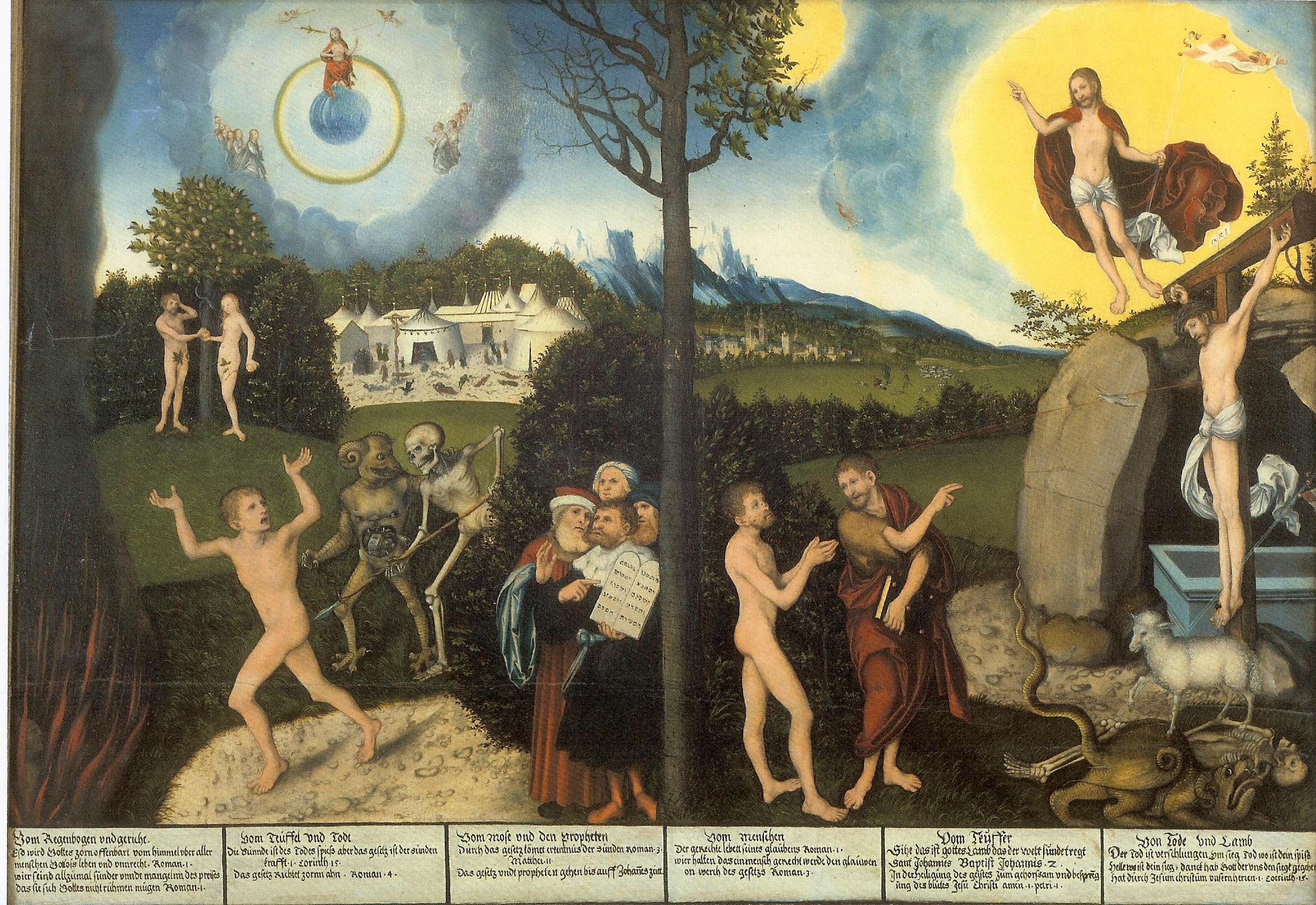
Two Covenants, One God
That doesn’t mean, however, that the Law of Moses lacks meaning or purpose after Jesus’s resurrection.
As we’ve observed, the idea that the God of the Old Testament was wrathful and vengeful, and the God of the New Testament was gracious and loving, has long been declared heresy by the church. From the beginning, Christians have asserted that the same God behind the Law of Moses is the same God at work in Jesus’s death and resurrection. The first Christians saw themselves as heirs to the promise given to Abraham, and believed they worshipped the same God.
In some ways, this makes intuitive sense. Isaiah’s prophecies, Abraham’s promises, the typology of King David all fit snugly into this one-God framework. Gospel themes of grace, redemption, forgiveness, justice, and repentance are easy to find in these stories and elsewhere in the Old Testament. Many are even directly referenced by the New Testament authors as foreshadows of the gospel before the gospel was fully articulated.
In other passages of the Old Testament, including the Law of Moses, the quest is harder to accomplish. How is it possible that the same God who said “stone adulterers” also, when presented with an adulterer to stone, refused to do so (John 8)? How does Jesus get away with not undergoing cleanliness rituals when he touches dead bodies or other unclean people? Jesus rejects and dishonors his mother when she tries to meet with him and end his ministry — isn’t this a breach of one of the Ten Commandments?
It can seem a priori and metaphysical to say that one God acted consistently across two testaments. And yet, reading the Law of Moses in this regard reveals a different angle for understanding it apart from a list of “thou shall nots.” Reading the Law of Moses through the lens of Jesus’s death and resurrection, it’s not just possible, but expected, that readers will find shadows, signs, and hints of the gospel in the passages most would think least likely to contain them.
On some level, most Christians already do this. They understand, for example, that the complex animal sacrifice system of the Law of Moses foreshadows the death and resurrection of Jesus. As Christians continue to study these animal sacrifices — the occasion for them, their cost, their frequency — the scope and depth of what Jesus accomplished grows grander in relief. Witnessing these thousands of animals slaughtered in worship for the sins and offenses of the people of Israel, how precious must the blood of Jesus be that his blood alone was the mechanism that purchased redemption for the sins of the whole world?
Remarkably, though, no Christian reads the passages of animal sacrifice and says “I must, therefore, out of obedience to God’s command, sacrifice an animal for my sins or gratitude to God.” In fact, few people modernize or moralize this portion of scripture by suggesting that we give other offerings, like money, to atone for our sins or express gratitude for God. The sacrificial system, for Christians, is not a “thou shall” command to be enacted, but a glimpse into the depth and richness of the final sacrifice to come. In this part of the Law of Moses, we find insight into the gospel of Jesus.
What would it look like to read the rest of the Law of Moses in this same capacity? Is it possible to read the Law of Moses and not come away with some set of moral principles (which the law cannot engender and fall short of Jesus’s command to love as he did), but instead, discover a new appreciation for the gospel itself?
Take, for example, the laws regarding skin rashes and other epidural illnesses in Leviticus 13. It is not a popular text, defined by what modern people consider a convoluted set of rules regarding hygiene, medicine, and quarantine. Through the lens of Jesus’s death and resurrection, however, a number of other themes reveal themselves.
- One might, for example, reflect on the clean/unclean dichotomy of this passage, and be reminded of the greater spiritual reality of perfection that is required to truly be one of God’s people.
- Another reflection might center on the goodness of the body created in Genesis 1, and how these rashes and boils are marks of the fallen body.
- A third reflection might look at Jesus’s passion and mark the impacts of sin on his hands, his back, and his head, while he is led away outside of the assembly to die (just as a leper might be ostracized in their own time).
- A fourth reflection might highlight the New Testament’s insistence that there will be new bodies in the new creation to come, and when skin ailments and illnesses are eradicated from the earth, this commandment will no longer be necessary.
What seems at first like an ancient, uninformed system of quarantine becomes an insight into the gospel of Jesus’s death and resurrection and his promise to return. Without this interpretive framework, the passage may be studied merely as a historical curiosity, a pre-modern attempt to keep people from being sick using ancient medical knowledge developed before germ theory. Instead, we find a robust contribution to the greater themes of the Bible — the brokenness of the world, the purity of heaven, and the need for outside approval to cross into that which is better and newer. A similar insights can be found in any number of other commands.
Reading the Law of Moses with the gospel as the primary lens of interpretation is like reading a good mystery novel twice. Knowing the end of the Agatha Christie novel allows the reader a new way to connect with the story when it’s retold. Clues were missed, subtle curious reactions make sense, and character motivations become clear. This is exactly what Jesus does with his disciples on the Road to Emmaus, and with this framework in mind, we can read the Law of Moses to learn more about God’s plan, character, and priorities for the world.
Final Thoughts
At the beginning of the series, I outlined how certain political strands have sought to prioritize the law of Moses as the framework for political governance. Not only that, I noted a number of instances where the law of Moses is used in opposition to the gospel priorities of the New Testament for Christian life and devotion. In doing so, a few implications become clear.
- No other nation in existence has the same relationship with God as biblical Israel. Understanding the law of Moses as a covenant, a contract outlining the stipulations that Israel must follow to live in the land God promised them, puts into perspective how no other nation in the history of the world has that kind of relationship with God. Nations may seek to be Christian nations, but God has not given them laws or instructions for life and governance by carving them into a stone with his finger. What appears to some to be a universal guiding principle is in fact specifically related to Israel’s covenant relationship with God and their greater mission to declare their God’s superiority to the world.
- These Old Testament laws perform a special function beyond serving in a constitutional role. According to the New Testament authors, the primary role of the Law of Moses was to prepare the people to recognize Jesus when he arrived, and to prepare their hearts for the gospel. Since Jesus has arrived, the primary goals of the Law of Moses have been completed. Given this, deriving principles for governance from the law of Moses is not simply as easy as “God said it therefore we should do it.”
- If one is going to apply the Law of Moses to one’s life as a standard of behavior (or to one’s governance as a standard of political organization), one should be totally committed to applying all of it and not simply picking and choosing ones that fit to present circumstances. Is the political leadership advocating for the Law of Moses prepared to wear clothes made from only one textile, to personally participate in the execution of adulterers via stoning, or follow all of the stipulations regarding the Sabbath? Are those who seek to follow it on a personal level prepared to do likewise?
- The Law of Moses is not the same thing as heavenly perfection. It merely foreshadows the ethic of self-emptying service and love embodied by Jesus’s death and resurrection. Following it, and expecting it to have any sort of divine blessing or providential advantage on this side of Jesus’s resurrection is a fool’s errand, an exercise in pride, and ignorance of the Bible’s own commentary on itself.
- The insight of the New Testament writings is that the law itself does not engender the change required to obey it. The wisest pastors will know this intuitively. Like John Berridge, the aforementioned Anglican revivalist, they will have come to know that preaching rules and law and sanctification does not bring about rule followers, law-abiders, or holier congregants. The preaching of the gospel, however, is a message that bears within it the Holy Spirit’s power to make those changes.
These are five of what could be dozens of insights that could apply in our time, but they are five of the timeliest. In a world that’s obsessed with rules and regulations and changes in behavior, the Christian ethical vision transcends these into something richer and more profound. Instead, the Christian seeks out a heart that is filled with love and desire for God and others, so that the ethical vision of sacrificial service to others becomes a joy and a desire, not merely an outward behavior. The world says “this is ethical behavior,” while the Gospel says “here is a loving heart that produces ethical behavior.” The only way to get this heart is to start with faith and God’s help through the power of the Holy Spirit. Reflecting on all of God’s word, including the rules, through the lens of Jesus’s death and resurrection does not add to that self-emptying moral vision. Instead, it provides a deeper insight into the grace of God that empowers that vision, so that we are not only told how to behave, but our hearts are inclined to do so.





a great ending to the series, I’ve enjoyed following along. thank you for the insights
Awesome exposition of the word! Please continue to study and share!