




There is a story New Testament scholars like to tell about Judas Iscariot that rivals any true crime podcast. I’ve relayed the tale myself in classes I’ve taught. It’s the story of how Judas the disciple became Judas the arch-villain and it goes something like this:
The opening act of the arch-villain story begins with the Gospel of Mark, the first Gospel written in early Christianity. When Mark narrates Jesus’ life, he reports that Judas agreed to facilitate Jesus’ arrest. Judas would lead the chief priests and scribes to Jesus when he wasn’t surrounded by loyal followers. Best to avoid a scene. Mark provides, however, no clear motivation for how a devoted follower of Jesus, someone within the inner circle of the twelve, could have so abruptly lost faith. Nor does Mark’s Gospel suggest what became of Judas after Jesus’ resurrection. The reader is left wondering whether Judas might rejoin the disciples in Galilee to greet the risen Lord. Would he be forgiven for betraying Jesus just as the disciples would be forgiven for abandoning him? If Judas can be redeemed, then there’s hope for everyone.
Next, Matthew chimes in by filling in Mark’s open-ended conclusion to provide an account of Judas’ genuine repentance and self-inflicted death. Judas, it turns out, tried to return the money he received for betraying Jesus, throwing the 30 pieces of silver on the floor and running away before it could be returned to him. The picture of Judas here is of one who made a terrible mistake, a mistake he recognized too late and from which he cannot be redeemed. Though Matthew’s narration leaves little question of Judas’ ultimate fate, you nevertheless almost feel bad for Judas. To have the entirety of your life defined by a single, irrevocable decision with no hope for return.

Then there’s Luke: while Matthew closes the door on Judas, he leaves the question of motivation unanswered. This is precisely where Luke picks up the thread. In his Gospel, Judas betrays Jesus after being possessed by Satan, and Luke makes no mention of any repentance on the part of Judas. Instead, Judas seems to have formed a reasonable exit strategy. With his earnings of 30 pieces of silver, Judas then bought a field, presumably to farm, and then grotesquely died after accidentally falling. This Judas acts under the control of evil — he’s been co-opted by forces opposed to Jesus to become someone entirely different from the faithful disciple who would have followed Jesus until the end.
With the Gospel of John, the arch-villain story reaches its climax. Jesus declares early on in his ministry that while he chose the twelve, one of them was a devil. (Jn 6:70). A few chapters later, Mary of Bethany poured expensive perfumes on Jesus’ feet and Judas objected to the waste. “Why was this perfume not sold for three hundred denarii and the money given to the poor?” Here, the narrator makes Judas’ intent perfectly clear. The thief had no intention of giving this money to the poor (Jn 12:5–6). Judas was greedy and his betrayal of Jesus for a bag of silver was an easy way to make quick money.
Scholars like to tell this story because for them it illustrates the stepwise growth of a concept over time, like watching an elapsed video of a seed germinating in the soil of the church. With each step along the way, the portrayal of Judas seems to get worse, and worse, and worse. He goes from a fallen disciple in Mark, to a condemned disciple in Matthew, to a possessed disciple in Luke, to finally an evil disciple in John.
But I want to suggest instead that this story expresses something else entirely. It’s not that the villain of the story became worse with every retelling. What’s actually going on is something far more sad, far more relatable. Each in their own way, the four Gospels are attempts to understand why Judas betrayed Jesus. The additional details given are not increasing evidence of his guilt but the desperate grasping of former friends interrogating the past to discover why Judas ghosted Jesus so suddenly. Were there signs of displeasure they had missed? Was Judas a spy from the beginning? Did the Devil make him do it? Wasn’t he in charge of the money?
The term “ghosting” originated within the context of romantic or dating relationships. A guy who stops calling or answering your texts seems to vanish into thin air. But the practice of abruptly cutting someone out of your life without a single word is commonplace nowadays, whether it be friendships, marriages, or adult children cutting off their parents. If you’ve ever been on the receiving end of ghosting, the absence of information is its own circle of hell. Those who have been ghosted find themselves questioning everything. They pore over text message histories searching for clues of discontent or endlessly retrace their steps to find some reason for the unexpected rift. When the unimaginable happens, we interrogate our lives to make sense of it, to find some overlooked domino in the chain of causation that led to the catastrophe.
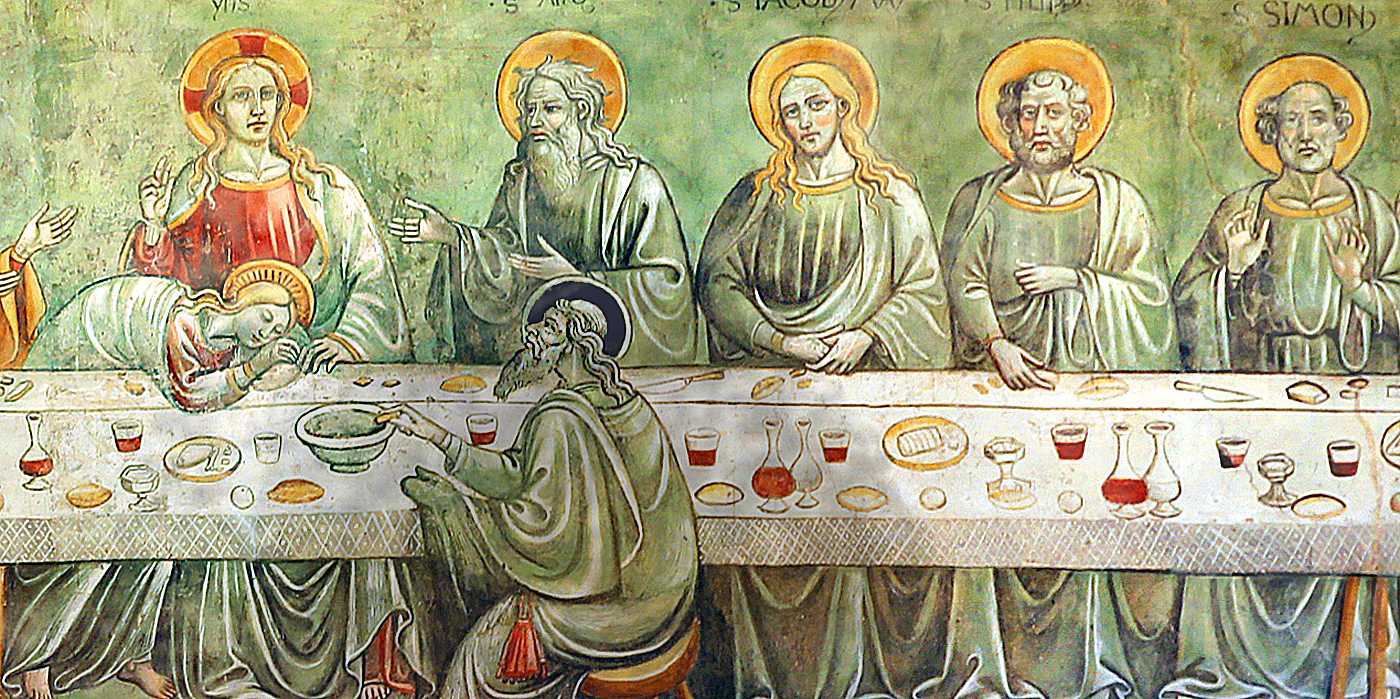
Jesus had previously told his disciples that he was going to be handed over to those who wished him dead, but they likely imagined such a heinous defection coming from some third-rate neophyte who only joined up with the crowd because Jesus fed him fancy bread and fish. So when Jesus broke the news on Maundy Thursday of his imminent betrayal by one within the inner circle, the twelve were all blindsided. They don’t all surreptitiously glance over at Judas to see how he would respond to being called out so publicly. They don’t whisper amongst themselves and trade knowing looks across the table. They instead ask Jesus who the turncoat is, because they genuinely don’t know. I imagine each disciple looked around at the others in amazement before pausing to consider whether Jesus was talking about themselves. “Is it I, Lord,” they all asked.
Hindsight might be 20/20, but those who lived with Judas for years couldn’t pick him out of a lineup of suspects. To them, he was just one of the twelve. To the faithful who remained, Judas’ betrayal is a cautionary tale: not of the mixed nature of the church, but that any follower of Jesus could ghost him in the end. No one’s faithfulness is invincible. No one is so holy that they cannot fall into temptation. Narrow is the road, and we who walk it are frail.
When we read the stories of the Gospels, we like to imagine ourselves to be one of the normal disciples. Sure, we’re still a work in progress just as they were, but we’re on the way. Few imagine themselves to be Judas, but it might be closer to the truth than we’re comfortable admitting. One day Judas was a faithful follower and the next he was a tabloid headline. If you think you’re better than Judas, take heed, lest you suffer a similar fall.
As much as the Gospel of John is supposedly the climax of the retelling of the Judas-as-villain story, it nevertheless also testifies to something more profound that is often missed. Unlike the other three Gospels, John uniquely reports that Jesus knows who his betrayer will be from the beginning. Jesus knew it would be Judas who would hasten his death, and yet he still broke bread with him, taught him, trusted him. Jesus never cast Judas out or withheld his love. Grace looks its betrayer in the eye and treats them as a dearest friend. Though Judas wavered in the end, Jesus’ devotion never does.








Love this, Todd!
THANKYOU
Thanks Todd
Getting ready to preach tonight, I was struck by how John records that Jesus washes Judas’s feet before he names him and sends him off on his betrayal mission. To your point: the betrayal seems inconigruent given Jesus’s love, which makes it that much harder to understand.
An excellent summary of what the different Gospels have to add to the Judas story and how some of those pieces potentially apply to our own story. An excellent article for today, Holy Thursday. Thank you Todd.
This paragraph is money!
“When we read the stories of the Gospels, we like to imagine ourselves to be one of the normal disciples. Sure, we’re still a work in progress just as they were, but we’re on the way. Few imagine themselves to be Judas, but it might be closer to the truth than we’re comfortable admitting. One day Judas was a faithful follower and the next he was a tabloid headline. If you think you’re better than Judas, take heed, lest you suffer a similar fall.”
[…] For example, the disciples of Jesus. At the start of Holy Week, they enter Jerusalem as a unit, strong and together. Three of them tell Jesus that they’ll stick with him through thick and thin. Days later, when Jesus needs them most, they fall asleep. Then there’s Peter, who assures Jesus of his devotion and loyalty yet ends the week having denied his Lord three times. And that’s without saying anything about Judas. […]
“This paragraph is money!” Very odd way to start a comment.
Just discovered this blog/site and feel as if the target audience is for two generations after myself. But I need to learn about Grace, always like to learn more about Christ, and after reading the (to me) clear advert on The Big Relief (turned off the long video on it, not my taste), I decided to check out the home page.
Glad I did, as it brought me to this post. Very well written, learned (and has me pondering how much I already felt) about this. Thanks!
Still, this comment…. starting with something *not* about Judas, yet “is money”…. Either it is witty sarcasm of the highest degree, or something *very* different than intended….