




In Flannery O’Connor’s short story “Revelation,” the main character, Mrs. Turpin, has fully given in to the temptation which plagues us all, though she wouldn’t see it that way. A large Southern woman, Turpin has a penchant for looking down her nose at black people and all those she terms “white trash.” O’Connor makes it clear as the veil of Turpin’s mind is pulled back, and we witness the way she sizes up and ranks everyone while sitting in the doctor’s office waiting room with her husband. Turpin is a good, hardworking Christian woman of virtue, upstanding, prim and proper, while all these others are … well, you catch the drift.
Outkast has a line in their song “Roses” that could well describe Turpin: “Now I know you like to think your [stuff] don’t stink, but roses really smell like woo-ooo-ooo.”
Turpin’s thin veneer of genteel politeness masking unchecked self-justification and self-satisfaction over and against everyone else grates on a particular girl. She could not be more obviously beneath Turpin. The girl’s name is Mary Grace, and Mary Grace comes to a point where she can’t take it anymore.
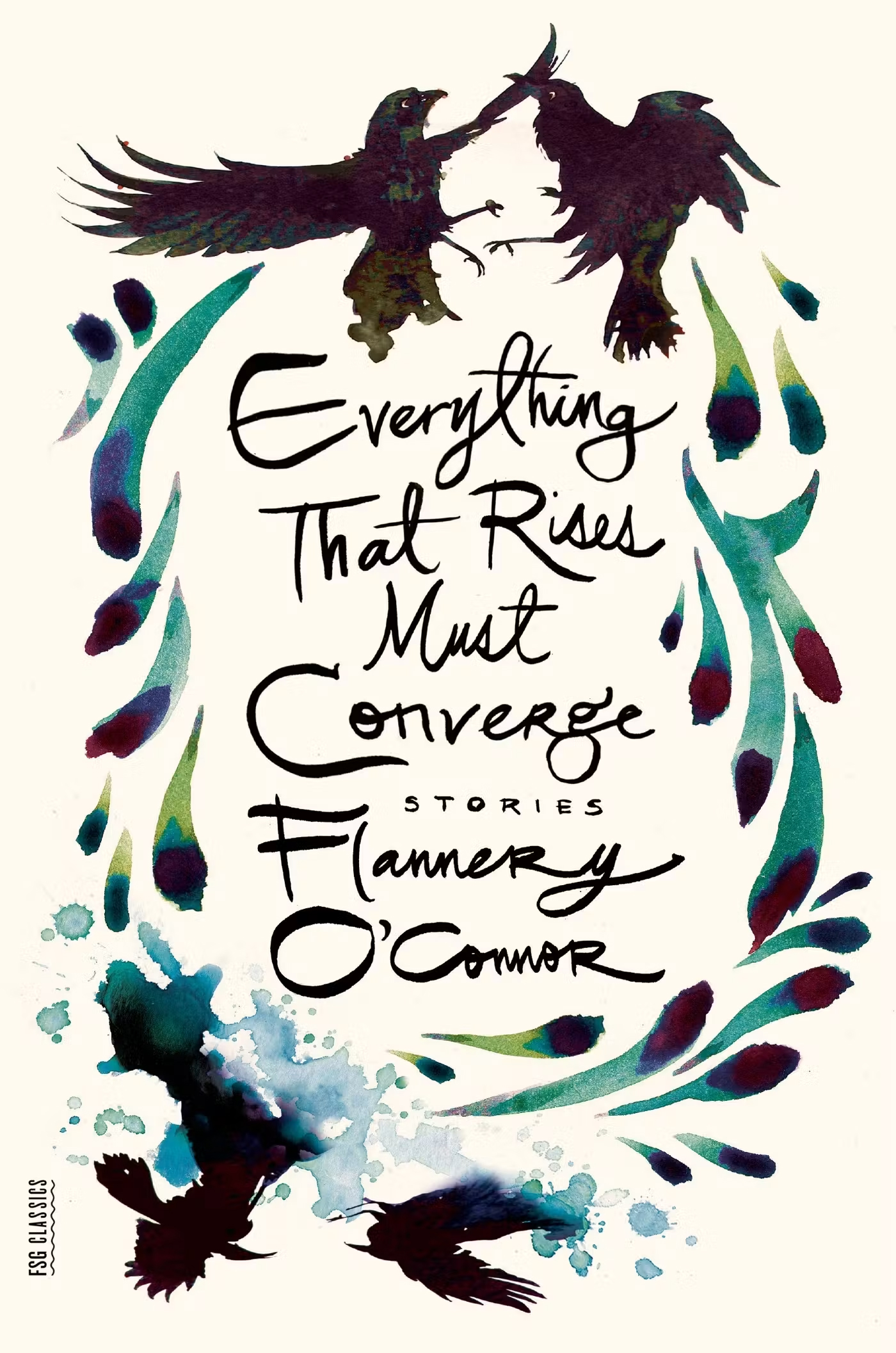 This speech by Turpin is what sends Mary Grace over the edge: “‘If it’s one thing I am,’ Mrs. Turpin said with feeling, ‘it’s grateful. When I think who all I could have been besides myself and what I got, a little of everything, and a good disposition besides, I just feel like shouting, “Thank you, Jesus, for making everything the way it is. It would have been different!” In a sudden and surprising act, Mary Grace hurls a book across the room hitting Turpin in the face, and then she launches herself at Turpin, “clamping” the woman’s neck in her hands.
The room is a flurry with nurses careening to pull Mary Grace off of Turpin. They eventually sedate Mary Grace, and Turpin recovers, leaning forward to look at Mary Grace with recognition. “There was no doubt in her mind that the girl did know her, knew her in some intense and personal way, beyond time and place and condition. ‘What you got to say to me?’ She asked hoarsely and heard her breath, waiting, as for a revelation. The girl raised her head. Her gaze locked with Mrs. Turpin’s. ‘Go back to hell where you came from, you old wart hog,’ she whispered.”
The word of truth hit Mrs. Turpin, and it changed everything. Even after she and her husband leave the waiting room and go on with their day, she can’t shake the words spoken over her. They linger like a scar, causing her to question her place in the world.
I imagine that’s happened to many, if not most, people. Not choked out after getting hit in the head with a book, but having to stop because something happened that made you question your place in the world. That what you’ve been doing isn’t working anymore, isn’t good, isn’t right, and you’re left wondering how it all would fit back together?
I wonder if that’s how the chief priests and elders felt when Jesus arrived in Jerusalem. This backwoods, uneducated, wannabe messiah arrives just before Passover with great fanfare, like some sort of obtuse conquering hero coming in on a donkey, announcing an enigmatic kind of the upside-down kingdom where the first would be last and the last would be first, while children shout, “Save us!” He then makes a beeline to the temple, where he sees it filled to the brim with the business of religion and kicks out the money changers. “It’s written, My house will be called a house of prayer. But you’ve made it a hideout for crooks” (Matt 21:13). The disabled and blind continue to flock to him, and he heals them.
All this hubbub makes those same chief priests and elders angry. They want it to stop, so they ask the loaded question, “Can’t you hear what they’re saying!?!” laced with the implicit: “Make it stop!” Jesus answers, “Yes, but haven’t you read your bible? Don’t you know it’s supposed to be this way when God shows up? Or did you forget the eighth Psalm, From the mouths of babies and infants you’ve arranged praise for yourself?” I bet those leaders went home that night questioning their place in the world.
And so, when Jesus shows back up the next day in the temple, the leadership is on high alert. He comes in teaching once again about his topsy-turvy kingdom and changing your hearts and lives in response to his presence, and the leadership wants to know why he thinks he can do this. “What gives you the right? Where are your credentials? Who said you could do this?”
Jesus, being the frustrating type of person he liked to be, pulls a Derek Zoolander and answers their question with a question of his own: “Where did John the Baptist get his authority to baptize, God or humanity?” They tried to trap him, but he ends up trapping them; because if the leaders say “God” they’ll be castigated for not buying in, and if they say “humanity” the crowds will tar and feather them for slandering a prophet. Doing the politically expedient thing, shorthand for the thing that will allow them to hold on to power and control as much as possible, they cop out and do a collective shoulder shrug. They can’t get past their self-justification projects, so they say, “We don’t know.”
Jesus knows they know the answer but are unwilling to admit it; so, he concocts that story about two sons to do just that — get them to admit the truth. Dad tells them both to go work in the vineyard. One says no but eventually changes his mind and goes. Another says yes but doesn’t go. Simple. Who does the Father’s will? The leadership can’t help but answer correctly, the first one.
“Yes!” Jesus says, “You get it! You know it, and yet you won’t give it up. John came to prepare the way for me, and the good-for-nothing tax collectors who steal from the poor to give to the rich and themselves got it, the down and out with no way to make money other than selling themselves as prostitutes got it. They believed and found new life in their deadness. They do the will of my Father. I said once, ‘This is my Father’s will: that all who see the Son and believe in him will have eternal life, and I will raise them up at the last day (Jn 6:40). They knew who they were and, in admitting the truth of it, found me ready to take their sins away and replace them with new life. It’s coming in a few days on a hill not so far away, when I die for your forgiveness and am raised for your justification.”
But us straitlaced religious types? We can’t. We won’t let ourselves because it’ll mean giving up our hopes, our dreams, our ideas. It’ll mean giving up our self-justification projects. It’ll mean we have to lose ourselves. And you can’t do that. There’s no power or glory in that. To us, control isn’t something to give up but something to hoard.
Those people whom we despise, at whom we sneer and look down our nose, they get the red carpet to the kingdom. They’re first because they know they’ve got nowhere else to go. But if we allow ourselves to just for once let go and trust in a savior who forgives our sins, then we can bring up the caboose of this kingdom-bound train.
When Mrs. Turpin is home on her farm tending the hogs in their pen, something happens. The revelation she had been waiting for from Mary Grace came to full fruition.
At last she lifted her head. There was only a purple streak in the sky, cutting through a field of crimson and leading, like an extension of the highway, into the descending dusk. She raised her hands from the side of the pen in a gesture hieratic and profound.
A visionary light settled in her eyes.
She saw the streak as a vast swinging bridge extending upward from the earth through a field of living fire. Upon it a vast horde of souls were rumbling toward heaven. There were whole companies of white-trash, clean for the first time in their lives, and bands of black[s] in white robes, and battalions of freaks and lunatics shouting and clapping and leaping like frogs.
And bringing up the end of the procession was a tribe of people whom she recognized at once as though, like herself and [her husband], had always had a little of everything and the God-given wit to use it right. She leaned forward to observe them closer. They were marching behind the others with great dignity, accountable as they had always been for good order and common sense and respectable behavior. They alone were on key.
Yet she could see by their shocked and altered faces that even their virtues were being burned away.[1]
[1] Flannery O’Connor, “Revelation,” in The Complete Stories, (The Noonday Press, 1995), 508.








Thank you Will! I think I read that story years ago and finally with your help I am able to see myself as Mrs Turbin which I never would have allowed myself to admit before. Surprisingly it feels great 😊
Thank you for this. I just quoted from “Revelation” in last Sunday’s sermon.
“She lowered her hands and gripped the rail of the hog pen, her eyes small but fixed unblinkingly on what lay ahead. In a moment the vision faded but she remained where she was, immobile. At length she got down and turned off the faucet and made her slow way on the darkening path to the house. In the woods around her the invisible cricket choruses had struck up, but what she heard were the voices of the souls climbing upward into the starry field and shouting hallelujah.”
Hallelujah indeed. Amen