




The thirty-second chapter of Exodus is a well-known lynchpin of the book. In it, Moses descends from Mount Sinai with “two tables of testimony, tables of stone, written with the finger of God” (31:18) only to discover that Aaron has cast, with the golden earrings of the wives, sons, and daughters of Israel, a molten calf which the people of Israel dance before in worship. Moses’s anger waxes hot, as the King James tells us, and he throws the tables out of his hands, breaking them beneath the mountain. As they crumble to dust, we see the true futility of the Law.
Earlier in Exodus 24, Moses spoke the commandments of God to the Israelites, “and they said, all that the Lord hath said will we do, and be obedient” (24:7). Moses then returns to the mountain for God to give him “tables of stone, and a law, and commandments which I have written; that thou mayest teach them” (24:12). It is then that Moses dwells on the mountain for forty days and forty nights — and it is then that the children of Israel reveal themselves to be not only “stiff-necked,” (32:9) but also impatient.
Before the children of Israel can even receive the tables of testimony, written by the very finger of God, they have already broken their covenant. They have already fallen short of their promise to God and his commandment to “have no other gods before me … [to] not bow down to them, nor serve them … neither make unto you gods of gold.” Before God can codify his words and inscribe the tablets, the gold was melted down, and an idol was born. In the moment Moses carries the Law down from the mountaintop, the Law is already condemning. And though it is Aaron and the Israelites who are the first to “break” the Law, it is Moses who physically breaks the Law, in his anger and frustration at the human heart and the heart’s inability to fulfill God’s commandments.
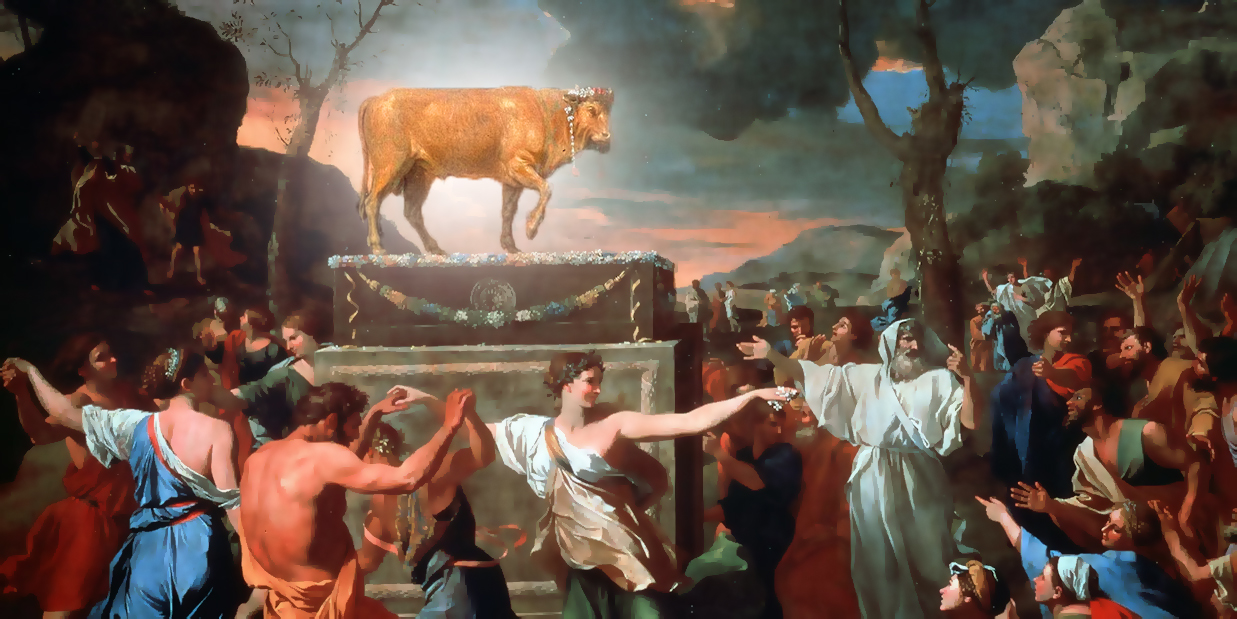
Moses’s condemnation of his people is swift and harsh. A violence almost inconceivable to our modern sensibilities. He burns the golden calf, grinding it to powder and forcing his people to drink water mixed with the powdered gold. A cursed cup — the poison of sin and idolatry filling the bellies of the Israelites. This is no communion scene; it is, instead, a recapitulation of the Garden. The forbidden fruit, consumed and ingested, the toxin of sin filling the bloodstream of God’s people. There will be no other gods, neither man (Gen 3:5) nor calf. There is no redemption for those who dance and bow to a god that they themselves have fashioned.
But it is when Aaron tries to shift the blame, begging Moses not to be angry with him because the people were set on mischief (Ex 32:22), that the violence of the Law is revealed. The NRSV translation tells us in verse 25 that Moses sees “that the people were out of control,” but the King James translation gives a slightly more interesting (and literal) English word for the Hebrew para’, which can be “to unbind” or “make naked”:
And when Moses saw that the people were naked; (for Aaron had made them naked unto their shame among their enemies:) Then Moses stood in the gate of the camp, and said, Who is on the Lord’s side? Let him come unto me. And all the sons of Levi gathered themselves together unto him (Ex 32:25-26).
Back to the Garden. Sin uncovers, unbinds, and unveils. Sin not only makes the Israelites naked before their enemies but makes them naked before God. “I was afraid, because I was naked; and I hid myself” (Gen 3:10). Moses sees his people’s shame, sees their nakedness, sees them exposed. They fashioned for themselves a golden calf, and they exposed themselves to the wages of their sin. Payment is due. The camp must be purged.
Moses goes to the gate, and he calls those who are loyal to the Lord to his side. This time, it is not just gold-flecked water that will be his people’s punishment. This time, they will pay for their guilt, their sin, their nakedness with their lives.
Thus saith the Lord God of Israel, Put every man his sword by his side, and go in and out from gate to gate throughout the camp, and slay every man his brother, and every man his companion, and every man his neighbour. And the children of Levi did according to the word of Moses: and there fell of the people that day about three thousand men (Ex 32:27-28).
On the day that the stone tablets of the Law were first brought down from Mount Sinai by Moses to be given to the Israelites as a covenant with God, three thousand Israelites were put to the sword, killed for breaking the Law before they had even received it into their midst. “For the wages of sin is death” (Rom 6:23).
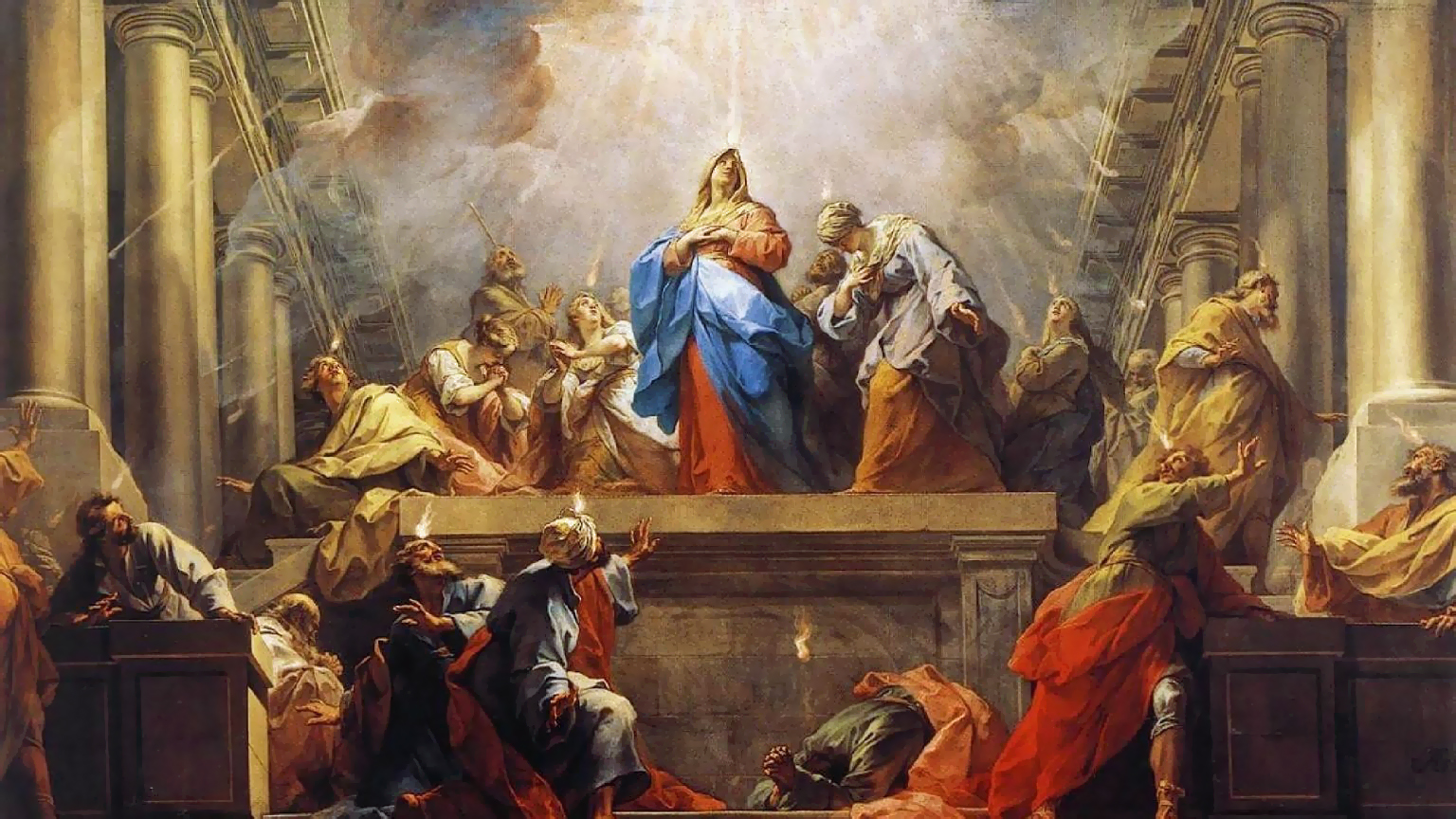
About fifteen hundred years after Mount Sinai, a group of Jewish men gathered in a house to celebrate the festival of Shavuot. Shavuot honors, fifty days after the Passover, that very moment in history when God revealed the commandments to Moses and the Israelites. It honors Mount Sinai and all that happened there. As one of the Three Pilgrimage Festivals for the Jewish religion, Shavuot also brought pilgrims from every nation together in Jerusalem. And on one particular Shavuot, in 33 A.D., the city would have been packed.
Fifty days before that Shavuot, another event had taken place alongside the Passover feast. A man named Jesus of Nazareth had entered the city of Jerusalem, been betrayed by one of his own disciples, and been crucified upon a cross. Shavuot was occasionally referred to, in Greek, as Πεντηκοστή (Pentēkostē) for falling on the fiftieth day after the Passover. Pentēkostē in 33 A.D., however, would change the Greek word’s significance for all the ages to come. The group of men gathered in the house that day were followers of the crucified Jesus.
And suddenly there came a sound from heaven as of a rushing mighty wind, and it filled all the house where they were sitting. And there appeared unto them cloven tongues like as of fire, and it sat upon each of them (Acts 2:2-3).
Most Pentecost sermons I’ve heard like to dwell on this moment. How the disciples were filled with the Holy Spirit and began to speak with other tongues and “every man heard them speak in his own language” (Acts 2:6). Every pastor likes to mention the historical context — how surprising this is because the men are Galileans and therefore uneducated. They shouldn’t be able to speak in all the languages of Babel. The lectionary gets us all the way to when Peter defends them, saying they’re not drunk because it’s only 9 a.m. (which I happen to think is peak Bible humor — is Peter implying things might have been different at 5 p.m.?). Somehow, though, neither the lectionary nor the preacher ever seems to get all the way to the end of Acts Chapter 2. But it is at the end of the chapter where we see the fifteen-hundred-year salvific arc of God’s plan:
Then they that gladly received his [Peter’s] word were baptized: and the same day there were added unto them about three thousand souls (Acts 2:41).
On the very first Pentēkostē, the first Shavuot, three thousand Israelites were put to the sword by the sons of Levi for their trespass against God’s law. On the first Pentecost after Jesus Christ’s resurrection, the Holy Spirit descends; Peter preaches death, resurrection, baptism, and remission of sins; and three thousand souls were saved.[1]
The Law kills, but the spirit gives life (2 Cor 3:6). The church of the gospel is born on the very anniversary of the church of the Law, redeeming the destructive sin and violence of Sinai. Redeeming the condemnation of the Law.
Let’s return to that mountaintop. The day after the slaughter of the three thousand, Moses climbs again to the mount of Sinai, where he appears before the Lord. Moses and the sons of Levi have delivered the Lord’s judgement, the blood price, but it is still not sufficient payment for the Law’s trespass. Moses understands this, because the first thing that he says to the Lord is an admission of the guilt that still remains:
If thou wilt forgive their sin —; and if not, blot me, I pray thee, out of thy book which thou has written. And the Lord said unto Moses, Whosoever hath sinned against me, him will I blot out of my book (Ex 32:32-33).
Three thousand deaths are not enough. The sin is still there, yet to be forgiven. And Moses asks the Lord to accept himself as a sacrifice for his people’s mistakes.
Moses is not Christ. Anyone who has spent time in the book of Exodus knows this well enough. But here he is, after dealing out horrific punishment to his people for a horrific sin, willing to lay down his life for them.
This is the very first verse in the Bible in which the Lord’s book is mentioned. We know more about this book because of a later verse, in the Psalms, in which David cries out for punishment for his adversaries: “Let them be blotted out of the book of the living, and not be written with the righteous” (69:28). There are references to a book in Psalm 40, Psalm 87, and Psalm 139; those “written among the living” in Isaiah 4:3; sin recorded “with a pen of iron, and with the point of a diamond” in Jeremiah 17:1; a “book of remembrance … for them that feared the Lord” in Malachi 3:16; and, in the prophecy of Daniel, a time when “thy people shall be delivered, every one that shall be found written in the book” (12:1).
The book is the Book of the Living, the Book of the Righteous, the Book of Them That Feared the Lord. At the end of time, one wanted their name to be found written in the book. Deliverance would come for those whose names were inscribed.
But God is direct with Moses. Inscription in the book is not guaranteed. In fact, one’s name could be written in the book only to be blotted out, erased as if one’s righteousness had never been. For my grammar nerds out there, “living” is the present participle of the verb. An active, present state of being and, therefore, a state that can cease to exist. The living could become the dying. In the act of blotting out one’s name, those who live can become, in the space of a heartbeat, those who pass away. With one mark from God’s hand, The Book of the Living could become the Book of the Damned.
Whosoever hath sinned against me, him will I blot out of my book.
We don’t know if God blots out the names of those three thousand who were killed at Sinai. Perhaps we are not meant to know. What we do know is that God sends a plague to punish the people because of the calf (Ex 32:35). A cup of powdered gold, the deaths of three thousand men and women, a plague from God. All because the people desired a god that they could see, a god that they could limit to the scope of their own experience. A god on their level.
What happens on Mount Sinai proves to us, without question, that the punishment for sin is harsh. We may not fashion our idols into golden calves in modernity, but we have them nonetheless. Shall three thousand be killed for worshipping their paychecks? How many would be sacrificed to the idol of Instagram? We have made unto ourselves gods of gigabytes and microchips; we are just as guilty as those who wandered in the desert so many thousands of years ago. We limit the things we worship to the things we can fashion with our own hands.
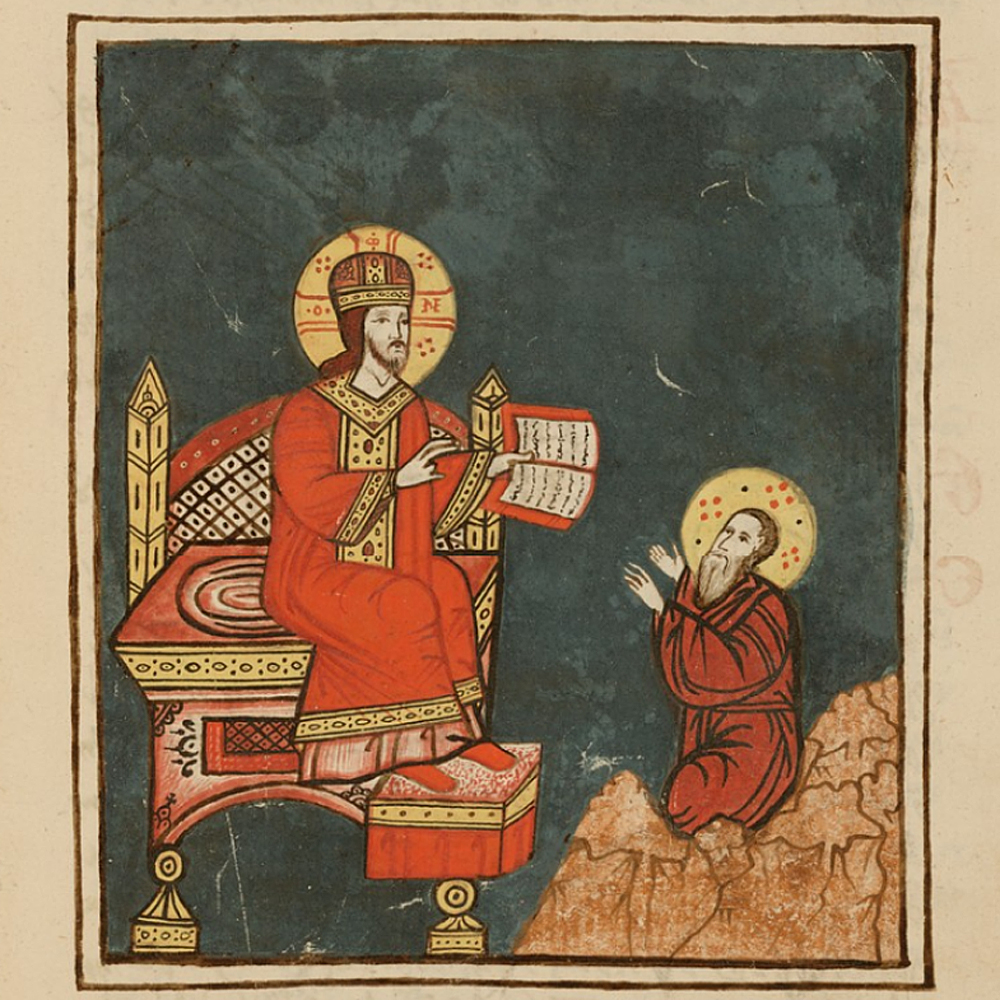
Folio 171r of Ms. 931 at the University of Chicago Library, Greek New Testament Revelation, 17th century
But on the other side of that auspicious year in history — 33 A.D. — we are not struck down by swords for our deadly sins. We are not even made to drink powdered iPhones (though we certainly deserve to). And the reason for this has something to do with that Book of the Living.
You see, there comes a moment in the Gospel of Luke where Jesus tells the seventy whom he has sent out to, “Rejoice, because your names are written in heaven” (10:20). The writer to the Hebrews also makes reference in his letter to those whose names are “written in heaven” (Heb 12:23) just as Paul writes of the “book of life” (Phil 4:3). The Lord’s book reappears in the New Testament, just as it appears in the Old, but with one important difference. That present participle has evolved into a noun: life. That tenuous state of being — the one that could be snatched away with the beat of a heart, with the ink of the blotting pen, the bending of a knee towards a golden calf — has become concrete. As the Son of Man says in the Book of Revelation, “He that overcometh[2], the same shall be clothed in white raiment; and I will not blot out his name out of the book of life” (Rev 3:5).
The Book of Life, unlike the Book of the Living, is a permanent state of being. Once we have come into right-standing with the Father, it cannot be undone. Our names will not be blotted out, our righteousness will not be erased, no matter how many times sin creeps back in. And there is one simple reason for this: our God is a God who lifted his sword of execution from the backs of his own people and struck out the payment for our sin on a sacrifice that was, finally, fully sufficient. A sacrifice that was enough for three thousand plus three thousand a million times over. Our God is a God who drove the sword of judgement into the heart of his own Son. Who wrote our names in his book using an ink that will never fade and that can never be erased. Revelation reminds us, a few chapters later, whose ink, whose lifeblood this is: “the book of life of the Lamb slain from the foundation of the world” (Rev 13:8).
And now we see why, in that same chapter in which the Law came down from Sinai, condemning the Israelites to death and destruction, the Lord God reveals the existence of his book. Just as the Lamb’s blood paid for the deaths of the three thousand at Sinai through the three thousand who were saved in Jerusalem, some fifteen hundred years later, so his blood continues to pay, over and over, the debts of the world, of our sin, of our hearts. On the other side of the cross, we are no longer living. We are life. We are a people whose names are eternally inscribed, with the ink of his Son, by the very finger of God. And we can be assured, from now until the end of time itself (and beyond) that nothing can blot us from his sight or from his love.
And the city had no need of the sun, neither of the moon, to shine in it: for the glory of God did lighten it, and the Lamb is the light thereof. And the nations of them which are saved shall walk in the light of it: and the kings of the earth do bring their glory and honour into it. And the gates of it shall not be shut at all by day: for there shall be no night there … And there shall in no wise enter into it any thing that defileth … but they which are written in the Lamb’s book of life (Rev 21:23-27).








Thank you for this assurance-filled reflection, Derrill. With so much violence everywhere, it’s hard to read the OT anymore! I have to focus on the “red letters” of grace through Jesus that fill us with hope and encourage us to love unconditionally. Pentecost people! I thought you were referring to Dolly Parton, also inimitable! 🙂 Much love to your family.