This Sunday is one of the most important in the calendar year, a sadly under-celebrated holiday with no school or bank closures: Pentecost. This day, fifty days after Easter, marks the outpouring of the Holy Spirit on Jesus’ followers. As described in Acts 2, it’s a dramatic event, visible in tongues of fire, audible in a bevy of languages. Yet, for many Western Christians today, this holiday feels tertiary — much like the Spirit itself. So what does Pentecost actually mean? Why is it celebrated?
Comfort, O Comfort my people, says your God. (Isaiah 40:1)
One role of the Spirit that Jesus emphasizes in the Gospel of John is that of the Paraclete, variously translated as Advocate, Helper, and Comforter. Before his death, Jesus assures his disciples poignantly, “I will not leave you orphaned” (John 14:18). This is the case not only because Jesus will return, but because God sends the Comforter in Jesus’ name (v. 26).
Living in a time rife with cruelty and loss, it is not uncommon to find ourselves deeply despairing. We lose jobs, relationships, abilities, and loved ones. Indeed, to love — especially in the inclusive, self-giving way Jesus commands — is to open our hearts to pain. When we feel raw and detached, exposed and set adrift, achingly vulnerable, and perhaps very distant from God, the Spirit is there to wrap us up and bring us home.
And yet, the Holy Spirit is not a teddy bear. It would be folly to limit the third person of the Trinity to the role of emotional support. In fact, we can’t limit the Spirit to anything — “The wind blows where it chooses …” (Jn 3:8). The tender immediacy of the Spirit as Comforter is not to be confused with lack of power.
But you will receive power when the Holy Spirit has come upon you, and you will be my witnesses in Jerusalem, in all Judea and Samaria, and to the ends of the earth. (Acts 1:8)
The comfort of the Spirit is not passive but active, creating a path forward. When God says to the Israelites, “Comfort, O comfort my people,” God is speaking to a group experiencing the emotional and practical effects of violent conquest. This comfort stands with the inconsolable mother grieving her child. This comfort breathes life into dry bones.
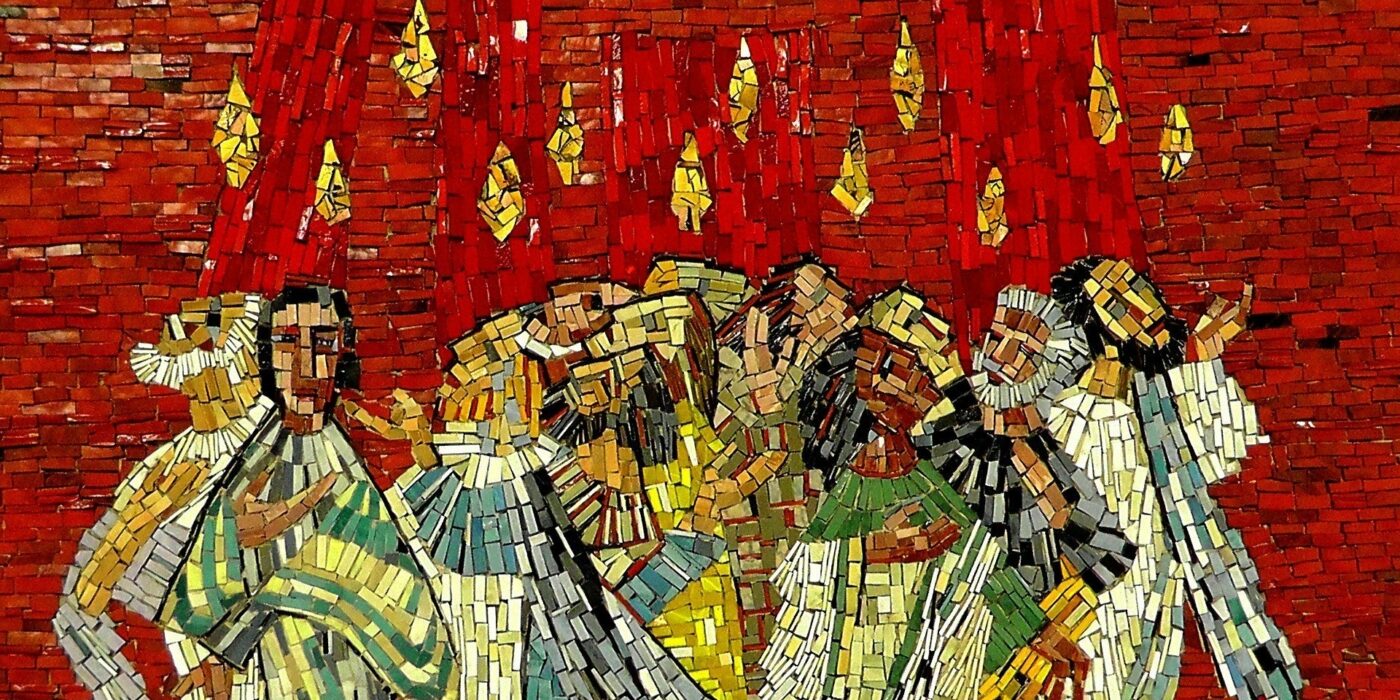
The disciples to whom Jesus is speaking when he describes the Paraclete are about to endure the very real trauma of watching their best friend be crucified; many of them will also die early and violent deaths. Some of them will be disappointed to learn that he is not the kind of savior who restores their people to political power (Acts 1:6) or overthrows the empire oppressing them.
But after Jesus ascends — a glorious event that I can only imagine left them with mixed feelings — the Spirit arrives to stir them, accompany them, teach them, and enable them to do the very hard work of witness and service that Jesus has left them to do. The presence of the Comforter enables them to face some serious discomfort for the un-kingdomlike Kingdom of God.
Indeed, the Spirit has the power to guide us in adversity, advocate for us in our weakness, uplift us from our despair, and even improve us, bringing us closer to Christlikeness. Yet here once more we must remember a caveat: the Holy Spirit is not an electrical socket.
In an age that valorizes self-help, it may be tempting to see the Spirit as a kind of cosmic energy that, if we only tap into it, will make us into the righteous, successful people we want to be. But the power of the Spirit is of the Spirit, which is to say, God’s power — not ours.
This Advocate is not a lawyer for hire; this Helper is not a servant we direct. Rather, the Spirit acts on us, for us, through us, and sometimes in spite of us — on both an individual and a cosmic level: “We know that the whole creation has been groaning together as it suffers together the pains of labor” (Rom 8:22), and in these pains, “we do not know how to pray as we ought, but that very Spirit intercedes with groanings too deep for words” (v. 26).
Intimate, personal comfort and global, transcendent power may seem to contrast, but scriptural descriptions of the Spirit encompass many seeming opposites: fire and water, strength and softness, wisdom and feeling, growth and security, movement and abiding, justice and mercy. The Spirit’s inclusivity also bridges human divides, reaching those with little social power:
I will pour out my spirit on all flesh; your sons and your daughters shall prophesy, your old men shall dream dreams, and your young men shall see visions. Even on the male and female slaves, in those days I will pour out my spirit. (Joel 2:28–29; see also Acts 2:17–18)
At the beginning of Luke — to which the Book of Acts is the sequel — the Spirit facilitates Jesus’ conception, an event that is at once tender and world-transforming. The Spirit is also active in Jesus’ baptism, his going into the wilderness, his teaching, and his being called to “bring good news to the poor … proclaim release to the captives and recovery of sight to the blind, to let the oppressed go free” (4:18; see also Isa 61:1).
Pentecost is not a story about God handing over a security blanket or booting up a power grid so we can be Better Selves. It’s a story — or rather, a pivotal moment in The Story — of God drawing all people to Godself. Indeed, the Holy Spirit is deeply comforting, and through this comfort urges us forward into the world — a world that is brutal, beloved, and in need of a powerfully present God.