




I recently spent a semester painting in the South of France. During my program, I attempted to paint luminous mountain landscapes, enchanting still lifes, and French models (who made the landscapes pale in comparison). But don’t be fooled, the grandeur of my surroundings could not silence even the least of my seemingly never-ending sentiments of self-doubt.
I spent many days filling my canvas with angry brushstrokes and ugly colors formed in frustration with my lack of novelty. Some days I just gave up entirely in order to self-loathe and pout mysteriously under a tree in the landscape.
One day, my professor found me hiding under the protection of an exceptionally magnificent white oak. As soon as he sat down beside me, I blurted out with anguish, “This is such a waste of time. Why even try to paint flowers when Van Gogh has already done it so much better than I? What’s the point of even trying?”
My professor’s response to this melodramatic exclamation of self-pity was a humble chuckle and sigh of affirmation. He then presented the idea that nothing of worth is ever considered completely novel. He referenced T.S. Eliot’s Tradition and the Individual’s Talent (which would soon become my creativity crutch). He explained that an artist’s true talent lies not in his/her ability to be completely and utterly novel, but in their ability to create something simultaneously timeless and temporal in a way that fuses the past and present together into a harmonious, continuous dialogue. Only through this acknowledgement of the limitations inherited by the past can one be free to explore endless possibilities for expression and creation.
Throughout my program, we purposefully did activities to break down our infatuation with our own aspirations for perfection and novelty. We painted objects by holding our paintbrushes in our mouths between our teeth. We turned off the lights and painted to the limits of what we could see and learned how to let our imaginations lead our hands along the canvas (pictured below). We painted with our arms completely outstretched, forbidden to bend, which forced us to move our entire bodies. It was liberating.
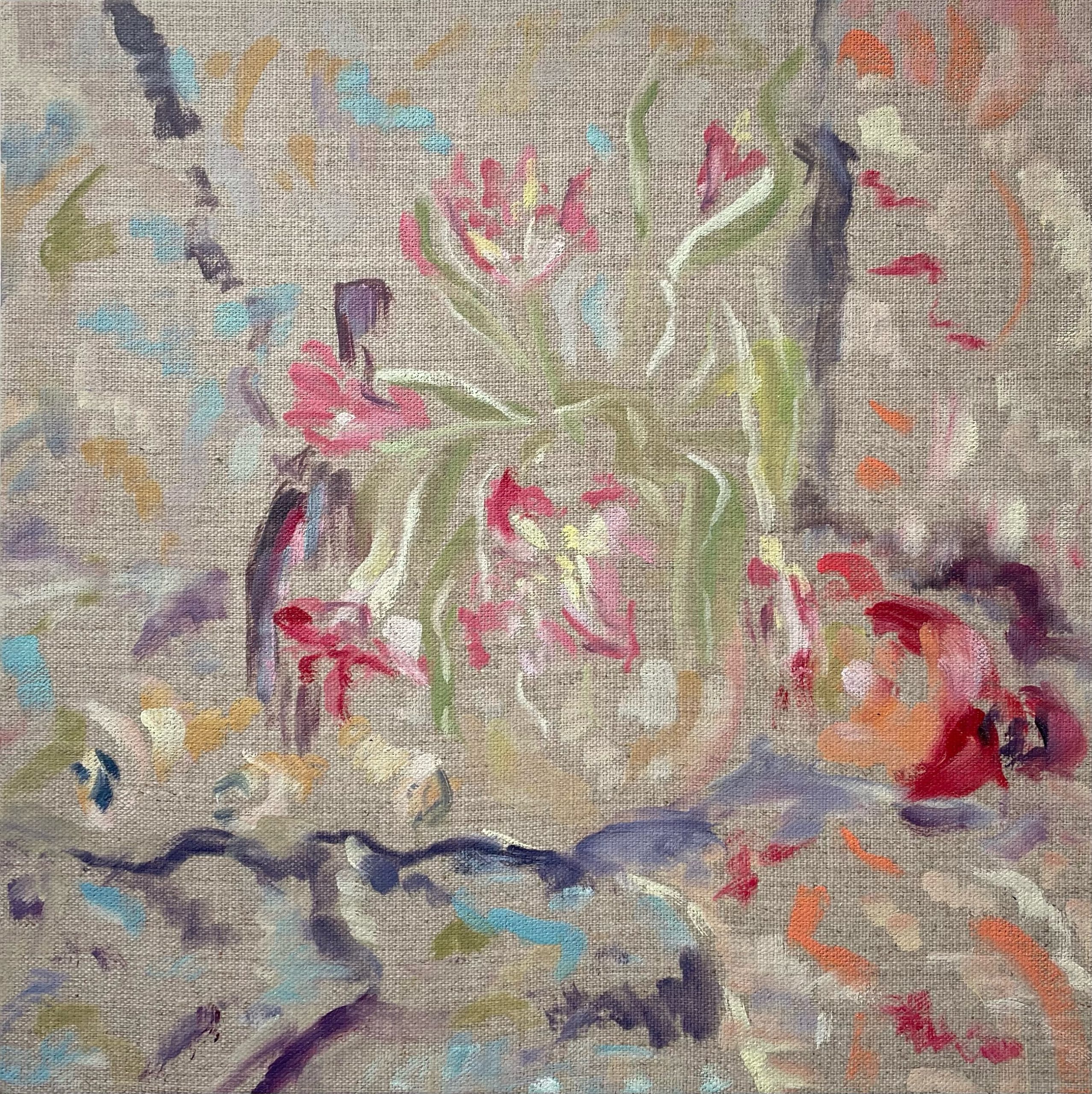
Slowly, I started to let go of this paralyzing pursuit of novelty. After a long day of gazing, admiring, and trying to capture and reinvent the wondrous works of creation, I would often imagine God looking at my frivolous, silly little attempt to create something out of my awe of his creation. In my head, he would always smile back at my work. Not because it was exceptionally wonderful, but simply because it was mine.
Though our fears may be paralyzing, God nevertheless desires us in our messiest state. In view of divine mercy, what’s the worst thing that could happen? Falling short? Messing up (again …) ? All the more opportunity to cling ever more tightly to Jesus’ robe of perfection, majesty and splendor.
Jesus was, of course, incredibly original. He was wildly counter-cultural and revolutionary. He showed the world grace, forgiveness, and mercy in ways that the world had never nor will ever see from anyone else. But at the same time, he was not novel in an absolute sense.
Jesus assimilated himself into a specific culture in a particular time period. He dressed the way others did, spoke their same language, participated in their holidays and traditions, and cited Jewish scriptures as testifying about himself. He was simultaneously and irreducibly Jewish and the savior of the world. If he had been entirely novel, he would have been an unintelligible alien. If he had been completely novel, we would not have been able to engage with him, to connect with him, to learn from him, and ultimately to love him.
The more we step out with humility, courage, and vulnerability to engage with his creation in new ways, the more opportunity God has to show us his absolute and overwhelming love. Bring your messy paintings, your improperly-knotted embroidery, your off-key singing, and your runs speckled with walking spells to the Lord most high. He delights in our engagements and explorations of his creation no matter how imperfect or repetitive or silly they may seem.
For the past few years, my poor, sweet roommates have endured my ever-expanding collection of my nephew Charlie’s drawings on our communal refrigerator. Every morning, while I stand over the trash can to empty my french press’ coffee grounds, I pause to admire the innocent beauty of Charlie’s work. No matter how offensive his renderings of my face may be, they are a genuine and tangible expression of his love. Nothing he could ever do would make me love my nephew any less or any more than I do. I can’t help it. Even when he cheats at every single game in the entire world; because I’ll be honest, that one comes close.
But this daily sacrament of pausing to appreciate his drawings reminds me that even when my paintings look like Charlie and I freaky-Friday-ed our bodies, God still looks at my attempts to honor his creation with endearment, and he is pleased.








Very entertaining and good information. I hope you had an amazing journey.
Fancy my reading this when I’m gearing up to take the next little step in a longtime creative dream. Thank you for the encouragement!
All artists steal from each other
You know in a way, the crash of our idealized vision and our actual creation – whether that creation be a painting, a golf shot, or an essay on a test – represent the moment where a small “L” law is blossoming in our spirit. It is the moment where that little law points to our creation-ness. Our finiteness. Our limits. And as such those moments are deeply precious as they expose us to something infinite, unlimited, and perfect which we perceive but can never acquire. This is the opening where Grace come in.
I, for one, love your artistic offerings and now can add your fresh and fun honesty of what absolutely can paralyze any one trying to create. #loveyoumore
Wonderful, Harmony – thanks! This dynamic works for sermons also. Very occasionally, I give up on TPS (The Perfect Sermon) and lean on sermons by preachers like the Paul’s – Zahl and Walker – and sometimes credit them.