




When I was a little girl, my church held annual Easter pageants, the successor to medieval passion plays. A member of our congregation, clothed in nothing but a glorified diaper, would allow himself to be covered in a mixture of chocolate syrup and red food coloring, then pose on a cross made by another church member who had evidently aced shop class. His hands would grip metal handles in such a way as to appear from a distance that they were driven through with nails. While the choir sang, the man on the cross would do his best to look thoroughly miserable.
Adults might not have been fooled by this pantomime, but when my young eyes glimpsed it for the first time, it captured my imagination. Yes, I knew it wasn’t really Jesus in front of me. I had heard how they made the fake blood with help from Hershey’s. Yet I was powerfully aware that on the actual hill of Golgotha all those years ago, an innocent man really had been horrifically executed in this gruesome manner, and the thought of it distressed me. I was escorted out by a compassionate church worker who took pity on my tears.
I wonder if this is the sort of reaction we all ought to have to the central event of the Christian narrative. Plenty of religions recall the deaths of their holy men with special commemorations, but none of those holy men died in quite this way: stripped naked, flayed alive, declared an enemy of the state, impaled on a tree. Crucifixion was, for the peoples of the ancient world, the worst fate imaginable, a practice specifically meant to maximize suffering and humiliation. It was reserved for the lowest of the low — slaves and traitors — and engineered to be so shockingly violent that, when passersby saw it, they would banish any thoughts of resisting authority.
Of the aspects of Christianity that provoke objection, the crucifixion of Jesus has been near the top of the list for two millennia. To the ancient Jews, it was a sign of God forsakenness — the cursed death of one hung on a tree. To the ancient Romans, it was proof that the person in question could not be divine. But to modern Westerners, nothing about Christ’s crucifixion offends as much as its bloody violence. Such an event, we reason, could only have occurred in the barbaric world of the ancients. If the proof of a respectable religion is one that eschews violence, particularly human sacrifice, then a religion that revolves around a Father who sends his Son to die by crucifixion is so obscene as to provoke disgust. Only a non-enlightened society could think that God would require blood: that salvation for humanity could come through the sacrifice of innocent human life.
Well, why did it have to be blood anyway? We must not become so desensitized to the sight of Christ on the cross that we fail to ask this obvious question. Of all the ways God could have saved the world, why did he choose this one? Why was it necessary for his Son to die?
Christian theologians have struggled with this question over the centuries and developed several theories, some competing and others complementary. Perhaps Christ’s life was the price paid to the devil to free those held in bondage; or maybe Christ died not to pay the devil but defeat him and all the powers of evil. Others theorized that Christ was setting a moral example: We ought to lay down our lives for each other, even as he did for us.
None of these theories quite explains the need for blood. Ransoms are typically paid in coin, not the execution of innocent people. Surely the God who created Satan and his minions could have snuffed out their existence without the need for a crucifixion. And what kind of person tells another person they love them by being tortured and crucified? Might not the moral example of a full 80 years spent healing the sick have been more powerful than taking on a literal Savior complex?
The unsatisfactory nature of these explanations led to the early proposal of another: When Christ died on the cross, he was behaving like the lambs that were sacrificed in ancient Israel. He was taking upon himself the sentence of death owed to sinners, because without the shedding of blood, there could be no remission of sins. Over time, this idea was developed. Anselm of Canterbury said that in acting as our substitute, Christ was satisfying the honor of God. The Protestant reformers opted instead for a legal metaphor, arguing that Christ satisfied the demands of God’s justice. But in each of these variations, the central image was that of atonement: the shedding of blood for the removal of sins.
For many, this explanation does not make the crucifixion less obscene but more so. Could humanity really be so steeped in evil as to require a human sacrifice? Are we not, at our core, good people capable of making good? Are our sins so grave and our perversion so total that it demands the shedding of blood?
What conclusions a person draws from viewing the cross may depend on which version of the cross they are viewing. No artistic representation is neutral. Each communicates something theologically. Medieval churches in Europe all featured a prominent crucifix, but the Christ hanging upon it was not usually covered in blood, nor was the look on his face one of total agony. With the Renaissance came a renewed focus on realism in art which, in the context of the crucifixion, meant portraying Christ’s suffering. One German painter was to take this to a historic extreme.
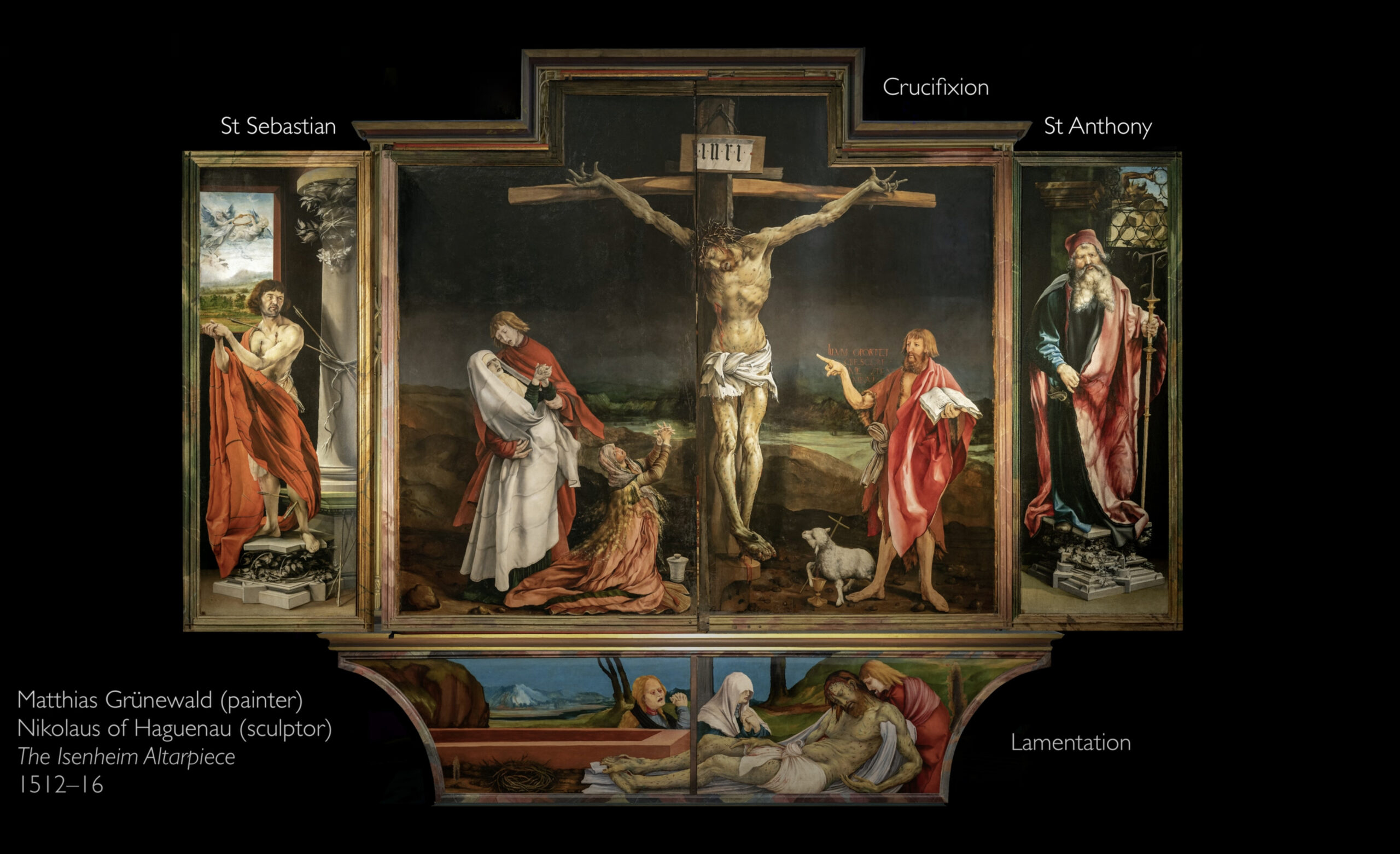
Matthias Grünewald pursued his artistic career in the first quarter of the sixteenth century. The little we know about his life indicates it was filled with hardship. His wife, Anna, suffered from what contemporaries deemed to be demonic possession (likely severe mental illness) and had to be institutionalized. Grünewald saw in his most intimate relationship what could happen when the human mind loses its capabilities. He understood the frailty of human nature and the depths of sickness.
When Grünewald was commissioned to create an altarpiece for the Monastery of St. Anthony in Isenheim, he knew one of the monks’ primary tasks was to care for victims of serious illness. The monastery’s hospital was frequently home to those suffering from St. Anthony’s Fire (ergotism) and plague. Both conditions disfigured the body and required complete removal from society. In a time when infectious disease was more prominent and deadly than it is today, the plague struck fear in the hearts of Europeans as nothing else could. It was no respecter of persons, afflicting the old and the young equally, the rich and the poor, city merchants and country farmers. No human body, however fit and nourished, could withstand its power. Even today, the fatality rate for plague is around 60% for the bubonic variety without antibiotics and close to 100% for its septicemic and pneumonic varieties.
The patients lying in that hospital were not sick as much as they were the living dead. Every hour exposed the inabilities of their bodies, their minds, and the best medical care available to heal their disease. The very breath they drew was a mockery of their fate, for they were already dead in every practical sense.
The crucifixion that Grünewald created for the Isenheim monastery was unlike any other. Not only did he continue his pattern of portraying Christ in physical agony, his body writhing and twisted, but he covered Christ’s bloody skin in sores just like those of the patients. For Grünewald understood something of the cross’ theological significance: It was a mirror into which humans could gaze. There the victims of disease saw the reality of their situation. They understood that their spiritual condition was as dire as their physical condition. For despite humanity’s best efforts, we are as incapable of healing ourselves spiritually as those sufferers were of healing their bodies. We too are alive but dead. “And you were dead in trespasses and sins …” (Eph 2:1).
The first step in the Alcoholics Anonymous recovery program is the admission of personal powerlessness. The sufferers of Isenheim understood this instinctively. Their greatness and pretensions were long forgotten, their pride cast on the rubbish heap. When they looked at that image of the crucified Christ, they saw clearly the truth of their disease, but they also saw something else. Yes, this was the sacrifice their sin had required, but it was also the cost at which God himself was willing to purchase their healing. The depths of human evil could only be healed through the shedding of blood, but the God of the universe loved them enough to take on their flesh, suffer alongside them, and offer up his veins. The cross of Christ announced both the reality of their disease and the infinite worth of their souls.
Christ did not merely enter into their suffering. He provided the healing they craved.
In his poem “East Coker,” T. S. Eliot imagines Christ as a physician presiding over a hospital that is the world entire. This Christ does not offer mere words of comfort or quick cures that will leave the patient sick again. He aims to cut out the cancer.
The wounded surgeon plies the steel
That questions the distempered part;
Beneath the bleeding hands we feel
The sharp compassion of the healer’s art
He suffers and bleeds with us, but his blood speaks a better word than ours. He comes “not to please” but “to remind of our, and Adam’s curse, / And that, to be restored, our sickness must grow worse.” This is the hospital of the world, “Wherein, if we do well, we shall / Die of the absolute paternal care / That will not leave us, but prevents us everywhere.” For as chemotherapy is a poison that kills the cells, so the cure Christ brings requires death: not only his own but ours. By his perfect law, he puts sinners to death that he might raise them again.
The dripping blood our only drink,
The bloody flesh our only food:
In spite of which we like to think
That we are sound, substantial flesh and blood —
Again, in spite of that, we call this Friday good.
He plies our sinful flesh with the double-edged sword of his Word, which separates joint from marrow. With his law, he puts to death that which cannot be restored by nature so it may be resurrected by something beyond nature. For grace does not merely restore nature, as if nature alone could be our salvation. Our greatest need is the one who enters nature: the God who becomes flesh.
For nature is a created thing subject to the one beyond it. The Creator must create again, not with words alone but by the Word made flesh. For by the law, we are put to death with Christ upon that cross, where sin is revealed as sin. By our union with that same man, we become partakers in his righteousness. He tastes death that we may taste life. He assumes all we are in order to resurrect it.
Only by faith can the vilest act in history be seen as good. For in the cross of Christ, the glory of God is hidden under its opposite. That was the teaching of Martin Luther in his theses for the 1518 Heidelberg Disputation. The one who deserves to be called a theologian “comprehends the visible and manifest things of God seen through suffering and the cross.” We confess that Christ came not to save the healthy but the sick, and by his wounds we are healed.
I have felt the sickness in my flesh — the piercing steel of the wounded surgeon, the fever pitch of purging fire. In the darkest hours of my life, when my faith has seemed on the brink of death, I have gazed upon the crucified one whose bleeding wounds plead for me. In that obscenity, I have beheld a beauty of love beyond compare, which awakens a desire within me to be united to this one who was crucified and rose again, for my healing and that of humanity. And in those moments, I believe; and by faith alone, I call this Friday good.







