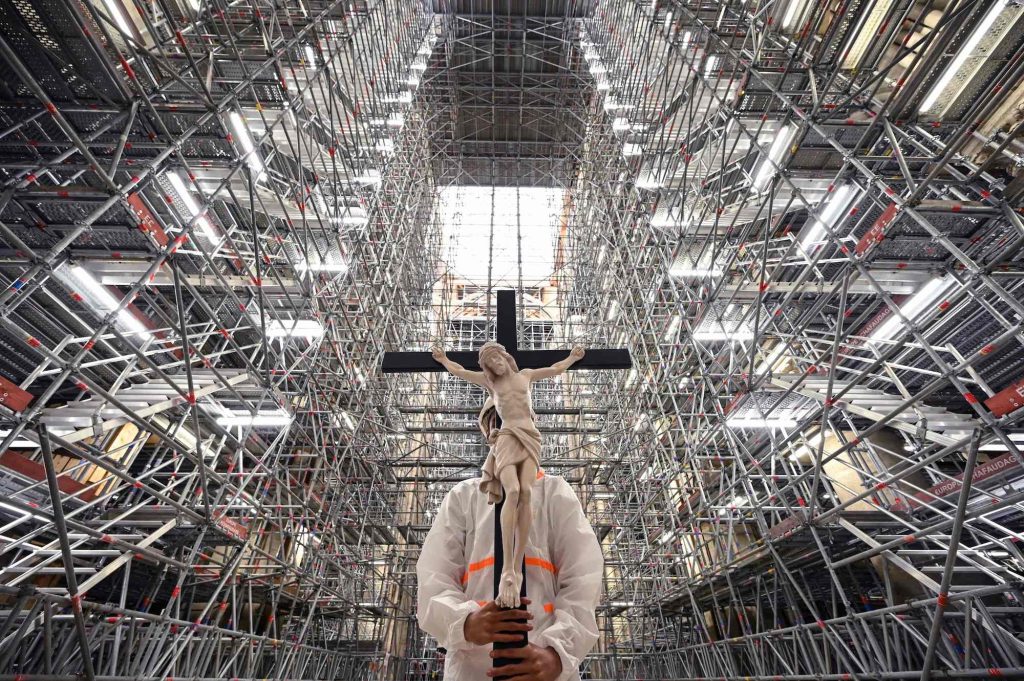
Photo by BERTRAND GUAY/AFP via Getty Images
As Jesus was leaving the temple, one of his disciples said to him, “Look, Teacher! What massive stones! What magnificent buildings!”
“Do you see all these great buildings?” replied Jesus. “Not one stone here will be left on another; every one will be thrown down.” (Mark 13:1–2)
Over $15 billion has just been spent to elect a president of the United States. Almost $1 billion has just been spent to restore Notre Dame Cathedral. The effort of politics and the salvation of a sacred building are exquisitely human devotions.
It was a human effort to build Solomon’s Temple, which Jesus visited in Jerusalem — perhaps $300 billion in today’s worth. Religion itself is a human effort — perhaps not as rank and cynical as politics nor as aesthetically obsessed as the building of an icon, but organized religion tries to manifest all God has given us to do. Every Bible is a book. Every hymn is a song. Every service is an interactive play with a script. Every icon, every ritual is invented and effected by us.
But Jesus is human, too. A connection of the sacred and profane is who humans are.
I am an architect. I am often asked to help those wishing to build, change, or save the buildings they use for whatever purpose. When buildings are built to the glory of God, our investment is not just about money or effort, our mission involves devotion. But any building that is made is just a building. I shock those parishes who put their trust in me (including my own parish, where I have been the properties chair for over twenty years) when I declare simply that if the building burned down, God in my life would be unchanged.
Jesus was clear that “magnificent buildings” can simply go away because they are buildings. Once again, St. Paul finds folly in our efforts to build the sacred when the sacred is within each of us:
Do you not know that your bodies are temples of the Holy Spirit, who is in you, whom you have received from God? You are not your own; you were bought at a price. Therefore honor God with your bodies. (1 Cor 6:19–20)
Architects grapple with trying to transcend our corporeal limitations while living in the bodies that we were given. In an article on the human body and architecture, researchers Linxue Li, Qi Zhang, and Meiting He write, “Since Vitruvius’s Ten Books on Architecture, the topic of body, as a representative of the humanistic tradition of architecture, has continuously promoted the development of architecture.”
Architecture can be defined as a dance with our bodies (through construction and the use and appreciation of a space), just like our food, clothing, and politics. The complexities of all the ways we implement the simplest of tasks — breathing, seeing, understanding — is insane. Our relationship to buildings is equally miraculous, so obvious as to go unacknowledged. But we know that beauty exists because He reveals it. That beauty is as ineffable as it is gut-punching.
Science has only revealed even greater complexities about the human body, with more questions revealed than answers. I do not find architecture to be baffling, but the way we are affected by it (to the point of being willing to spend $1 billion to maintain the sacred) defies logic — because faith is senseless, because grace does not make sense. Grace is simply unavoidable.
Just like those temple stones. Humans cleft them, transported them, and installed them according to a design they created in a city humans created. By us, for us. But we want to be more than us — we want to be connected to what is beyond our capacity to control, let alone understand.
But God creates the creators. Time and tide are not by us, and in the world we are given, what we do here inevitably ceases. Not one stone here will be left on another; every one will be thrown down. We live on the basis of God’s will. We have an incoherent faith that our Creator creates through us.
In Exodus, the source of life and creation is clear by the word of God to the point of defining that what we build can be fully sacred:
“Then have them make a sanctuary for me, and I will dwell among them. Make this tabernacle and all its furnishings exactly like the pattern I will show you.” (Ex 25:8–9)
But we humans want ownership of what we make. We even want to own our intimates, too – spouses, children, even religion – but we ultimately own nothing. Our temples will be knocked down. In 40,000 years an Ice Age will sweep away the 1,000 things I have designed — if they even exist by then. But in truth, I will no longer exist in a generation: so my faith in the world that I make is laughable.
But I am a human, given the facility to manifest the loves, fears, hopes, and beliefs of this world, even though I cannot control any reality beyond the effort. Not one stone here will be left on another; every one will be thrown down.