Set to hit mailboxes in a few weeks, the new issue is available to buy here.
Find subscription options here!
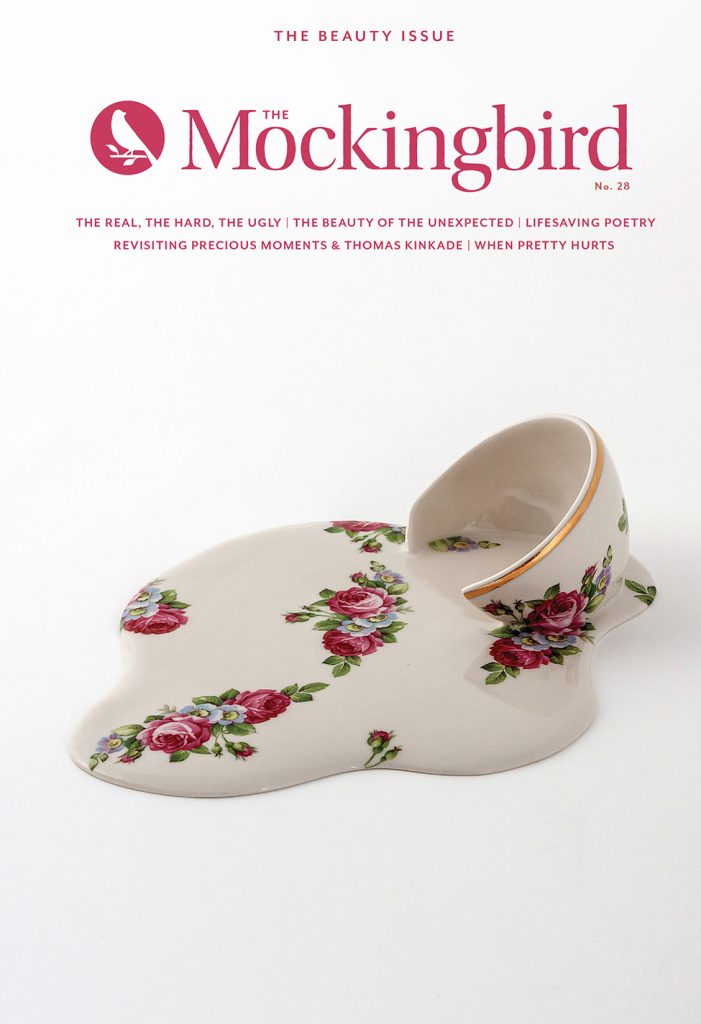
“Who were you to decide what was beautiful? Things are beautiful if you love them.”
— Jean Anouilh (1950)
Imagine a preacher’s kid struggling to find his purpose in life. Beginning at age sixteen, he gets a job in the “art world” at a gallery. But in his twenties, he’s pretty sure contemporary art has sold out to commercial incentives, and so, frustrated (and also expecting to be fired), he resigns. He tries other jobs, but none stick. He tries bookselling but finds it dull; he tries theology school but fails the entrance exam; he tries lay preaching but fails the final exam; he goes to a coal mining town to serve the poor, but, despite his best intentions and committed efforts, his contract is not renewed. His personal life is, somehow, worse. He proposes to three women, is roundly rejected by each, moves in with a pregnant sex worker, and that relationship doesn’t last either. Meanwhile he paints — he has become an obsessive painter — but survives on his brother’s money, selling only a few drawings and one painting in his lifetime. After a striking act of self-harm — lopping off an ear — he continues to paint daily, mostly from a psych ward, and with little encouragement. His palette grows more vibrant even though his prospects do not. Ultimately, he takes his own life.
As you’ve probably guessed, this is the broad-strokes tale of Vincent van Gogh, whose work now draws over two million visitors every year to the Amsterdam museum devoted to it. His orchards, cypresses, and starry nights, so laced with hope and pathos, bear a rich and singular beauty. A hundred years after he painted the Portrait of Doctor Gachet, it sold for 82 million dollars. The point is not that he was a misunderstood genius. It is that beauty operates on its own terms. Beauty cannot be coerced from an artist nor from the market; no one can force the beholder to see it. It seems only miraculous that what Van Gogh made from his labyrinth of dejection attests, generations later, to a kind of beauty that he himself may not have recognized.
Certainly, Van Gogh found beauty in the works of others. One of his great inspirations was Charles Dickens. “I want to paint what Dickens has done with words,” he wrote. “I find all of Dickens beautiful …” The work of both men hinges on a similar understanding of beauty: for Dickens, it arises most reliably in humble, even tragic circumstances; glamor is usually suspect. One moment early in Bleak House illustrates this perfectly. A well-to-do philanthropist, Mrs. Pardiggle, pays a visit to the impoverished household of a brickmaker. She reads to them at length from the Bible, departing only after expressing her sincere hope that when she sees them next, the family will be “improved.” But Mrs. Pardiggle has completely missed what was right in front of her eyes: the brickmaker’s family is mourning the death of their baby.
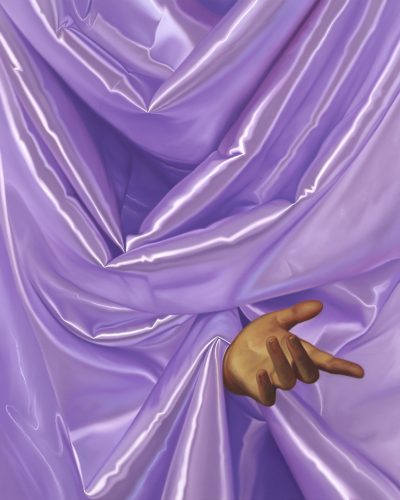
Shawn Huckins, Hand of a Young Man in Purple Satin Fabric, 2024.Oil and acrylic on canvas, 42 x 34 in.
It is a gut-wrenching realization. Thankfully, the family is not without comfort. “An ugly woman, very poorly clothed, hurried in.” This woman — Mrs. Pardiggle’s polar opposite — bears bruises and marks of abuse. She has no words of wisdom, no Bible to quote. “She had no kind of grace about her but the grace of sympathy; but when she condoled with the [mother], and her own tears fell, she wanted no beauty.” Observing the scene, the narrator says:
“I thought it very touching to see these two women, coarse and shabby and beaten, so united; to see what they could be to one another; to see how they felt for one another, how the heart of each to each was softened by the hard trials of their lives. I think the best side of such people is almost hidden from us.”
It is a terrible scene, made beautiful only by the extension of sympathy, understanding, and unbidden presence.
Beauty, like grace, arrives mysteriously. It surprises. A reminder of God’s presence in the world, beauty functions as grace itself. As such, it can manifest through conventionally ugly means. A dim shelter for the unhoused. Recovery meetings in a church basement lined with Calvinist Bible commentaries. An embarrassing apology.
The centerpiece of the Christian faith, the cross itself, is the most beautiful ugly thing there is — a life sacrificed.
This is what religious people so often get wrong about beauty. They think it is one’s responsibility to create; the dogmatic keep a tight leash on what’s “acceptable.” Easily digestible aesthetics must be adhered to.

Ben Cowan, Blessing Leaf 4, 2025. Oil and acrylic on cast aqua-resin, 8×10 in.
But beauty is narrowly defined in secular society too. There is, at present, a 400-plus billion dollar “beauty industry” aiming to “empower” individuals to attain higher levels of physical attractiveness and self-regard. Needless to say, this approach can be exhausting and, not infrequently, fruitless. Are “beautiful” people ever content with their looks? Not easily, as supermodel Emily Ratajkowski expressed in her memoir: “I’m always thinking … if only my nose was a little smaller, my whole life would be different.” When we approach beauty from a standpoint of control, it’s a mug’s game.
In this issue we look for the beauty in the ugly, and the ugly in the beauty. Gretchen Ronnevik writes about the truth of sad things; Michael Wright peers into the darkened vault of Thomas Kinkade’s most intimate paintings; Ross Blankenship praises poetry in the age of artificial intelligence; and Jane Anderson Grizzle investigates why everything that’s supposed to be “beautiful” looks the same. Other insights come from scholar Natalie Carnes, art historian Matthew J. Milliner, novelist Randy Boyagoda, and writer Joy Marie Clarkson.
This issue also features four interviews, with two-time National Book Critics Circle Award finalist Paul Elie; prolific poet Jeanne Murray Walker; Atlantic culture critic Sophie Gilbert; and art historian Aaron Rosen. We have fresh poems by Jeanne Murray Walker, Ryan Alvey, and Paul J. Pastor, plus new writing by Kathleen Norris and a long-awaited contribution by our copy editor extraordinaire, Ken Wilson. Sarah Condon offers new advice on postpartum bodies and in-law relations, and David Zahl connects our desire for beauty to our most fundamental need — the need to be loved.
Through it all, we find the truest, most beautiful thing we know: that grace falls on the undeserving. After all, you’re not loved because you’re beautiful, you’re beautiful because you’re loved.
Table of Contents
ESSAYS
Pretty Hurts
GRETCHEN RONNEVIK
A Visit to the Precious Moments Chapel
MATTHEW J. MILLINER
Flat Earth
JANE ANDERSON GRIZZLE
Can Poetry Save Your Life?
ROSS BLANKENSHIP
Kind of Scary, I Guess?
RANDY BOYAGODA
The Call of Beauty
NATALIE CARNES
The Whole Picture
MICHAEL WRIGHT
London Calling
JOY MARIE CLARKSON
—
INTERVIEWS
JEANNE MURRAY WALKER
SOPHIE GILBERT
PAUL ELIE
AARON ROSEN
—
POETRY
Little Blessing for Subplots
Small Formal Treatise on Beauty
50th Birthday
JEANNE MURRAY WALKER
The Crystal Hand
By Dying Oak
PAUL J. PASTOR
Sleep Comes by Hearing
Holy Ground
RYAN ALVEY
—
LISTS & COLUMNS
The Confessional
ANONYMOUS
Dear Gracie …
SARAH CONDON
Finding Beauty in the Unexpected
KATHLEEN NORRIS
From the Glossary
On Our Bookshelf
Bible-Based Beauty Products
Running After Tops
KEN WILSON
—
SERMON
The Cheap Perfume Route
DAVID ZAHL