




1. There’s a clip of Queens of the Stone Age’s front man, Josh Homme, being given George Harrison’s rosewood Telecaster to play. It’s the guitar you can hear George playing on “Let It Be.” So, it’s a six-stringed big deal. After obediently fiddling about on the guitar for around forty seconds, Homme shakes his head and puts it back down — “Man, seriously, I think I have to stop playing these things … some things you’re supposed to touch, and some things you’re never supposed to touch.”
And that’s it. The clip ends.
I think about that little interaction a lot. Most predictably, when people make movie/TV adaptations of novels that I love. And, come to think of it, even novels that I really don’t.
I wish I weren’t one of these people, I really do. But I just can’t help it. Some things you’re supposed to touch, and some things you’re never supposed to touch. Right? There are, of course, a plethora of notable exceptions to the rule (hello to Saint Emma Thompson’s 1995 adaptation of Sense and Sensibility and a special salute to Peter Jackson’s LOTR trilogy), but on the whole, I’m coming at each new visual adaptation with a level of cynicism (let’s call it nervousness, shall we?) that I have no right to hold.
So, as you can imagine, I was slightly less than excited when I first heard about Zoe Kazan’s go at adapting John Steinbeck’s East of Eden for Netflix. Some things you’re supposed to touch … and surely Steinbeck isn’t one of them.
Oh, and then I heard that Kazan and Co. had tweaked things a little. They had humanized the novel’s notorious monster — Cathy Ames. And I thought that was a total, albeit predictable, tragedy.
Until I watched it.
Salon’s Melanie McFarland asks her readers if it’s about darn time Cathy Ames was reconsidered, wondering whether her own literary professors were simply “too tired to parse such nuance.”
When Steinbeck first introduced Cathy Ames to the public in 1952, and when Elia Kazan (Zoe’s grandfather) brought his version to the screen three years later, we were only allowed the slightest glimpse into her soul. Elia Kazan’s movie, written by Paul Osborn, barely covers the last third of Steinbeck’s 600-page epic. It also omits Lee and focuses primarily on James Dean’s Cal Trask, one of Cathy’s sons, leaving most of her story to secondhand whispers. When a lawman confirms to Cal the rumor that Cathy, known by then as the nearby town’s madam, Kate, shot his father, Cal muses, “He must have done something to hurt her.”
“No, sir,” the man counters. “He gave her everything that any woman could ask for.”
But how would he know? Zoe Kazan’s Cathy, which closely hews to Steinbeck’s original vision, defies easy assumptions about a woman’s wants and needs. Nothing about her, or the way Pugh plays her, is simple.
I, perhaps similarly to McFarland, watched this latest reconsidering of Steinbeck’s material and found myself wondering why I’d never been frustrated with how hollow, how stubbornly 2D Cathy Ames appears to be. She’s a monster, I always thought. And that’s the beginning and end of that.
Such interpretations of Cathy are comforting in their distance, aren’t they? We can revel in the luxury of making an anomaly of her — “I believe there are monsters born in the world to human parents,” Steinbeck writes, and we sit cozily in the belief that we are not one of them.
How soothing. And yet, how theologically hollow.
This is something McFarland picks up on:
But if the best fiction can also be instructive, maybe the last moral of (Zoe) Kazan’s “East of Eden” can help us hold multiple truths at once. Cathy’s reasons for doing terrible things may be understandable, even relatable, while the transgression remains unforgivable. A person may even warn us by crying for help or, as Cathy does, advising those on the verge of falling into her trap to turn back … But for a few twists of fate, she could be any of us.
She’s drawing specifically on how our circumstances, “twists of fate,” can make beasts out of any one of us. And she’s right, of course. But I think what we also need to reach for here is a basic acknowledgment of the reality of sin, no? Our brokenness and our breaking-things-ness. The hurt we feel, the hurt we inflict. That crack, the fracture — our relentless propensity to miss the mark. We can’t keep that at a cozy distance; we can’t identify dollops of it in Cathy Ames without wincing at the same dark substance within our very selves.
So, maybe Steinbeck can be touched, after all. Just leave George Harrison’s Telecaster alone — I beg of you.
2. Right, let’s stay on the theme of reading for one more, shall we? The Sunday Times columnist, James Marriott, keeps scaring me with all his talk of a “post-literate society.” Is he being a little too prophet-of-doom, here? Man, I hope so. How am I supposed to make friends if I can’t quote Jane Austen to people, siphoning her wit and pretending it’s my own?
The Wall Street Journal’s Daniel Akst reviewed James’ book on this very topic. A book which, ironically, I have not yet read. Thinking about it, James Marriott better hope that his thesis is blown out of all proportion — if only for his own book sales.
Akst wrote this,
“The decline of student reading is only the most visible symptom of a wider crisis,” James Marriott warns in “The New Dark Ages,” a disturbing book about the death of the print culture that once shaped our lives, culture and democracy. “In America,” he writes, “reading for pleasure declined by 40% in the first two decades of the 21st century. And in the U.K., more than a third of adults say they have given up the habit.” Publishers have evidently responded by dumbing down their offerings. Mr. Marriott cites an analysis from the Economist of New York Times bestselling books over the course of nearly a century that found that “sentences in popular books have contracted by almost a third since the 1930s.”
As a short sentence lover, I’d like to suggest that short sentences alone are not cause for alarm. But still. Dammit.
I guess I have two questions, both of which are answered by James Marriott via Daniel Akst — first up, what’s to blame?
Nothing, in Mr. Marriott’s view, has done more than the smartphone to bring on the culture of illiteracy that we seem to be entering. He notes that people on average now check their smartphones 144 times a day. A columnist for the London Times and an inveterate reader, Mr. Marriott recounts his own early experience with the technology. “It was often a matter of minutes after sitting down with a book,” he writes, “that I would spring up again, assailed by thoughts that were at once impossibly petty and yet possessed of an inexplicable urgency,” to check his phone.
Figured. My second question: What’s at stake here?
For Mr. Marriott, reading isn’t only a matter of personal cultivation. On the contrary, he makes a strong case that reading is a necessary ingredient for the exercise of reason, providing a mechanism for arguments to be considered and assessed, for truths to be asserted and defended. Reading, as generations of the downtrodden have discovered, can be liberating, which is why a number of slave states before the Civil War made it illegal to teach the skill to black people. […]
Mr. Marriott believes that the decline of reading and writing (and the growth of hyperkinetic distractions such as TikTok), abets the rise of an ignorant, irrational and distracted electorate. “Mass literacy is a recent phenomenon,” he writes. “So is mass democracy. We simply don’t know whether one can survive without the other.”
Noted.
If James Marriot’s thesis holds water, there’s reason to lament. These stories that we’ve apparently stopped reading, they’re hooks upon which we can hang our own experiences — but you don’t need me to tell you that. If my observations, my thoughts, my ponderings were the only ones residing in my mind, with no dialogue partners invited in, the world would shrink before my eyes.
Anyway, I guess we’ll all have to buy and read James Marriott’s book, won’t we? And in so doing, smugly prove him wrong.
Gosh, his marketing team have really got me where they want me, haven’t they?
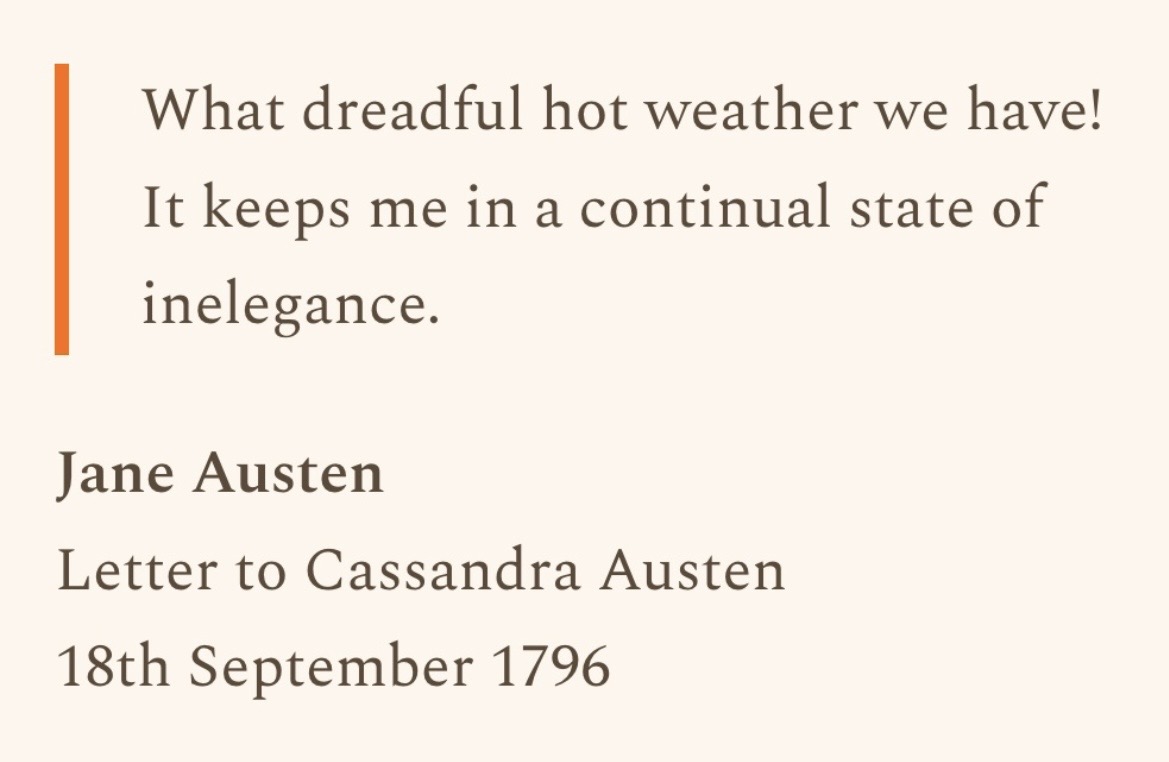
Courtesy of my all-time favorite Instagram page, Letters of Note
3. OK, you’ve earned a palate cleanser … So, behold, a list of “Deleted Scenes from ‘The Sound of Music‘” as gifted to the world by Sarah Dabby. My personal favorites are
“Liesl sings, ‘I am sixteen going on seventeen.’ Maria replies, ‘I am twenty-two going on twenty-three.’ Liesl has several follow-up questions.”
Mmm. How do you solve a problem like Maria and Georg’s slightly awkward age gap? Well, darling, you just don’t mention it. And then there’s
“The nuns host Maria’s bachelorette party.”
I’ll have you know that nuns are having a real cultural moment right now — we’re only just stumbling out of what people are calling a “Nun Girl Summer.” Both Lily Allen’s West End Girl and Rosalía’s Lux — arguably two of the most successful albums of the last year — heavily relied upon nun imagery in their artwork.
I have many, many, many thoughts about this. But for now, let’s just say that a nun-thrown bachelorette party might not be as much of a laughingstock as one might initially assume.
And last, but not least, there’s
“Brigitta asks what, exactly, the Nazis have against the Jews. The Captain says they can discuss it after the song.”
Last Christmas, I convinced my husband to watch The Sound of Music with me by describing it as a WWII movie. He no longer allows me to pick the films we watch.
Elsewhere in humor, there’s
- “Local Woman Deeply Ashamed Of The Feral Creature Caramel Slice Turns Her Into” from The Betoota Advocate (well, ‘tis the season)
- And then there’s the Onion’s “Smiling, Unblinking Tom Cruise Just Wants To Know Why Nation Didn’t See ‘Digger'”
Tom, I can answer this one for you — there is, and always has been, something incredibly off-putting about a prosthetic cat.
4. Next up, we have John Blase writing for Inkwell. I’m not sure I’ve been this delighted by a collaboration since boygenius formed. Blase’s piece, “Putting the Quiet Life on Trial,” takes us by the hand and leads us onto the rocky terrain of “wanting.”
Yet I too am a born wanter. My hunch is we all are to varying degrees. I mean, if you have a pulse, you’re in. I don’t feel I’ve missed so much, but I don’t want to miss anything if I can help it. I’d like to go out with as few as possible, to live Bukowskian: “So well that Death will tremble to take us.”
But behold now the valorization of “Ordinary” Christianity — the stay-in-place, semper fidelis Jack or Jasmine living out a regular old non-glamorous life for God. To me, it feels wrapped up in our vibe shift, our current yearning for grandmacore, reaching back for a simpler, gentler, saner time. You know, Friday nights at Blockbuster and J. Crew magazines. Rumor has it even the young men are going back to church.
OK, being British (Welsh, for those who care for the particular), I have no idea what Blockbuster or J. Crew are, but I think I get his point. We’re numbing (or, maybe, chastising?) ourselves out of wanting anything that bursts the banks of the “ordinary.” Yet, we humans are creatures who yearn, who crave, who long for, who want. And history/society/my own aliveness tells me we have no real framework for how to hold “want” healthily — we either deny our “wanting” at all costs (a picture John Blase paints in this piece), or we let it rule us (a picture we, very sadly, don’t really need painting for us).
And while John gets it, he laments it. Particularly the way this leaks into our experience of our faith,
In our legitimate strivings for a representational faith — one populated by our regular old non-celebrity selves, one that looks like most of us — there exists also the concern that the overcorrection might blur or even erase the aspirational: a faith with room enough to dare to dream what we might be, to make mistakes, to shoot for the moon, risk it all, to live Buechnerian: “Where your deep gladness and the world’s deep hunger meet.” To get carried away, for Christ’s sake.
What’s that Mary Oliver line, again? “Keep some room in your heart for the unimaginable.” Blase pulls the unimaginable into his readings of the Gospel narratives, referring to Jesus as
this pied piper looking over his shoulder singing Come sail away with me. According to the oldest manuscripts, people dropped their nets or whatever they were doing and took off after this thirty-something Galilean. They and their wanting got carried away: Jesus, joy of man’s desiring.
What was it that hooked them? I’m just a drugstore theologian, but I maintain part of it was his style — this attractional, polar-opposite-of-boring force that drew men, women, children, centurions, tax-collectors, dogs even, to his side. And while okay, Jesus was loving and joyful and peaceful and kind and gentle and all that, I gotta believe it was his absolute childlikeness that knocked their socks off.
Actress Daisy Edgar-Jones, who is currently promoting her new movie, a brand-spanking-new adaptation of Sense and Sensibility (don’t even get me started), recently caught my attention when she suggested that “whenever one is in the throes of a yearn, I feel like you are probably most aligned with yourself, you’re most aware of being alive …” I think I pretty much entirely disagree with her. When I was “yearning” for my now husband, I convinced myself I was a Pixies fan. That could not have been less aligned with myself. But, alas, then I read of Jesus being the “joy of man’s desiring,” and I want nothing more than for all to be carried away by their wanting of him. Me included.
5. Shall we have one more from the land of Substack before we move on? It’s Elizabeth Oldfield’s “How to have 1,500 people for dinner” — the origin tale of her (rather infamous, actually) Monday Night Dinners.
Elizabeth is ever-convinced that community is the logic of the universe — and who are we humans to pretend otherwise? She suggests that acts that seem “soft” (you know, neighboring, sharing, caring, and hospitality) are actually charged with political, sociological, and spiritual significance. A dinner party can, indeed, be a radical act. So, from her decade-ish worth of experience, she has curated a list of nine hard-won pearls of wisdom for anyone who wants to host their own extraordinarily ordinary dinner party.
I’ll just pull out one or two, shall I?
Regularity is the point: hospitality is one of those lovely aspirations which, honestly, sounds like something I don’t really fancy when presented with the opportunity. … This bizarre culture of possessive individualism will always give us reasons not to be together, so sometimes it takes a strong container to push back.
Can I be honest with you? I’ve fallen at the first hurdle here. There is not much in the world that I relish more than a cancelled plan — possessive individualism, as Elizabeth puts it, has got its claws deeply within me. The older I get, the more I have to take a stand against the allure of aloneness. Have you seen that “Loneliness Influencers” are a thing now? They are influencers (obviously) who post overly romanticized videos of their seemingly solitary days with a caption along the lines of “A day in the life of a woman with no children, no partner and no friends.” While it feels like a storm in a Tik-Tok-shaped teacup, it also feels insidiously like a poison being packaged up as a remedy. At least to me, an ever-introverting zellenial.
And then there’s this piece of advice, which I find much easier to get on board with:
Keep Tidying to a Minimum: my husband always says hospitality is not the same as entertaining. Yes, I will get the kids to plump the pillows on the sofa and run a hoover around if the carpet is filthy, but generally, people take us as they find us …
I’m too Type B to really care too much about plumped cushions or matching glassware, and I’d rather dive in front of someone attempting to open up my chaotic fridge than actually set aside time to organize it. But still, even I need reminding that there’s a biblical call to hospitality and not to entertaining — people-pleasing, dear friends, is not a fruit of the Spirit.
I’ll leave this one there — if you’re hankering for the other seven pieces of advice, you know where to find them.
6. And finally, before we say our farewells to each other and this week, let’s take a moment to celebrate Canadian poet, classicist, and essayist Anne Carson, winning the 2026 Nobel Prize in Literature. Beloved as she is for her ceaseless innovation and ability to blend genres, the Swedish Academy praised Carson for her “bold and inventive oeuvre that, in playful dialogue with the classical tradition, has created new forms for contemporary literature.”
Carson’s response to winning such an accolade? “Yikes.”
There’s something deeply satisfying about all the poetry draining out of her in the moment.
The New York Times’ very own Nobel Man, Alex Marshall, prepared articles for forty-six possible winners. Thankfully, Carson was one of them. He writes,
Among Carson’s key works cited by the Nobel committee are “Eros the Bittersweet,” her debut book-length essay from 1986 about the god of love, and “The Glass Essay,” a long poem from 1995 about unrequited love.
Ah — here we are again, pondering our own yearning ways. A few lines that I have long loved from “The Glass Essay” are
Also my main fear, which I mean to confront.
Whenever I visit my mother
I feel I am turning into Emily Brontë,
my lonely life around me like a moor,
my ungainly body stumping over the mud flats with a look of transformation
that dies when I come in the kitchen door.
What meat is it, Emily, we need?
Gosh, if women had a pound (whoops, sorry, a dollar) for every time they feared they were turning into Emily Brontë … well, they’d have enough money to create an annual literature prize.
My mother speaks suddenly.
That psychotherapy’s not doing you much good is it?
You aren’t getting over him.
My mother has a way of summing things up.
She never liked Law much
but she liked the idea of me having a man and getting on with life.
Well he’s a taker and you’re a giver I hope it works out,
was all she said after she met him.
Give and take were just words to me
at the time. I had not been in love before.
It was like a wheel rolling downhill.
But early this morning while mother slept
and I was downstairs reading the part in Wuthering Heights
where Heathcliff clings at the lattice in the storm sobbing
Come in! Come in! to the ghost of his heart’s darling,
I fell on my knees on the rug and sobbed too.
She knows how to hang puppies,
that Emily.
Well, would you look at that … loneliness, wanting and yearning, classic literature (that, apparently, we’d rather not read but watch in seven parts on Netflix) — set aside the Sound of Music cameo for a moment, and it appears we’ve wrapped up our week’s key themes with the words of its newly appointed Nobel Prize winner. Huzzah!
Strays:
- I do hope this isn’t just some clichéd Britishness leaking out of me, but I can’t quench my curiosity when it comes to the religious and spiritual language being heaped upon the Oasis reunion.
- Kate Bowler is hallowing the absurd.
- Is Elon Musk the Cecil Rhodes of our time?
- To reward yourself after reading about Elon Musk.





Great to have BTR in the weekender rotation! So kind of her to translate things for those of us on this side of the pond too.