




1. First up this week is Terry Godier’s piece on technology as something that demands our time and attention:
Nothing you own is finished. Everything exists in a state of permanent incompletion, permanently needing. Your phone needs updates, needs charging, needs storage cleared, needs passwords rotated. …
Most of your screen time isn’t leisure. It isn’t addiction. It isn’t even a choice.
It’s maintenance.
Your phone is not a slot machine.
It’s a to-do list that writes itself …
The tiredness is not a character flaw. The guilt, the sense that you should be handling all of this better, more gracefully, with less friction, that guilt was manufactured. It was placed inside you by an industry that profits from your participation and a wellness culture that profits from your shame.
Both need you to believe the problem is you.
I’m reminded of Jacques Ellul’s critique of technique, that techniques purport to offer more control over the world but end up being just another thing that requires management. Here, the role of guilt and shame in that cycle makes it cut even closer to the bone. Godier notes that he owns a $12 watch that he calls “The Last Quiet Thing”:
My Casio is on my wrist right now.
It’s telling me it’s 2:34. That’s all it’s telling me. It collected no data while I slept. It has no report to show me. It has no opinions about my health, my habits, or my attention. It is, in this moment, asking absolutely nothing of me.
And that absence, the peace of a thing that does what it does and then shuts up, feels like the most luxurious thing I own.
Not because it’s retro. Not because it’s minimal.
Because it’s done.
It was finished the day it was assembled in 1989 and it will be the same watch tomorrow that it is today. It will never update. Never change its interface. Never ask me to accept new terms.
I can’t help suspecting that technology’s need for us to manage it in a false narrative of continued improvement — helped along by us — isn’t a major part of its draw. Every update is a life improvement. Things that are finished and given to us as a gift don’t offer nearly the same scope for our egos to go about their task of constructing world where we are productive, optimized, and always getting better. If Terry Godier is any indication, mayhaps the tech world will start producing its own burnt-out exvangelicals who, I hope, will find the idea of a fully accomplished, past-tense, no-maintenance-or-updates-required salvation to be just what the doctor ordered.
2a. Two pertinent pieces in the social sciences this week. First up, Cell Reports published online new psychology research by Valley Liu et al. trying to determine why individuals demonstrate moral inconsistency — that is, we don’t live up to the moral principles that we expect others to live up to. The team had participants do a moral behavior (MB) task where they had six seconds to choose to be honest with another person or be dishonest for monetary gain. They were then given a moral judgment (MJ) task where, standing back as third parties, they rated whether the “dishonest” option was aligned with their morality. Surprise surprise, people expressed more stringent moral standards as judges than they exhibited as moral actors (see Figs. 2B, 2C).
The researchers came up with a way to quantify this moral inconsistency (MI) (imo, a surprisingly decent one). People with higher MI seemed to tend to[1] exhibit weaker connectedness in a region of their prefrontal cortex. Interestingly, when researchers stimulated that region of the brain, they found moral inconsistency slightly increased rather than decreased — seems there are no easy answers there. While science might be able associate human immorality with this or that region of the brain, using that knowledge to change behavior (at least, for the better) is a different beast.
Still, it’s refreshing to see science empirically bearing out some of the anthropological realities — bound will, hypocrisy, etc. — that the humanities disciplines, alas, have largely left behind. The researchers also note the perspective shift that occurs when we move from making our own choices to evaluating other’s choices:
The actor-observer bias indicates that people tend to focus on and explain their own behavior with external causes and others’ behavior with internal causes. As profit was the external incentive and honesty was the internal incentive, our study supports this bias by showing that individuals were more sensitive to the profit magnitude in MB and to the dishonesty magnitude in MJ.
For me, “The researcher offered me all this money — he almost wants me to cheat!” but for thee, “Your principles are warped!” It’s an observation easily universalized — I cut people off in traffic to spare my son the pain of being the last kid picked up from the car line, but others cut me off because they’re bad drivers and probably bad people, too. Most of our objectionable behavior probably is more attributable to “internal” factors than we’d like to believe (see Mt. 15:19), and that of others more “external” than we assume. (We’ve done a little on external versus internal attribution and justification by faith here.)
The distinction is helpful, too, for clarifying forgiveness. Attributing others’ sin to external factors is good to do, especially if you and I (like most others, apparently) tend to err on the side of overlooking those things. But forgiveness does something different: It identifies the wrong actually done from the other person’s heart but chooses not to hold it against them anyway. Rather than attributing the harm to external circumstances or explaining the behavior away, one just absorbs it. Excusing others’ behavior is good, but forgiveness is different — a difficult, mysterious, heart-level choice to suffer in the offender’s place.
2b. Second, the National Bureau of Economic Research did a piece on how people choose colleges. It’s a choice with a significant impact on the future of one’s life, earnings potential, etc., so you’d expect us to all buckle in our unbiased, rational decision makers, carefully weigh the data, and make a well-informed decision. But that’s not quite how it works: Instead, students are 10% less likely to apply if it’s hot outside on their tour and 8% less likely to apply if it’s raining. “Feel” plays a big choice, which I think we knew already. I imagine the other major factors are things like whether the lunch was good, friendliness of the hotel staff, charisma of the tour guide, and opulence of first-year dorms.
While the puncturing of our illusions of rationality results in a lower anthropology, it would be a mistake to think that more “rational” is “better” and less rational is “worse.” Just because our instinctual perceptions are nebulous, subject to emotional distortion, and hard to articulate doesn’t mean they’re any less legitimate or valid than supposedly “rational” factors. The “vibe” one gets or the way one feels led in prayer seems at least as reliable a criterion as, say, number of books in the library, availability of canoes for rental, breadth of study-abroad programs, or other silly but supposedly “objective” factors.
The actual experience of choosing an educational institution feels oddly redolent of this week’s Onion headline, “Crab Just Happy to Be in Bucket with All His Friends.”
3. Over at Vox, “Why a Little Delusion is Good for You” seeks the golden mean between optimism and pessimism. Too much optimism can promote foolish behavior (not buying insurance because you think you’re a brilliant driver), but excessive pessimism depresses and therefore enervates you. Optimistic delusions, in mild or even not-so-mild doses, can be empowering:
Even if the likelihood of, say, writing a New York Times bestseller is relatively low, “if I’m optimistic about it and I get that sense of control,” [Wake Forest Psychology Professor Christian] Waugh says, “then I do the behaviors that are necessary for making that thing happen. By being optimistic, I have now improved my probability of that thing happening.” The best version of optimism inspires action, whether that’s working harder or asking for help and support. Instead of assuming a lofty goal is beyond the realm of possibility, a touch of overconfidence helps you forge a path toward achieving it.
On the other hand,
“We tend to forget things that have failed in the past, and we don’t incorporate failure when forming new expectations,” [behavioralist Chris] Dawson says. “What we tend to do is over-remember things that went well, and yes, we incorporate those things into our expectations, but we tend to gloss over a failure. Even if we do remember it, we think, well, that was probably someone else’s fault.”
The good folk at Vox advise having a healthy self-confidence but also being clear-eyed about one’s mistakes. What the piece takes for granted is as interesting as what it says: The tension between optimism and pessimism is framed as one of subjective attitude about our own abilities, with the apparent intention of helping us decide exactly where to set our internal slider between overconfidence and under-confidence.
I doubt we have much direct control over our attitudes toward ourselves and the world, which are deep-seated and largely formed in relationship to the places, experiences, and people around us. I suspect that rather than trying to effortfully inhabit the perfect place on the blinkered spectrum between egoistic optimism and despondent pessimism, one might hope — pray! — to be delivered from that spectrum by a love that gently punctures our vanity while affirming our fundamental belovedness.
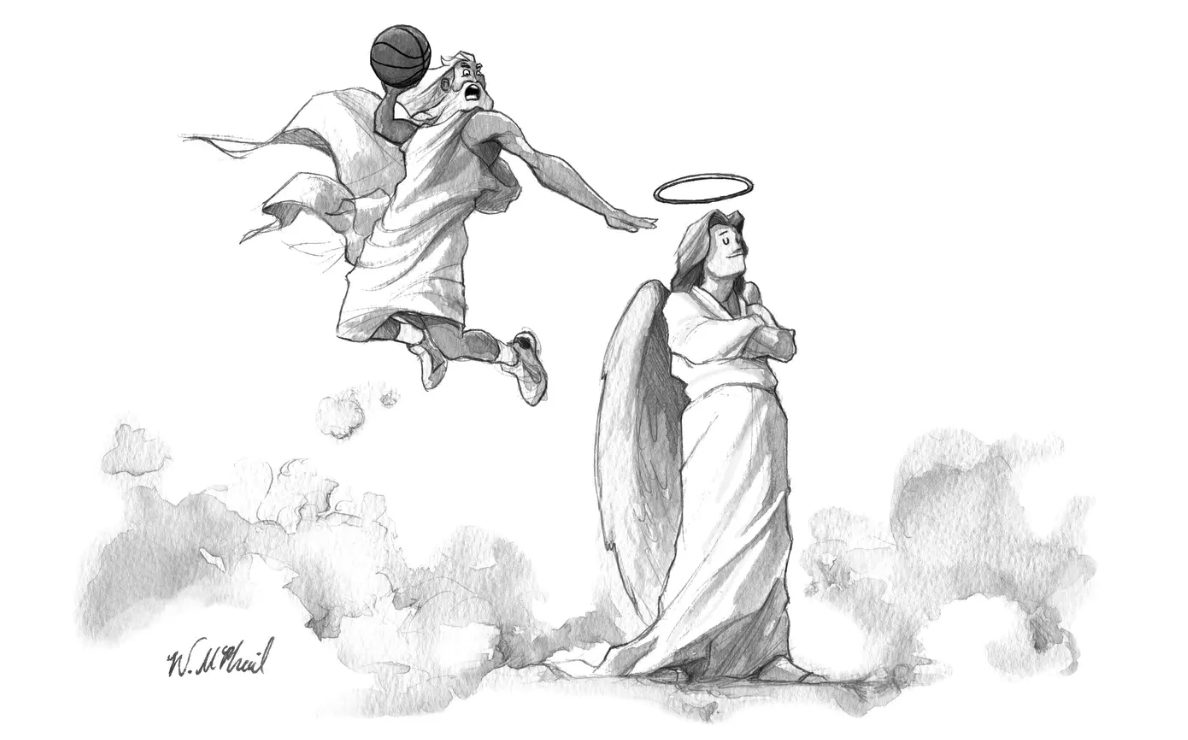
4. Paul Kingsnorth explores silence as a means of relating to God. Our human self-improvement paradigms can go in circles on a sort of flat plane — e.g., someone might use their power of self-formation to vacillate between imperfect optimism (preening overconfidence) and imperfect pessimism (despondency) — but the religious are clear-eyed that transcending those well-worn ruts involves the agency of a Third Party. Kingsnorth, whose Buddhism led him into Eastern Orthodoxy, discusses the limits of personality and — woe to us scribes — our inability to write our way out of them:
Things are particularly bad for this ‘Paul Kingsnorth’ character, because he makes his living writing articles like this one. Not only does he need to do this to eat, but more existentially, he has written for so long that he now sees the world almost entirely through the lens of the written word. Even if he wasn’t getting paid to write things down, he would be writing them down anyway, which would just continue to encrust the artificial world around the artificial self, and make it harder to escape from both…
[…] spiritual progress, that work of theosis, requires us to drop all of our illusions. To smash through the cement of words and concepts and identities and opinions. To see ourselves naked before God. To make ourselves simple again.
Discussing Jesus’ statement that only the childlike can enter the kingdom of God, Kingsnorth notes:
There is no point in worrying about whether you are silent or childlike or holy enough, or in trying to make yourself some kind of holy ascetic through force of will. Force of will doesn’t get you that far. You can run off to the forest or the desert if you like: some people are called to that life and some people are not. But we are all called to make a desert of our hearts. The Holy Spirit will alight there, we are told, when it finds a peace to welcome it.
In Mark, it’s the Spirit itself that drives Jesus into the wilderness, and Lord knows there are periods when life makes a desert of our hearts. The invitation to become as a child is perennially comforting, as almost all of the pressures of the world and our own search for value tell us we must become something else.
5. While talking about Kingsnorth, it seems only natural to include the WSJ’s report of a rather predictable phenomenon: “AI Isn’t Lightening Workloads, It’s Making Them More Intense:”
“It’s not that AI doesn’t create efficiency,” said Gabriela Mauch, ActivTrak’s chief customer officer and head of its productivity lab. “It’s that the capacity it frees up immediately gets repurposed into doing other work, and that’s where the creep is likely to happen.”…
Dean Halonen, co-founder and chief revenue officer of software startup Steelhead Technologies, said he has experienced the work-creep first hand. Deploying AI has let his company automate a lot of administrative tasks and made its software developers more efficient at writing code, he said.
“But what we’re finding is, the work that is out there, it seems unbounded,” he said. “It’s like the appetite is always to do more, not to, like, go home at noon.”
6. Thought-provoking piece over at New York Review of Books tackling Mark Lilla’s Ignorance and Bliss: On Wanting Not to Know and Emily Ogden’s On Not Knowing: How to Love [!] and Other Essays. The piece diagnoses contemporary culture with a “will to ignorance”:
The denial of evident truths seems to be gaining the upper hand, as if some psychological bacillus were spreading by unknown means, the antidote suddenly powerless. Mesmerized crowds follow preposterous prophets, irrational rumors trigger fanatical acts, and magical thinking crowds out common sense and expertise …
Refreshingly, Lilla eschews seeing this as a purely modern cultural phenomenon, instead linking it to human nature, via this humdinger from B. Pascal:
The self wants to be great, and sees itself small; it wants to be happy, and sees itself wretched; it wants to be perfect, and sees itself full of imperfections; it wants to be the object of men’s love and esteem, and it sees that its defects deserve only their dislike and contempt. This embarrassment in which it finds itself produces in it the most unrighteous and criminal passion imaginable, for it conceives a mortal hatred against this truth, admonishing it and convincing it of its faults. It wants to annihilate this truth, but, unable to destroy it in its essence, it destroys it as far as possible in its own knowledge and in that of others.
In Richardsonian terms, we might view this as a hybrid between the “flight” and “fight” options in human responses to the Law: fight, flight, and appeasement (more here and here).
How do we become undeceived? The short answer takes inspiration from Augustine of Hippo, who recounted being consciously deceived in his Confessions; Lilla notes that in the end, “It takes a divine force to reveal him to himself.” Sounds like Lilla draws parallels between Freud and Augustine — which the reviewer, who seems skeptical of overly close analogies between the “horizontal” and the “vertical,” treats lightly — and critiques the “will to ignorance’s” manifestation in fantasies of esoteric wisdom, moral innocence, or nostalgia for a perfect society. Suffice it to say, I’ve added it to my reading list.
Ogden’s book takes a more positive view of not knowing, noting that we make many of our decisions in a state of uncertainty, yet we must make them anyway.
‘When I talk about unknowing … I am talking about a capacity to hold the position of not knowing yet — possibly of not knowing ever. I’m talking about living with the dimness that I will mostly inhabit.’
The reviewer adds, “Not knowing yet keeps open the horizon of possibility, for the moment we know for sure, something has been foreclosed.”
The recourse to human freedom seems small consolation for living in the darkness of uncertainty, but it’s refreshing to see Ogden grappling with the problem. When so many of our questions have clear, definite answers in a simple AI query, we experience something of a crisis when we have to make the inevitable judgment call. We’re not comfortable proceeding on limited knowledge or in an inherently subjective area.
It’s a pervasive problem: I can’t make a parenting decision without a search through the Kindle version of Moms on Call, and HR professionals tiptoe around issues until they’re confident that Section III.D(12)(c)(ii) of the Employee Handbook speaks directly to the situation at hand. These forms seem ways to make sure we get it “right” by conforming to externally established standards, even as the construction and maintenance of those standards make contemporary life exhausting.
7. A liberating thought this week from Nadia Bolz-Weber on dealing with changes in oneself. As she notes, many of us see our identity as our predicates — the guy who did X, the baseball star, “that messy drunk girl” — but the risen Jesus calls Mary Magdalene by her name:
I imagine that over the years, in the company of Jesus she had grown used to being seen as a whole person. And now he was gone, and maybe part of her grief was wondering whether anyone would ever see her that way again.
But then, as she stood weeping Jesus says, “Mary.” And she turns.
Not at the sound of “hey aren’t you that crazy lady?” She turns at the sound of her name spoken by the one who knew her completely through every iteration of her life.
[…] there will still be times when we find ourselves wishing we could return to an earlier version of our lives. Or an earlier version of the world. Or an earlier version of our church.
But the God who meets us in Jesus is not in love with some archived edition of us. I guess what I mean is that even as our lives keep changing beyond our ability to keep up, God continues to know us in love.
I know there’s that cutesy saying that the only constant in life is change, But there is a deeper constant in this world which is a God who changest not — who is always calling us by name with that still, small voice that tells us who we are. A God in whose presence we can totally relax, from whose heart flows such generosity that we are defenseless against it.
So no matter what change comes, there’s just no need to ever impersonate a previous version of ourselves.
And if your power-clean maximum declines or your temper gets worse, God will be there in the future, always ready to call you by name.
Strays:
- The seven fat cows of Internet humor seem to’ve been swallowed whole, for the time being, by the seven skinny cows of internet discourse — c’est la vie, c’est la guerre. If quasi-religious think pieces are any consolation, there’s an essay on Flannery O’Connor occasioned by a release of a new collection of her stories (though for my money the LOA Collected Works is worth its weight in gold).
- Arthur Brooks on the emptiness of the modern world.
- Matthew Burdette on accepting ourselves and others as burdens or future burdens — occasioned by a comment from a wizened Robert Jenson.
- And an excellent post by Heather Havrilesky advising a supplicant on finding happiness in NYC (“The humanity of New York City loves humanity.”).
- Plough chronicles how Solzhenitsyn found faith.
- Also, icymi, heard Evergreen is fantastic, and our own Todd Brewer did a fantastic interview with the creators.
[1] For the statistics folks, r = − 0.318, p = 0.015, 95% CI = [− 0.532, − 0.065]. Been a long time since I’ve done much with stats, but that seems like a weak-ish correlation, and the -.065 on the bottom bound of the CI seems to put a bit of an asterisk next to any conclusions we would draw. The authors end up finding a more solid correlation when connectedness of the brain region and cross-task moral encoding are both considered.








What a treasure trove!! Thank you Will, once again.
Great stuff, thanks, but we seem to be missing the Flannery O’Connor link in the first of the Strays. Would love to have it.
That Plough article unexpectedly moved me. Strangely enough, I was somehow assigned Robert Jenson for my junior paper adviser as a Princeton undergrad back in the late aughts – he must’ve just retired, and I was a wide-eyed kid who knew next to nothing about his reputation, although I came from the same Lutheran heartland roots as he. I remember him tolerating me well enough in our one-on-one meetings about my work, and he later gave my paper on the Christianization of Scandinavia a generous-seeming B+.
So excited Will, that you are writing for Mockingbird!
Article # one…is how I feel not only about technology but about almost everything. Not quite done. Today we fixed a leak in a water pipe to the shed. Tomorrow it’ll be something else.
And I’m really old!! The end of the runway is in sight and yet…
Someday!