1. When my wife was pregnant with our second, we came up with a sweet way to share the good news with my parents. This would be grandkid number four for them, and so at Christmas time, we gave my mother four identical “I love you Grandma” Christmas ornaments. As she counted out all four identical ornaments, you could see the other family members recognize their meaning — their heads jolted from watching my mother to my wife and I as we smiled knowingly. When my mom finally put two-and-two together, the screams of joy and laughter, and the follow up hugs, were among the most joy-filled moments I’ve ever had the privilege of experiencing.
Over at the Cut this week, Kathryn Jezer-Morton asks: “How Does ‘Big-Reveal’ Content Shape Our Family Stories?” There was no production value to our “big reveal,” no lights except some wall lamps and the Christmas tree, no audio production outside of our own ears, no video except our happy memories. You had to be there, as the kids say. Still, given that “Big-Reveal” content is so popular, it’s hard not to see its influence, even when it’s our family’s rather simple Christmas joys. Jezer-Morton is right to ask how all these “reveal” videos — outfit reveals, gender reveals, college decision reveals — have blurred the lines between good news and spectacle. Being sweet for family and friends is a lot different when it’s also performative, and being performative is not the same as being sweet:
Big-reveal content is one such form of meaning-making that runs on emotions. All of us who continue to post content about ourselves to social media are competing with brands and public figures for our friends’ attention. We simply can’t expect to have anyone see our cute family content if we don’t juice up the emotional or visual impact of what we’re sharing. Big-reveal content helps to transform ordinary life into something splashier and enlarges our modest domestic worlds into places that feel hyperreal and exciting alongside the manufactured excitement produced by brands and influencers.[…]
Big-reveal content is the ultimate commodification of our emotions by a marketplace that pits us in a winnerless race against everyone we’ve ever met. It is also a mirror that reflects the way many people see the world, translating inner states into externalized reactions for the camera. Over time, this kind of content has aggregated itself into the contours of a worldview wherein something has to be visible for it to be interesting. The invisible; the mundane; the entire immense world of preparation, maintenance, care, repetition, and service — none of this exists in the world of the big reveal.
She goes on to conclude that we are worse off when life’s most impactful moments must also be a spectacle for us to expect that people will care about them. Can something really be good news if it’s quiet, slow, or unflashy, ignored by the masses and flying under the radar? It sounds like Nathanael’s first response to hearing about Jesus: “Can anything good come out of Nazareth?” The answer, of course, is that those Nazareth things are often the most meaningful, and spectacle will only drain them of their purest and distilled joy.
2. The encroachment of performance is not only manifesting in big reveals. Olga Khazan’s exploration of “coaching” in the Atlantic, titled “Please Tell Me What To Do,” is fundamentally about getting life right, but at what cost? Khazan’s assertion, and I think she’s right, is that the profession of coaching is the expensive plug filling the culture’s widely experienced friendship void. The parade of coaches — life coaches, vacation coaches, birth coaches, weight loss coaches, nutrition coaches, financial coaches, divorce and co-parenting coaches — not only help people create some sort of expert bespoke life strategy, but they also prevent clients from becoming socially obligated to those around them. The cash, as it turns out, is not a bug, but a feature of the coaching system, because it keeps us from relational interdependence.
In some circles, an idea has taken hold that asking strangers for advice without paying is gauche. Emailing someone to “pick their brain” has become a corporate misdemeanor. (“Set the precedent that you are not comfortable talking without a pre-booked and pre-paid official meeting,” goes some typical advice on how to respond to such an affront.)
People today also have fewer close friends than they used to, and they may be reluctant to rely on those friends for help. Overwhelmingly, the coaching clients I spoke with told me that they would not expect their (few, flawed, busy) friends to provide the same level of guidance that their coaches do. Friends and family members are biased. (“You never know if someone has your best interest in mind,” Liz told me.) A stranger who doesn’t know you seems more likely to be neutral. Friends may say clumsy or unsupportive things as they respond to your texts between meetings; a coach’s job is always to have the right mantra at hand. […]
But using coaching in this way undermines one important aspect of friendship: reciprocity. During a common type of friend hang, one person shares their problems for a while and the other person offers their best stab at some solutions. Then they switch. Pagis told me that debts — for example, owing someone a few minutes of uninhibited venting — “are important for social relations.” With coaching, however, “you are avoiding creating these debts.” If part of friendship is being there for each other, what becomes of the institution when you don’t have to be? When the well-heeled can afford to take their problems to a coach, friends risk becoming merely the people with whom we have pleasant catch-up brunches before we rush home to pay by the hour to give the real dirt to a stranger.
3. Peter James quit doing standup comedy a little over a year ago. After fifteen years of trying to make it as a comedian, he found himself burned out, resentful, and longing to spend his time with his wife and family. So he quit and is very happy about it. Now he’s using his Diary Of A Failed Comedian Substack to let everyone know that it’s OK to quit things. Reflecting on the one-year anniversary of leaving the comedy business, he offered this insight: the best part of no longer being a comedian is no longer having to mine every single life experience for new material.
Comedians love to say that “Everything is material.” To them, anything that happens in life is fair game to joke about onstage. They’ll usually point to someone like Richard Pryor, who mined his very real substance abuse issues and turned them into legendary bits. The problem is, most comedians are not Richard Pryor. They don’t have the ability to deftly and thoughtfully navigate their personal demons and come out the other end with a remarkable insight that also happens to be funny. They’ll call their comedy “therapeutic,” but what they’re really doing is using comedy to avoid their issues by taking them too lightly. If comedy is supposed to be therapeutic, why are so many comedians struggling to function as normal human beings? […]
It’s a relief to have this burden off of me now that I’m not doing stand-up anymore. It’s a relief that I don’t have to tell these jokes, and it’s also a relief that I don’t have to go searching for them. When you’re a comedian, your material is your life force. It’s what makes the entire thing go. Because of this, you’re constantly on the lookout for new jokes. Whenever something remotely interesting happened to me, or any little insight flitted across my mind, I would stop and ask “Should I write about that?” It’s a process that always kept me one level removed from the present moment. I would think about an experience in terms of potential material, rather than take it in for what it was. […]
I don’t feel a constant need to be on the lookout for the next punchline. I can just sit back, take things as they come, or even let them pass without a second thought. It might not be a “funny” way to live, but it’s certainly a lot more enjoyable.
Mining our lives for a good story is a temptation that every creative faces, whether they’re comedians, writers, Christian website bloggers, or Sunday preachers, to say nothing of influencers and social media users. The constant pressure to perform drives the creative mind inward, desperate to share some life experience that is unique to the speaker but relatable to an audience. For those performing before the eyes of the internet, everything must be perfect. It’s why the big reveals need to draw the biggest feels, and coaches are required to help perfect every decision. The freedom hope that this failed comedian offers, however, is that life is better without a laugh track, and moments can be enjoyed for themselves and not for the utility they bring to the open mic night.
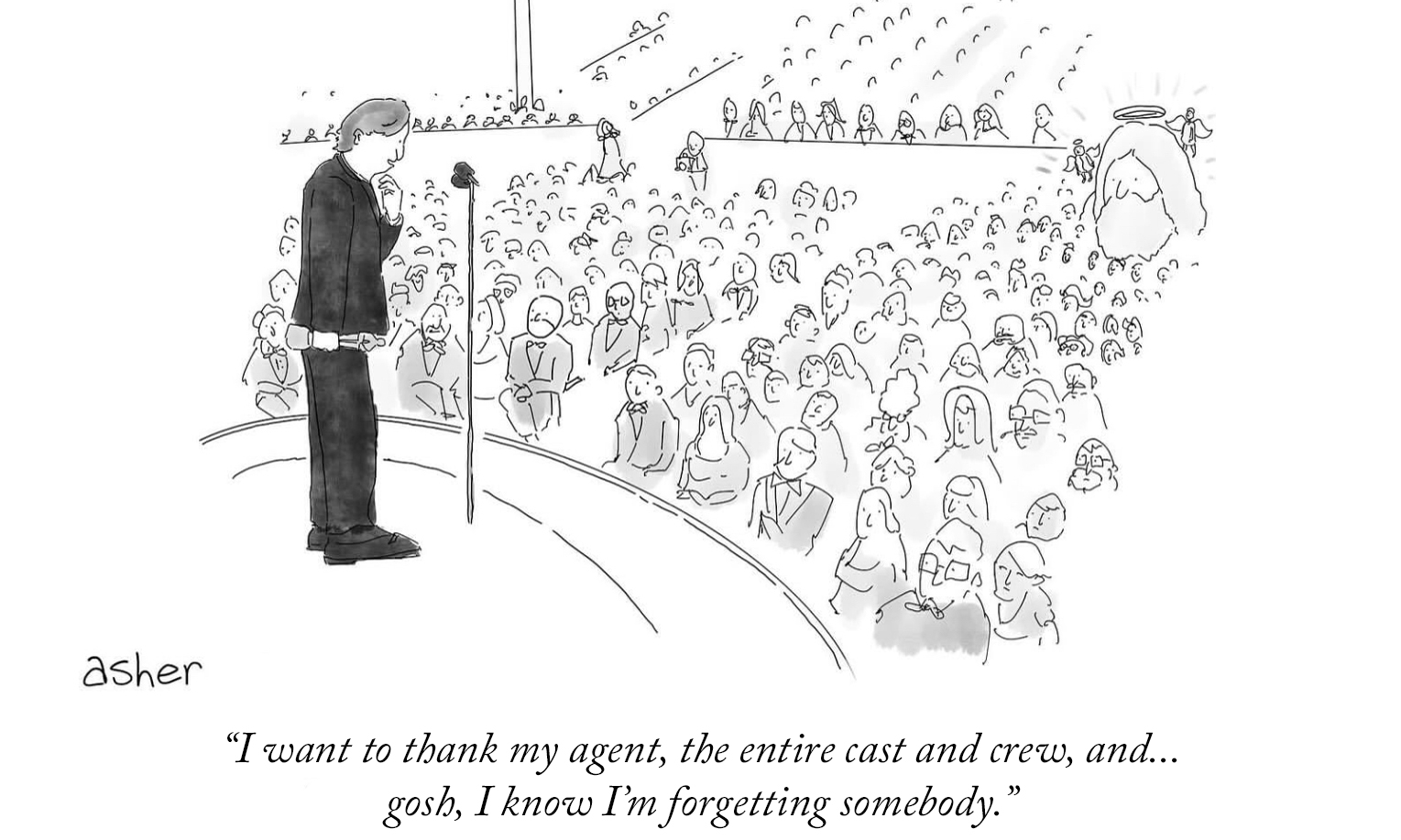
4. Moving on from jokes to more jokes, the Daily Mash reports that “Couple grudgingly making meal because they bought all the ingredients.” I feel seen. And the Onion reports that “DoorDash Order Arrives In Humiliatingly Large Bag.”
This year’s best Lent joke, however, goes to NewsThump, who reports that “Rick Astley Is Giving You Up for Lent.”
Astley, who rose to fame on a pledge of his eternal fidelity, has left fans ‘gutted’ with the announcement which is expected to commence immediately and last for forty days and forty nights.
A statement from his agent went on to say that the singer would spend his time until Easter letting you down, running around and deserting you, before trying to make it all better by buying a box of chocs and some wilted flowers from a service station.
“For the next six weeks, I’m going to make you cry, say goodbye, tell a lie and desert you, and I’ve got to say I’m really looking forward to it,” Astley told fans.
“We’ve known each other for so long – it’s been thirty years, for God’s sake, and frankly, a bit of time to myself would really help clear my head and get some space.
5. A couple of entertainment notes this week. First, the trailer for Andor’s second season has arrived (see above), and yours truly cannot wait to crack open this easter egg on April 22. I maintain that the show is the best contribution to the Star Wars universe since “The Empire Strikes Back,” and also, it’s the most Mbird-worthy entry to the Star Wars canon to date. The trailer above gave me chills: from the “Gimme Shelter” Stones-style soundtrack to the no-look-bomb-detonation, to the bittersweet wedding dancing (?) and fiery action sequences… ::chef’s kiss::
From prestige TV to Lifetime TV, the New York Times profiled another sort of entertainer: YouTube star, reality TV icon, and dermatologist Dr. Sandra Lee, better known to the world as Dr. Pimple Popper. Not even Dr. Lee knows why the internet’s vast rabbit hole of “popping” videos, which feature the explosions of pimples, cleaning out of blackheads, the removals of cists, and similar such body horror, remain so popular.
There is no shortage of theories about why some people find solace in popping videos. Dr. Lee herself speculated that it was enjoyable to watch a conflict get resolved and a doctor “put everything back in place.” Or maybe, she said, it was “this primate tendency, of wanting to pick at things and get rid of things.”
Anne Schienle, a psychologist at the University of Graz in Austria who studies disgust, put forth another hypothesis.
“Some people enjoy disgust,” Dr. Schienle said. Such people, she explained, can take pleasure in a sort of “benign masochism.” It is a similar displeasure to that which can come from eating spicy food.
“They like it because they know it’s not actually threatening,” Dr. Schienle said.
In 2021, Dr. Schienle coauthored a study on people’s reactions to pimple-popping videos. Everyone who participated in the study found the videos disgusting. But curiously, those who enjoyed these videos had unique neurological responses; in fact, the videos activated parts of their brain’s reward systems.
My theory? Popping videos are secondhand relief, a dermatological drama of blockage, infection, pressure, and release. For people looking for relief, here’s tangible, physical expression of it.
6. Also in entertainment, ’90s kids are certainly sad to hear that Michelle Trachtenberg died this week at age 39. She was the child star of the beloved Nickelodeon movie “Harriet the Spy” and a scene stealer across a number of beloved franchises, including Pete and Pete, Buffy the Vampire Slayer, and Gossip Girl. In Salon, Coleman Spilde offers his eulogy for the actress, especially her ability to speak for the sophistication of the child’s heart and mind:
“Harriet the Spy” is unlike any other children’s movie I’ve seen to this day. It’s brutally honest in the way that so much media made for kids is not. The film never once talks down to its young viewers, or believes that they can’t understand complex themes and difficult scenarios. Harriet herself is as three-dimensional as it gets. Some early reviews described her as a brat. Others thought the movie — which deals with divorce, loss, poverty, depression, child psychoanalysis, you name it! — was too progressive. But what those adult critics failed to see was that, no matter how much a parent tries to shield their kid from the world’s hardships, they will inevitably experience them anyway. And when viewers met Trachtenberg’s steely, prying gaze, millions of children and their parents learned an invaluable lesson: Just because kids are young doesn’t mean that they don’t see and feel everything that adults do. […]
Despite the clever plotting and the beautifully written characters, Trachtenberg holds the entire film together. She was just nine years old when she filmed the movie, but Trachtenberg’s Harriet has visible wisdom well beyond her years. There is immense depth behind her sparkling eyes, which she can turn sullen in a second. “Harriet” was one of her very first roles, but onscreen, Trachtenberg displayed the talent of an industry veteran. She held the camera and demanded its attention. Even as a child, nobody could steal a scene from her. She knew what it was like to be a kid who wants to be seen, who is aching to be understood. And in “Harriet the Spy,” she gave a voice to every single child who felt the same way.
7. I was blessed to offer a newborn child in my church her first imposition of ashes this past Wednesday. Telling her that she will return to dust one day is a pretty harsh reality check for someone who doesn’t even comprehend her own mother’s voice. The value of any worldview should be directly related to how it answers the problem of evil, and perhaps, there is no more evil, grievous, or sad reality than the death of a child. In Dostoyevsky’s famous novel The Brothers Karamazov, the atheist brother Ivan challenges his Christian brother Alyosha this very issue. After recalling a particularly wicked incident of violence done to children, Ivan tells his brother that he cannot believe in a God that would allow such violence to happen. Or, at the very least, if this God exists, Ivan declares he would refuse to accept an entry pass into this God’s paradise.
And yet, outside of the novel and in the real world, it seems that the death of a child, practically speaking, is what pierces the veil and drives people into God’s arms, not from them. Far from being the philosophical origin of life’s wickedness, the Christian gospel at its unadulterated fullest is about the only balm that stands up to such traumas. To that end, two final links:
First, there’s this from the New York Times: “‘My Problem Was Not With Grief With a Capital G. My Problem Was That Eric Was Dead.’” Peter Wehner interviewed Nicholas Wolterstorff, professor emeritus of philosophical theology at Yale, talking apologetically about faith, Jesus, and politics. The first two bits are great, but it’s the third act of the interview that hits the gut, as Wehner asked Wolterstorff about the death of his 25-year-old son back in 1983.
Let me first say a word about owning grief. What struck me when reflecting about my own grief and reading and listening to people was that a lot of people want to disown their grief in one of two ways. The most common way is to remove it from the story of their lives. If I ask them, “Tell me the story of your life,” and then they don’t mention the divorce they had or the death of their son and I say, “But I thought you had a child who died,” they say, “Oh, yeah, but that’s behind me.” We have the language of getting over it. Don’t cry over spilled milk.
In the Christian tradition, there is another kind of disowning that one finds especially in Augustine, and that’s not to remove it from the story of your life but to say: That’s some regrettable part of my life. I should not have loved my son in such a way that I would grieve over his death. I found, just my gut, that it wasn’t that I had a philosophical argument against these positions, but my gut was saying I can’t disown Eric and his death. He was worth loving when he was alive. How can it not be worth grieving over when he’s dead?
But then there are different ways of owning it. And I came to think that what I was going to try to do — and I would encourage others to do — is to own it redemptively, as part of the story of my life but in such a way that something good came out of it, that it wasn’t just an evil in my life. And in my case, I can say that my writing “Lament for a Son” is a component, in a way, of my attempting to own redemptively Eric’s death, to own my grief redemptively, that something good would come out of it.
And there are other ways of doing it, of course. Some parents whose child has committed suicide who then become active in working with suicidally inclined people — that’s owning their grief redemptively. And I recently became involved with a program run by Calvin University and Handlon prison in Michigan. And a year or so ago, I talked with them about owning grief redemptively in prison. And what they said was — I mean, it’s phenomenal that, yes, they could own grief redemptively in prison and do what they could to heal the anger and denial in their fellow prisoners and do what they could to prevent people outside from doing what they did. The way in which they were owning their grief redemptively was moving, unanticipated, inspiring. There are lots of different ways of doing it. But rather than just letting it be an unredeemed evil in one’s life, if one can eventually, not immediately — you can’t do it at once — eventually own it redemptively.
8. Also this week, Ashley Lande testifies in Christianity Today about her conversion from psychedelic drug evangelist to a follower of Jesus. It was having a kid that made Lande question her love of mushrooms and acid, which opened up the door for something beyond drug trips in her life:
A friend gave us a children’s book that aimed to introduce New Age concepts such as how we will be absorbed back into cosmic oneness upon death. “I am my ball, I am my feet,” the little boy in the illustrations stated happily. “I am the puppy across the street!”
I’d uncritically accepted these concepts when they came through more sophisticated words — but now that they were distilled into a child’s simple declaratives, my heart reared back in disgust. I looked at my precious son, golden haired with squishy toddler rolls, and I realized I didn’t want him to be absorbed back into the oneness. My heart rebelled and grew faint at the very idea, yet I didn’t know where else to turn.
But when a close friend’s toddler died of Leukemia, it was a reality check that shocked Lande into something bigger and more loving than New Age could offer:
Three weeks after her diagnosis, the leukemia did its evil work. She had just turned two. At her funeral, I approached the tiny casket, trembling, while my own eight-week-old baby moved imperceptibly in my womb.
Almost as confounding as the tragedy itself was how Kerry and her husband were being sustained through it by something that I couldn’t yet fathom. They were heartbroken yet not completely destroyed. They grieved, but as Paul says in 1 Thessalonians 4:13, they did not grieve as those without hope. I was mystified. […]
Suddenly, all the trifling New Age conceptions of what ailed humanity were insufficient to account for the sordid mess of history. There was something very wrong with me, with us. The tragic death of a child woke me up to the fact that the world was broken, and so was I. All my journeys into the psychedelic hinterlands, all my attempts to clear my mind through meditation, all my grueling yoga sessions for the sake of some elusive “enlightenment” were worse than worthless. I couldn’t save myself. But Jesus could.
Strays:
- “No manipulation, no deception, no connivance is necessary when we live within this sphere offered in and by the Spirit.” Mockingbird’s Ian Olsen over at Political Theology.
- The Workism Trap
- Snow Days and Holy Interruption