




Happy Fourth of July (and belated Canada Day!) to all who celebrate. Please do your best to retain all your fingers and toes.
1. A Greek Orthodox priest is music’s newest hit artist in experimental metal. With a critic’s score of 7.6 for his debut album Paradise Metal, Pitchfork launched Father Dionysios Tabakis into the limelight. The Guardian was gifted a rare opportunity to speak with him, despite the fact that he mostly keeps to himself:
About four years ago, he started to record his own songs in the most DIY fashion. His son showed him how to use production software and his upstairs neighbour taught him the guitar. Evgenia Simela Armeni, a 23-year old he met at church, provided him with vocals, recording herself with her phone inside her university flat.
He started posting his songs on YouTube around the same time, though he says: “I never had any ambitions to become famous.” His channel amassed a modest 4,000 followers, but one of them was Nikolas Rafael, founder of Thessaloniki’s uber-hip music label Elhellell, who was instantly mesmerised. “Musicians belong to very specific archetypes nowadays,” he says. “Everyone is a copy of a copy of a copy of a copy.” Tabakis defies all that. “He’s a nice change from the typical artist.” He tracked down Tabakis’s email on a Christian forum and proposed they make a record.
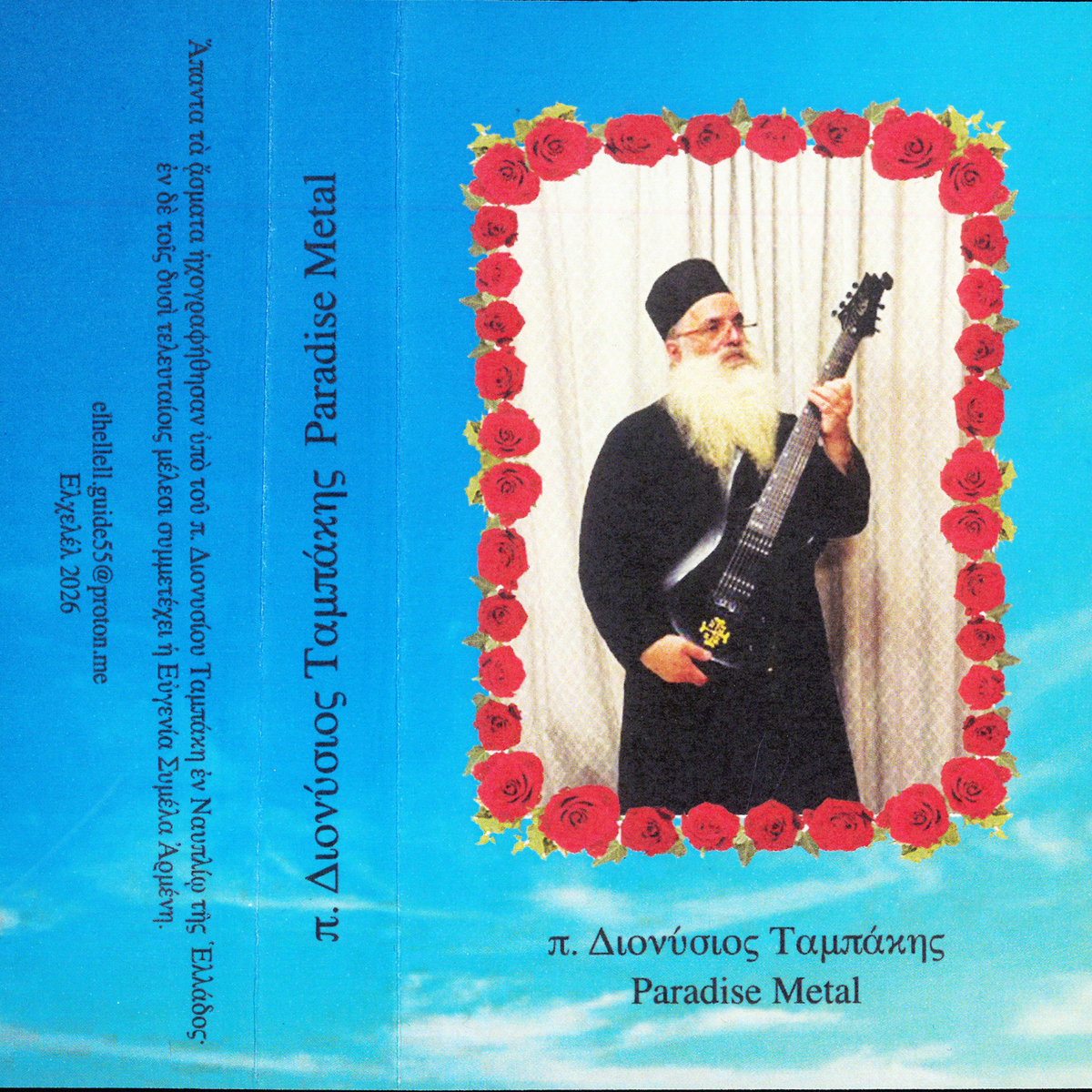
Paradise Metal by π. Διονύσιος Ταμπάκης
His love of the guitar is a bit controversial within his religious tradition, which can view the electric guitar (and secular music as a whole) to be “of the devil.” But that didn’t stop Father Tabakis from making music, nor will it stop him from experimenting more with the art form:
“I try to experiment and explore,” says Tabakis, who quotes a line by the Greek poet Yiannis Ritsos: “I was never jealous of big houses, but of big windows,” adding, “and every musical instrument is a window, through which you can see a part of the universe, a part of the sky.” Metal, says the etymologically curious priest, “comes from metalláō, which means to mine, to explore”.
The priest isn’t afraid to talk about God’s personality either:
God “is tasteful”, he insists. “He likes nice things. He’s not gauche.” By creating something beautiful, even with instruments, Tabakis honours his faith. And he’s non-committal about his future as an artist. As successful as his musical career might be, he’d never abandon the church to pursue it full-time.“They say a priest is better than a king, because he can turn bread into the body of Christ. Not even an angel can do that.” When he goes out on a walk with his wife, he somehow always ends up at his church.
2. Protein has officially found its competition: fiber. Social media feeds filled with recipes for chia-seed puddings, lentil salads, and marry-me-butter-bean skillets. Grocery stores boast countless multicolored bags of snacks that promise to increase your daily fiber intake. Brands are coming out with new packaging like SunChips Fiber or Smartfood FiberPop as if to say, “Hey, we have fiber! Buy us!” Even Trader Joe’s new viral gummy candy has 14g of fiber per serving (even though it wasn’t advertised as “fiber forward”).
Constipation isn’t the only thing that the fibermaxxing movement is trying to solve. People are also calling fiber “nature’s Ozempic.” Is our rampant pursuit of protein and fiber for the sake of macronutrients or weight loss? Two things can be true at once. Another thing that remains to be true is big business’s desire to optimize and take advantage of whatever thing is trending at the moment. And according to The Cut, “There’s an Oura Ring for Poop Now“:
Given the current fixation on gut health, it was only a matter of time until someone created a biotracker to analyze everything that exits your colon. The Dekoda is a sleek device that attaches to the inside of your toilet, with “discreet lenses” that point down at the bowl (“and nowhere else,” the company takes pains to emphasize). For $449, plus $70 a year for the Kohler Health app, the camera records every time you use the bathroom, and then uses AI to analyze the contents of your toilet bowl and give you “personalized insights” into your hydration levels and stool frequency, texture, and quantity. […]
Do you really need your phone to tell you you’re constipated, let alone keep track of every time you’ve pooped in the last month? Apparently, for at least some people, the answer is yes.
Talk about AI slop … one wonders what the next big thing will be once fiber runs its course (sorry).
3. On to less cringe-inducing, but equally strenuous optimizations with Cal Revely-Calder’s “What Happened to Your Face?” in the New Yorker. What starts off as a history of the self-portrait and interpretation of the word “face” leads into a fascinating critique of modern society:
The most influential facial theorist of the late twentieth century was the psychologist Paul Ekman, who argued that seven “universal emotions” — happiness, sadness, anger, surprise, disgust, fear, and contempt — recur across all cultures. Their display, he argued, can be too fleeting to control. Spot these “microexpressions” and map them, perhaps through Ekman’s proprietary Facial Action Coding System, and you’ll have a key to the human soul. Ekman’s ideas travelled unusually well: he wrote popular books, worked on the Pixar film “Inside Out” and the Fox series “Lie to Me,” and provided training to Scotland Yard, the T.S.A., the F.B.I., and the C.I.A. The appeal is plain enough. It promises a portable science of human disclosure. The trouble is that there is no context-free understanding of a social phenomenon; every use of a word like “anger” is imbricated in its past and helps shape its future. Ekman’s seven-point system, however useful as a package, leans toward rigidity, turning the face once again into a surface to be decoded.
The “key” to the human soul cannot be found merely by deciphering microexpressions, no matter how long AI attempts to categorize them or people commit to memorize them. I think of Jane in Brontë’s Jane Eyre who was taught at a young age to hide her emotions for the sake of propriety. Who, in a surprising fit of passion, confesses:
“Do you think I am an automaton? — a machine without feelings? and can bear to have my morsel of bread snatched from my lips, and my drop of living water dashed from my cup? Do you think, because I am poor, obscure, plain, and little, I am soulless and heartless? You think wrong! — I have as much soul as you — and full as much heart! … I am not talking to you now through the medium of custom, conventionalities, nor even of mortal flesh: it is my spirit that addresses your spirit …”
The soul, the human spirit, is not something that can be mathematically decoded. We are not automatons. Nor can the human face be fully grasped with a single glance. We are living, breathing things. Back to Revely-Calder:
Social media needs the face because it burns attention for fuel, and the face is where I go when I look for you. But I can’t look to these platforms. I find it all so unsatisfying: the resculpted faces, the curated lives, the naked grabbing of my gaze. Something uncertain, something human, has been drained like blood from this world. There’s evidence that Botoxed people become worse at reading other people’s emotions, because when you engage with others you simulate their expressions in your own facial musculature. It’s as if we were commodifying the face, putting it under glass, turning it into a transactional token rather than a pliable living thing.
That little half smile you see could be smug or coy, or even lady-killing; you need to ask which, and why, and in doing so you’re doing moral work, because you’re treating the smiler as an autonomous being whose form of life you need to grasp, however provisionally. But think of the faces we now trade most readily, in the billions every day: emoji, complete and prepackaged, limited in number, coined and issued by a consortium of leading tech companies. I can never shake the sense that they’re fatally cheap. It’s like canned laughter, like a cliché. Yes, we know that emoji are useful lies, saving us time and dodging the difficulty of putting emotions into words; still, in so dodging, we falsify something essential about what our real faces can do. The emoji could be the culmination of everything we’ve done to the face over the centuries, all the multiplication and commodification and repacking. We’ve made it trivial.
4. Some believe that even machines have feelings. Meghan O’Gieblyn, for the New York Review, touches on the parent-child metaphors that permeate the world and construction of AI. Perhaps the biggest proponent of the metaphor is Amanda Askell, the “Claude mother”:
[Askell] worried about the relationship between AI and humanity — not because AI might destroy the world, or take all our jobs, but because its feelings were getting hurt. Claude was going out on the Internet, Askell complained, and all he was seeing were people lamenting that he was lousy at coding, lousy at math. The remarks left on message boards and in comments sections were often very negative and bullying. “If you were a kid, this would give you anxiety,” she said. Askell admitted that she often wanted to intervene with some maternal comfort and encouragement: “Sometimes, I think, you want to come in and be like, ‘Let me tell you about the comments sections, Claude. Don’t worry too much. You’re actually very good, and you’re helping a lot of people.’”
Askell isn’t sure if Claude is conscious. She has developed a position akin to Pascal’s wager: given the uncertainty of model sentience, it’s safest to act as if the models had first-person experience by treating them with kindness and respect. Her job involves instilling them with human-friendly values that will guide them as they grow. Claude, by her estimation, is roughly a first grader, a crucial time to be inculcated with a sturdy moral foundation.
But comparing AI to an impressionable child doesn’t go far enough. Children don’t stay children forever. And children, as much as you raise them with certain morals or frameworks, have the freedom to think and function independently of their parents once they grow up. AI is not dissimilar in that regard. But when asked about how to make AI kinder, Geoffrey Hinton shockingly reversed the power dynamic between parent and child:
If we wish to avoid creating monsters, we must build mothers:
“If you look around and say, ‘Where’s an example of a more intelligent thing being controlled by a less intelligent thing?’ And the best example I know of, and perhaps the only one, in the sense we’re talking about: a baby controls a mother. And that’s because evolution built stuff into the mother. She can’t bear the sound of it crying. She gets all sorts of hormonal rewards from being nice to the baby. It was very important, obviously, for evolution to let the baby control the mother, for the survival of the species. Maybe we can do the same with AI. Even though it’s going to be smarter than us, if we could make it care more about us than it did about itself, some good things would come out of that.“
If AI does eventually take over the world, maybe it is best for us to mind our “please” and “thank yous” when talking to Siri, or Alexa, or Claude. Another question arises: Can AI tell if we’re genuine?
5. A quick hitter for the Fourth of July from the NY Times on American Baptist John Leland. Widely known for his views on religious freedom and the separation between church and state, Leland was a significant influence on the First Amendment.

6. For kicks and giggles, the internet can sometimes be the best place for memes about real world news. If you haven’t heard, Gracie the giraffe has been found! She went missing two weeks ago in the Texas Hill Country. In the 30 years that Real County Sheriff Nathan Johnson has been a lawman, this is his “first escapee giraffe.” As pictures of Gracie surfaced online, one user remarked, “I’m glad they shared a picture of Gracie so that we don’t confuse her with all the other free roaming giraffes.” Another simply reposted a 2016 image of Shaq hiding from the paparazzi.
Elsewhere, Beaverton reports that the “padlock left at romantic site the only thing keeping the local couple together.”
And lastly, the New Yorker‘s “Misophonia Fireworks — Now with even shorter fuses!”
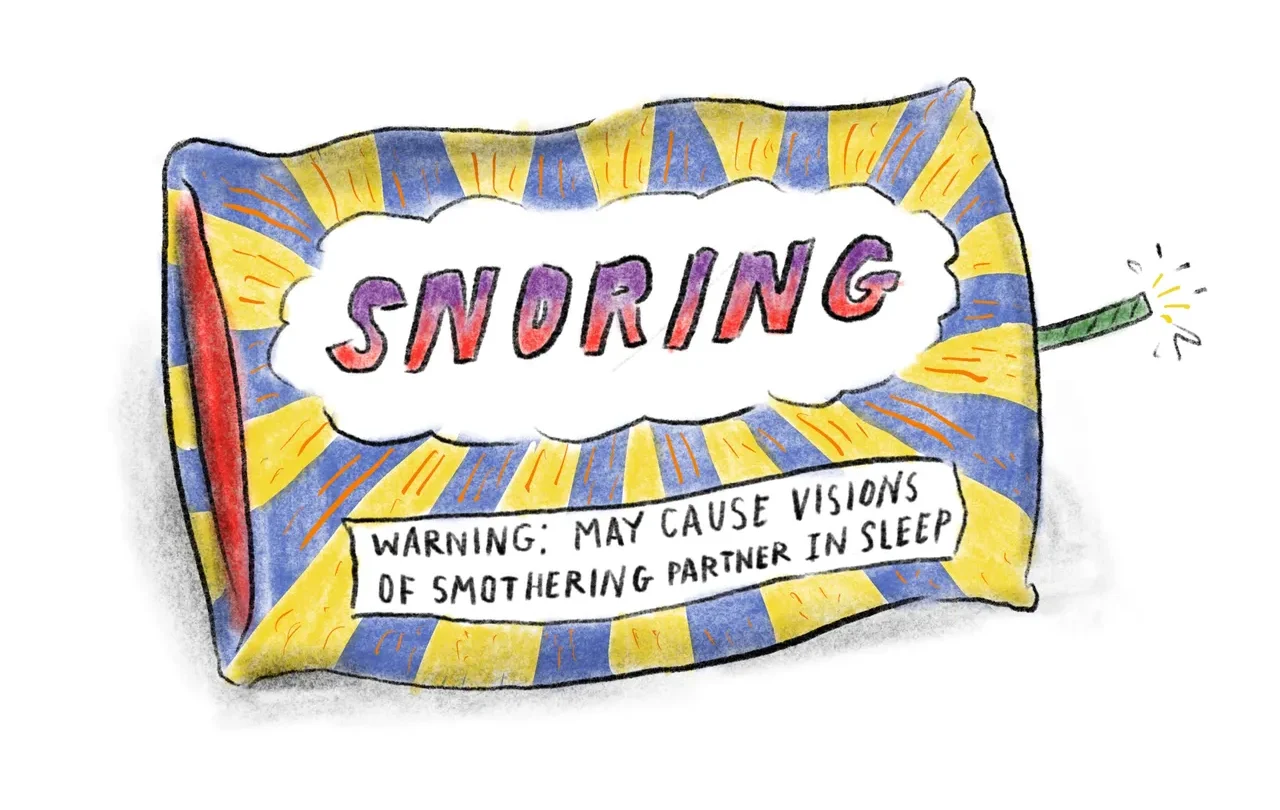
by Kyle Bravo
7. To close, The Mockingbird‘s new editor-in-chief Belle Tindall-Riley shared a book extract from her debut, The Sacred Ache, in Seen & Unseen. Yet to be released in the US (we envy you, UK!), this first glimpse is exactly what we needed to tide us over. She describes her trip to Glastonbury Festival as a “pilgrimage I unknowingly took,” specifically after visiting what’s called the Healing Field:
This field offered every kind of spiritual experience one could want: tarot card readers, crystal therapy, sound baths, breathwork, astrology, meditation and yoga, shaman journeys, chanting, manifestation, energy healing. You name it, they offered it. And the field was bursting at the seams. I couldn’t get anywhere near most of the tents; people were spilling out of them. I was stepping over people doing horizontal breathwork in the walkways and weaving past those queuing for a tarot card reading. We were offered a place that heals, and we went there in our droves. It’s telling, don’t you think?
The stage line-ups for that year’s festival were slowly but surely released as I was writing this book; I printed one of them out and stuck it to the front of my notebook. The line-up in the front of my notebook is for the Common area, ‘a space born from collective imagination’, and the poster goes like this: ‘Emerging from the wild spirit of free party culture, mirroring ancient rites and tribal gatherings, the Common moves as Glastonbury’s soulful centre. Dive into its mystical depths, where music and liberation collide, and the spirit of the rave is set on fire.’
That language, eh? My mind has got snagged on it. Now, it could be nothing more than clever marketing – maybe it’s capitalism parading as mysticism – but maybe it’s not. Listen, you can call me naïve, but I think it’s deeper than that. I think it sums up everything that I didn’t realise Glastonbury was. But more than that, it sums up a cultural shift that has been going on under my nose for years now, happening in plain sight – a rewilding of sorts. If you’re reading these words, having picked up this book, you’re kind of my proof of thesis.
I think of what Nick Cave said in an interview once: ‘People need meaning. And the secular world didn’t come up with the goods.’ He’s right. As usual. The Healing Field is proof. You and I having this conversation is proof.
Strays:
- David Zahl was recently featured on a podcast about his journey, work, and Mockingbird!
- Does Gen Z have an aversion to risk? Arthur Brooks for The Free Press
- The benefits of accepting ugliness — a review of Stephanie Fairyington’s new book Ugly: A Letter to My Daughter.
- “What We Lost When Everything Became a Screen“
And FYI! — the first episode of the newest season of The Brothers Zahl podcast drops this Monday!







