




1. TikTok has made headlines in the news recently as lawmakers are seeking to ban the app in the U.S. for fear that it “provides sensitive data about American users to Chinese authorities.” Of course, this has resulted in various jokes in comment sections and videos of what “data” China is actually stealing from their TikToks — like fan edits of Baby Grogu or montages of Peeta Mellark from The Hunger Games (yes, the 2012 movie franchise is trending again). Whatever your stance is on whether or not TikTok should be banned, we can all probably agree that the addictive scrolling habits of social media are not good for us. And sometimes, the more comfortable we become sitting in front of a screen the more anxious we get when we can’t hide behind them. In his Substack, Freddie deBoer writes a haunting reflection on what this age of online and AI distraction is doing to our real lives:
All across our culture, you’ll find people eager to abandon the fundamental task of our lives, fostering and maintaining human connection, so that they can fall deeper into a pit of hedonistic distraction forever … That’s progress now, the steady accumulation of various tools to avoid other human beings, leaving people free to consume #content that is by design totally, existentially disposable, throw-away culture that asks nothing of us and which we don’t remember because neither creator nor audience wants to invest enough for remembering to make sense. […]
Here you have kids talking about why they prefer online life and identifying precisely the conditions that make me despondent: they like being online more than living their real lives because their online lives serve as an intermediary and distraction from what they don’t like about themselves and their world … Online life is more “peaceful and calming” because online you’re permitted to be a vegetable. Online you can mute yourself, render yourself an unperson, remove yourself from existence and in so doing avoid the pain of being alive.
The people who talk about AI as this all-transforming technology — they’re telling you that our next step as a species is to build an army of Tyler Durdens and to give up on real love, real feeling, real people. And I’m asking you to refuse. I’m asking you to choose the other thing, in whatever way you can. That’s the existential question for humanity in the 21st century. That’s the challenge in front of all of us. Will you shoulder the risk of pursuing real human connection, as hard and intimidating and discouraging as that can be?
Pursuing human relationships (of all kinds) is scary, and it’s rarely ever easy, especially for a generation being raised with online platforms that only provide a falsified sense of real, meaningful connection. And for those who still find it difficult to leave their homes, reconnect with old friends, or reach out to family — it’s hard to find our way through the mess of the trenches. The flip-side is even more terrifying. Relying on technology or entertainment or distraction to fill the void of real love and keep us from possible (inevitable) hurt only leaves us wanting, lonely, and more afraid.
2. A pub in Lower Manhattan took a chance on real human connection by hosting a party, albeit quite an exclusive one. The ticket to getting into said social gathering? Your name must be Ryan (sorry Bryans). For the New York Times, Alyson Krueger interviewed Ryan Rose, who started what she called “The Ryan Meetup” in February. Only three Ryans showed up to the first party, but after distributing over 500 fliers around the city and D.C. the event soon became viral on Reddit and Instagram — resulting in hundreds of Ryans packing into Ryan Maguire’s Bar & Restaurant last weekend:
The meetup came along at the perfect time for the Ryans of New York City and the greater East Coast. Many of them said they had been looking for a sense of community as the isolating effects of the pandemic waned, and they wanted to socialize again.
“I generally tend not to be very social or outspoken, but it’s so easy to be here,” Mr. Solomon said. “There is this weird kinship.” […]
Ryan Minnifield, 38, an office manager for a construction company, took the train an hour and a half from Massapequa, on Long Island, specifically to find other female Ryans … She nodded to the other meetup attendees. “This is probably the most female Ryans I’ve ever met,” she said. “I love them all already. It’s like they have a vibe. They understand me.” […]
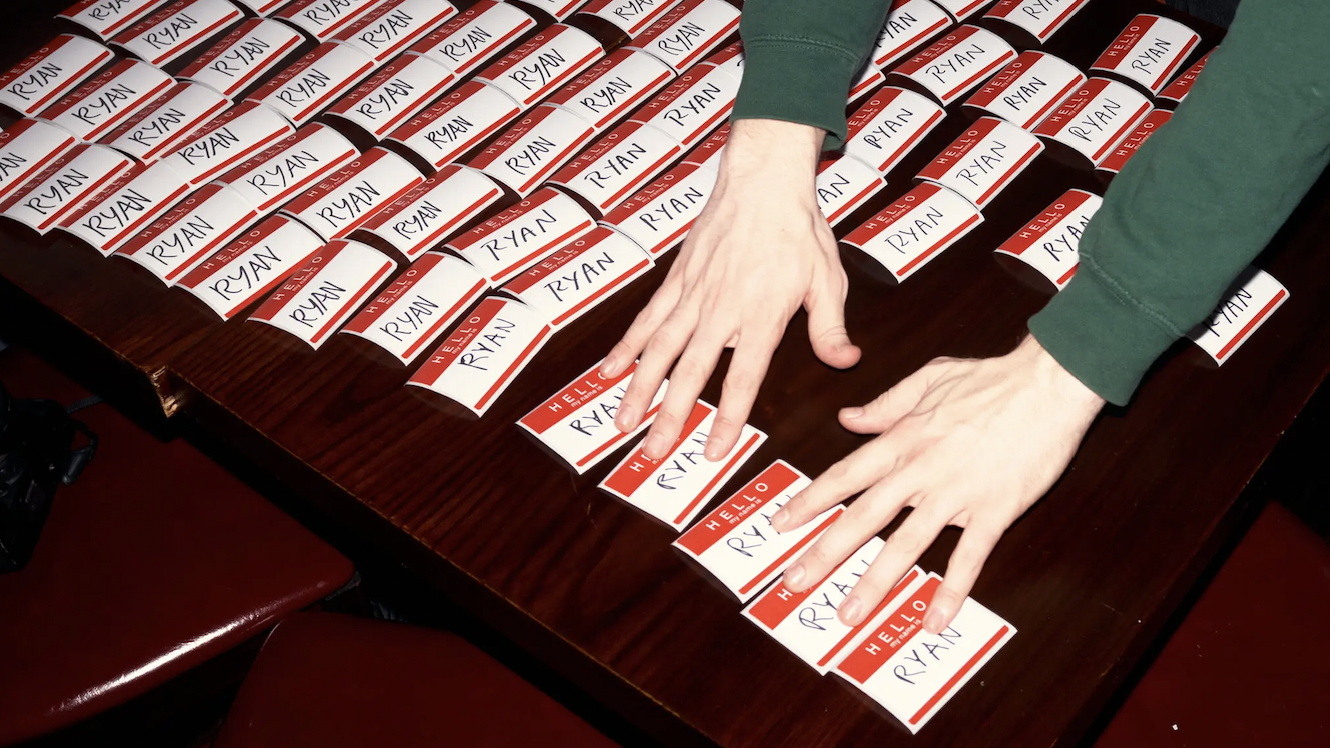
Ryans looking to expand their networks were pleasantly surprised by the diversity of the crowd.
“So many different types of people are going to be here, because the only thing they have in common is their name,” said Ryan Fuchs, 34, who lives in Stony Brook, N.Y., and works in ophthalmology.
“A gathering where we all just have our name in common — it’s the most random, obscure, silly thing,” he said. “I mean, we are all wearing the exact same name tag. What more can you ask for?”
On the topic of friendship, C.S. Lewis once wrote: “The friendship is not a reward for our discriminating and good taste in finding one another out. It is the instrument by which God reveals to each of us the beauties of others.” I’ve written about this before, but friendship is more so the result of proximity than what we may think of compatibility. Or in this case, friendship can be the result of having the same name on your name tag as someone else. It isn’t so much the work we put into making friends, but the random experiences and collective need for connection each of us shares. It’s a hopeful thing that despite the pandemic, regardless of our attachments to our phones, and in the face of social isolation, ridiculously un-serious and wholesome fun can still happen in this day and age.
3. Next up, AWE favorite Meghan O’Gieblyn gives some advice about tab management for Wired. Sort of like Dear, Gracie but for technology geeks. I write to you, currently, with 22 tabs open on my computer and find it hard becoming “a closer” — mostly because I’m afraid that if I close a Gmail tab it will make me log in again (and go through the wretched process of two-factor authentication). But as Meghan alludes to, maybe our inability to close our many web tabs has to do with something more subliminal:
Although I haven’t read the articles about tab overuse (and don’t plan to), I assume they point out its irrationality — having too many open slows down your browser — and recommend organizational strategies, like tab managers, that allow you to more easily access information. But to my mind, tab accumulation has, like most compulsive habits, a subliminal purpose that eludes our crude attempts to rationalize it out of existence. Your open tabs are essentially your personalized map of the internet, a method of visualizing where you have been and where you hope to go next. […]
The person who insists on investing more and more detail into the map, like the user who tries to tile over the gaping void of the internet with endless tabs, is in danger of creating a hall of mirrors, cloistering themselves in a reflection of their own image and forgetting the living, breathing territory that lies beyond it.
What I’m trying to say, I suppose, is that the accumulation of tabs often stems from a desire to make the digital realm more static and familiar — and to reduce the infinite possibilities it holds. The internet, after all, is in a constant state of flux. The location of information is always changing, and our memory of what we have encountered is hazier all the time. It is, indeed, a land of spirits and ghosts.
My own accumulation of tabs may be because of my (valid) fear of two-factor authentication but it’s also because, like everything else in my life, I want to be in control. To enter the realm of the internet search bar is to be susceptible to the vast rabbit holes of the internet and dare to be curious in the face of such unfamiliar possibilities. Perhaps closing our worn-out tabs is like letting go of our threadbare ideas of how the world is or how the world should be, and open us up to unfamiliar voices and new wonders. To erase “the map of your personal cosmos” and become, as O’Gieblyn closes her article, an intrepid explorer in the world, facing the dragons of the unknown with courage and curiosity.
4. For some kicks and giggles, a Reductress headliner reads, “Study Finds Nothing More Embarrassing Than Accidentally Playing Motivational TikTok at Full Volume.” Can’t let them know we sometimes fall into the pits of self-help, eh?
“Look, there’s no shame in benefitting from a pre-teen yelling inspiring quotes at you,” Dr. Green continued. “But there is plenty of shame in broadcasting ‘PAIN IS AN ILLUSION, INVEST NOW’ to a group of strangers.”
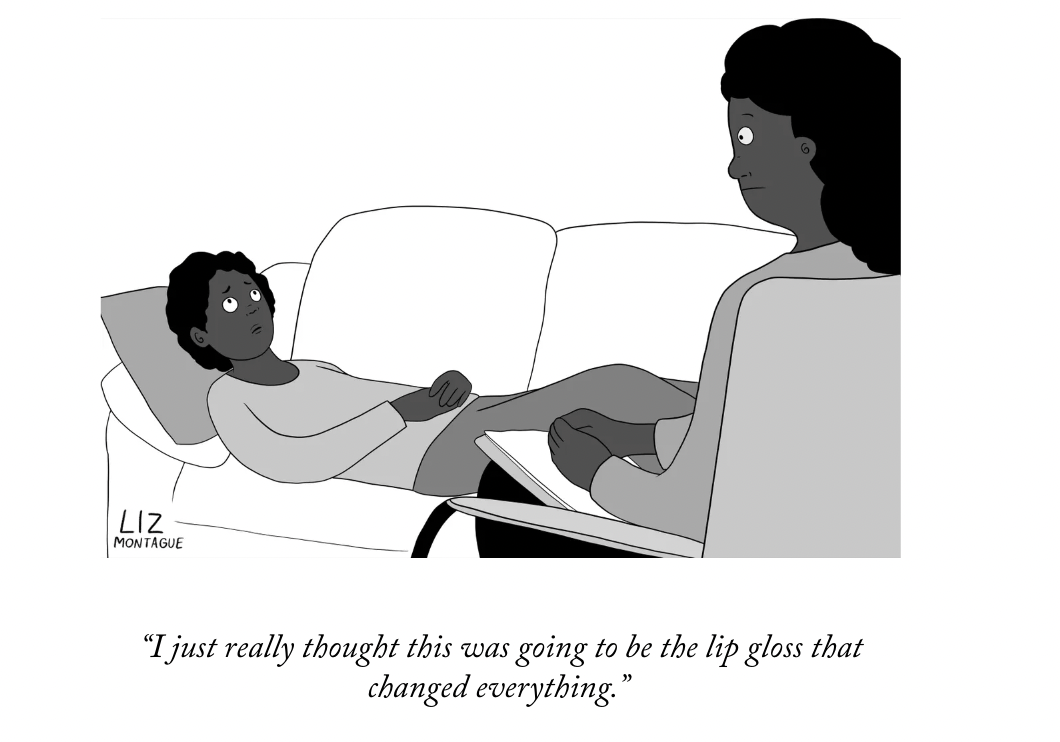
No need to be stuck at home scrolling on your phone when you can do the same thing at a restaurant instead — “Couple mix things up by going out to restaurant to scroll through phones.” And last, but not least, a comic from the New Yorker by Liz Montague:
5. For those of you who don’t keep up with the news regarding the art world (including me), perhaps you’ve missed the most recent “Art War” between the British Museum and the Greek government. This so-called war was fueled by the Vatican’s recent return of three fragments of the Parthenon sculptures to the Acropolis Museum in Athens — an action understood as a gesture of friendship. The same can not be said of the British Museum who, under the 1963 law, are only permitted to loan such objects and aren’t considering returning them to Greece.
There are nuances to the subject of course, arguments for and against the British Museum, especially as it pertains to the British Empire’s history of imperial looting. But don’t all empires have similar histories of stolen artifacts? Haven’t all museums housed such divisive antiquities? Matthew Milliner, for the Public Discourse, doesn’t think this situation has to be as complicated as the museum trustees, government leaders, and the internet has made it out to be:
What is missing from the Parthenon Marbles debate and other skirmishes in the Art Wars is an understanding of how grace might play a role in settling these disputes. Such an absence is not surprising, for presumably “neutral” museums — founded in the Enlightenment in the wake of the European wars of religion — were designed in part to avoid any theological appeals. But grace might help anyway. If the British government were to freely give the marbles back to Greece, it would not only illustrate recent claims for the sound moral character of the British; it would also set a good precedent for similar debates taking place among other museums and nations. […]
So far in the debates about the Parthenon Marbles, no one to my knowledge has brought up the idea of a gift — yet this very concept could provide the path for settling the dispute. A gift transcends guilt, shame, or restitution. A gift rules out the language of “demand,” for no genuine gift can be demanded. […]
Grace is a gesture that the pagan culture that created the Parthenon Marbles was unable to imagine — and unfortunately, the culture of modern museums frequently seems unable to imagine grace as well.
Maybe this is why it is the church, not the museum, that seems more capable of noncompulsory charity. Late last year, Pope Francis, choosing against a loan, simply gave back the pieces of the Parthenon in the Vatican collection to the Orthodox Archbishop of Greece (who will return them to the Acropolis Museum). Perhaps the Pope had been reading St. Paul.
Ha! Perhaps…
6. The Parthenon Marbles are proof of how much significance we place in objects as defining symbols of our nations and identities. And as we head into Palm Sunday, Esau McCaulley (who’s speaking at our upcoming NYC Conference!) remarks in Christianity Today that the palm trees are “symbolically linked to military victories and Messiahship.” But more importantly, McCaulley notes that Jesus didn’t choose the symbol of the palm branches for himself. What did he choose instead? As Zechariah prophesied in the Old Testament, a mere donkey.
Jesus picked a symbol that emphasized humility and lowliness instead of military strength. That fact should inform how we celebrate and remember his entry into Jerusalem. Of course, it would be impractical for every church across the globe to find a donkey to drag into and out of its sanctuary. But we can spend Palm Sunday reflecting on what it means to follow a king who rejected the way of violence. […]
Jesus’ claim to be the Messiah was not simply about a goal — God’s rule over all things. He and the crowd agreed on that point. His earthly life and ministry were also about the means of accomplishing that goal: namely, sacrificial love. […]
If we strive to establish God’s rule through self-assertion over neighborly care, pragmatism over principle, and malice over love, then whatever else we accomplish, we are no longer following in the way of Jesus. God chose meekness, integrity, and love to gather his people. That is the message of Palm Sunday. For all the shouts of acclamation, Jesus never lost sight of the cross.
Once again, Jesus is met with the people’s expectations of who the Messiah would be — a strong warrior, a fierce conqueror, a noble king. What they received instead was a God who loved his enemies, forgave his foes, and ate with the lowly and the lost. As we wave our palm branches and sing Hosanna this Sunday, it is not for a Messiah we expect, but for the crucified Christ, whose body was broken and blood was shed for the world.
Strays:
- The above song, “Let a Little Light In” is the first single from NYC Conference speaker and worship leader Jon Guerra, whose newest album “Ordinary Ways” drops on May 12th!
- Expressive Individualism and its Discontents
- Depeche Mode’s new album “Memento Mori” — The Exquisite Darkness of Depeche Mode by the New York Times
- The Russell Moore Show — Fleming Rutledge on the Cross
- Our Big Problem Is Not Misinformation; It’s Knowingness — “Knowingness, then, is a false claim to knowledge that makes it impossible to learn anything new. Knowingness is why present-day culture wars are so boring. No one is trying to find out anything. There is no common agreement about the facts, and yet everyone acts as if all matters of fact are already settled.”
- Elizabeth Bruenig writes about society’s inflexibility with respect to illness despite our years in the pandemic in her essay for the Atlantic, Sick All the Time.








Re #1: Freddie’s piece was devastating in its impact. It’s made me think a lot about how much time I spend in front of screens, even as someone who is theoretically conscious of the forces he names so eloquently. I’ve sent it to lots of friends and family. I want to strive always to “have the courage to be human”, as he says at the end.
I also wonder how this passage sits alongside a Christian understanding of the captivity of our human wills: “Will you shoulder the risk of pursuing real human connection, as hard and intimidating and discouraging as that can be? Or will you hide in your room forever, comforted by fast food and porn and opiates and therapy and TikTok, risking nothing? It’s up to you.” When we know as Christians that we so often ‘do the thing we hate, not the thing we love,’ how can we ever hope to be able to make this choice freely, when the forces and technologies working against us are getting ever smarter, more sophisticated, and more ubiquitous all the time?
This is where I also find Paul Kingsnorth to be so prophetic in his writing about the Machine, too. We may have to seek active escape from demonic forces before it’s too late. It certainly invites ridicule to assert that TikTok could be a demonic force, but the more I see, the more I’m persuaded it might be true. Honestly. (I certainly think it’s true of Facebook and Twitter.) Us liberal Protestants have a hard time talking demonology, but I think it’s a language worth recovering.
Why isn’t there the optional “i” spelling?
Rian.
I offer this as proof that Brian is misspelled.
Bryans unite.
Y? Because we like you.