




1. Starting off a bit of a downer point, but it’s worth stating to (hopefully) prevent disappoint down the road! If you’ve made some New Year’s resolutions this year, I wish nothing but the best for you. But I’ve also found that significant, lasting change happens when personal willpower isn’t the driving force in the equation. Because if all one has is self-determination, then you might find the deck stacked against your desires. Two thousand years ago, the apostle Paul accounted for this gap between intention and action by way of cosmic forces he named Sin and the Flesh. Such a view of human nature may be deemed unfashionable today but, as James Marriott writes in the Times, in the modern world the human will is anything but free:
Human agency barely figures in the commercial strategies of tech companies who control vast amounts of information about human behaviour. They are accustomed to seeing their customers not as unique and surprising individuals but as fairly predictable data points. […]
Perhaps it is because we are so deeply embedded in a hyper-individualistic culture that insists endlessly on our uniqueness, specialness and willpower (“just be you”, “you can do whatever you put your mind to”, etc) that we find it hard to believe we are so predictable and susceptible to manipulation. But it is important to recognise that when we are online we are often not doing the things we want to do, but the things tech executives would prefer us to do. […]
To thrive in the modern world requires, if not full-scale Sapolskian determinism, then at least a level of realism about the limits of free will. Pitted against the armies of behavioural experts and food scientists who stand behind every smartphone app and ready meal, frail human willpower stands little chance.
To those with New Year’s resolutions, Marriott ends with a brief appeal: “Success is more reliably achieved by refusing to fight.” And in that way, perhaps the answer lies not so much in self-enhancement, or becoming a better version of you, but in self-denial? Maybe even a death and resurrection.
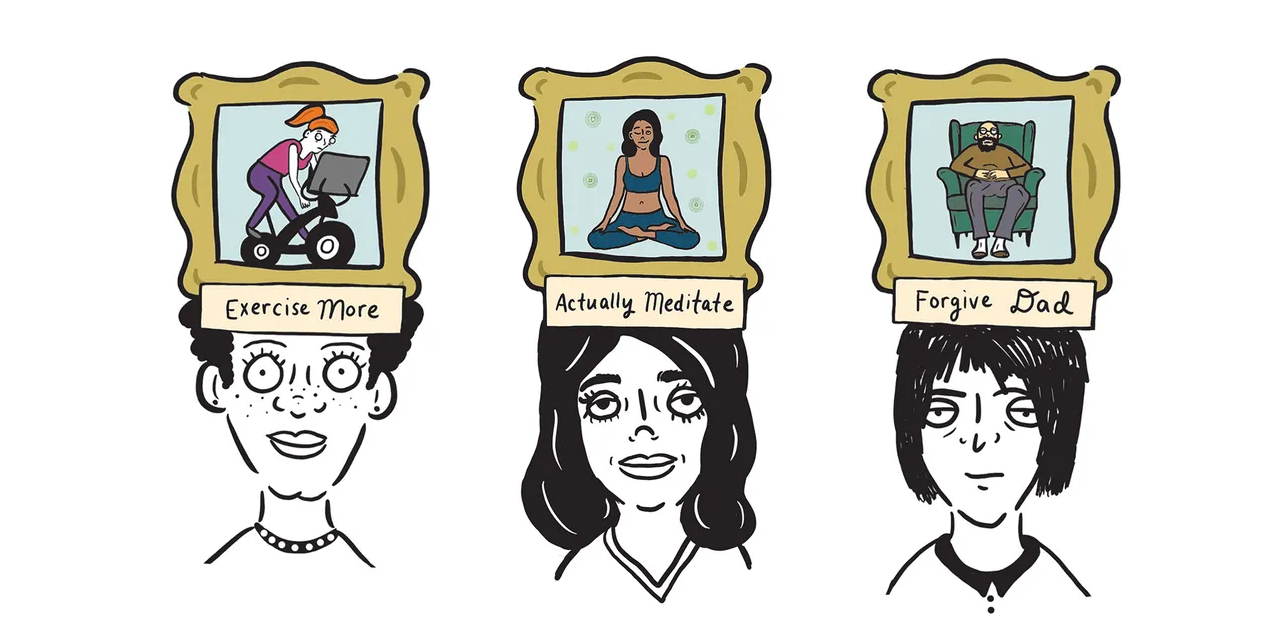
2. More incidentally a New Years reflection than anything, but William Collen’s “An art of becoming? What about an art of being?” raises a salient question about the kind of stories we tell ourselves. Why must we mark the passage of time as one step along a lengthy journey? We take stock of where we’ve been and where we’d like to go, as if a failure to move forward entails a backward devolution. Time is linear, we are told to believe, and therefore our lives are a story whose plot we must compose. Or perhaps we are given time by our creator to make the most of it. Either way, as Collen tells it, making your life into a grand story is the kind of lie that only really works if you are young, educated, and upwardly mobile. The older you get, however, the glory story can turn into more of a sad tragedy.
Imagine being told, over and over throughout your life, what makes for a good life. House in the suburbs? Vacations every summer? Going out to eat with regularity? Our culture is very good at pushing onto us what it thinks are the “correct” goals and ways of life […]
Now think on this: stories, in order to be good stories, must focus the energy of their plots on a hero becoming something, never just being something. Implicit in the basic structure of all narrative is the idea that the life worth reading about is full of drama, excitement, and a rising from height to height. The stories are riveted on moments of change, enlightenment, and awakening; they all stop at “happily ever after.” There is no narrative model for how to remain static in life. Stories tell us we ought to desire things, to change and grow; but stories don’t tell us how to be contented with what we already have. And I think that’s a grave deficiency.
Or, to frame his point differently, the narrative arc of stories by design tell us little about how to find contentment in the reality of the everyday. In Christian terms, if story is the controlling metaphor for life, then change and personal growth is the only measure of fidelity. And in this way, the crisis of faith felt by those whose stories don’t turn out the way they imagined says more what we believed about God than Christianity itself. Back to Collen:
If I want to embark on an odyssey of becoming, I have a wealth of narrative patterns to follow, models of how to become the thing I want to become; but if I am already where I want to be, I’ve got none.
So if I am at a stable position in my life, and all the stories are shouting at me about how great it is to become something . . . am I not getting a subtle message that I ought to ditch my current situation, break the relational bonds that keep me where I am, abandon that long obedience, and go off and become something new?
One could say that Collen is just going through midlife crisis, but this would miss his broader point. The midlife crisis is feature, not a bug, of the “becoming” narratives we tell ourselves. But if we are not becoming, what are we? If the new year is not a step forward, what is it? As Collen points out, there are no stories of linear growth in the Bible. There are, however, stories of disruptive divine intrusion — the kind that circumvent our resolutions — to create surprising new life where there was none before.
3. And on that front, I’d be remiss if I didn’t at least mention here New York Times columnist David Brooks’ story of his coming to faith, in part because it maps almost perfectly onto the framework offered by Andy Root at the most recent Mbird Conference. For Brooks:
When faith finally tiptoed into my life it didn’t come through information or persuasion but, at least at first, through numinous experiences. These are the scattered moments of awe and wonder that wash over most of us unexpectedly from time to time.
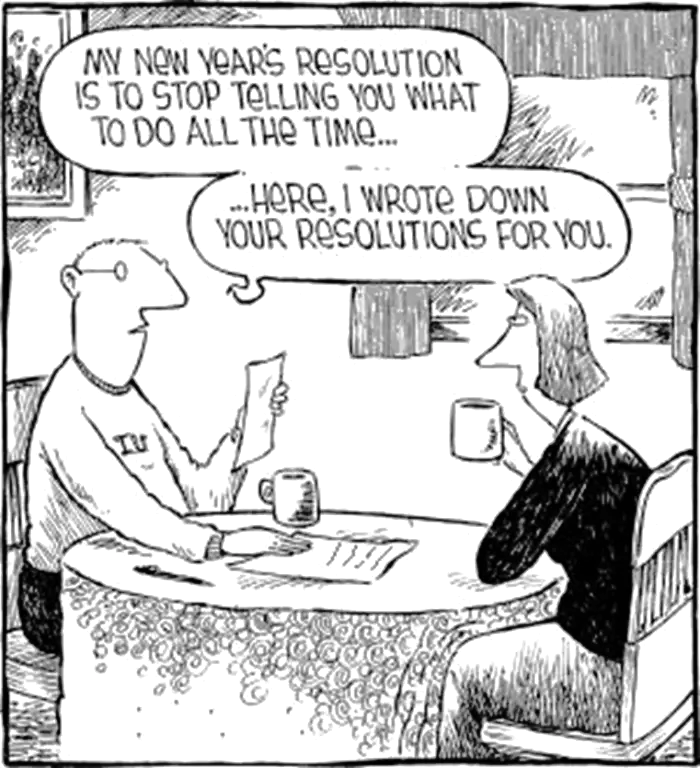 4. The aspirational hopefulness of a new year makes for great comedy, especially comedy that offers a refreshing dose of reality. Or as Pope Francis recently wrote in the New York Times, “Self-mockery is a powerful instrument in overcoming the temptation toward narcissism.” Along these lines, the Chaser reports, “‘This will be my year’ says woman for 10th year in a row.” Similarly, the New Yorker ran an oldie but goodie from 2020 on “Totally Legitimate Reasons That I Can’t Go for a Run.” Playing off this New Years trope, the most clever bit of humor comes from the Onion and their “Gym Installs Confusing New Equipment To Mess With Anyone Joining In January.”
Back to Pope Francis, amid his op-ed on the necessity of humor, he relayed a few (mostly funny) jokes to help make his point:
[There was a] rather vain Jesuit who had a heart problem and had to be treated in a hospital. Before going into the operating room, he asks God, “Lord, has my hour come?”
“No, you will live at least another 40 years,” God says. After the operation, he decides to make the most of it and has a hair transplant, a face-lift, liposuction, eyebrows, teeth … in short, he comes out a changed man. Right outside the hospital, he is knocked down by a car and dies. As soon as he appears in the presence of God, he protests, “Lord, but you told me I would live for another 40 years!” “Oops, sorry!” God replies. “I didn’t recognize you.”
5. This next piece of writing from Jake Maynard had me laughing out loud for its Larry David level of observational insight. Maynard works for a greenhouse in Pittsburgh that sells Christmas trees between Thanksgiving and Christmas. This year, he wrote a diary for the Paris Review of his daily interactions with customers. Here’s one entry that I, a former New York City resident, can 100% confirm:
Sunday, December 8
53 degreesNew York Disease is when people have to tell you they used to live in New York. A guy in a camel-hair coat told me he lived in New York for eight years. In New York, apparently, you just have to carry your own tree home. I heard about it from a woman yesterday. And again from a couple last week. You wouldn’t believe how many New York blocks they’ve carried trees.
People with New York Disease need to share their thoughts on Pittsburgh, too. And you know what? They actually really like it, so far! They like the slower pace. They could never have a yard like theirs in Park Slope. Or twelve-foot ceilings. And it’s so neighborhoody. And it’s so down-to-earth, still really working class, you know?
Maynard observes the Patagonia-core couples with roof racks, the woman who loves fat trees but hates fat people, and the rich kids who turn feral on the tree lot. The Christmas tree lot is one of the few places where all kinds of people go to shop, and all the varieties of people he encounters almost seem unreal. It’s also a lesson in the kind of truths people are willing to tell a perfect stranger.
6. Next, we turn to a review of the movie Perfect Days in ABC Religion. While the review is itself another endorsement of Eastern spirituality by a westerner that I find to be quite boring, if not imperialist cultural appropriation (seriously … it’s Seven Years in Tibet all over again), there is an insightful classification of non-religious western spirituality. According to Adrian Rosenfeldt, there are two forms of it today: wellness spirituality and nature spirituality.
Wellness spirituality is a modern approach to spirituality that emphasises personal growth and inner peace through practices like mindfulness, meditation and self-care. This modern form of spirituality has become a powerful force in self-help culture, New Age practices, and the booming happiness industry in the West, championing self-mastery, autonomy and personal optimisation — key values of neoliberal thinking. In this framework, the burden of spiritual wellbeing is placed on the individual. Failing to achieve this is often seen as a personal shortcoming, reinforcing the emphasis on self-reliance in the pursuit of enlightenment that is foisted on the young. […]
Nature spirituality offers a different path, emphasising a deep, spiritual connection with the natural world, viewing it as a source of wisdom, healing and transcendence. However, in our neoliberal “burnout society”, this alluring form of spirituality can be dangerous for young people, who are encouraged to view nature as a benign and welcoming presence.
Now, it’s easy to see these two forms of spirituality at work within religious contexts too, but for now I’ll note how well it explains the growing “spiritual, but not religious” demographic. If there is no personal God who reveals himself, you’ll either turn inward for answers or outward toward nature.
7. If you read enough parenting books — or for that matter, self-help books — you’ll eventually notice something of a pattern. Everyone tells you what’s worked for them. If if were not so, they wouldn’t have written a book about it. Amid the preponderance of books, two things can be surmised. The first is that no single technique is applicable at all times. Different children and different circumstances require different approaches. Parenting is not for the dogmatically inclined. The second is related: the fads and trends in parenting techniques are largely made up from trial and error. Longitudinal studies on such things are impossible to conduct. This means that assessments of the passing parenting gospels, for better or worse, occur largely within the field of ethics, i.e. what kind of values does a given parenting approach reflect? And over at Unherd, Marilyn Simon has some choice words for the values of certain kinds of gentle parenting, most especially for what it says about forgiveness and the human condition:
But the real problem with gentle parenting is that it removes moral freedom from a child because it refuses to accept the moral depth of a child. Punishment is unnecessary because the child is never bad, merely misunderstood. […]
In neglecting the dark corners of a child’s soul, gentle parenting does children a disservice. For the fact is that most children know that they’re sometimes bad, and that they sometimes do things out of malice, spite, and greed. Gentle parents are right: shame and guilt are negative feelings which may cause “trauma” for the child, as for the adult. No kidding. But the job of the parent is not to prevent any potential “trauma”, it is to love the child even when they are bad, and to punish them, and most importantly to forgive them. A child can’t understand the lightness of forgiveness without understanding first that one needs it. […]
Forgiveness is the precursor to redemption, a transformation that happens on the inside. A child becomes an individual moral agent only through the transformative process of parental punishment and forgiveness.
To my mind the word “punishment” here could be misconstrued by the more authoritarian-inclined as a justification for wrathful parenting, but the broader point still holds. It is by an awareness of guilt that forgiveness takes hold. Or in Simon’s words, “In parenting, it is redemption that should be the focus.” And that’s a far more important lesson to learn than any measure of correct behavior.
8. I know it’s well past the time of Yuletide cheer (to all the church calendar warriors: the twelve days of Christmas only work if you don’t celebrate New Years), but this last one from Esau McCaulley remains salient year-round.
The Christmas story is about God becoming a child, but not in the sense that an infant had all the knowledge and power of God squeezed into a baby form. It’s not about divine shape-shifting. It’s about divine limitation, humility, and weakness. A crying, unsettled Jesus who soiled himself like any other baby captures the central miracle that Christmas proposes. For the Christian, God became one of the hungry, cold, dirty, and often-lonely people of the world. He is not detached from us; he is one of us. Once God joined our number, he infused us with fresh dignity. The Church can never rightly turn its attention away from the needy, be they infants or adults, because it worships a God who made himself needy. […]
In a world weary of religious speech, Christmas is the celebration of an act. That act is the display of divine vulnerability taking on the complete helplessness of a child. God wraps himself not in strength and power, but in weakness. That idea that true power comes not through the exercise of it, but in setting it aside, seems as unbelievable in the 21st century as it did in the first. […]
Christmas reminds Christians like me that we should set aside our quest for earthly power and instead entrust our future to a God who joined his tears to ours, both in his nativity and later upon the cross.
Strays:








Wait, why do the twelve days of Christmas only work if you don’t celebrate New Years?
Well, the strict church calendar people will say that the *real* new year is the first Sunday of Advent. But I’d say that for most people, “the holidays” end on Jan 1, by which point they have begun to take down decorations and turned off the Mariah Carey.