




1. “Every family has a black sheep” — or that’s at least what people used to say about difficult family dynamics. Perhaps they spent time in prison, moved to Seattle, or married the wrong person. A black sheep remains part of the family, but it is clear that they don’t quite fit in with the rest of the herd. The script for how a parent might deal with a black sheep has been well established in books and films for a long time now. With some patience and sympathy, every prodigal comes home eventually. But what if the black sheep runs off and never wants to be found again? As told in a recent New Yorker article by Anna Russell, it happens more often than you might think, and the number of children going “no contact” with their parents seems to be increasing.
Russell interviews many estranged children to try and understand what happened. While some cited physical abuse or drug use, the common denominators for most were parental judgment, feeling misunderstood, or believing they were underappreciated. But alongside these fairly ordinary descriptions of a relational breakdown, Russell repeatedly heard judgmental psychological jargon. Their childhoods were “traumatic” and parents were “classic narcissists” or “toxic.” Along the way, she interviews one psychologist, Joshua Coleman, who considers family estrangement to be a symptom of broader cultural shifts:
Coleman believes that estrangement is becoming more common, in part because of “changing notions of what constitutes harmful, abusive, traumatizing or neglectful behavior.” He cited a paper by the psychologist Nick Haslam that showed that the definition of trauma has expanded in the past three decades to include experiences that were once considered ordinary. “The bar for qualifying as a trauma today is much lower,” Coleman writes. He’s seen parents cut out because they say negative things about a child’s sexuality, or romantic partner, or because they refuse to accept a child’s boundaries. A growing number of his clients cite political differences as a reason for estrangement. In “Rules of Estrangement,” Coleman devotes a chapter to the prevalence of psychotherapy — subhead: “My Therapist Says You’re a Narcissist”—and concludes that “therapists’ perspectives often uncritically reflect the biases, vogues, and fads of the culture in which we live.” In a culture that values independence, in other words, a therapist might advise a clean break. “Today, more than at any other time in our nation’s history, children are setting the terms of family life in the United States,” he writes.
The phenomenon may also be related to broader changes in how we think about the family. Bland has noticed a generational divide. Older people often have a sense of duty when it comes to family, and this means that “they won’t break relationships even if they find them very dysfunctional,” she told me. Parents tell her that they tolerated worse behavior from their own parents. But members of younger generations “feel that they need healthy relationships, rather than any relationship.” They don’t see family relationships as mandatory. Coleman told me that divorce often plays a role. The liberalization of divorce law in the seventies helped people escape terrible marriages, but divorces can also provoke feuds, introduce new allegiances, and “cause the child to feel more like the parents are individuals, with their own assets and liabilities, rather than a family unit that they’re a part of.” There’s been a shift away from “honor thy mother and father,” Coleman said, and toward notions of happiness and mental health. “In some ways, the ideals we now have for romantic love are really parallel to the ideals we have for parent-adult-child relationships.”
Now, I know many who believe their estrangement was both justifiable and the best thing for everyone involved. Doubting the validity of what they say seems like needlessly adding another pyre to the inferno, but it’s difficult to escape the conclusion that the situations aren’t ideal, perhaps even sinful (see below). I don’t know any parent who doesn’t have at least a dozen mistakes they wish they could do over again. The situations she describes seem intractable; the records of wrong are endless. At the same time, justifications for life-altering decisions sometimes outstrip the evidence, especially where the righteousness of one’s decision depends upon the toxic unrighteousness of the estranged. And it’s worth noting here that none of the parents Russell spoke with were glad their child doesn’t call.
Now, Russell doesn’t offer much advice in her mostly descriptive column, but she does commend apologies from parents as at least a good staring point, regardless of the outcome. Which is to say that reconciliation is never possible without mutual forgiveness and understanding.
2. On the subject of parenting quandaries, the U.S. Surgeon General recently made news for recognizing, among other things, the increased mental health risks for parents. Of particular note was his warning about what he calls a “culture of comparison,” or what we might call the ratcheting up of the law upon parents to not just keep kids happy and healthy, but set them up for success.
The more parents feel they are falling short of meeting their children’s needs, the more they scramble to make up lost ground.
One response to a world in which success and fulfillment feel increasingly out of reach has been an intensifying culture of comparison — often propagated by influencers and online trends — with unrealistic expectations around the milestones, parenting strategies, achievements and status symbols that kids and parents must pursue. Chasing these unreasonable expectations has left many families feeling exhausted, burned out, and perpetually behind.
On this point, Alan Noble goes into more detail, specifically the belief that proper technique will lead to optimal results. (Not unlike how we tend to view ourselves and our own life stories.)
Every aspect of parenting must be done efficiently or we are morally inferior parents. That is the message we receive over and over again.
Mothers must breastfeed the Right Way. You must put your baby to bed the Right Way. You must do tummy time the Right Way. You must potty train the Right Way. You must discipline the Right Way. You must teach them to read the Right Way. You must do screen time the Right Way. And schooling (home school? private? public?), athletics, music lessons, diet, the sex talk, smart phones, social media, dual-enrollment classes, college, mental health — everything must be done exactly the right way or you’ll mess up your kid and then it’ll all be your fault when they can’t compete in a hyper-competitive world. They will fail and go to therapy and complain to their therapist about how you ruined their lives and you’ll have to live with that. […]
A consequence of this comparison is low-risk parenting. When the stakes are high, it’s important not to gamble the life of your children, and so they need to be kept safe from a harmful world. Jonathan Haidt has argued that we have gone wrong by being overprotective in the “real world” and underprotective in the digital world, and I think that’s exactly right. The reason, I think, parents become overprotective is because we have made the consequences for mistakes in parenting existential in nature.
If that feels like dire news, Olga Khazan has a word of relief to stressed-out new parents inundated with doctors and books and podcasts and influencers giving you detailed and often contradictory techniques:
Other fields of medicine have patchy evidence bases too, but pediatrics is unique because people have so many questions about every little thing, and the answers all feel very high-stakes. Few adults worry that taking the wrong multivitamin will ruin their life, but giving your baby the wrong kind of formula can feel like a matter of life and death — at least when you’re hormonal and running on two hours of sleep. […]
Some pediatric advice — about, say, the importance of childhood vaccines and placing babies on their back to sleep — is grounded in firm evidence. The problem is that many pediatricians don’t differentiate between advice that’s based in science and advice that’s just probably a good idea. […]
And for parents, clashing pediatric advice can, paradoxically, be a relief … When large meta-analyses point in opposite directions, or when different specialists come to different conclusions, or when baby books offer conflicting suggestions, it’s often because what you do won’t matter all that much.
Phew! No need to stress out over the small stuff. There’ll be plenty of other ways to mess up as a parent:
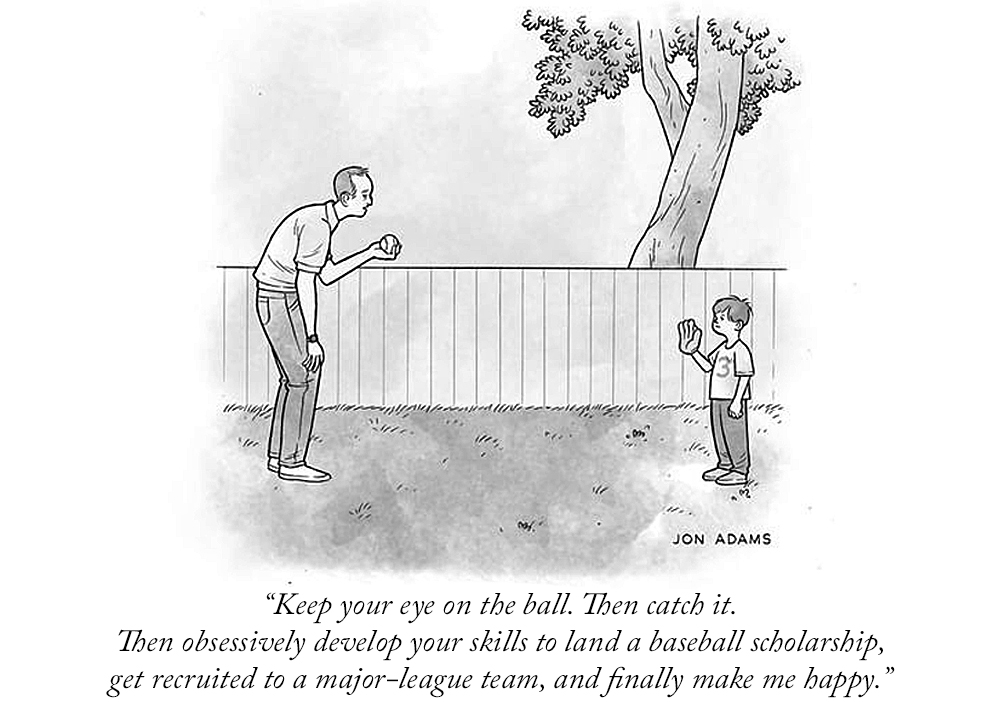
3. OK, one last parenting piece (I promise!), but this time the article comes from The Onion and their “Dad Not Leaving This Mini Golf Hole Until Son Shows Him Some Good Form.” Elsewhere, McSweeney’s has found the testimony of Abraham’s sacrificial lamb and Reductress keeps up their winning streak with “Nice! This Woman Breaks a Promise She Made to Herself Every 15 Seconds“:
In an inspiring story emerging from Boston, MA, 24-year-old Dana Wright just took stock of her life and realized she breaks a promise that she made to herself – on average – every 15 seconds.
“My friend was telling me that a great way to increase your self-confidence and achieve your goals is to make sure that when you make a promise to yourself, you stick to it,” Dana told reporters gathered at the scene. “I had never heard of ‘making a promise to myself’ but as soon as she described it, I realized I’d been breaking those all the time.” […]
“Well, I said I’d eat breakfast and then didn’t do that, so kind of an immediate ‘L’ on my part,” Dana told reporters, counting the broken promises on her fingers until they exceeded the capacity of her hands. “Then, I said I’d leave the house by 10am – didn’t do that. Didn’t get my groceries even though I told myself I would, didn’t drink a glass of water. Wow, I don’t trust myself at all.”
As far as any promises she has actually kept, Dana told reporters that she promised to let herself take a break once she finished a work task.
“I didn’t finish the work task, but I did take the break!” she continued. “That counts, right? That’s a promise I kept!”
4. Of course, what’s funny about the above not-keeping-promises satire isn’t strictly the hypocrisy of it all, but the way it describes something that is true for everyone. Who among us hasn’t failed to be their best self? Giving a name to that gap is the first of Christianity’s two great insights: things are worse than you think, and better than you can imagine. On the former point, Elizabeth Oldfield did a splendid write up for Comment on the usefulness of the doctrine of sin in her article: “Soul Work for the End of the World.” Double bonus points for referencing Francis Spufford!
[The concept of sin] gives me a frame to understand how on earth we have got ourselves into this mess, and a rigorous lens on my own complicity in it all. I have come to understand sin less as the legal concept it is often received as and more as relational, at its heart about disconnection.
Francis Spufford, professor of creative writing at Goldsmiths, calls this tendency the Human Propensity to Fuck Things Up, or HPtFTU. It is his attempt to rebrand a word that has fallen far, far out of fashion. “Sin” is now used jokingly, if at all. A slimming club’s shorthand for calories. The name of a lingerie shop. It sounds like self-indulgent naughtiness, harming no one, the liberated opposite of Puritanism. […]
Despite all this, I have found I need the concept. I am seeking a deep life of connection, to become the kind of person the world needs, and disconnection keeps getting in the way. This language gives me a way of talking about all the fractures, large and small, the twig-snapping crackle-glaze of human interactions … It is about the threads between us and others, us and the natural world, and, yes, us and God. Sin, barely recognizable now in the cultural cipher it’s become, is tragedy. Kant called it the crooked timber of humanity, the tendency to break things, accidentally and deliberately, that just seems baked in. I like Spufford’s use of “Fuck” because its fricative-plosive helps us hear the brutality. The HPtFTU is all the times we choose withdrawal, self-protection, or attack—when we centre ourselves, not as part of a healthy rhythm of receiving and giving in a web of relationships, but because we’re terrified no one but ourselves is going to meet our needs. I see my sin (which, I should say now, needs meeting with grace, not judgment) as a bundle of my self-destructive tendencies. The HPtFTU shows up in lashing out, hiding, craving, and numbing behaviours that close down the possibilities of intimacy, with myself, others, and the beyond.
Amid a time when everyone seems to be debating the causes of the current “epidemic of loneliness” — another Surgeon General’s Warning — where technology and social trends are largely to blame, Oldfield argues that our loneliness more fundamentally derives from sin. Indeed, the first sin recorded in the Bible after the paradise of Eden was rivalry between two brothers. If sin is at the root of division (Spufford calls it “the crack in everything”) then it reframes how we think of it. Rather than the competition over scarce goods, disagreements over issues, or dislike of another’s annoying habits, a doctrine of sin points elsewhere to our innate inability to love properly.
5. This last article is a bit dense, but packs a punch. Outlining the difference between teaching and preaching, Paul Griffith’s “Hearing Homilies” makes a strong case for the sermons that deliver the goods. One gets the sense that the esteemed theologian has heard far too many bad sermons and he wants to set the record straight. A sermon isn’t a sermon if it fails to become a word of address to the hearer, having something to say about both Jesus and everyday life. In doing so, it is not the preacher who speaks, but God himself.
Jesus speaks in every homily, then, but that does not mean he is always heard — even when the homily’s words are listened to and understood. It’s possible, for example, to listen to a homily and hear only the words of a confused and self-regarding preacher retailing heresy, just as it’s possible to taste in the host only a dry, unnourishing wafer. It’s also possible to listen closely to a homily’s words and hear only yourself: your own judgments, your own preferences, your fat and greedy ego chewing on what’s said for your own purposes, which will usually include your own glorification. Hearers’ ears may be closed. It’s also possible, even common, for preachers to veil what Jesus says so heavily that it’s scarcely audible. They can, and do, speak so as to stage their own persons, or to demonstrate their wit, or their humility, or their acumen, or to seek the congregation’s love for themselves rather than for Jesus. […]
It’s possible to be more precise about why the paraphrasable content of the words of a homily doesn’t suffice to make those words homiletic, and why recordings and transcriptions of homilies aren’t homilies.
Wittgenstein writes, in Zettel (§717), “Gott kannst du nicht mit einem anderen reden hören, sondern nur, wenn du der Angeredete bist.” (“You can’t hear God speak to someone else, you can hear him only if you are being addressed.”) This is perceptive and helpful. The remark, on its face, isn’t about what God says (the words God uses, let’s say), but rather about the conditions under which whatever words God uses can be heard as God’s. Were you to overhear someone say to someone else, “I forgive you for what you did,” you could know who said what to whom and the paraphrasable content of what was said. You might take note of the words and tell other people about them. But you couldn’t, in that situation, find yourself forgiven; the words couldn’t perform for you the act they performed for their addressee. You’d have overheard the words used, but you would not have received the force, or effect, of those words: what those words do wasn’t done for you.
We can apply this to the words spoken in homilies. Suppose that these, spoken by Jesus, do one thing only, though in an endless variety of modes: perform the transformative gift of Scripture to the congregation, collectively and individually, with a sharpness that lays bare everything of significance about the lives of those who hear them, and can, when heard, transform those lives. The words of homilies, on this view, have as an essential property a particular kind of performativity, like — but deeper and more comprehensive than — “I forgive you,” or “I promise you,” or “I am with you.”
Strays:
- Panic Attacks and the Peace of God, by Kyle Zunker
- The Wild God We Can’t Coerce, by Belle Tindall
- Hannah Anderson with some brilliance: “Our ambivalence toward children is actually rooted in a misunderstanding of our own origins and existence”








Re: ‘increased mental health risks for parents’…
https://youtu.be/pzRhlwJ49Os?feature=shared
[…] with their parents without sounding callous toward one of the parties involved. Yet as Todd pointed out in last Friday’s weekender, it also feels naive to suggest there isn’t some correlation […]