




1. On the latest episode of The Mockingcast (out on Tuesday), we take an extended look at moral psychologist Jonathan Haidt’s opus in the Atlantic “Why the Past 10 Years of American Life Have Been Uniquely Stupid.” We did this because it is one of those rare essays that has a magisterial quality, synthesizing a panoramic array of observations about the impossibilities of modern life and presenting some tangible steps forward. Meaning, it’s not just another “social media is bad” piece (though it’s not not that either); Haidt goes further, pointing to the intensification of viral dynamics that occurred about ten years ago, and tracing the inarguable fallout that those tweaked algorithms have produced on pretty much every level of society. A few key paragraphs:
Before 2009, Facebook had given users a simple timeline –– a never-ending stream of content generated by their friends and connections, with the newest posts at the top and the oldest ones at the bottom. This was often overwhelming in its volume, but it was an accurate reflection of what others were posting. That began to change in 2009, when Facebook offered users a way to publicly “like” posts with the click of a button. That same year, Twitter introduced something even more powerful: the “Retweet” button, which allowed users to publicly endorse a post while also sharing it with all of their followers. Facebook soon copied that innovation with its own “Share” button, which became available to smartphone users in 2012. “Like” and “Share” buttons quickly became standard features of most other platforms.
Shortly after its “Like” button began to produce data about what best “engaged” its users, Facebook developed algorithms to bring each user the content most likely to generate a “like” or some other interaction, eventually including the “share” as well. Later research showed that posts that trigger emotions –– especially anger at out-groups –– are the most likely to be shared...
This new game encouraged dishonesty and mob dynamics: Users were guided not just by their true preferences but by their past experiences of reward and punishment, and their prediction of how others would react to each new action. One of the engineers at Twitter who had worked on the “Retweet” button later revealed that he regretted his contribution because it had made Twitter a nastier place. As he watched Twitter mobs forming through the use of the new tool, he thought to himself, “We might have just handed a 4-year-old a loaded weapon.” The newly tweaked platforms were almost perfectly designed to bring out our most moralistic and least reflective selves. The volume of outrage was shocking.
Okay, so I’m not sure any of this is news. But that doesn’t make it any less urgent, especially for those seeking to take the spiritual and emotional temperature of the culture in which we find ourselves. In fact, I’d go so far as to say that understanding these dynamics, their ever-increasing scope and overwhelming power, is all but necessary if you want to avoid hating your fellow humans today, to say nothing about loving them. Models of ministry, for example, that ignore these factors will have a hard time puncturing the surface of where/how people actually live today. A few other favorite asides:
- “Across eight studies, two social scientists found that being online did not make most people more aggressive or hostile; rather, it allowed a small number of aggressive people to attack a much larger set of victims.” In our parlance, social media doesn’t create sinfulness — the problem is still within (Mark 7) — so much as make it that much easier for those whose sin manifests itself in particularly anti-social ways to exert influence on untold numbers of strangers.
 Elsewhere, he surfaces a dynamic that one sees in church life, quoting no less than James Madison. People are so prone to factionalism that “where no substantial occasion presents itself, the most frivolous and fanciful distinctions have been sufficient to kindle their unfriendly passions and excite their most violent conflicts.” Social media, in other words, has both magnified and weaponized the frivolous.
- He cites the 2018 “Hidden Tribes” study, which broke down the American public into seven ideological groups. The one furthest to the right, known as the “devoted conservatives,” comprises only 6 percent of the U.S. population. The group furthest to the left, the “progressive activists,” comprises 8 percent of the population. These two extreme groups not only dominate social media platforms (posting roughly two-thirds of the sum political content), they also happen to be the whitest and richest of the seven groups.
- “The political extremists don’t just shoot darts at their enemies; they spend a lot of their ammunition targeting dissenters or nuanced thinkers on their own team.” That is, the most dominant form of purity culture these days is political. The folks in my predominantly “blue” town are not afraid of what those in the “red” counties will say about them. They are overwhelmingly concerned with what their more ardently blue neighbors will say. Same dynamics apply to denominations.
Needless to say, the entire 8000 word behemoth is a must-read–alarming perhaps but suitably so, and not without hope. On the cast, we talk about the pastoral implications of Haidt’s diagnosis and what on earth the role of the church might be in the midst of this craziness, which he predicts is only going to get (much) worse.
Smack dab in the middle of the article, Jon quotes former CIA analyst Martin Gurri who nearly a decade ago described the power of social media as a universal solvent, breaking down bonds and weakening institutions everywhere it reached. An interesting use of words, as just this week I came across a quote from Presbyterian superstar Tim Keller:
“In the past I thought of Easter as a kind of optimistic upbeat way of thinking about life. And now I see that Easter is a universal solvent. It can eat through any fear, any anger and despair. I see it as more powerful than ever before.”
Speaking of Keller, pretty cool to see him plugging Gerhard Forde in his “Recommended Reading from the Pandemic.”
2. Next up, Mbird Conference speaker Anne Helen Petersen channeled 1 Corinthians 8:8 in Bon Appétit, arguing that “There Is No Such Thing as “Junk” Food.”
Whatever the reason you eat what you eat — and no reason is more valid than any other, including and especially deliciousness — it has no correlation with your value as a person. It does not make you a worse person to eat “junk food,” and it certainly doesn’t make you a better person to eat whole grains. Contrary to what those worksheets might tell us, food does not have moral character, and consuming it does not influence or infect our own character. Food is delightful, and food is fuel, and food is culture. It becomes shadowed with shame — often, the sort that can distort our eating habits for years to come — not when we eat it, but when we restrict it, and attempt to spread that shame to others who do not.
3. The Romans520 Social Science Study of the Month comes to us courtesy of Arstechnica, which relayed a finding just published in Science, that “Highway warnings about traffic deaths may increase crashes”. Oh boy:
“[Researchers] Hall and Madsen propose that the running total of traffic deaths increases anxiety and therefore cognitive load, robbing drivers of the mental bandwidth they need to pay attention and drive safely. The researchers note that this effect increases or decreases in pace with the increase or decrease in road deaths … Bigger numbers weigh heavier on drivers’ minds. […]
In total, Hall and Madsen estimate that displaying road death information increases crashes by 4.5 percent over the following 6 miles of road. This has caused an extra 2,600 crashes a year in Texas since the practice began in 2012, at the cost of 16 deaths and perhaps $380 million to society.”
4. In humor, not the funniest week of all time but the Hard Times nonetheless made me chuckle with it’s mock-editorial, “Religion Is Made Up Bullshit That Only An INFJ, Sagittarius, Enneagram Type 4 Would Believe,” and the Onion produced a giggle with its “Ikea Wardrobe Contains Cheap, Poorly Constructed Fantasy World Inside“:
“When we first discovered a whole magical realm in Uncle Reynold’s wardrobe, we were astonished, to say the least, but as we got closer to the capital’s castle, we saw that it was made out of really low-quality plywood and had already cracked in a bunch of places,” said eldest daughter Emma Wentworth, adding that her siblings’ excitement at an invitation to meet the Regent Queen Nyblom and her talking leopard had been significantly diminished when the monarch sat down on her regal throne and it immediately broke under her weight.
5. I’m probably not the only one surprised by how frequently we’ve been quoting Wired of late. But hey, they’re doing great work, the latest example being Virginia Heffernan’s “The End of Alcohol.” Heffernan surveys the latest crop of “quit-lit”, as well the soberinfluencer movement more generally, contrasting it (gently) with her own more old-fashioned path to sobriety, i.e. AA. In the age of social media-driven wellness, sobriety, it would appear, has not only turned the opposite of anonymous, it has become big business (e.g., Katy Perry’s new line of mocktails) — with all the attendant liabilities #seculosity:
For years, there’s been a stampede of self-help books by alcohol skeptics, most of them women, many of whom once had trouble drinking not the third bottle. These books have included My Unfurling, by Lisa May Bennett; The Unexpected Joy of Being Sober, by Catherine Gray; Sober Curious, by Ruby Warrington; and Quit Like a Woman, by Holly Whitaker. The subtitles run together, but they make big promises. If they follow the instructions, readers of these books will break up with alcohol, emerge from the grip of anxiety, radically defy patriarchy and capitalism, and become happy, healthy, and even wealthy. As 12-steppers will tell you, traditional recovery from alcoholism guarantees none of these marvels.
You might think there would be an oligopoly in neo-sobriety superstardom, but no, it’s a thousand points of light, and each soberfluencer has staked out a niche approach or at least some trademark design elements. Many also sit in Venn patches with lifestyle masters in apparently related realms: exercise, spirituality, prosperity, productivity, and even conspiracy. From what I’ve divined from a heady three-day scrolling bender, the biggest influencers in the sobriety space fall pretty clearly into three categories: mystical gurus who ground their sobriety in rococo superstitions, professional habit-breakers who regard sobriety as a happiness hack, and reps from the managerial class who advocate for medical interventions and cognitive science to treat a brain malfunction they now refer to as alcohol use disorder.
Leafing through thousands of influencer posts, a hundred ads for top-shelf celebrity soft drinks, and a dozen journal studies of brain receptors doesn’t, blessedly, make me want to drink. But all of this does make me want to drop my last name, grab a steel folding chair, and indulge in some old-time AA, complete with sloganeering in a musty church undercroft. Keep it simple, stupid. Or my favorite: Easy does it. I’ve decided these new abstainers have an entirely different goal than the anonymous alcoholics of yesteryear. [ed note: fame and money]
… So much of the new sobriety flex is anathema to the captious alcoholics of 12-step groups. But carping that others aren’t doing sobriety right is such a common mistake among recovering alcoholics that Bill W., the founder of AA, came up with excellent slang for the carpers: “bleeding deacons.”
6. On the theological front, Syndicate hosted a beautiful and wide-ranging symposium on Simeon Zahl’s groundbreaking book The Holy Spirit and Christian Experience and wow! Those who haven’t had the chance (or $$) to engage with the work of our upcoming conference speaker will get a good sense of why we simply had to fly him across the pond to speak (and risk contravening his status as disfavored Zahl sibling). The final entry in particular, from theologian Karen Kilby, underscores the radical and dare I say controversial nature of Simeon’s project — and it does so in the most glowing terms imaginable. Bravo:
The third element of the argument that stands out for me is Zahl’s retrieval and defence of classical Protestant patterns of thought around justification by faith and sanctification. He pushes back against a range of critics who want to move away from the classic “forensic” understanding of justification in favour of a more participatory account: on the one hand the critics are wrong to cast justification by faith as mere “legal fiction” and mere propositionalism; on the other, the participation-centred understandings of salvation do not do what they claim, because they remain abstract, finding little purchase in experience.
Zahl’s retrieval of themes from Luther and Melanchthon (and behind them, Augustine) is, I think, a brilliant piece of ressourcement, faithful to the tradition to which it is a return while also a fresh and challenging intervention into contemporary debate. Justification by faith and the classical Protestant “disjunctive” understanding of the working of grace become, in Zahl’s hands, genuine possibilities for belief in our own time: psychologically plausible, experientially concrete, realistic and compassionate. Zahl is capable of bringing out, in a way that can be understood by an outsider, the deep and continuing attractiveness of these traditional Protestant patterns of thought. His retrieval of an “affective Augustinianism” will have, I think, a particularly wide appeal….
This is what it looks like, one might say, when a theologian genuinely works in a way that is biblically rooted, historically rich, and engaged in contemporary debates, while also combining commitment to a particular tradition with ecumenical generosity and interdisciplinary expansiveness, bringing together careful conceptual analysis with practical and pastoral relevance, and when all this is done with proper attention to the scholarly literature in each of the areas touched upon, and with a self-reflexive clarity. It might be possible to use Zahl’s book, then, as a case study with students, to show them everything that is expected in putting together an argument in systematic theology—or one might hesitate to do so, for fear of leaving them daunted.
7. We’ll close with a seasonally appropriate sonnet from Mbird fave Mark Jarman, this one titled “Epilogue” and published back in 2015 in Reflections (out of Yale):
Today is fresh, and yesterday is stale.
Today is fast, and yesterday is slow.
Today is yes, and yesterday is no.
Today is news, and yesterday’s a tale.
The grave is empty. Last night it was full.
The glorious means of death was once a shame.
Someone is God who had a common name
That you might give a child or animal.
It happens overnight. The world is changed.
The bottles in the cellar all decant.
The stars sign the new cosmos at a slant.
And everybody’s plans are rearranged.
Today we meet our maker, in a flash
That turns the ash of yesterday to flesh.
Strays:
- David Brooks on how Some People Turn Suffering Into Wisdom
- Love me some eschatological Liam Gallagher lyrics (above)! “And there’s a new world yet to come/ and all your pain will release at night into the arms of the chosen one.”
- “For Lent, I’m Reading Up on the Christian Saints“
- “Repair and Remain: How to do the slow, hard, good work of staying put.“
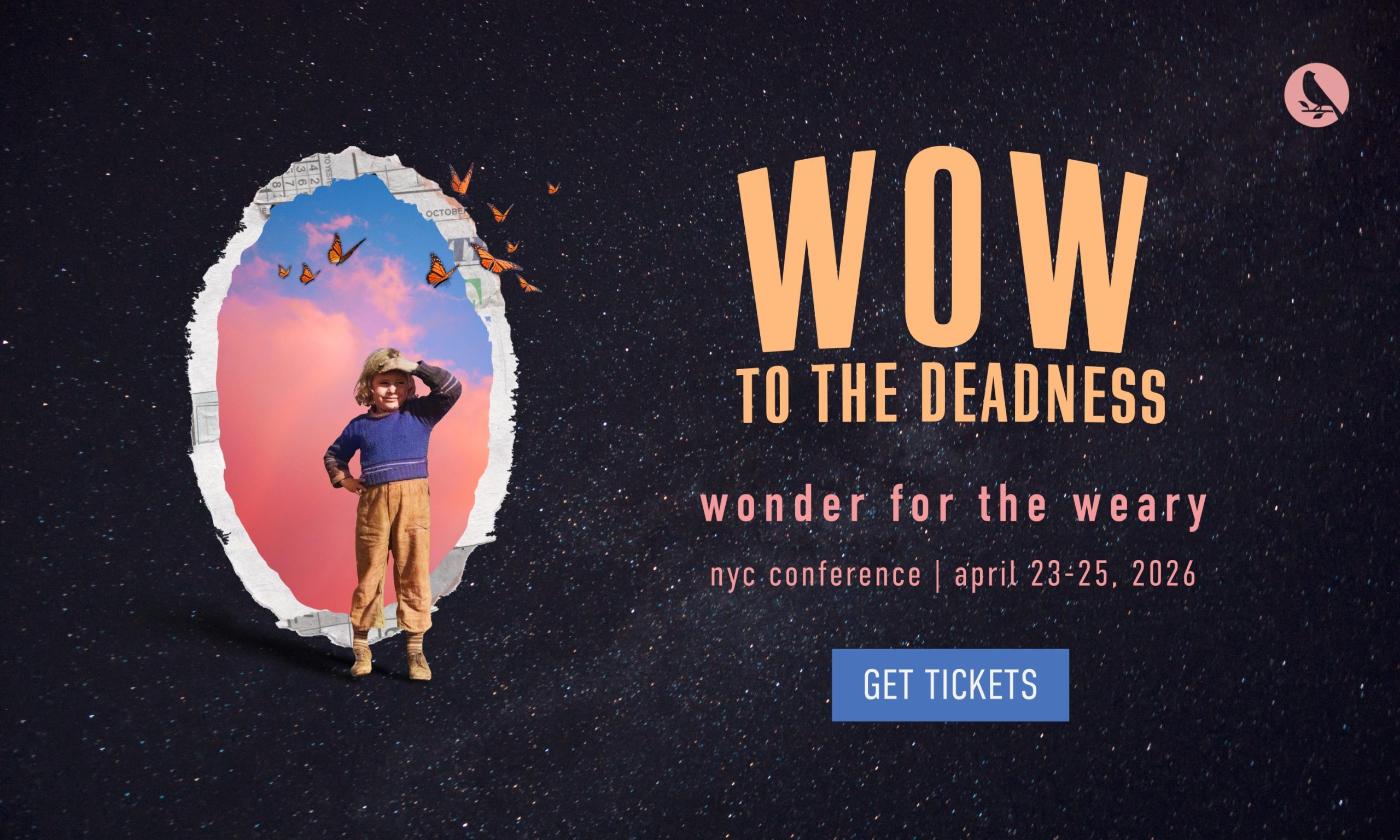
- No weekender next Friday as we’ll all be in NYC, attending our big Spring Conference! Very very very much looking forward to seeing people in person after a two year layoff. For those who can’t make it, we are planning to livestream as much of it as we can (watch this space for details). But last-minute folks should know that there are still tickets available (just no food) and walk-ins more than welcome. If money is holding you back, please email us at info@mbird.com, and we’ll see how we can help. Oh, and the EpiscoDisco on Friday night is free! Pre-registration will close on Tuesday.







The Haidt piece was amazing. Granted, I’m predisposed to favor his line of argument, but even attempting to read it as neutrally as I could manage, I found myself constantly thinking, “Yes, that’s exactly it.” He perfectly names so many of the dynamics that are operative on these platforms and the incentives they create. I was off Facebook for 3 months during my sabbatical last year and it was glorious. I did not miss it *at all*. Now I’m wondering whether maintaining a page for my professional work is even really necessary.
We’re conditioned for addiction to our “Yeah, buts” about social media: “Yeah, but I see photos of my sister’s kid!” “Yeah, but I can stay connected to my study abroad pals” “Yeah, but I want to be part of this hobby group” These are random examples but there is not a “Yeah, but” in the world that can’t actually be created some other way with some effort (and maybe that’s the key). So, do the ends really justify participating in this awful, toxic miasma of a platform? Every day I’m more convinced the answer is no, they never are.
No junk food? Let’s reverse this. Imagine someone with an ample supple of “character,” whatever that means to you. Let’s also imagine this person has access to food choices and an income to make choices. Would not this person, with their dose of “character,” decide to eat as healthy as possible, so as (for example) to decrease the odds of being a burden on others and on the so-called “health care” system? This same person might also wonder if foods purchased support local merchants and growers, or the industrial agriculture complex. I would hope that this character-ladened person would make a choice of foods that decrease the likelihood, however small, that our planet and its creatures will suffer. Yes, there is “junk food,” and yes that’s better than no food and sometimes it’s rather enjoyable food, but the category is real (now called “ultra-processed”) and it’s hurting people. We might ask why JF is so prevalent, and the injustices and corporate greed behind that. “Whatever the reason you eat what you eat—and no reason is more valid than any other, including and especially deliciousness—it has no correlation with your value as a person.” Thank you for stating the obvious — my point is simply that people who value people see food not as value-free, but as an opportunity to love your neighbor, not shame them. “Junk food” has kept too many people sick for too long, which this author seems to deny or ignore. In the end it’s a specious argument based on inductive reasoning. It’s not a celebration of food, but a celebration that there’s no telling a healthy food from a harmful one.
[…] appreciate this cultural commentary on our current social media fueled world. Here is a podcast and a short reflection on what it can mean for us people who believe in the […]
Agreeing with the commenter who took up problems with the “dont say ‘junk food'” article. Seems to be that the author’s logic goes that we’ve seriously mislabeled junk food is and weaponized those labels in antiquated ways, and therefor let’s do away with the label in the name of…equity?
We live in an advertising environment designed to exploit our impulse control and siphon us toward making unhealthy choices. It’s fine to call it what it is!