




From its beginning, HBO’s The White Lotus has been a show about death. The opening scene of season one was a shot of a coffin, and every season since has started similarly: with a “flash forward” of a dead body floating in the ocean or murderous gunshots cascading through a resort. Every season then goes back in time to answer all our questions surrounding this mysterious death: Which character is going to die? And how? And by whom?
But more than any season yet, season three explores a more profound — and Christian — question: What about someone dying before they die?
As in every season, the show’s characters arrive at the White Lotus (this time a resort in Thailand) seeking “life.” Piper, a Buddhist, arrives in search of transcendence; Saxon arrives in search of sex; Kate, Jaclyn, and Laurie arrive hoping to rekindle nostalgia and old friendship; Rick arrives hoping to enact revenge on the man who allegedly killed his father.
But in their search for life, only one character dies in order to achieve it: Timothy, played by Jason Isaacs. Tim is a generationally wealthy businessman from North Carolina, a Duke grad, the descendant of a state governor, and also (to the amusement of many of this blog’s readers) an “Episcopalian.” Unlike most of the characters, Tim arrives at the White Lotus with everything already — family legacy, financial security, and a beautiful wife and children.
But early on, we learn — unsurprisingly — that the idyllic life Tim has constructed is of course a charade, and that he has come by at least some of his wealth dishonestly. As he sits by the pool and drinks cocktails in Thailand, back in America, the Wall Street Journal and the Washington Post are set to run stories exposing his involvement in shady financial enterprises. The FBI is down his throat. Timothy’s lawyer tells him nothing can be done. Tim should be prepared, upon his return to the States, to lose everything — literally everything — and spend years in prison.
At this point in the show, Tim is “dead.” His former life, as he knows it, is over. The only question is whether Tim will accept this death — and for much of the season, the answer is no. Instead of coming clean with his family, Tim disintegrates into a dreamworld of pain pills and alcohol. Yet whenever his family asks him what is going on, he insists (as we all do) that “everything is okay.”
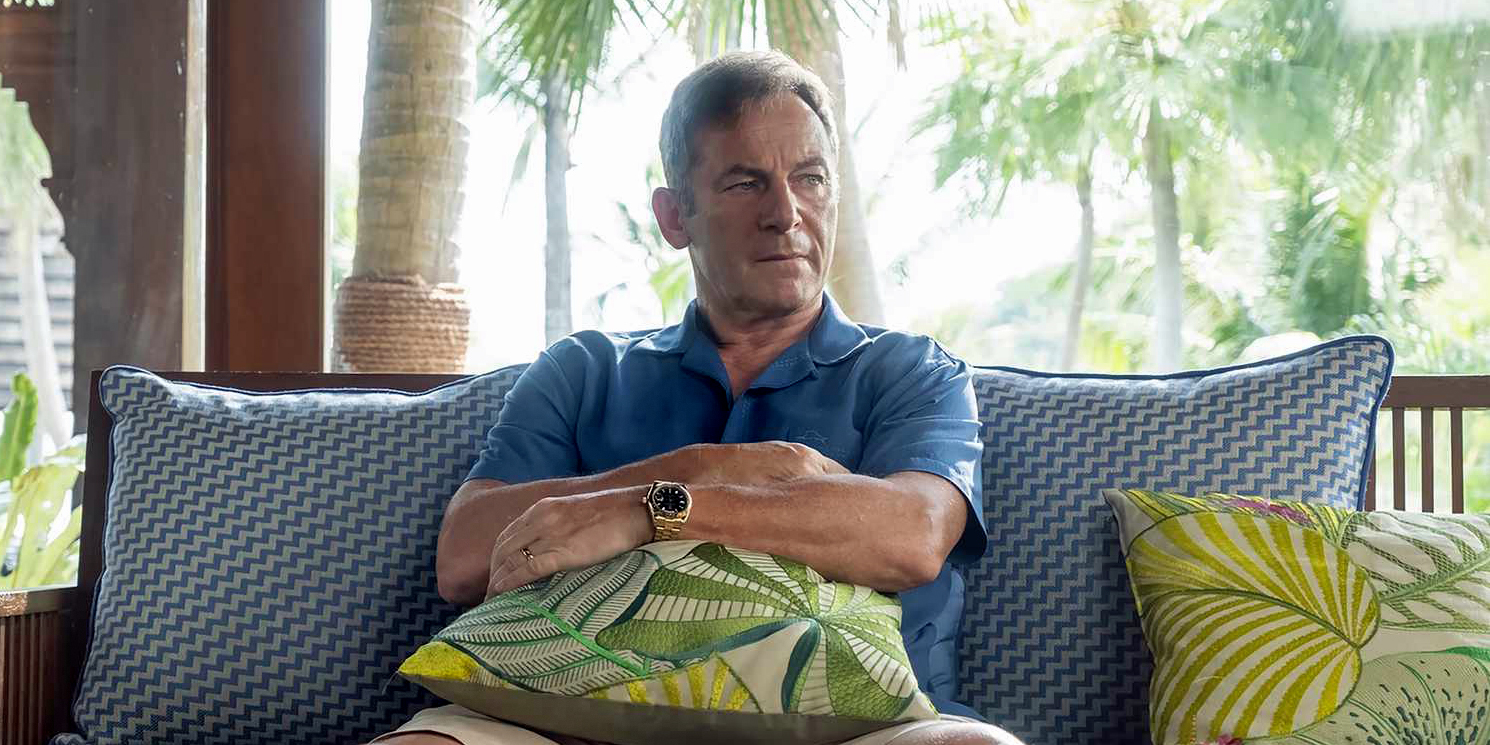
Eventually, Tim’s guilt and dishonesty escalate into suicidal ideation. He oscillates between fantasies of killing himself and killing his family — whom he presumes, probably rightly, could not possibly want to live a life devoid of money and all its securities and pleasures. In the season finale, he hatches his final plan, one that only the cynical and zany writers of White Lotus could devise. On the resort there is a tropical tree known to locals as the “suicide tree” due to its poisonous seeds. Tim will grind up the seeds in a blender, mix them up with piña colada mix, and kill him and his family with poisonous piña coladas. Night comes, and Tim carries out his plan. But upon seeing his wife and son put the piña coladas to their lips, he mercifully “comes to himself” (Lk 15:17). He slaps the drink out of his son’s hand. He goes to bed resolved to live — at least for one more day.
But the next morning, his youngest son, Lochlan, wakes up and makes a fateful protein shake, using the same blender his dad had used to make the piña coladas. The remaining residue of the seeds causes him to pass out and (presumably) die. Tim wakes up to the horror of his son lying lifeless by the poolside — a fatal victim of Tim’s abandoned plot. The father runs to his son and holds him in his arms, weeping in desolation.
For Tim, this is the crucifixion. Everything Tim ever valued is gone: his career, his esteem, his family, his freedom, and now his son. But resurrection comes in the show’s final minutes. Lochlan (miraculously!) comes back to life, and his first words are these: “I think I saw God.” Tim holds his son convulsing and crying out, “O God, O God.”
The show ends with the family of five getting on a boat to leave the island and go back to the airport and fly back to North Carolina. Boarding the boat, they get their phones back. This is a pivotal moment, since one of the ways Tim hid the news of their impending doom was by taking away his family’s phones. But he can’t hide any longer. As everyone turns on their iPhones and reads hundreds of panicked text messages, Tim says, profoundly, “Things are about to change.”
He speaks better than he knows. For this is the Christian gospel, that it is only in dying before we die, that we really live. That it is only by “coming clean” that we are finally made clean. And that things change only when our life as we once knew it is mercifully demolished.
In Robert Capon’s exegesis of the Parable of the Prodigal Son, he reads that most famous of Jesus’ parables through the lens of death and resurrection. In that story too, everyone must die in order to live. First, the father dies when the younger brother asks for his share of the inheritance — in effect, the younger brother says to his dad, “I want you dead.” Next, the younger brother dies in a manner similar to Tim in White Lotus: in a far country, among the pigs, his life in utter disrepair. In Jesus’ parable, the only character that refuses to die is the older son, who chooses to remain on the life support of his own grudges and moral superiority.
In White Lotus, Tim is the only younger brother. Everyone else is an older brother who refuses to die. Belinda, a working-class mother who dreams of opening her own spa business, refuses to “die” when she accepts five million dollars of blood money because she would rather follow her dreams than have a clear conscience. Piper, the Buddhist, refuses to “die” when she decides not to live at a Buddhist meditation temple because the beds are gross and there is no air conditioning. Rick, by far the most tragic character in the story, refuses to “die” when he can’t let go of his grudge against the man he thinks killed his father.
We must die before we die.

Throughout his corpus, the Southern novelist Walker Percy insisted there are two types of people in the world: the “ex-suicide” and the “non-suicide.” The ex-suicide is someone who has been honest about the tragedy of life — who has stared all of life’s despair and disappointment squarely in the face — and has concluded that the only logical conclusion in the face of such sadness is, as Sartre and others taught us, to commit suicide and end it all. But at some point (and by some grace) the “ex-suicide” chooses, instead, to live. He passes through the waters of suicidal ideation and comes out safely on the other side. He “dies” without dying — he dies before he dies — and as a result, life becomes worth living.
Conversely, the non-suicide is the person who never contemplates death/suicide because he or she remains dishonest or inauthentic about life’s pains. The non-suicide maintains the illusion he can tight fist life and somehow make a life for him or herself through willpower and hard work. He can live without dying.
Returning to the Prodigal Son story, the younger son is an ex-suicide, and the older son is a non-suicide. And returning to the White Lotus, the only ex-suicide is Tim. He is the only character who is truly free. Listen to the freedom Percy assigns the ex-suicide:
The difference between a non-suicide and an ex-suicide leaving the house for work, at eight o’clock on an ordinary morning: The non-suicide is a little traveling suck of care, sucking care with him from the past and being sucked toward care in the future. His breath is high in his chest. The ex-suicide opens his front door, sits down on the steps, and laughs. Since he has the option of being dead, he has nothing to lose by being alive. It is good to be alive. He goes to work because he doesn’t have to.
From a horizontal vantage point, Tim gets on the boat to go back to North Carolina in worse shape than any other character. His former life is over — public humiliation and prison await. But. But. From a vertical vantage point, Tim alone has passed from death to life. Since he has the option of being dead, he has nothing to lose by being alive. Things are about to change.








SO good, Jordan! Love the horizontal/vertical vantage point distinction. Thanks for this.
Great essay! I loved the season and appreciate your commentary. I thought Tim, after he told his family that “things are about to change” had a beatific look on his face. The swelling music after the confession seemed very religious to me (not like the weird flute-y stuff of the theme song). Good luck back in Raleigh!!!
This is by far the best and most extensive theological commentary I have EVER read on The White Lotus. Well done Rev. Jordo.