




1. Over at The Lost Word, Tara Isabella Burton has a provocative meditation on desire. A part of her suspects that love should wholly transcend self-interest, that we should love the stranger as much as the guy from our hometown who shares our history and interests. Perhaps so, but most of us embody our idiosyncrasies and can’t help but do so. Do we have any choice in what we love? For Burton,
Our desires are so often as much about how the world has already affected us, than how we want to affect the world. The strange things that pull us — that remind us of childhood, or home, or a teenage cast party, or a first love — [are] as much evidence of our vulnerability as our sovereignty. If “what I want” is part of “who I am,” it is in part because I have less control than I think over either.
My desires, at least, are always attractions to unanswered questions. They’re longings to plumb mysteries I can’t fathom. I want to heave my whole body against locked doors.
Reframing desire/object in the language of curiosity/mystery, Burton notes:
The language of mystery makes more sense to me. It makes sense to me as an artist: working on pieces where all my uncertainties can be held in tension, offered up without resolution. And it makes sense to me as a person discerning everything in my life, all at once. To stand in a mystery — to expect not full knowledge but to hope for understanding — is, at least, to be open to incompleteness […]
I respon[d], selfishly, to particularity (a resemblance, a memory, an evocation) in a poem, or a painting; the particularity helps me pay attention; I pay attention and I see something else beautiful in it, foreign to my first understanding, which remakes me, a little bit next time I find that particularly calling me, in another painting, or another person. I can’t ever get out of myself. Most doors I’ll never open. Even the ones I try I’ll only splinter, get a shoulder through at best, and hope that what comes through, in the end, is light.
Burton’s insights work toward a distinction between desire to acquire something which augments the self, versus desire as being led into a world where the self feels small before a larger mystery which it dimly apprehends, or in which it incompletely partakes.
The piece also sheds light on different ways of approaching individual desire: the ascetic way, seeking agape by denying one’s particular, self-interested loves, or the way of Dante (among others), where particular loves can lead one toward agape.[1] Burton embraces the latter, which seems a helpful paradigm for us contemporary Protestants, who are talking much more about desire and aesthetics than we were in the ’90s but almost always in the context of “formation.” Burton’s question — how do you engage transcendent beauty and mystery with the self God has given you? — is a good one.
For more on relating to real but ungraspable mysteries, check out Belle Tindall Riley’s excellent talk from last week’s NYC conference, “An Age of Unknowing: A Generation’s Yearning for Mystery.”
2. The Atlantic published a bevy of relevant pieces this week, beginning with Megan Garber’s article on performance anxiety. Garber notes that the rise of social media and the possibility of public representation of everything you do have “eroded the old distinctions between the performing of life and the living of it.” She writes that “mass self-consciousness is ascendant. Performance anxiety is becoming a way of life.”
Garber has several interesting observations, including the gradual use of language from fiction (etymologically, something “made” or “produced”) to describe everyday life. We think about our lives in term of character arcs, “main character energy,” etc. In a world where we feel we are constantly performing for an audience, there’s a corresponding impulse toward privacy. Garber notes that after the pandemic, “many people kept wearing masks. They did so not as a defense against other people’s germs but as a defense against other people’s eyes. A common explanation was I’m sick of being perceived.” But in a vicious cycle, our retreat into ourselves removes human foibles even more from public life:
The less you’re around other people, the less patient you might be of the foibles that can compromise a performance, whether your own or someone else’s. The desire for a stage environment that is under total control — in which every line sparkles, in which no awkward pauses occur, in which misspeaking and misunderstandings are violations — may be a rational response to the pressure to be forever “on.” The main character, after all, has one job: to put on a good show. But when the show never ends, the need to stage-manage doesn’t either. And that can be exhausting.
Sure can. The piece doesn’t provide an easy solution. But the predicament is another sign that our culture is increasingly in need of (and primed for?) a message that meets our foibles with forgiveness, that we share fallen nature and share healing grace; that even though I’ve flubbed most of my lines and bungled my character arc, my belovedness and hope are firmly rooted in a God who loved me and gave himself for me.
3. At the Wall Street Journal, Carolyn Gorman makes the case that it’s okay to be unhappy, arguing that “happiness” is not the normal human condition, nor is “unhappiness,” in itself, a disease to be treated:
In the years since Sigmund Freud discovered the couch, Americans got the strange idea that happiness is the natural human condition. Unhappiness, they decided, is a psychological problem…
In recent decades, there’s been an obsession with improving “mental health.” But the concept of “mental health” has so many vague definitions that anyone the least bit unhappy is presumably “mentally unwell.” Therapy culture has taught us to attend closely to our emotions because anything negative supposedly might be the early sign of something serious and merit professional intervention…
For most of Western history, constant happiness hasn’t been a goal in and of itself. The good life meant striving for more, which naturally involves effort and discomfort. Freud saw psychoanalysis as a tool for returning miserable patients to “ordinary unhappiness.” Seeing unhappiness as a normal part of life might be what’s needed to feel better.
While there are undeniably mental health problems that can be diagnosed and improved with treatment, for “ordinary unhappiness,” Gorman’s insights seem constructive. One Christian writer noted that in some of his congregations, people felt an overwhelming pressure to be happy and like they were messing up their lives if they weren’t.
When someone is unhappy in an ordinary sort of way, making them think there’s something wrong with them doesn’t help. And I can’t help but wonder whether the law of “thou shalt be happy” doesn’t motivate us, like a whip to a beast of burden, to pursue various avenues that numb our unhappiness — doomscrolling, etc. And when we apply that law to our children, well, it’s safe to say it often produces the opposite.
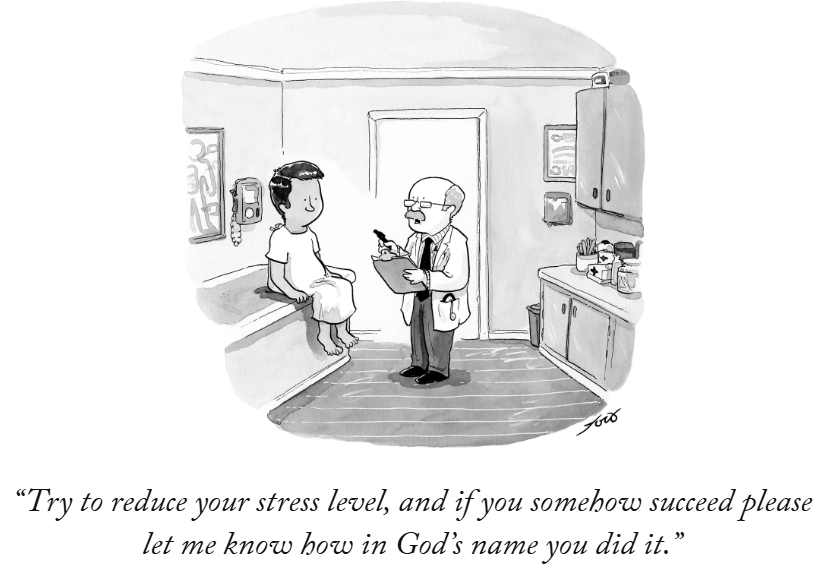
4. In the case of happiness, there are particular structural reasons why mandating it seems to produce the exact opposite. In this week’s post at Experimental Theology, Richard Beck lists several of those mechanisms. Of note here is the “hedonic treadmill” effect, that a new gadget or new accomplishment generates a short-lived feeling of satisfaction, after which we return to a baseline. Hence the treadmill analogy — we keep running forward even as we don’t move in space.
Another mechanism is poor “affective forecasting” — we’re reasonably proficient at judging what course of action will make us healthier or more professionally successful in the future, but we’re pretty bad at judging what will make us happy:
We stand at the fork in the road of a life decision. We look down one path and make a prediction about how happy we will be if we travel that road. We make an “affective forecast.” Then we look down the alternative path and make a happiness prediction for that choice. We compare those forecasts and pick the one we think, at the moment of choice, will make us happier.
Sadly, as I said, we are terrible at this task. Due to “miswanting,” desiring the wrong things, we are poor at predicting joy. We travel down roads that do not lead to happiness.
The misalignment of our desires and what will make us happy seems as good an entry into a secular doctrine of sin as any. But there’s also the problem of the will: even when we can affectively forecast what will make us happier, we are often constrained by the will. As a self-hating Missourian once said, “Between the motion / And the Act / Falls the shadow.”
Beck also notes the old Aristotelian point that happiness is a byproduct of certain goods, which means it doesn’t do well to pursue it directly, and that pursuing happiness promotes patterns of narcissistic thought, which in the long run undermine happiness pretty significantly. Given all that, it seems the “thou shalt be happy” mandate not only fails to confer the power to fulfill it but actually provokes the opposite in some pretty specific ways.
Which all appears to validate Gorman’s intuition. Liberating us from the pressure to be happy may be a countercultural, urgent, and liberating way for grace to make contact.
5. One way our desire for personal happiness — or the closely related ideal of self-actualization — plays out is in efficiency, control, and streamlining. In the process, the earthy, bright, messy things of the world, in which our ancestors were enmeshed, are placed at arm’s length; daily experience loses texture. At the New Yorker, Hanif Abdurraqib provides a wistful, non-quite-fatalistic reflection on “Our Longing for Inconvenience” in the modern world:
I learned early lessons in patience and precision using a hand-me-down dual tape deck that I kept in my childhood bedroom. I would wait, sometimes for hours, to hear a song on the radio that I wanted to record onto cassette. I’d be careful to wait until the end of the d.j. intro before hitting Record, so as not to get it onto tape, and I’d cut out early if the d.j. intruded at the song’s end. I learned that if I wanted to avoid picking up the harsh click sound of the tape stopping, I could hold down the Pause button and then press Stop. In both the Walkman and the bedroom tape deck, the cassette’s inner spool of tape would sometimes get caught up in the gears of the machine; the remedy was to gently remove the cassette and wind the tape back into the casing with a pencil, lest you destroy your coveted archive of songs—some of which, for all you knew, might not come on the radio again.
Abdurraqib, it seems, learned lessons about carefulness, attentiveness, work and reward, etc. And I remember learning those lessons as I painstakingly assembled my iTunes collection in 2005, lovingly editing songs’ metadata like a geologist poring over her favorite rocks. How many of the lessons formerly taught by necessity must we now learn by social engineering, repetitive self-discipline, or not at all? How many gifts we used to receive, unwillingly and unknowingly and appurtenant to some inconvenient necessity, must we now struggle to achieve? Abdurraqib concludes with her struggle to take on as much inconvenience as she can handle:
I’ve resolved to never have my own groceries delivered, even though when I go to the grocery store no one seems especially interested in making eye contact, let alone in speaking. And I don’t blame them, because some days I’m not sure that I am either. What makes the madness increasingly incurable is that I want parts of the past that are increasingly incompatible with this iteration of our world. I walk through the grocery store, half smiling, with my hood up. My friend finds a VHS player but can’t connect it to any television in his house.
Still, I understand her desire, because so many of my own desires are detached from the reality of the times we live in. I am still inventing inconvenience in order to bolster my desire to feel alive.
6. In the social-manifestations-of-Romans-7 category, the Atlantic explores the tension between Americans’ undaunted reverence for monogamy and the increasing inability to live up to it. Polled on a range of moral issues like euthanasia, gambling, and the death penalty, the one moral behavior Americans almost universally condemned was infidelity.
The article notes the powerful emotional effects of infidelity vis-à-vis other forms of harmful behavior. One woman, whose husband incurred significant debt without her knowledge until collectors came and stripped her house, remarked that “it’s so much better … than if he cheated on me.” The preference recalls a line from a certain ancient Hebrew love poem, “If one offered for love / all the wealth of one’s house / it would be utterly scorned” (Song of Songs 8:7).
It’s understandable that we tend to view our partner’s exclusive commitment within marriage as a proxy of our own belovedness. At the same time, it would appear that the weight of our seeking fulfillment through such relationships leads to fewer and fewer actual marriages:
Fewer have actually been getting hitched, but that might be a testament to how seriously the institution is taken; people tend now to think of matrimony as something for which they need to prepare — save up money, get their career in order, find their soulmate […]
What a tortured relationship Americans have with monogamy. They can’t live with it; they can’t live without it. Pundits who panic about monogamy’s demise aren’t necessarily wrong. Only a minority of Americans live up to the nuclear-family model: two married parents with kids, all under one roof, their relationship not open or adulterous. Maybe people are so protective of monogamy because they can sense that it really is vulnerable. The problem is that they end up putting immense pressure on the custom to provide them with purpose and complete fulfillment. It’s perhaps no wonder that so many people cheat; they may want more from their relationship than it can ever really give them. The glass gripped too tightly will shatter.
The irony, then, is that our very idealization of marriage creates expectations that scare us off it (Bowie: “ter-ri-fies me”) or makes us seek too much from it, sowing the seeds of later dissatisfaction, restlessness, even infidelity. In light of that, The Atlantic piece ends with modest advocacy for looking to sources of meaning other than monogamous marriage.
Most of the pastors I know who do marriage counseling would agree — we need a source of fulfillment beyond our spouse. But other sources of fulfillment — work, polygamy, etc. — tend to take us away from the family. Christianity’s the only one I know that affirms the family and marriage while not making them absolute. I wouldn’t quote Matthew 22:30 in a rehearsal-dinner toast, but it’s a good example of how the hope of the world to come acts as a brake on our tendency to overburden the good things in life.
Sociologically, conservatives tend to assume the decline in Christianity has harmed monogamous, long-term commitments by making people value them less. The Atlantic piece suggests otherwise; that the decline in Christianity may have harmed monogamous commitments by making us value them above all else. As the theologian Charles Marsh once said of the ’60s counterculture, in the absence of a religiously transcendent frame of reference, “Eros, overburdened, collapses in on itself.” Seems an apt description for today, too.
While we’re on the subject, I hear Christine Emba’s talk on “Modern Love” at our NYC conference last week was not to be missed. Can’t wait to listen.
7. In humor, the Onion’s “Man Finally Good Enough at New Hobby to Realize How Bad He Is At It” struck a chord — “At last I’ve gotten to the point where I’m able to just pick up a guitar and immediately grasp how little talent I have for it. I’ve come a long way, and I can now see that I have absolutely no business trying to play music.” Makes me wonder if my old dormmate from YoungLife camp ever mastered the opening of “Stairway to Heaven.”
McSweeney’s takes on ’90s nostalgia with its “Fine. This Is What I Was Really Like in the ‘90s”:
Nothing about love was complicated back then. Relationships lingered without the ability to instantly reach someone via text, and most breakups were done on a folded piece of loose-leaf paper…
If I said I’d meet someone at a bar at 10 p.m., I just stood there alone sipping my amaretto sour. If they didn’t show up, I didn’t get a text saying: Running late. I just went home and assumed they had moved or died…
There was no doomscrolling, only staining my fingertips with the same copy of Rolling Stone for months.
So, no, honey, I wasn’t “vibing” in the ’90s. I was perpetually slurping a forty-ounce Slushie, waiting for a payphone, and shaking cigarette ash off my oversized flannel shirt. Just like you, I was figuring it out, only with better music and thankfully scant photographic evidence.
Plus the Babylon Bee weighs in with a classic “Dad Splits Commute Time Between Worshipping the Lord Jesus Christ and Cursing Out Bad Drivers”:
Witnesses said Jeff West, a project manager at a local company and also an elder at his church, was on his way to work Wednesday morning and going through his normal routine of alternating between singing along with worship music and loudly shouting imprecatory exclamations at nearby drivers as he drove through traffic…
At publishing time, West had reportedly made up for his outbursts of profanity by uttering a quick prayer for the drivers who offended him on his way to work.
Strays:
- The Atlantic this week also ran a raw and honest memoir of maternal grief (excerpted from Danielle Crittendon’s forthcoming Dispatches from Grief, to be released May 5), a sympathetic profile of John Mark Comer, and a glowing review of James K. A. Smith’s new book, Make Your Home In This Luminous Dark.
- The NYT’s interview of Bob Odenkirk, sketch comedian turned Saul Goodman of Breaking Bad / Better Call Saul fame — and now action movies — is worth a read.
- Also notable is Paul Bradbury’s reflection at Seen and Unseen on anonymity, where he suggests that “value capture” — the idea that evaluation based on others’ criteria makes us internalize those criteria as our own — accounts for the value of anonymity. As Bradbury notes, it perhaps sheds a bit of light on the “messianic secret” motif, too.
- For writers, perfectionists, and/or Connecticuters, the New York Review of Books wrote up an exhibit on errata at Yale’s Sterling Memorial Library. In addition to an anecdote about a 1631 KJV print run that omitted the “not” in the Seventh Commandment — nightmare fuel for copyeditors and pious Englishmen alike — there’s something both terrifying and comforting about a museum of mistakes.
- And finally, thanks be to God, not one but two of our favorite musicians — Paul Zach and John Van Deusen (who met rave reviews at our 2025 Charlottesville and 2026 New York Conferences, respectively) — released new music today. Listen, mark, inwardly digest, etc.
[1] But then for every Dante there’s a Proust, who managed to turn his particular infatuation into a sort of transcendence, albeit a solipsistic and infinitely more fraught one. It also bears mention that even though we rarely choose the way of ascesis — I want my Staedtler mechanical pencils! — life often forces us into it. To take an example from Burton [spoiler alert for Sense and Sensibility], Marianne wasn’t able to choose the good, stolid Colonel Brandon until the dashing Willoughby abandoned her. And all for the best, in the end. (FWIW, Elinor’s restraint about the matter reflects a sober evaluation of her influence over her sister’s misplaced affections and, one could argue, presents a salutary example for elder siblings and pastoral ministers today.)








Thanks for another great and fulsome Another Week Ends. While no 1631 KJV, you did miss an important “not” in the sentence “Christianity’s the only one I know that both affirms the family and marriage while also making it absolute”!
Thanks for the encouraging words and for the catch! It’s been updated. I don’t want to end up in that museum…