The following appears in Issue 26 of The Mockingbird magazine.
A Mistake, Or a Mystery?
How does the life of the mind relate to the life of faith? I first began to feel the pressure of this question in a confirmation class at the age of fourteen. The boy who had the role of class smart-aleck asked the teacher, “But how do we know that it is true?” I can’t remember what precisely the “it” was, but I remember the response. “Faith is a gift,” our teacher answered, “and if you don’t take care of it, you may lose it.”
I don’t think what she said was false. And yet her answer in that context seemed to communicate something quite terrifying: “Keep asking those questions, young Ernie, and you’ll be going to hell.” Quite a severe way to deal with an irritating adolescent. I don’t know what Ernie made of it, but the conclusion I took was that faith requires a suppression of the intellect.
Some years later I stumbled into the study of theology, to discover thinkers who were deeply immersed in the tradition and practice of faith while at the same time completely free — free to explore a much wider set of questions than it had ever occurred to me to ask. It was a relief to escape the sense of conflict between faith and the intellect. But I have continued to puzzle over other aspects of this relationship — the relationship between the life of the mind to the life of faith.

How do thought and study relate to prayer? When is the seeking of the mind itself a prayer, or something closely related to prayer, and when is it distraction, diffusion, a displacement from what might be required — or simply something else? On a communal level, what can be the role of intellectuals in a church formed by a carpenter’s son, and in a tradition which hears the words of St. Paul: “God has chosen the foolish things of the world to shame the wise”?
One part of theology where this issue feels particularly acute is around the doctrine of the Trinity. It is not just that there is (here as elsewhere) a range of technical vocabulary one needs to find one’s way around: hypostasis, ousia, procession, relation, perichoresis, spiration, filioque. When you try to find out what these words mean, you don’t usually get a simple answer. Hypostasis and ousia, for instance, before they were taken up into trinitarian theology — before the distinction between them became crucial to the very heart of trinitarian orthodoxy — were used more or less interchangeably. In the philosophical discussions of the period, both meant something like substance. As for procession, Thomas Aquinas carefully sets out its meaning, but he does so by introducing some familiar uses of the word and then systematically removing everything that could make such uses understandable. And the concept of subsistent relations is, as I read it, a kind of conceptual equivalent of a tongue twister; Rowan Williams, in an article where he seems to think he understands how St. Thomas understands the Trinity, ends up invoking a Möbius strip. Or to give one more example, Bernard Lonergan, the famous Canadian Jesuit theologian who had an almost obsessively orderly mind, would apparently summarise his lectures on the Trinity as follows: five notions, four relations, three persons, two processions, one substance. And to this, his students would add, it is said, zero understanding.
One response to all this difficulty is to conclude that something has gone badly wrong. The doctrine of the Trinity must be a mistake. Perhaps one adopts the “Hellenization thesis,” the idea that the pure gospel was distorted in early Christianity by the influence of Greek philosophy. Or perhaps one aims, as with the philosopher of religion John Hick, to rise entirely above the complexities of any particular religious tradition and focus on what is simple and common to all — God, or just “the Real.” I had lunch once with John Hick, when he was a kindly elderly Emeritus Professor in Birmingham University and I was just beginning to teach there. I told him I was doing some work on the doctrine of the Trinity. “You’ll understand,” he replied, “that I think that is a terrible waste of a bright young mind like yours.”
But the doctrine of the Trinity is so deeply embedded in our tradition and practice — creed, liturgy, prayers, hymns, the sign of the cross and so on — that even if we leave aside all the other problems with the Hellenization thesis and with John Hick’s program, the “mistake” hypothesis is not one open to anyone who inhabits, or feels any kind of commitment to, this Christian tradition.
If not “It’s a mistake,” one can of course say, “It’s a mystery.” That’s, in my experience, a very widely used strategy. And as with the line that the nun used when I was fourteen, I wouldn’t want to say it is simply untrue. But it can feel pretty unsatisfying and anti-intellectual, certainly if it is the first and only thing one says. And it doesn’t really help to understand all the technical difficulties of the doctrine. Surely a mystery shouldn’t have to be so complex?
Trinitarian Boldness (I)
A third option, beyond either “It’s a mistake” or “It’s a mystery,” has emerged in the last couple of generations — we might call it trinitarian boldness. Much of the so-called trinitarian revival in theology, from the 1980s onwards, has been marked by a distinct confidence. One hears of a great reversal: that which had been thought a problem, a puzzle, an abstruse bit of celestial mathematics, is actually the solution, the exciting contribution Christian theology has to make to wider society. The apparent obscurities of the doctrine are presented as in fact enormously rich. They are rich with content that can be imagined, elaborated, and even, to use contemporary management jargon, “actioned.” As I see it, there are two main camps of trinitarian boldness: social trinitarianism on the one hand, and kenotic trinitarianism on the other. While both have a definite appeal, my own view is that neither is, in the end, the way we must go.
In the social trinitarianism camp are Jürgen Moltmann, Colin Gunton, Leonardo Boff, Miroslav Volf, Paul Fiddes and a whole host of lesser-known names. It is an approach that gained momentum especially with the publication of Moltmann’s The Trinity and the Kingdom in 1981. Social trinitarians vary in many ways. They come from different continents and denominations, bring different philosophical presuppositions, are motivated by different practical issues, and draw different conclusions. But nearly all share the following four features — and they all share at least three of them.

“Puzzle” from the series Skipping Sundays, by artist Heather Evans Smith.
First, and most fundamentally, social trinitarians think that Christians ought not imagine God on the model of an individual person or thing which has three somethings — three sides, aspects, dimensions, or modes of being. The starting point instead is to think of God as a collective, a group or society, bound together by the mutual love, accord, and self-giving of its members.
A second feature has to do with the word “Person.” We speak of the Trinity as Three Persons in One God, and for social trinitarians, the word “Person” is deeply meaningful.[1] It is not quite identical to the contemporary term — the everyday concept of “person” has to be corrected and purified by trinitarian theology. But the theological term “Person” and the ordinary word “person” can be connected enough that what we know of divine persons helps us think about human persons.
When you hear that God is three Persons, should you be thinking of an analogy with three people? Yes, say the social trinitarians, as long as you also work on improving the way you think about the people.
A third feature of much social trinitarianism has set West against East. Social trinitarians criticised the approach of Augustine and Aquinas and the Latin West, and presented themselves as retrieving the thought of the Greek-speaking Cappadocians from the East. This dimension of social trinitarianism has fared particularly badly: the criticisms of Augustine and Aquinas have been shown to be unfair, the contrasts set up between East and West unsustainable, and the alignment between the social trinitarians’ own views and those of the Cappadocians unjustified.
The final and most interesting thing uniting social trinitarians is how they approach what makes the three one. What social trinitarians present as the rejected, Western approach to the Trinity is one which starts with God’s unity — it begins with the oneness of God — and then struggles to find a way to accommodate threeness. As social trinitarians start from the three persons, you might therefore suppose the difficulty will be to make sense of God’s oneness. At this stage, however, rather than a problem to be grappled with, they find instead the great beauty and power of the doctrine, often in the concept of perichoresis. Perichoresis, a patristic term, means interpenetration or mutual indwelling. It emerged well after the trinitarian debates of the fourth century, originally in discussions about the relation of Christ’s divinity to Christ’s humanity, but eventually was incorporated into a trinitarian context.
In the hands of social trinitarians, perichoresis tells us of the beauty of the eternal divine life. Moltmann writes that each Person, by virtue of their eternal love, lives in the other two and “communicates eternal life” to the other two; he describes it in terms of fellowship and the “most perfect and intense empathy.” Cornelius Plantinga writes of “a zestful, wonderous community of divine light, love, joy, mutuality and verve” in which there is “no isolation, no insulation, no secretiveness, no fear of being transparent to another.”
Crucially, however, the concept of perichoresis does more than this: it not only offers a beautiful understanding of the Trinity, but it enables the doctrine of the Trinity to be put into action. The Trinity, through perichoresis, is a sort of perfect society, an ideal community, and so we can learn from it how to model interpersonal relationships, social groupings, national governance, and church institutions, among other things. For Moltmann, it allows us to find, in our political and social organisation, the middle path between the individualism of Western capitalism and the collectivism of the communist system. And in the sphere of the Church, whereas the inadequate, overly monotheistic view of the Trinity “justifies the church as hierarchy,” he suggests, “The doctrine of the Trinity [properly understood] constitutes the church as ‘a community free of dominion’… Authority and obedience are replaced by dialogue, consensus, and harmony.” Such was the enthusiasm around social trinitarianism that I have seen it used not only in the mission statements of individual theological colleges — their vision of how teachers and students are to get along is modelled on the vision of how the Persons of the Trinity relate to one another — but also as a proposed guide for town planning.
All this is one example of trinitarian boldness — what had appeared to be tricky and technical concepts were in fact sources of deep insight for intellectual, social, political, and ecclesial realms. What had been embarrassing has become the chief point upon which to commend the Christian God: not a conceptual stumbling block but something with which to transform the world.
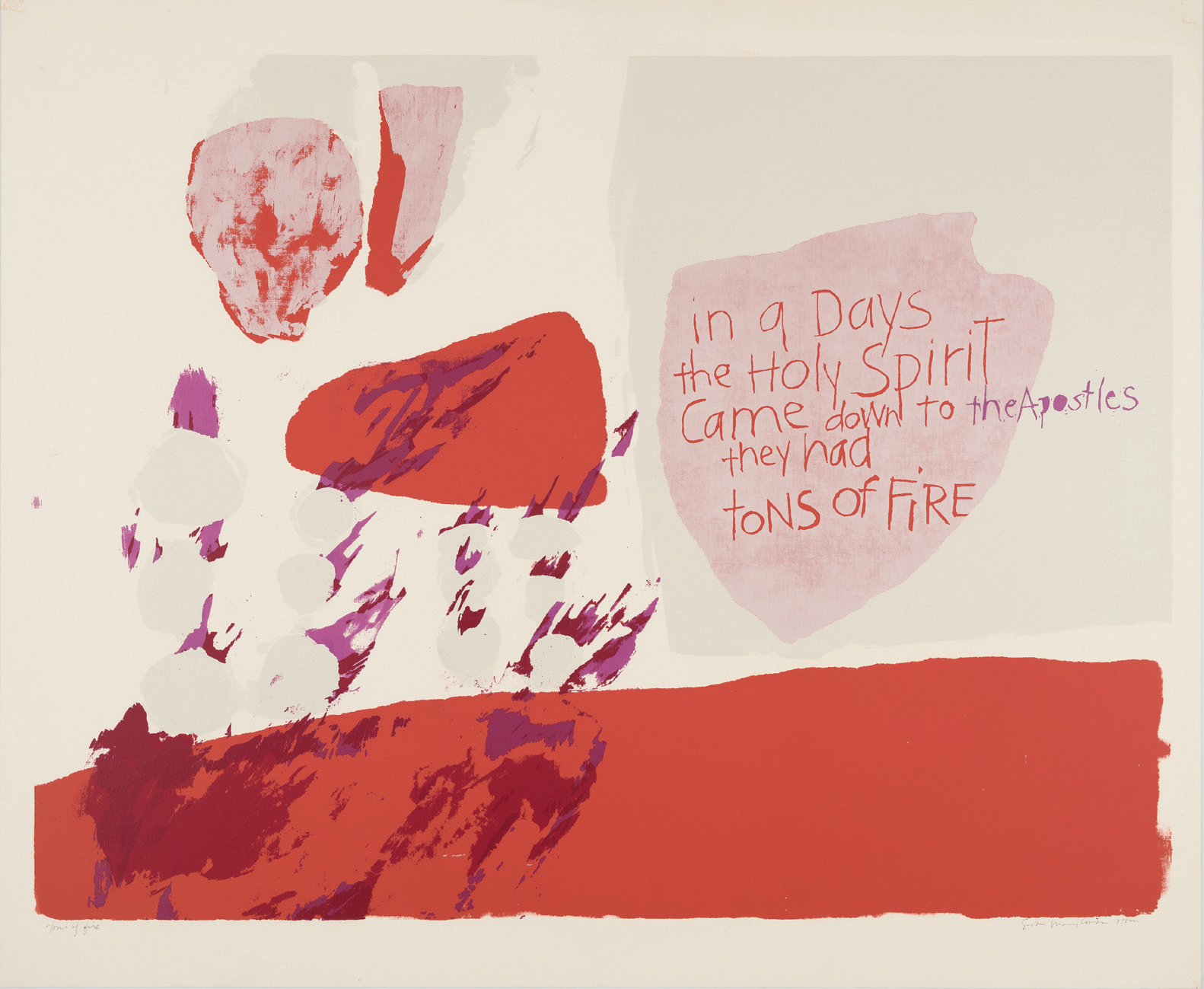
Corita Kent, tons of fire, 1962. Serigraph, 25.5 x 30.5 in. Courtesy of Corita Art Center.
Trinitarian Boldness (II)
For my second example of boldness, I will turn to kenotic trinitarianism. This is of course yet another technical term. The word kenosis comes from the reference to self-emptying in Philippians, where we read that “Christ Jesus, who, though he was in the form of God, did not regard equality with God as something to be exploited, but emptied himself, taking the form of a slave, being born in human likeness.”
The widely influential Swiss-German Catholic theologian Hans Urs von Balthasar sees kenosis, self-emptying, as the key, not just to the understanding of Christ’s incarnation but to the life of the Trinity itself. Balthasar’s argument begins from the familiar idea that the Son, the second person of the Trinity, who is “begotten not made,” receives everything he is from the Father: the Son is the perfect expression of the Father. So if the Son empties himself, he must be imitating the Father: self-emptying itself must come from the Father. And to go one step further, the Father’s kenosis (Urkenosis) is the very act through which the Father begets the Son. The Father empties himself, gives himself away, to the Son, and by so doing, gives existence to the Son.
Linked to this idea are overtones of danger and loss — Balthasar does not quite say that the Father loses himself in begetting the Son, but there is the suggestion that loss is risked. He also speaks of an infinite distance between Father and Son, something that was a shock to me the first time I came across it, because everything I had read in the longer theological tradition emphasized an absolute closeness.
Finally, Balthasar thinks, there is not suffering itself, but something like suffering — that which can become suffering — in the eternal life of the Trinity. All this means that the event of the cross and, as Balthasar sees it, the abandonment of the Son by the Father on the cross, is rooted and grounded in the eternal life of the Trinity.
Balthasar is not like the social trinitarians in proclaiming a social, political, or ecclesial programme from his theology of the Trinity, at least not in an explicit way. The Balthasarian trinitarian theology is bold in a different way; it’s a less strident but strikingly bold vision nonetheless. Balthasar quietly makes quite radical departures from tradition by introducing a sense of risk and loss in the Trinity: the infinite distance between the Persons, the kenosis of the Father, the presence in the eternal Trinity of something which becomes the cross and the abandonment of the Son by the Father. It all gives you a sense of dramatic tension and intensity in the inner life of the Trinity that you don’t find elsewhere.
Furthermore, running through his writings one finds a certain distinctive spiritual atmosphere, one where suffering, loss, and even humiliation are consistently associated with sanctity, where self-abandonment is at the heart of the Christian life, where at every level love and suffering are inextricably associated. Even though Balthasar does not explicitly argue from a vision of the Trinity to a programme for how we should live, there is a correspondence, a kind of isomorphism, in his picture of the two.
Problems
Could anything be wrong with these bold kinds of theology?
A first issue, in my view, is their tenuous relation to tradition. The bold trinitarians are doing something not really rooted in the fourth-century struggles that led to the doctrine, nor to most of the centuries that followed. And the second issue is this: to make the doctrine into something we can more easily imagine, they risk talking about God as we speak of items in the world, and indeed of falling into tritheism.
But, you might respond, doesn’t tradition develop? Surely the arrival of a new way of understanding should not automatically be dismissed; that is a recipe for being defeated before one has begun. And even with respect to tritheism, might one not say that there are always dangers in any way of speaking about God? Perhaps all theologians must court the risk of falling into one heresy or another.
I have some sympathy for both points, and so it is necessary to go one step further to identify what is ultimately most unsettling in these approaches. The deepest problem as I see it is the gap between what the bold trinitarians are doing and how they present themselves. If they were to acknowledge the novelty of their proposals, setting them out in a more experimental tone, in a more careful vein, it could be untroubling, or at least less troubling. But in fact many social trinitarians present what they do as a reclamation of tradition, a correction of what they see as its long descent into mere monotheism. In Balthasar, while there is less of an attack on other kinds of trinitarianism, there is nevertheless a stance of confidence and authority, no hint of hesitation about what is what, and particularly what is happening within the Godhead.
If the tone were different, in both cases the contribution could be of value. After all, we cannot imagine the inner life of God; we cannot imagine how the Persons are one and three, what an eternal procession is, what begetting means.
But we also cannot shut down our imaginations. Whatever presentation of the doctrine we make, even if it comes with all the caveats in the world, our minds will be active, constructing some sort of image. A new proposal, whether it be social trinitarianism or kenotic trinitarianism, can shake up and destabilize the imagination — so long as the new proposal doesn’t present itself as the way to understand the trinity, a pattern into which we can allow our imaginations settle.
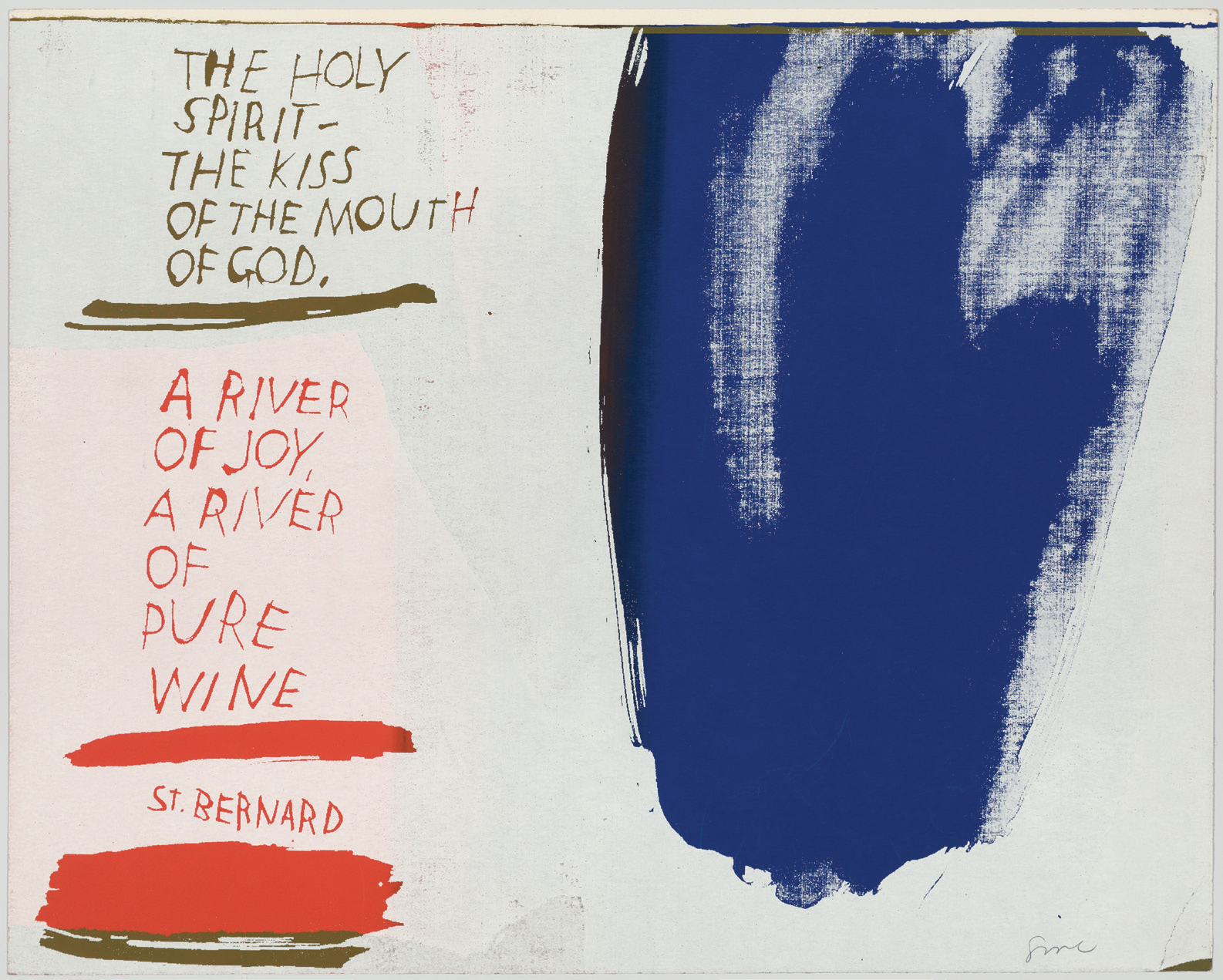
Corita Kent, a river of joy, 1964. Serigraph, 11 x 14 in. Courtesy of Corita Art Center.
Accepting Defeat
So far I have laid out three paths. There’s the “It’s a mistake” option, which — whatever else one might think about the particular ways this has been argued — is simply not open to anyone who feels committed to Christian tradition. Then there’s the “It’s a mystery” option, which has overtones of repression and suppression of the intellect. In contrast to that, there is the bold option, explored in various ways in recent theology. This last is not without interest or value, insofar as it can helpfully confuse and unsettle our imaginations, and stop them from fixing on some particular picture of what it means to be three persons in one substance. But the bold options cannot themselves be a stopping point either.
What then, you might ask, do I propose instead? What’s left? What to do in the face of technical difficulty and the deeply puzzling quality of this doctrine?
The first thing to say is that seeking understanding, rather than defaulting immediately to an appeal to mystery, is a perfectly reasonable starting point. One has to go down those routes, perhaps even to engage with the bold trinitarians for a while, before accepting that one is not going to arrive at an answer to the question of how to think about eternal processions, or about a three-who-are-each-entirely-God-but-who-are-not-three-Gods.
To accept the defeat of this project — to accept that one is not going to arrive at intellectual satisfaction — is not to consign the Trinity to irrelevance. It is instead a prompt to step back and think again.
Perhaps we cannot understand the Trinity, the three-in-oneness of God, not because it is so far from us, but because it is so near. We are caught up in the Trinity. The Christian life is a life of being brought into the Trinity — not a contemplation from a distance, nor a mimicry at a distance, but a genuine incorporation, a being taken up by the Spirit into the movement of the Son from and to the Father. Perhaps we are too much in the midst of the Trinity, too close, too involved, to be able to form an overarching conceptualization.
Still, you might say, I haven’t quite dealt with the difficulty with which I started. Even if we can understand the Christian life as already, in fact, trinitarian — we are on a journey to the Father, following the Son, moved and supported by the Spirit — there remains the issue of all those technicalities. What is their role?
Trinitarian technicalities have arisen as people grapple with problems, with difficulties, and false paths. Those who say the Creed routinely recite “God from God, light from light, true God from true God, begotten not made, consubstantial with the Father.” We are thereby saying, five times over, “I am not an Arian heretic.” Do we know what it means to be begotten in this context? Definitely not. Can we fill out the word consubstantial with positive content? Probably not. And yet at the same time we do know what these phrases mean, in that we know what they rule out. We can actually understand what it means not to be an Arian: not to think that the Son is
a lesser being than the Father, a half-way intermediate between God and the rest of creation. And this does matter to the life of faith, to what we understand to be happening when we encounter Jesus in the Eucharist, in Scripture, in prayer, in other people.
Interestingly, if the technicalities are doing their work properly, as ordinary Christians we don’t really need to know about these technicalities to practice our faith. They are there as a precipitate of past conflicts, now simple way markers continuing to keep us on track, giving us the pattern by which we read Scripture and by which our prayer is shaped.
What I am proposing is that the technicalities remain technicalities. They are not the mystery. Certainly God, the Trinity, is mystery, and in the Christian life we are in the midst of mystery and oriented to it. But the language of hypostasis and ousia, of subsistent relations and perichoresis — this is not where the mystery is hiding. This is necessary if limited technical language.
Let me try an analogy from the life of universities. Over time, universities build up their own technical terminologies, along with their policies. There will be policies on plagiarism, on credits and progression, on examining systems, on what respect in the classroom requires. These are all necessary for the well-functioning of the university, for preventing things going off-track in a whole variety of ways. But they are not the very substance that the intellectual life of a university is about — you don’t get an education by memorizing, dissecting, or contemplating the university policies. The technicalities are important, but they remain technicalities — to study them is not to contemplate the mystery.
This is in part a deflationary account of the role of the intellectual life for faith. Intellectual struggle is not automatically, or at least not always, also prayer. Study of doctrine will not automatically take you more deeply into contemplation of God. And yet, even so, it has value.
First, it is important to the life of faith to be able to pursue, intellectually and freely, the questions that worry us, and this importance is not undermined by the fact that we don’t always end up with satisfying answers. I remain convinced that the suppression of my classmate Ernie’s question was not part of the logic of Christian faith, but a distortion of it.
Second, even if the result of intellectual work can sometimes be the conclusion that something cannot be known, this is still important to know. To bring into sharper focus the limits of what we can know is to bring into greater clarity our situation before God.
Third, sometimes along the way, even though we fail to reach a satisfying understanding or new heights of contemplation, we have our imagination unsettled and opened up in new and helpful ways. There is a real but modest role for the intellect: it is not the pinnacle of Christian life, but it has its small part to play.
Karen Kilby, originally from the woods of Connecticut, now works as Bede Professor of Catholic Theology at Durham University in the northeast of England. Her most recent book God, Evil, and the Limits of Theology, circles around the role of unknowing in relation to all that is most important to us.
Parts of this essay have been adapted from Balthasar: A (Very) Critical Introduction (Eerdmans, 2012) and “Perichoresis and Projection: Some Problems with Social Doctrines of the Trinity” (New Blackfriars, 2000).
[1] St Augustine asked himself why we use the word Persons, and concluded that it was only because it sounded a bit better than saying “three I don’t know whats”. Some major 20th century theologians, such as Karl Rahner and Karl Barth, further cautioned that because of the way “person” is now understood in other contexts, it has become misleading as a technical term of trinitarian theology and we would do better to substitute a different terminology — “mode of subsistence” and “mode of being” were their suggestions. Taking Augustine, Rahner and Barth together this is what you hear: we have never known how to fill out the content of the term “Person” in trinitarian theology, and now that the wider meaning of the word has evolved, the situation has grown worse — the word is actively misleading.