




There is a specter haunting modernity: the specter of God’s Spirit. Laughing in the face of the impossible and liable to transform every obstacle into a passageway, the Spirit should elicit a shiver of horror when we contemplate his workings.
What is it that passes through our certainties as though they were as insubstantial as air? What frightens us even as we deny its existence? A ghost, of course. It isn’t impeded by the empty obstacles we put in its way, and it isn’t impressed by our halfhearted unbelief. And it does what it wants regardless of your intentions for the moment or for this place.
God’s Spirit, however, is the only ghost that is linked to death without being a creature subservient to death. This is because the Spirit is the Spirit of Christ, the One who is known through his life-unto-death and his rising from death. The Spirit has always been — the living bond of love between the Father and the Son and the bestower of life to creatures and utterance to prophets. But the point that brings all of his attributes and works into focus is his outpouring following Jesus’ ascension.
He who is the link between the trinitarian persons is also the link between the resurrected Christ and all who are united to him in faith. But do not overlook what that union is rooted in. It is a union born of the grave, a sharing in death and resurrection with Christ. That sharing is the accomplishment of the Spirit, carried out by him in the exercise of faith.
Faith, after all, is a death: a death of illusions, of pathetic efforts, of subjection to sadistic powers that do not care about you. The Spirit applies Christ’s work to you here, now. He overcomes all boundaries and barriers to bring the death and resurrection of Christ into present, existential reality for us living in his historical wake.
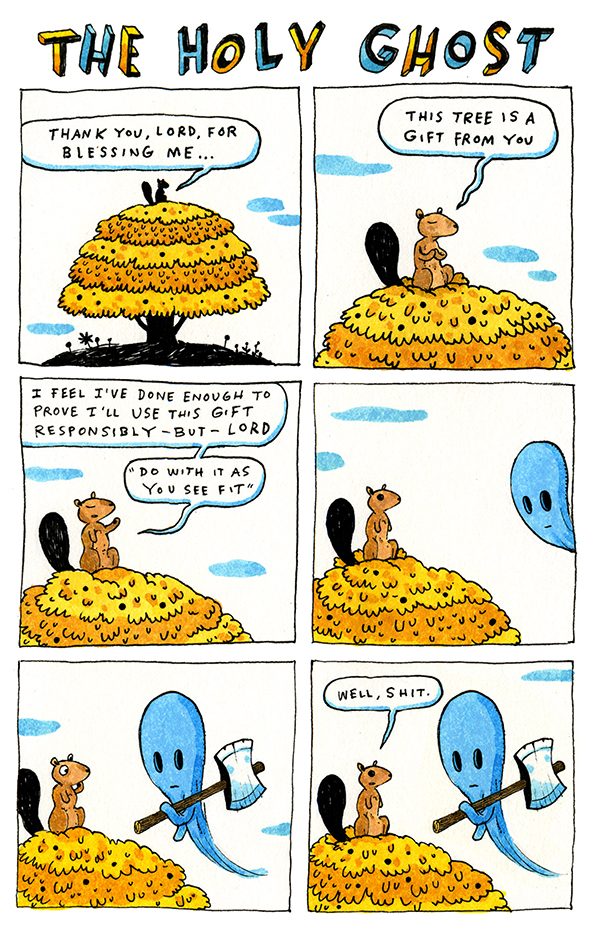
From John Hendrix’s The Holy Ghost: A Spirited Comic
And this is incredible precisely because we aren’t just anyone. We aren’t innocent, neutral bystanders in the economy of the Spirit. We are the ones rushing headlong into strife and death. We are the ones ravenously pursuing our own destruction, engineering fresh futilities and glutting ourselves on nothingness. It’s not so much that we have skin in the game as our skin is the game.
The Spirit interposes himself within the bizarre hostility of Adam’s race against their Creator, their hopeless war against God and themselves. They position themselves within a gravity well that has precisely one endpoint: death. Christ had to enter this gravity well for our sake, and the Spirit empowered him for this task. The Spirit is the uncanny force that overcomes the living death that characterizes our condition and not only opens the gates to the enemy but also transmutes our enmity into love. Our enemy wins us over by his own death and by wooing us into partaking of that death.
Perhaps “horror” strikes you as an odd word to use in connection with the Holy Spirit. I think, though, that this reflects a domestication of God’s otherness and a distancing between us and our linguistic inheritance. The horror lies in how the good news can first sound like terrible news, that we are radically vulnerable to infiltration by this invisible, intangible Other. If you understand faith only as a posture you or I adopt at some point in time, you overlook or filter out the wonderfully eerie truth that the Spirit of God is impinging upon your subjectivity to make assent and love possible where once they were not.
An aspect of this horror is that the past is not simply past, and that no wall you erect around yourself has guaranteed invincibility. We often try to quarantine the past to “protect” ourselves from its influence and ramifications, but that “wide, ugly ditch” between the past and whatever you think is the present isn’t all that wide. And while it may be ugly, that is what the Spirit routinely has to work with.
The truth is, the Spirit thinks it’s really cute how you are so certain that disenchantment is your circle of protection from believing and doing weird things. He isn’t intimidated by your sociology major or your physics degree. Frighteningly, he knows what makes you tick infinitely better than you do and isn’t above showing it to you along with its tactile link to God’s promises in Christ. This means that any impediment to faith isn’t as sturdy as we make it out to be. Every convert is an “unlikely convert” because every one of us has a death grip on our death drive.
“Horror” is especially apt when you consider the etymology of the word. That God cares not one whit for the level of your defenses should frighten the obstinate disbeliever. But for those who have been conquered from within, horror remains appropriate as the word comes directly from the Latin — horror, with its connotations of religious awe. In a more contemporary idiom, it’s a consequence of an encounter with the numinous, but, crucially, not the impersonal numinous of so much modern spirituality.
This is God’s subjectivity, the God revealed in Jesus Christ, stretching out to our subjectivity, not only tracing its contours with intimate understanding but also, crucially, filling the gaps that characterize us. We often think we know what would leap across those gaps, but in truth we regularly don’t know they are there. Others do: they recognize the contradictions that prick the fabric of our selfhood. We do not comprehend our lack, and we do not know what would fill us. We are like the tattered sheets that make the classic ghost costume, and it takes another ghost to understand us better than we understand ourselves.
The Holy Ghost, that is. The Spirit who hovered over the abyss at the beginning also infiltrated life into the abyss of Jesus’ death because these are of a piece. He even now rises out of the nothingness of our alienation and angst and sews new life where there has been nothing but dead ends.
Face it: one of the things you’re most afraid of isn’t rejection. What frightens you is the possibility of being known in exhaustive detail and loved in spite of all the ugly things you’ve ever done; for all of your excuses and rationalizations to be seen from within and known to be utterly inadequate, to be lies that keep you afloat and minimally alive. That terrifies you.
We try to flee what frightens us. And the abyss of our being, the void we feel gnawing at our contemporary world and life within it, rightly frightens us. But fleeing only harms us further, leads us further into the abyss. What we need, rather, is to abide in this abyss with Christ and his Spirit.
Crucified at the lowest point of this abyss, Christ tasted destitution and negation, and there the Spirit breathed resurrection into his lifelessness. Thus Thomas Merton writes in Contemplative Prayer that “the option of absolute despair is turned into perfect hope,” for “from the darkness comes light. From death, life. From the abyss there comes, unaccountably, the mysterious gift of the Spirit sent by God to make all things new.” May dread give way to awe and veneration as we abide with the horror of the Holy Ghost.







“ He overcomes all boundaries and barriers to bring the death and resurrection of Christ into present, existential reality for us living in his historical wake.”
Holy moly.