




Look, the virgin shall conceive and bear a son, and they shall name him Emmanuel. (Mt 1:23)
A virgin birth occurred in 2006 in England. The mother’s name was Sungai, and she gave birth to a boy child. As a matter of fact, she bore four boys and eighteen girls. She was a Komodo dragon, and she lived at the London Zoo. Virgin births, or parthenogenesis, occurs extremely rarely, but it does occur in 0.1% of vertebrates. Animals with backbones, yes, but not mammals like us – unless you count Anakin Skywalker.
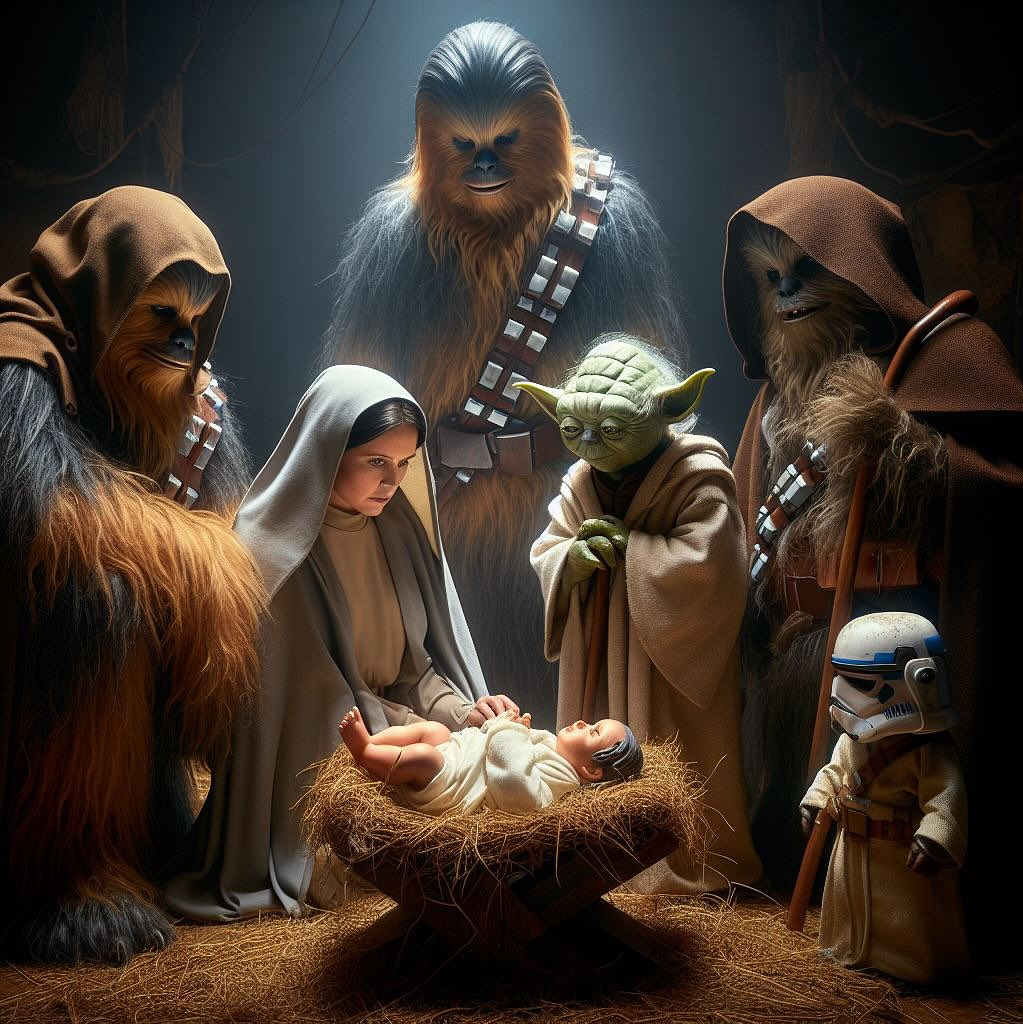
The parthenogenetic birth of a human being is a remarkable event because of its uniqueness. It’s not rare; it has never, ever, happened before. Despite this, and rather encouragingly in today’s skeptical times, upwards of 66% of American adults still believe in the miraculous origin of Jesus. Which is surprising, because, like W. H. Auden once quipped rather irreverently about the virgin birth, “What does it say but that no one can acknowledge that his parents had sex!”
Why is this unlikely beginning to our faith so important? While I could make some mildly entertaining stuff up about redemptive interdimensional space lizards or parallels between Star Wars and Advent, I’m instead going to take you on a short guided reading of smart people. I want to start with an obscure German theologian by the name of Joseph Ratzinger, also known by his rap name, Pope Benedict XVI. For him, the virgin birth is anything but trivial, and modern anxieties over this ancient dogma lead to a blind alley when it comes to what can and cannot be said about God himself:
Karl Barth pointed out that there are two moments in the story of Jesus when God intervenes directly in the material world: the virgin birth and the resurrection from the tomb, in which Jesus did not remain, nor see corruption. These two moments are a scandal to the modern spirit. God is “allowed” to act in ideas and thoughts, in the spiritual domain — but not in the material. That is shocking. He does not belong there. But that is precisely the point: God is God and he does not operate merely on the level of ideas. In that sense, what is at stake in both of these moments is God’s very godhead. The question that they raise is: does matter also belong to him?
Naturally we may not ascribe to God anything nonsensical or irrational, or anything that contradicts his creation. But here we are not dealing with the irrational or contradictory, but precisely with the positive — with God’s creative power, embracing the whole of being. In that sense these two moments — the virgin birth and the real resurrection from the tomb — are the cornerstones of faith. If God does not also have power over matter, then he simply is not God. But he does have this power, and through the conception and resurrection of Jesus Christ he has ushered in a new creation. So as the Creator he is also our Redeemer. Hence the conception and birth of Jesus from the Virgin Mary is a fundamental element of our faith and a radiant sign of hope. (Jesus of Nazareth, The Infancy Narratives, p. 56–76)
The virgin birth contends that God is definitely not abstractly metaphysical, but miraculously real. Infinitely real — and necessarily so. We do not need a God of abstract ideas, but a God of the here and now; God with us. Ideas are powerful, but they are ultimately insufficient. In his little book, A Short Systematic Theology, Paul Zahl explains why this particular reality is a necessity:
Plain experience and common sense inform us that no abstract Person can have made us as we are, let alone endured us, without also wishing to delete us and start over (Genesis 8:21; Zephaniah 1:2). Therefore, the existence of cruel and arbitrary nature, together with the universality of human sin, prevents us from beginning the theological enterprise from any concept of God that is distinct from revelation. All theologies of a cosmic harmonic principle shipwreck on the truths of tragedy, catastrophe, and injustice. This is why Christian theology is Christology and why the subject of theology is Christ. Moreover, Christ is theology’s subject not only as its theme but also in the sense of being its governor or voice, its driver. Christ proves to be the “I” of the conversation between God and human nature. (p. 6–7)
In this way, Zahl goes further than Benedict might seem to allow. If the latter believes that Christian belief falls apart without a virgin birth, Zahl radically reverses the equation: Jesus reveals who this God really is.
We understand theology as starting from the ground up, but understand that ground to be Year Zero of the Christian era, the initiating point when Jesus was born into a contentious, eruptive province of the Roman Empire, when “in those days a decree went out from Caesar Augustus that all the world should be taxed” (Luke 2:1). We begin, therefore, Christologically, with a concrete historic figure who appeared on the stage of human history. God’s grace is only manifest in the historical work of the historical Christ. (p. 9)
Perhaps more to the point, the incarnation does not simply inform us of the identity of God, but also the pattern of this God’s gracious activity in the world. God arrives on the scene as a benevolent interruption that precedes worthiness:
In the same way that Christ’s historic coming to earth precedes the links of love that are his presence in the setting of his absence, the coming of grace into the lives of humans precedes their being able to get outside of themselves and love others in a degree that is disinterested. In other words, “We loved because he first loved us” (1 John 4:19). Belovedness is prior to loving.
If a child born to a human being by the agency of the Creator of all that is or was seems unlikely, how much more unlikely is the revelation that this child was sent for us, so that we could know we were being loved by God before there was a now to experience it in — by the Creator of nowness itself. There truly can be no absence of his presence, as his grace — that prior undeserved, unwarranted love — is a truth more wonderful than belief can contain. I don’t want it to be true, I need it to be true. That is why we sing this time of year the name Emmanuel, literally Hebrew for “God with us.” A virgin birth and resurrection from the dead are both ways that God is repeatedly showing us that nothing can prevent His presence. Christ is with us!







[…] Our Year Zero: The good vews of the Virgin Birth, courtesy of Pope Benedict XVI, W.H. Auden, Paul Zahl, and our own Josh Reterrer. […]