




Is your life a comedy or a tragedy? Right now, in the midst of whatever you are supposed to be doing, into which literary bucket would you put your existence?
Notice that I don’t ask, is your life funny? That is an important question, and definitely related, but it is not quite the same.
After all, plenty of tragic heroes die hilarious deaths: think of poor Antigonus in A Winter’s Tale. Caught in the desperate trap between loyalty to his wife and his king, and sent on a terrible errand by the King’s mad jealousy, his death includes the best Shakespearean stage direction of them all: “Exit pursued by bear.”
Instead, I’m asking you to think about narrative arc.
***
Let me explain through reference to the rather bizarre 2006 movie Stranger than Fiction. I think, incidentally, that this is probably a bad film — it has Will Ferrell playing a serious role for one thing – but I kind of love it. Not least because it is a cheesy romance, but also because it asks, albeit in a Hollywood kind of way, some really interesting theological questions.
The conceit of the movie is that Harold Crick (played by Will Ferell) discovers that he is actually a character in a fictional novel that is in the process of being written. That his life is not, as he had thought, a “normal” one. Instead of an IRS employee with agency and decision, he is a work-in-progress being narrated by an omnipotent author. He finds this out because he starts hearing Emma Thompson’s voice telling his story.
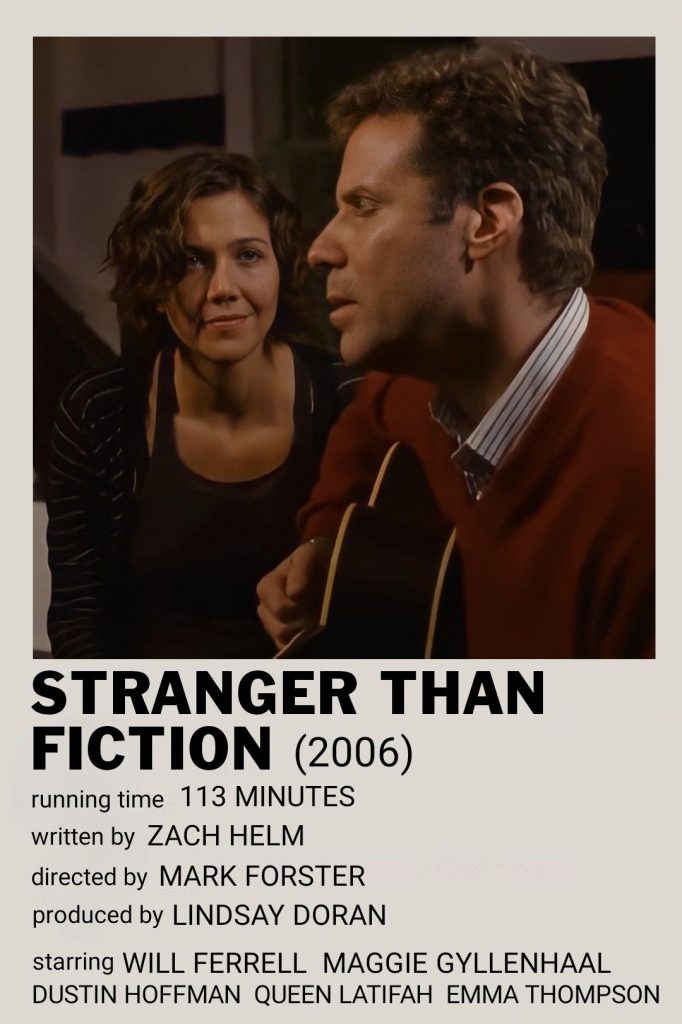
All of which has some really interesting theological resonances — asking questions about the Doctrine of God, of creation, and of free will, but those are not what I want to focus on in this article.[1]
Instead, I want to focus on a brief but critical scene that comes near the beginning of the film. Harrold, after his realisation that everything is not as it seems, does what anyone in these circumstances would: he visits an English professor.
And Professor Hilbert, a stereotypically eccentric academic played by Dustin Hoffmann, tells him that the core question to ask, the question on which everything else turns is:
“Whether you’re in a comedy or tragedy? To quote Italo Calvino, the ultimate meaning to which all stories refer has two faces: the continuity of life, the inevitability of death. Tragedy, you die. Comedy, you get hitched.”
The question you’ve got to figure out, Prof Hilbert tells our protagonist, the thing which will define the contour and meaning of your life, is, are you living in a comedy or a tragedy?
And so Harold goes out into his life with a notebook, keeping a tally of the tragic and the comic.
Land a joke with the beautiful girl? Check comedy. Completely misread the situation with the same beautiful girl? Check tragedy. Do the math, add up the moments, and you’ll find the answer that will define your life.
***
Now, the context for my own thinking about this question is the trend in academic circles of what’s known as tragic theology.
For nearly 70 years, theologians have found the intersection of theology and tragic literature very helpful for reflecting on a world that contains so much evil, and a religion which centers around a crucifixion.[2]
However, if we think in terms of narrative arc, Christian theology has always been and will always be, unashamedly comic.
That is not to say that it has always been funny, but it is to say that Christian faith does its thinking against an ultimate horizon of an unequivocally good ending. The Bible, like a Shakespearian comedy, ends with a wedding: the marriage feast of the lamb. The story finishes with a world in which order has been restored, in which every tear has been wiped away, in which death itself — the great force in tragedy — has been defeated. In the “continuity of life/inevitability of death” binary, Christianity lands squarely on the eternal life side.
Now the Bible is actually, I would argue, relatively underdetermined as to the specifics of heaven: the much-satirised images of clouds and harps owe their origin to deliberately imagistic and metaphorical descriptions — though, personally, the busier and more complex my life becomes, the more the stereotypical vision of hanging around on clouds playing the harp in a white robe actually sounds quite appealing!
But however we imagine heaven — and I think we are given pretty wide latitude — the Bible is unequivocal that it will be a good existence, that it will be the happy ending to end all happy endings.
So on one level, Christian life is always lived against a comic horizon, against a promise that if the ending is bad, that means it is not yet the ending.
***
There are undoubtedly problems with this ‘pie in the sky when you die’ type of discourse. It can be used, and has been used, as a way to minimize people’s suffering and pain in the present, holding out a carrot of hope for when they die. It can also be used as a way to deflect attention away from current problems that could actually be solved, arguing instead that if God will fix everything in the end anyway, there’s not much point in trying now. Indeed, these sorts of arguments were part of the impetus behind tragic theology.
But, despite those misapplications of the doctrine, eschatology — the area of theology which deals with what happens at the end of all things — is actually an important source of hope, and it is frankly unavoidable in the scriptures.
To give just one example amongst many, Paul writes in Romans 8: “I consider that the sufferings of this present time are not worth comparing with the glory about to be revealed to us.”
If eschatological hope is real, if the reality of a life beyond death is true, then there must also be real hope for real suffering people that the horizons of this life are not the end; that however much our world feels unescapably tragic, and however much some lives seem never to escape a tragic narrative arc, it is only because we see from a perspective within the story, and not from its end.
***
But there is also another horizon against which the Christian story becomes comic.
To be a human being, it strikes me, is often to live under a sort of existential question mark, a constant asking of whether I matter, whether I am good enough, whether there is any meaning to my life.
Remember Harold Crick, trying to figure out if he’s in a comedy or tragedy by a moment-to-moment tallying up of the funny and the sad? If we want to know what kind of life we are living, our natural internal logic tells us, then obviously the tally system approach is the way to go.
The New Testament, and especially Paul, has a word for this system for answering the “meaning” question: justification. We often build our lives around projects of justification, of searching for a verdict on our existence that will say, well done, you are enough, your story is one that means something.
Framed in this light, the question of comedy or tragedy is not so much do you die or do you get hitched, but, in the end, was this a story that went somewhere? Did the fragments get drawn together into a coherent whole, or did all the stuff of our lives just turn out to collapse into a meaningless splurge of inconsequential, disconnected events?
***
To the question framed in this way, Christianity gives an unashamedly comic answer.
Again, we have Paul speaking: “Who will bring any charge against God’s elect? It is God who justifies.”
The hope promised in Jesus Christ is not simply that all will be made well once we die, though it is not less than that.
It is also that we are justified. That is, that a verdict has been spoken on our life, and that that verdict is one of commendation, of approval, of love, and not one of condemnation. Indeed Paul is explicit: “There is therefore now no condemnation for those who are in Christ Jesus” (Rom 8:1).
As my former New Testament teacher Jonathan Linebaugh is fond of saying, this is a verdict that is based not on our biography, but on the biography of Jesus Christ. It is a verdict based not on the story I tell, but on the story God tells about me.
The question of justification — of whether we matter, of whether our story is going somewhere — is not a question that we have to answer. Indeed, it is not a question that we can answer. But it is a question that has been answered definitely, in our saviour who died on a cross.
So we don’t have to keep a tally in a notebook to determine if our lives are comic or tragic, because that decision has already been made, and has already been spoken over us.
In light of this gracious verdict, life can begin to feel a little different. Perhaps, when we suffer (and we will), we can trust that the pain is not the end of the story. And when we wonder whether our lives mean anything at all (and we will), we can know that there is an objective answer to that question in the death and resurrection of the Son of God. And when we feel that we are not enough, that our lives are disordered, and that our stories are meaningless (and we will), we can remember that “neither death, nor life, nor angels, nor rulers, nor things present, nor things to come, nor powers, nor height, nor depth, nor anything else in all creation, will be able to separate us from the love of God in Christ Jesus our Lord.”
And we can know that even when everything we see and experience seems to point to the contrary, our lives are in fact comedies, at least when played out against God’s horizons. Perhaps, then, we might find comfort for the trials we face, security when everything feels like it is falling apart.
And, who knows, we might even find laughter in this most ludicrous of worlds, because: “If God is for us, who can be against us?”








Thank you! One of my favorite movies. I very much enjoyed your reflection on it. I’ve loved the movie and always thought it was “deep.” I am glad to read of its depth.
Thanks so much for this article. I have not seen Stranger Than Fiction. Having read your article I’m anxious to check it out. Incidentally, if you haven’t read it I believe you would really enjoy Telling the Truth: The Gospel as Tragedy, Comedy, and Fairy Tale by Frederick Buchner.
Good writing. ( It’s usually ‘good’ when it says what I want said😂.).
Appreciate Jonathan Linebaugh quote regarding the verdict – Not based on my autobiography but on the one that’s written by God! Thanks.