




For almost ten years, we’ve been studying how people draw on their faith during times of suffering. One woman we interviewed summed up her theology of suffering in a single sentence: “I think I just came to a place where, ‘we’re in a world where it’s not perfect.’ We’re not in heaven and things happen.”
She wasn’t being flippant. She had cancer. She’d wrestled with God about it. And she’d arrived, through genuine struggle, at something that sounds simple but is actually quite profound — and quite rare. She knew where she was in the story.
Most of us don’t.
We’ve gotten very good in the modern church at two postures: triumphalism and despair. The triumphalist knows that Christ is risen, suffering is temporary, and the Christian life is fundamentally a victory lap. The despairing person has heard that message and noticed, with some bitterness, that their life doesn’t feel much like a victory lap.
What we’re less practiced at is the third option — the one that the church calendar actually offers us every single year, nestled between Good Friday and Easter Sunday. Holy Saturday.
 Holy Saturday is the day the disciples didn’t know what to think. The tomb was sealed. Jesus was dead. They had believed he was the one who would redeem Israel — and now they were sitting in an upper room, terrified, trying to figure out what any of it had meant. They were not in despair, exactly — they hadn’t yet had time to fully reckon with what had happened. But they certainly weren’t celebrating. They were just … waiting. In the in-between. In the not-yet.
Theologians have a name for the space we all inhabit — the disciples on that Saturday and all of us today: the “already but not yet.” Christ has already come. The decisive battle has already been won. But the ceasefire — the final defeat of sin, suffering, and death — has not yet arrived. We live between D-Day and V-Day.
That image comes from Oscar Cullmann, a Lutheran theologian who lived through World War II. D-Day, June 6, 1944, was the decisive turning point of the war in Europe. The Allied troops stormed Normandy, and from that moment, the final victory of the Allies over Germany was never seriously in doubt. And yet the war continued for nearly another year. Some of the bloodiest fighting happened after D-Day — after the decisive victory had already been secured. Soldiers still died. Families still waited. POWs still sat in camps across Europe.
Cullmann saw the cross and resurrection as the Church’s D-Day. As Colossians 2:15 puts it, Christ “disarmed the powers and authorities” and “made a public spectacle of them, triumphing over them by the cross.” The victory is real. It is assured. It is, in the most important sense, already over. But V-Day — when every tear will be wiped away, when death itself is swallowed up, when the whole creation is finally and fully restored — that is still to come.
There is a theological name for what happens when we forget this distinction: over-realized eschatology. It’s the attempt to live and worship as though V-Day has already arrived — as though the consummation is already here, the kingdom fully present, all groaning done. It collapses the “not yet” into the “already,” and it leaves suffering people feeling not just sick or bereaved or afraid but spiritually deficient. If victory is total, why do I hurt? If Easter has resolved everything, why am I still in the tomb?
This already-but-not-yet framework is not merely a theological curiosity. It’s a survival map — and its absence does real damage.
In our interviews of almost one hundred Christians navigating cancer, we kept encountering people whose suffering had been made harder, not easier, by their theology. Not because they’d been given too little hope, but because they’d been given the wrong kind — hope that had no room for the present reality of pain.
Monica, a cancer survivor, described the message she’d received this way: “God works it all out for good, so praise him in your troubles. And if you don’t praise him through your troubles, you’re missing the blessing.” For Monica, this created a kind of spiritual performance requirement on top of her cancer. She wasn’t just sick; she was apparently doing sick wrong.
John, who read healing scripture verses every day, believed the practice guaranteed his continued remission — a faith that functioned less like trust and more like a ritual for maintaining control.
What none of these frameworks offered was a theologically legitimate place to stand in the middle. A place where the victory is real, and the suffering is real, and both can be acknowledged without the second undermining the first.
The already-but-not-yet offers that place. As Paul writes in Romans 8, the whole creation is “groaning” as in the pains of childbirth, “waiting eagerly” for the redemption that is coming. Groaning and waiting eagerly — held together, neither canceling out the other. We don’t have to pretend the groaning isn’t happening. We don’t have to abandon the eager waiting because the groaning is real.
What makes over-realized eschatology so compelling — and so hard to resist — isn’t just theological sloppiness. There’s a psychological dimension worth naming.
Cognitive scientists distinguish between two ways of knowing. One is explicit: propositional, logical, verbal, conscious. The other is implicit: emotional, relational, embodied — the kind of knowing that lives in the gut rather than the head. Both are real. Both shape us. And crucially, the implicit system tends to drive the explicit one far more than the other way around.
This matters for how we relate to uncertainty. The capacity to tolerate not knowing — to sit with tension rather than resolve it prematurely — isn’t primarily a cognitive skill. It’s rooted in our emotional and relational foundations, in the implicit sense of whether the world is basically safe and whether we are basically held. People who have a secure relational foundation can afford to let questions stay open. People who don’t will feel the pressure to close them quickly, in whatever direction relieves the anxiety.
Our Enlightenment inheritance hasn’t helped. We’ve absorbed a cultural demand for what theologian Graham Ward calls “certainty, transparency, daylight forever” — a system in which any shadow of doubt or ambiguity is a problem to be solved, not a condition to be inhabited. The cultural message is that maturity means certainty. Mystery is for children.
The Christian message runs exactly counter to this. The already-but-not-yet is not a theological gap to be filled in. It is the actual shape of faithful life. We see, as Paul puts it, “a dim reflection as in a mirror” — not because our faith is weak, but because we are finite creatures living between redemption and consummation, in a story we did not begin and will not end. Learning to live well in Holy Saturday requires not just correct doctrine but a deep enough trust in God — implicit, relational, gut-level — that uncertainty doesn’t have to be resolved in order to be survived.
This is what we found in our research. The people who navigated suffering best were not, on the whole, the ones who had the most complete theological explanations. They were the ones whose relationship with God had become secure enough to hold the tension. One participant described coming to a place of what philosopher Kent Dunnington calls “glad intellectual dependence on God” — letting go of the need to find answers on the internet, to locate the person who’d been cured and replicate their protocol, to make God predictable. “If I can let all of that go and just make God God,” he said, “then everything else kinda goes away. And I can lead the rest of my life breathing, walking, in communion with God. It’s very nice.”
“It’s very nice” is not a triumphant cry. It is the quiet testimony of someone who has learned to live in the in-between — not because the tension has been resolved, but because the God who holds the tension is trusted.
Another woman in our study gave us that plain, honest sentence about the imperfect world. She hadn’t arrived there easily. She’d been raised to believe that good choices produce good outcomes — a kind of moral-market theology that her cancer had simply demolished. She was angry at God. But over time, she came to a different resting place: “I think I just came to a place where, ‘we’re in a world where it’s not perfect.’ We’re not in heaven and things happen.”
That’s not resignation. That’s eschatology. She had located herself accurately in the story — between fall and consummation, between D-Day and V-Day — and that location, once accepted rather than fought, turned out to be livable. The next world will be just. This one is not. That distinction, held by a faith that trusts the one who spans both worlds, turns out to carry more actual comfort than the false promise that this world should already be what it isn’t.
Holy Saturday is the church’s most honest day.
It’s the day that doesn’t let you rush to the ending. It’s the day that says: the world is not fixed yet, and you don’t have to pretend otherwise. It’s the day that asks you to sit in the tension between what is true about the past — Christ is crucified — and what is true about the future — Christ will rise — without papering over the present.
Most of us live here. Most of us live in between a decisive victory we didn’t earn and a consummation we can’t bring about. The strange gift of this in-between is that we don’t have to perform certainty we don’t have, or peace we haven’t found. We just have to be honest about where we are in the story — and trust, at the level deeper than propositions, the God who is already there.
We’re in Holy Saturday. And we are not alone there.
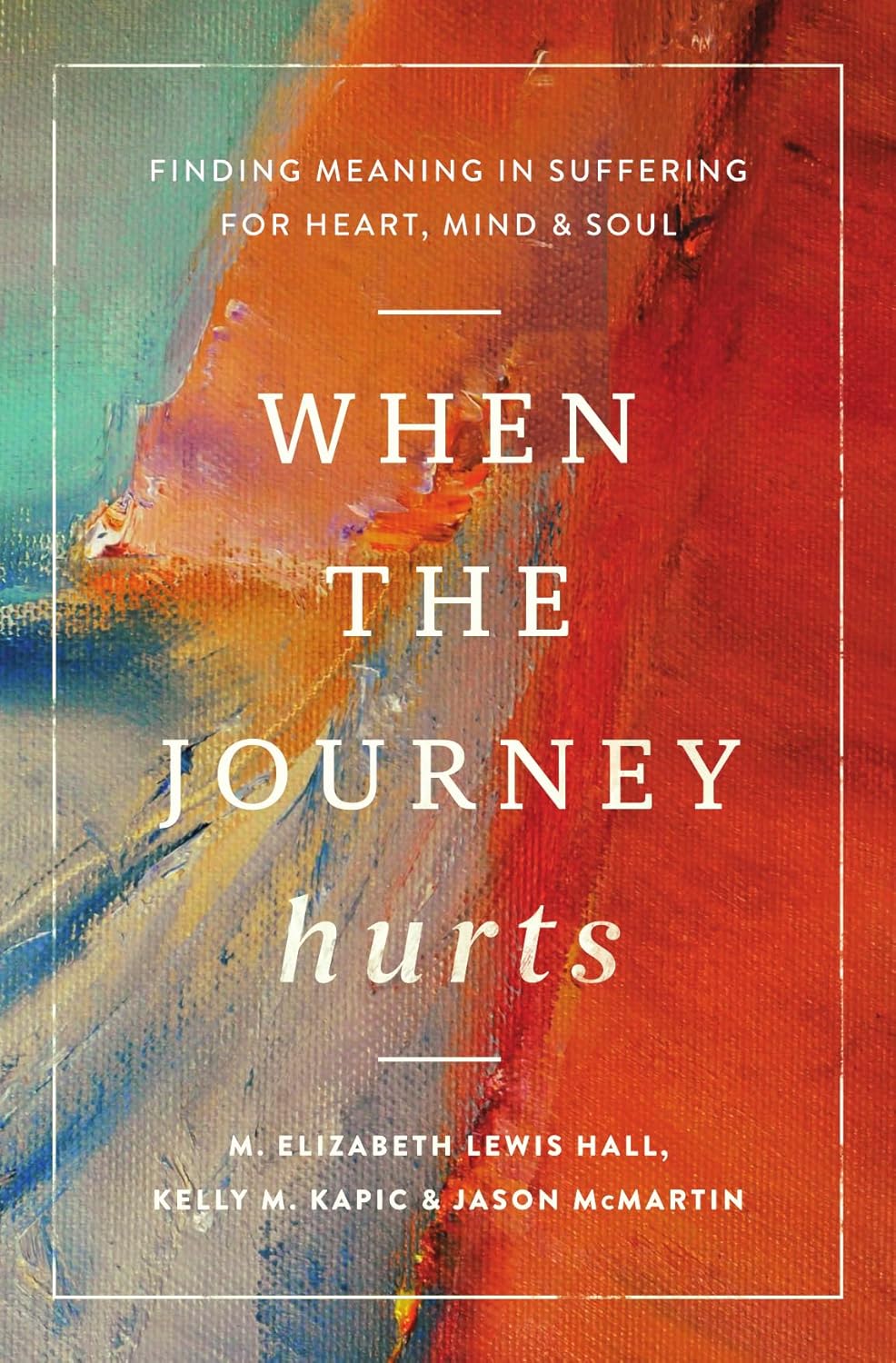
Elizabeth Lewis Hall, Kelly M. Kapic, and Jason McMartin are co-authors of When the Journey Hurts: Finding Meaning in Suffering for Heart, Mind, and Soul (IVP, 2026). Hall is a clinical psychologist and professor at Rosemead School of Psychology, Biola University and has over 150 academic publications. Kapic is a theologian at Covenant College and has written or edited over 20 books. McMartin is a theologian at Biola University and has served as an urban missionary and bi-vocational pastor.







Thank you. My church tradition doesn’t spend much liturgical or theological attention to on Holy Saturday, but when I stumbled across it I found it to be something that relates to my real life (unlike triumphalism). Holy Saturday isn’t easy or fun, but it is a blessing.
Thank you for this excellent piece. It reminds me of a quote from the wonderful Chritian psychiatrist, Dr. Frank Lake: “Most transformational counseling takes place on Holy Saturday.”
Thank you for this beautifully articulated lesson. I found it so helpful.
Thanks for the rare article regarding suffering. Kind of a history nerd so the D-Day/V-Day analogy resonates with me. And my grandparents were very active participants in that war effort.
Thinking of being ill in that light brought something to mind. We are commanded to love others as ourselves. What was Jesus doing for the first 30 years of His life to love others? Can a carpenter through his trade be loving others?
Everyone, I think, who has cancer is fighting, like our troops who hit the beaches on D-Day. Oh they are fighting to stay alive themselves to be sure, but they were and are also fighting for each other, and all of humanity. Loving others as they love themselves…regardless of the individual outcome, they are each one advancing the fight to find a cure. All those involved in research and the day to day care of cancer patients, they are fighting…all of them…until V-Day.
May God grant everyone fighting this fight a deep sense of His presence with them, and may cancer be brought under the dominion of our God given responsibility to fight the chaos by finding the cure.