




Where in all the varied movements of creation is there any work of God which is not wonderful? … Indeed, how many common things are trodden underfoot which, if examined carefully, awaken our astonishment. –Augustine (Letters 137.10)
My daughter Bekah has a quirky and remarkable gift. Ever since she was a child, she’s had a knack for looking at a stand of clover and immediately — instantly — finding a four-leafed cluster. Over the years she’s plucked her finds and tucked them in her journal. She’s well into adulthood now, and on a recent spring day, strolling with her and her then-fiancé on a mountain road, we passed a clump in full display. This time she outdid herself: within seconds she had found two four-lobed clovers.
“How do you do that?” I asked. She smiled and shrugged. Once back at the cabin we looked up the probabilities on Google: Only one out of every 5,000 stems (or 10,000 according to another source) have the foursome.
Bekah gave me one of the two she had found and I taped the gift to a page in my own journal. Looking at the clover just now, I’m baffled again. Perhaps a brain scientist or ophthalmologist could theorize about pattern recognition. About how some people have sharpened perceptual abilities. How some of us don’t.
The Mystery of What We Notice
The biblical tradition cares deeply about sight — about not missing the glory in front of us. Jesus himself bemoaned the refusal of religious leaders around him to recognize the work of God unfolding before their eyes, their stubbornness an obstacle to their awed recognition of the Son of God. No wonder Jesus’ most common healing miracle was the restoration of sight.
I realize in my daughter’s ability how there’s a mystery to what we perceive — and what we miss, something indefinable in what we zero in on or overlook. Who knows why some see a sharp outline when looking at wayside wonders, and others’ eyes have a gauzy, dimming film?
And I find myself asking more questions: Can I cultivate a keener eye? Not just for odd clover leaves but in larger matters? Can I better orient my life with more reverent attentiveness? I’ve been considering what it means to look, not distractedly but worshipfully. Not hastily but with greater attention. And with a greater sense of anticipation.
Why We Miss What’s Right in Front of Us
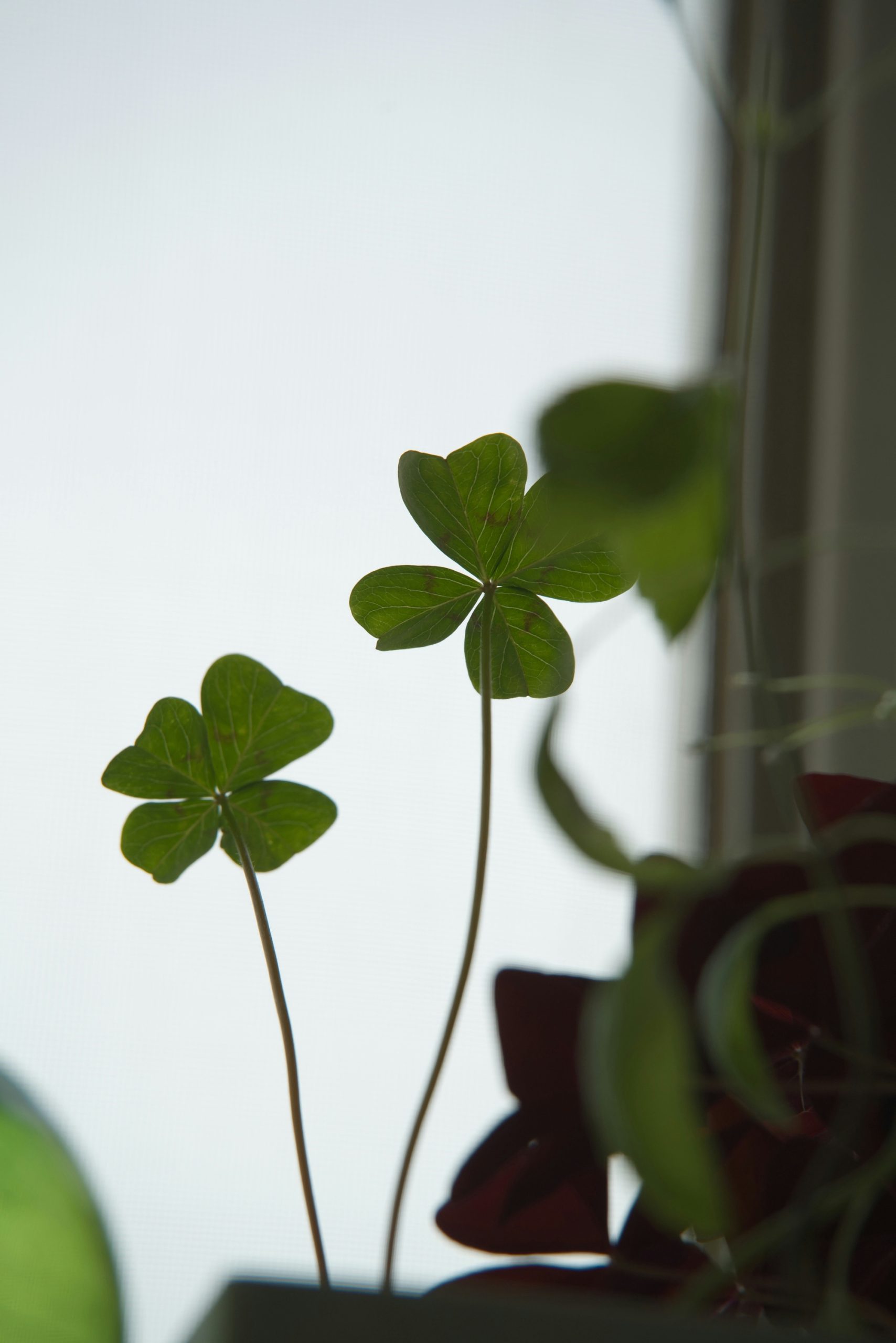
Sometimes I don’t see because I let distractions cover over my line of sight. Often, I simply forget to look. I don’t pay attention. And the phrase is intriguing: we have to pay something (like a moment or two) to have our looking rewarded. Much of that reality has to do with my scattered affections, my stutter-step threading or stumbling through everyday miracles. Maybe too often I don’t bother to move the surrounding virtual clutter to better see the created thing itself, in its mystery and reality and glory. Maybe my failure truly to see traces to how much I’ve gotten used to a mere scan. A rushed glance. Reverence does not thrive in the soil of hurriedness. We end up with, as someone put it, attention deficit disorder of the soul.
Flannery O’Connor was addressing a group of writers, but she could have been talking to any Christian, when she said, “There’s a certain grain of stupidity that the writer … can hardly do without, and this is the quality of having to stare, of not getting the point at once.” For, she said, “the longer you look at one object, the more of the world you see in it.”
I was told as a child that staring is poor manners. But gazing has its rewards. Might not a grain of humility, if it leads us to reverence as we traverse a wider world, open up our souls to insight and new delights we will miss if eyes stay glued only to our blue-glowing screens? We instead practice turning our eyes to our world (including other people) with a lingering, leisurely look.
A Presence-Saturated Universe
The handiwork of God has a translucent richness, and sometimes all that is just a look away. The heavens declare the glory of God, as we hear in Psalm 19, as does a carpet of woodland undergrowth. Sometimes reverent looking has its beginnings in simple wonder.
And when I lose track or get sucked back into bland, dulled seeing, sometimes lifting up my eyes to contemplate what stands outside my office window can reorient me. Even a bug-splatted windshield will do. Likewise, an unhurried look at a loved one bathed in candlelight. Glimpses stolen from a hectic day pull me toward the seen, put me back in touch, place me in the right posture — looking up or out. A charged glance may come in more simple settings than I think.
So most mornings I manage to sit still for a time. I try to remember that, as Dallas Willard wrote, we live in a “God-bathed and God-permeated world.” I may have to allow a little time to lapse, or a little more light to slant. When I can, I try to find some time or another to walk outside, sky suspended over me, whether at dawn or beneath a starry spectacle or under a noonday dark-clouded weightiness.
Eyes Opened by an Ache and a Grief
Sometimes what shakes us from our doldrums into reverent attentiveness has to do with hard, even harsh things. As a young adult I experienced the trauma of rejection by my parents. When I had left my California home as a young man for seminary on the opposite coast of the country, I met the person I wanted to marry. My parents thought I was too young and promised to boycott the ceremony. I proceeded, over my parents’ protests, with the wedding. It opened a rift in my relationship with my parents that took years to mend. I braved angry letters, threats to disown me. An aching for their affection and blessing went unfulfilled — for a time. Thousands of miles between us, my parents’ ailing health, and my tight finances all conspired against a reunion.
I saw again how suffering can narrow our field of vision, make us shrink back, can keep us from seeing blessings at hand. But it may also open us up, sharpen our raw seeing. What if the dreaded, ugly turn of events can jolt us alert, deepen our ability to see into the heart of things?
That is what I found when a trip Jill and I planned for Thanksgiving week — to California — finally brought a real change. We were to attend a church conference not far from my family’s Santa Monica home. It was the perfect occasion to gather — this time with Jill and our little children. And I felt a new appreciation for what I’d been denied. As I recount in my book Awake My Soul, from the moment we walked up the steps of their sea-green stucco house perched on a rise above the sidewalk, I was all eyes. I took in the familiar worn places in the gold shag carpet (installed in the seventies), the tropical flowers in the backyard, the view of the Pacific waters from what had been my second-story bedroom. I don’t think I casually noticed anything that trip.
Most of all, I took in my parents’ faces. During a spare moment of our stay I jotted in my journal, “I feel great love for my parents when I look into their eyes. And I feel it from them.”
We may let experiences roll over us until something, like a separation or illness, yanks us from distracted, half-tied noticing. Until suffering jogs or jostles us to a deeper look or heightened attentiveness.
Seeing the God Who Sees Us
Still sitting in a bit of wonder over my daughter’s uncanny ability to scan a bed of clover and see what just about anyone else would miss, I’m thinking of yet another kind of seeing, a larger perceiving that I’m also finding mysterious — and beckoning. I mean not just becoming aware of evidences of God but glimpsing God — the sight upon which no one can gaze and live, who yet condescends to become incarnated in humanity, taking up residence in creaturely life. Surely that means God shows up on the premises of my life, too. Psalm 19, with its assurance about the heavens declaring the glory of God, makes a turn to go deeper. We exult in not just a general (possibly impersonal) revelation of divine glory, but something even more relationally rich. God’s guidance, his attention to our lived lives, continues to work, “reviving the soul, … rejoicing the heart” (see vv. 7–8).
So it seems possible, as some of the church’s saints and mystics claimed, like fourteenth-century Julian of Norwich, that we meet a presence that doesn’t just see us from afar but who holds us in the palm of his hand. In one of her renowned visions, “all that is made” is like “the size of a hazelnut,” yet tended, loved (Revelations of Divine Love, 5). The child of God sees One who is both infinite and yet also willing to be intimate. Our souls stand at attention at such a gift. And so in the ancients I catch sight of a sharpened perception.
Julian surely had plenty of ugliness around her — a plague that exceeded our COVID pandemic for its sheer, crushing devastation. A petty war raged. Famine hung over everyday life. But she knew that horrific illness and unjust suppression of peasants did not blot out spiritual reality. When she spoke of hope, it was more than her eyeing traces of glory in creation, but something more personal, more relational, more close by. She knew she was being watched over by Love. Her visions made that clear — and not just of the hazelnut but in the crucified, willing Jesus. “And in this I saw cause for celebration and cause for lamentation,” she confesses: “cause for celebration, because our Lord, our maker, is so near us and in us, and we in him; … cause for lamentation, because our spiritual eye is so blind and we are so weighed down by the burden of our mortal flesh and the darkness of sin that we cannot see clearly the fair, blessed face of our Lord God.” (Revelations of Divine Love, 72). But it’s that Face that we want, isn’t it? The face of no less than God made real, brought down to flesh, subjected and submitting to the worst of human suffering.
In the Mix of Tedium and Transcendence
A while ago, with all this rolling around, I headed from my parked car to my office at the time with a prayer under my breath. I said something along the lines of “God, help me see today — see you.”
That day unfolded with a mix of tedium and significant conversations. I was already a bit down from a drizzly sky. And nothing instantaneous happened. But that day, and the next, I found myself noticing things that had a feel of hopefulness. That reminded me of the Ultimate presence. Was it grace, God’s pure willingness to answer my asking? More divine light got through to my heart’s field of vision. It was more than my simply squinting and looking harder.
With this kind of God drawing close, I tell myself to look around amid the odd and common and hard. Even better, I recall the extravagance of the God who has surprised me again and again, helping me to see what once I could not. Helping to make visible what I could easily miss.
With that kind of generosity at the heart of God’s doings, I’m hopeful that I can expect to see more — even more.
An alternate version of this article previously appeared in Fathom Magazine.





This is dazzling, Timothy. God bless you, your family, and your folks.
Thank you, Ryan. Your comment means a lot!
As soon as I read your thoughts I want to immediately read again!
I love this so much and remember you being able to “see” things others couldn’t when we worked together. I shall remember this. Thank you.
Thank you, Deen!
Thanks, Marcia, for your kind words. It was so good to work with you.