




When the Apostles’ Creed confesses belief “in the communion of saints,” it says that we trust that death is not the end of anyone; that death no longer has the power to separate us from those we love or to isolate those who love us from our company, nor any human from the God who loves all humans.
The 1984 film Places in the Heart begins on a Sunday in a small town in Depression-era central Texas. After church, we see families sitting down for meals.
The sheriff of the town sits down with his wife and children and prays. We hear gunshots in the distance. It seems a young Black child is drunk on whiskey he found and is shooting a gun down by the railroad tracks.
The sheriff goes to investigate, and the boy accidentally shoots him dead. The townspeople then tie the boy to a car and drag him through the town until he is dead and then hang his lifeless body in a tree, while the sheriff’s widow and sister wash and prepare the sheriff’s body for burial on the table where Sunday supper was just served.
The local banker begins to take advantage of the widow, making her house his blind brother and threatening to foreclose on her house and farm (implying in the process that sexual favors might help her cause). The widow hears about a contest for bringing in the first cotton harvest of the season and realizes she could save her house and farm if she combines the prize with a good price for her cotton. So she and a Black man she befriends, her children, and her blind boarder all set to work on bringing in the harvest. By sheer sweat, labor, and injury, they win the annual cotton prize, despite a violent tornado that kills several of the townsfolk. The Black man she befriended helps the widow negotiate a good price for her cotton from a crooked mill owner, and for this, the local KKK severely beats him.
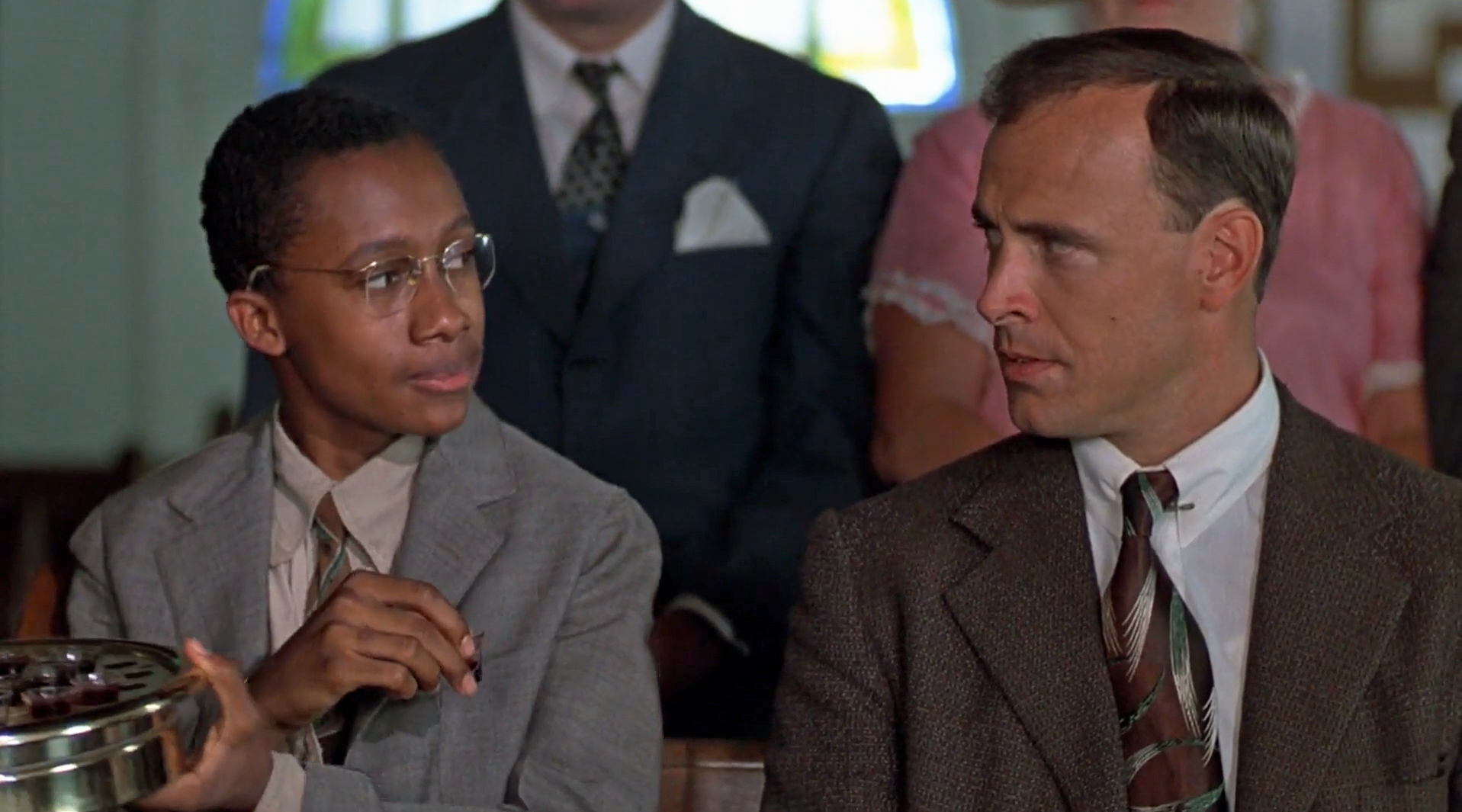
The film ends on a Sunday with everyone gathered at the church. As the congregation sings “I Come to the Garden Alone,” a plate of Communion crackers and a tray bearing thimble-sized glasses of grape juice are passed from person to person, from pew to pew.
It eventually becomes clear that all the folks who have died in the film or who have suffered and been banished are right there in the pews with those who are still “living,” taking Communion together as, and with, the communion of saints.
The final pair to share the bread and juice, the body and blood of Christ, are the deceased sheriff and the young Black boy, who says to the sheriff after they eat and drink, “Peace of God.”
Though some of the members of Christ are invisible, they are not dead. We see them with what scripture calls “the eyes of the heart.” Other saints are saints we can see, the ones sitting next to us in our pews, the ones who brush up against us as we walk down the street.
In Hebrews, there’s a litany of our ancestors in Jesus — some shady characters among them — whose lives are recounted with all the shadows of their actual lives in the world now gone. All that is left of them is their union with Christ, and we recognize them as the forever persons they are in him.
We are told that the saints — some known, most forgotten by history, some still inhabiting time — surround us in our lives. We cannot see most of them, but they are nevertheless really and truly here.
Communion takes us on a journey to a place where the visible world meets the invisible one, where in worship we experience our union with a great company that no one can number. In some churches, this is not left to the imagination. When you walk into an Orthodox sanctuary, everywhere you look, on almost every surface, you see the saints. At Communion (or Eucharist), as part of the mystery that we trust, the line between this world and the world that is coming to this world is all but erased. As Jason Micheli writes:
The Christian community is one that blurs the line between this world and the next. That’s why Christians use the word “veil” to describe death, something so thin you can nearly see through it. […]
Death does not destroy or fundamentally change our relationship to the dead. We pray and, according to the Book of Revelation, so do they. We praise God and, according to their Eucharistic prayer, which we are about to join, so do they. We try to love God and one another and, according to the Book of Hebrews, they do so completely.
As they were present on Mount Tabor, Moses and Elijah are present at every Lord’s Supper, as are Mary Magdalene and Priscilla, John and Paul, Irenaeus and Origen, Athanasius and Macrina, Francis and Clare, Edith Stein and Medgar Evers, Malcolm Muggeridge and Shūsaku Endō. We are saints together with them. C. S. Lewis wrote that we can ask these invisible but somehow embodied ones who surround us to pray for us, just as we might text a friend to intercede for us.
How is that possible? Because we serve the God of the living and not the dead (Matt. 22:32). They are with us as part of the communion of saints; they are not dead but alive. So we ask all who have died but who are not dead (Mt 22:32), who are alive in Jesus Christ and can “never die again,” to pray for us as we join their prayers.
Once a year on All Saints’ Day at the parish I serve in Michigan, everyone who has lost loved ones that year or who are in grief about any departed loved one or friend from any moment of their life is invited behind the altar for the consecration.
It is at the Eucharist where our communion with all the saints is most poignant, for at the end of the Eucharistic journey we are standing in the precincts of heaven with our feet on the earth. We are surrounded at the altar every Sunday by “all those who rejoice with us, but upon another shore and in a greater light, that multitude which no one can number, whose hope was in the Word made flesh, and with whom, in this Lord Jesus, we for evermore are one.”
Our fellowship with the dead is real, is ongoing, because Jesus Christ is resurrection and life. If you believe in him, if you die, you nevertheless live. If you believe in him, you never really die. Life goes on wherever God is.
The Rev. Kenneth Tanner is pastor of Church of the Holy Redeemer in Rochester Hills, Michigan. His book Vulnerable God will be published by Brazos Press in September 2026.








Thanks for this, Ken. Good word.
Bless you, Rebecca. May we all have many experiences of the resurrection.
So beautiful my brother. Our eternal communion with all our brothers and sisters stirs our love for each other! Praise to our God who has given us life in Christ!
Wonderful. Thank you my dear friend.
Absolutely beautiful. Thank you for this, my friend.
Thank you so much, KT. This is so beautiful. And that scene slays me every time – and every week as we enact it again.