This interview appears in Issue 28 of The Mockingbird magazine, now available to order.
Whether criticizing the latent shame in the Sex and the City reboot, displays of conspicuous consumption on TV, or the harmful effects of widespread porn, Sophie Gilbert is always looking beneath the eerily smooth veneer of popular culture. A striking example is “Reclaim Imperfect Faces,” her razor-sharp critique in the Atlantic this past spring in which Gilbert laments the rising trend of “digital faces tweaked and pixelated into odd perfection.” These days, she writes, women are supposed to look like “porcelain ornaments.” To make her point she tries an experiment with an A.I. image generator. Prompting the bot to generate the picture of “a normal woman,” it instead produces “four extraordinarily beautiful women with curly hair, sculpted jawlines, and plump lips.” The more specific prompt “an average 42-year-old woman” yields “four Anne Hathaway look-alikes with monstrously oversized grins and visible clavicles, betraying only slight lines around their eyes.” It’s a telling experiment (and easy to replicate, if you are curious), which reveals not only the standards of today’s Artificial Intelligence but also that of average people.
Gilbert is a National Magazine Award winner and Pulitzer Prize finalist in Criticism. Her new book, Girl on Girl: How Popular Culture Turned a Generation of Women Against Themselves, is a damning, kaleidoscopic inventory of popular culture in the last several decades. From Britney Spears to Sarah Palin, public-facing women have been expected to embody an impossible combination of pure and sexy, youthful and mature. Around the turn of the century, she writes,
The tenets of post-feminism became mandates that none of us could really opt out of. There was only one way to exist in public, and it was a trap. As emerging stars got younger and younger, the pressure on them to check all the wildly divergent boxes only intensified. Seventeen-year-olds were expected to be sexy virgins, girls with porn-star looks and purity rings, able to sell anything to any demographic. This is not a balancing act that anyone can pull off for long. And the more visibly expressive or submissive women became in their sexuality throughout the decade, the more was demanded of us in turn.
While much has changed since the early 2000s, much is still the same. With surgical precision and clear-eyed prose, Gilbert diagnoses today’s standards of beauty, how they were shaped by the past, and what they might look like in the future.
***
For millennials, the images in your book were lodged in our young minds at a very early age: nightmarish ads for The Swan of women covered in bandages post-plastic surgery, the mass sexualization of a teen-aged Britney Spears, and the Spice Girls as adult women at an endless sleepover. What was the experience like for you to rewind the clock and revisit all this cultural messaging from your girlhood? And what would you tell your younger self now?
In some ways it was astonishing to get a sense of the totality of it — I remembered things in isolation, like Britney shaving her head and Gail Porter being projected naked onto the side of the Houses of Parliament, but not all the smaller moments that reinforced the culture of objectification. The general tone of men’s magazines in the ’90s and 2000s was really shocking, because I hadn’t been the biggest reader of them as a teenager. But also things like Howard Stern[1] and reality TV shows that turned women into guinea pigs in totally unethical social experiments, popular comedies: in general, so much worse than I’d realized at the time.
I can remember feeling discomfited sometimes, but not really having the words or the critical ability to challenge things. Now I think I’d tell my younger self that feeling that way is not only fine, but it’s a sign that you do know more than you think you do about what’s right and what you deserve.
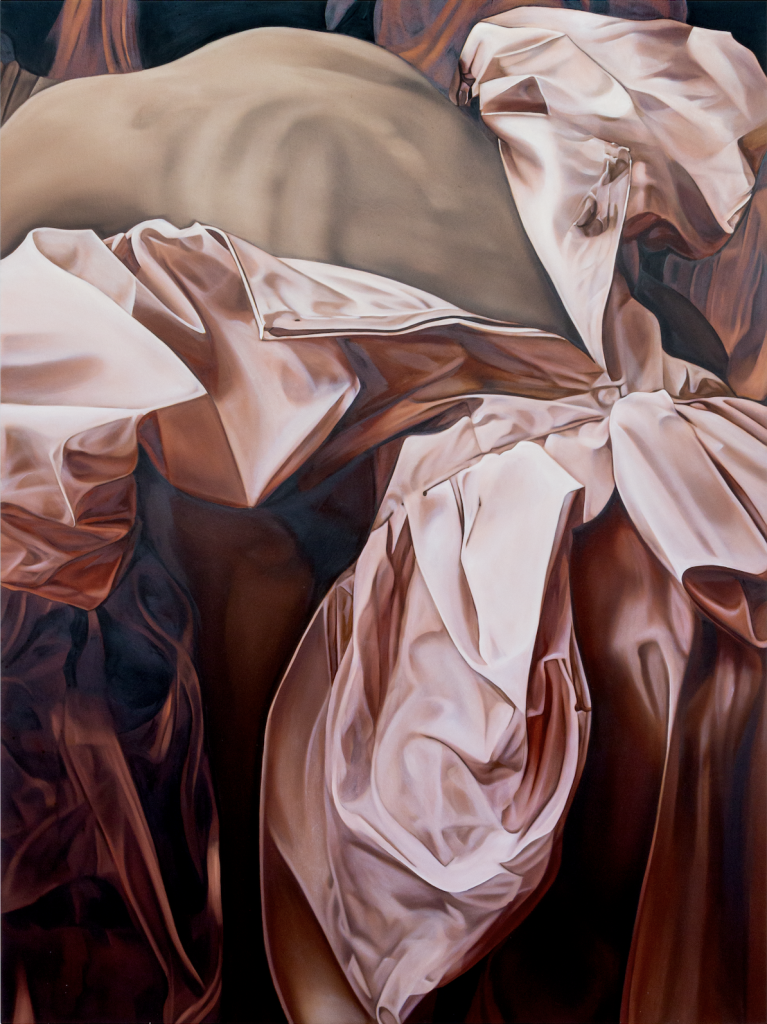
Rachel Sharpe, Chrysalis, 2025. Oil on panel, 48 x 36 in.
Lutheran theology makes a distinction between “law” and “gospel.” “Law” is a standard that you can never live up to, and “gospel” is the relief that frees you from that burden. In this parlance, your book shows many “laws” placed upon women through cultural messaging — that bodies must look a certain way and are endlessly “malleable” and purchasable.
What are some persistent harmful laws or expectations that you see today — and where might we find relief?
There are so many. There is a really pervasive expectation right now that women not age; they should do anything they can to visibly erase signs of aging, right up to and including $250,000 facelifts. We’ve come to accept as normal the fact that women (and, increasingly, men) will undergo unnecessary and risky surgical procedures and have toxins injected into their faces in order to look perennially thirty. But we don’t talk so much about what we lose in the process as a culture.
Society in the past has lauded wrinkles and gray hair in men as signs of wisdom, maturity, achievement, while demanding that women maintain the aesthetic of girlhood. What would happen if we actually rejoiced in signs of aging in women instead? What kind of values might we elevate? What kind of matriarchal wisdom and power might be allowed to thrive?
I think the discussion over teeth on the recent season of The White Lotus came from the fact that “flaws” in visible faces can feel like resistance. It is incredibly powerful to accept yourself just as you are. It requires overcoming an enormous amount of messaging that profits from telling you the opposite.
You describe how post-feminism repackaged liberation into shopping and self-objectification. Do you think beauty industries today still rely on that same post-feminist rhetoric of “choice” and “empowerment”?
Yes, of course. People use the word “empowerment” when they’re trying to justify something that they know others have valid arguments against, and that they want to sell us anyway. It’s never actually about giving women power. It’s about trying to persuade them that spending money or objectifying themselves will make them feel powerful. Wonderbras were deemed “empowering” by the manufacturers when they first launched. OnlyFans is “empowering,” its CEO insists. The word itself is usually a tell.
Is there a place for the market to help, or will the market always play a zero-sum game?
The market will do what the market will do, which is seize opportunities for profit. Often that desire can be toxic, but not always. I’m thinking about the beauty industry creating more options suited to a wider range of skin tones, for example, and becoming less exclusionary to women of color. And I’m trying to think of other examples and coming up short, but there are ingenious people out there, many women among them, trying to build businesses that aren’t wholly predatory or based on making women hate themselves.
In America’s Next Top Model and The Biggest Loser, shame was presented as a tool for self-improvement. What does that say to you about the moral dimensions attached to beauty?
Especially with regard to body weight, we’re programmed by decades of cultural coding to think that “thin” is morally good and “fat” is morally bad. We all have family members or friends who’ve internalized this worldview and so feel free to express judgment with regard to the bodies of others. And shows like The Biggest Loser really weaponized this impulse by encouraging the contestants to express feelings of shame, and encouraging viewers to judge their perceived failings at home, and, by extension, to project that shame onto ourselves so that we’d buy the Biggest Loser-branded products.
You quote E. Alex Jung: beauty has been seen as “a skill that can be honed.” Do you feel beauty can be honed or controlled in some way? If not, what is beauty in your view?

Spot illustration by Ruthy Kim
Beauty to me, at this point, is humanity. I’m much more drawn to someone who looks kind, thoughtful, or wise than I am someone who’s spent a fortune creating a face that’s symmetrical and technically flawless but also somehow uncanny.
One response to harmful cultural messaging (especially in conservative religious environments) is to censor, filter, or be otherwise suspicious of culture and artistic expression — a puritanical approach. How can we move toward a healthier expression of beauty and femininity, one that doesn’t exploit women, but also one that doesn’t shame them?
I think we need to reject shaming anyone for any personal decision they make regarding the way they look, but also be vocal about offering a counternarrative. The messaging regarding toxic beauty standards can feel so overwhelming. We need to make space for people to express different interpretations of beauty, ones that are based on self-acceptance, humanity, and gratitude.
If young people today were to redefine beauty for themselves, what do you think that might look like?
I think I’m too old to be an expert on this one. But there are a million different ways to be beautiful. I love the idea of a kind of philosophy of beauty that rejects the flattening effect of social media and A.I., and is curious and expansive.