




This essay appears in the Home Issue of The Mockingbird magazine. To receive your copy, order through our store, or subscribe here!
On a sunny Saturday afternoon in my neighborhood, I can’t go for a jog in any direction without seeing two or three lemonade stands. It’s notable because the houses tend to be set back on their lots, and casual neighborly interactions can be few and far between. Even after living here for a year, I still feel isolated sometimes.

Now, I’m not proud to admit it, but interested as I am in the presence of these lemonade stands, I tend to zip by the little establishments, waving kindly and making my excuses. You’ve likely made them too. “I don’t have cash!” I say with my palms up, or just a casual, “Looks fun, good luck!” What I don’t say is that I don’t particularly want lemonade, and I’m generally just trying to get to wherever I’m trying to get to.
Look, it’s objectively cute seeing kids sit at the end of their driveways selling their wares to passersby. And yet the interaction almost always makes me feel bad. It feels like a transaction predicated on my sympathy, and I don’t think I’m alone in that. I want to keep moving, walking my dogs, running, riding my bike. I want to keep my headphones in.
The last lemonade stand I saw, I happened to be on a bike ride with my two daughters. As I started a wide arc into the center of the street to wave and cruise on by, one of the two young girls at the stand yelled out the name of my older daughter. Recognizing the purveyors from Sunday school, we dutifully stopped to say hello. My daughters started chanting “lem-on-ade!” while I tried to explain to two elementary school kids that, although we would love lemonade, we didn’t have fifty cents (who carries change?) or any cash for that matter. And wouldn’t you know it, they pulled out a laminated Venmo QR code so I could pay with my phone.
Five dollars and three pours of overly sugared lemonade later, we were back on the bike trying not to spill too much out of our solo cups. But my four-year-old was quiet on the way home, and I could sense what this meant.
The next weekend I was awakened Saturday morning by an urgent whisper: “Daddy! Can we do a lemonade stand?” It was 5:45 a.m.
I had spent the preceding week fielding questions. When would we do it? Where would we put it? What if it rains? What if no one comes by? What if no one stops? What if we run out?
Lemonade stands hold an interesting place in the American cultural imagination. In many ways, they are perceived as crawling on the way to entrepreneurial walking. Make a product and sell it — that is the way. Now, I’m generally here for the oddball projects and excursions that come with parenting small kids, the more nonsensical the better. Making robot costumes out of old Amazon boxes before sunrise, hunting for shells in the pea gravel, coloring the concrete orb left on our patio by the prior owner with so much blue chalk it begins to resemble Neptune. But entrepreneurial lessons at age four are not my bag. Just writing this makes me feel inadequate, like perhaps I should be teaching my kids about money, profit, and creating value. But to what end? Can’t we just take it easy and play with friends and build forts and climb stuff?
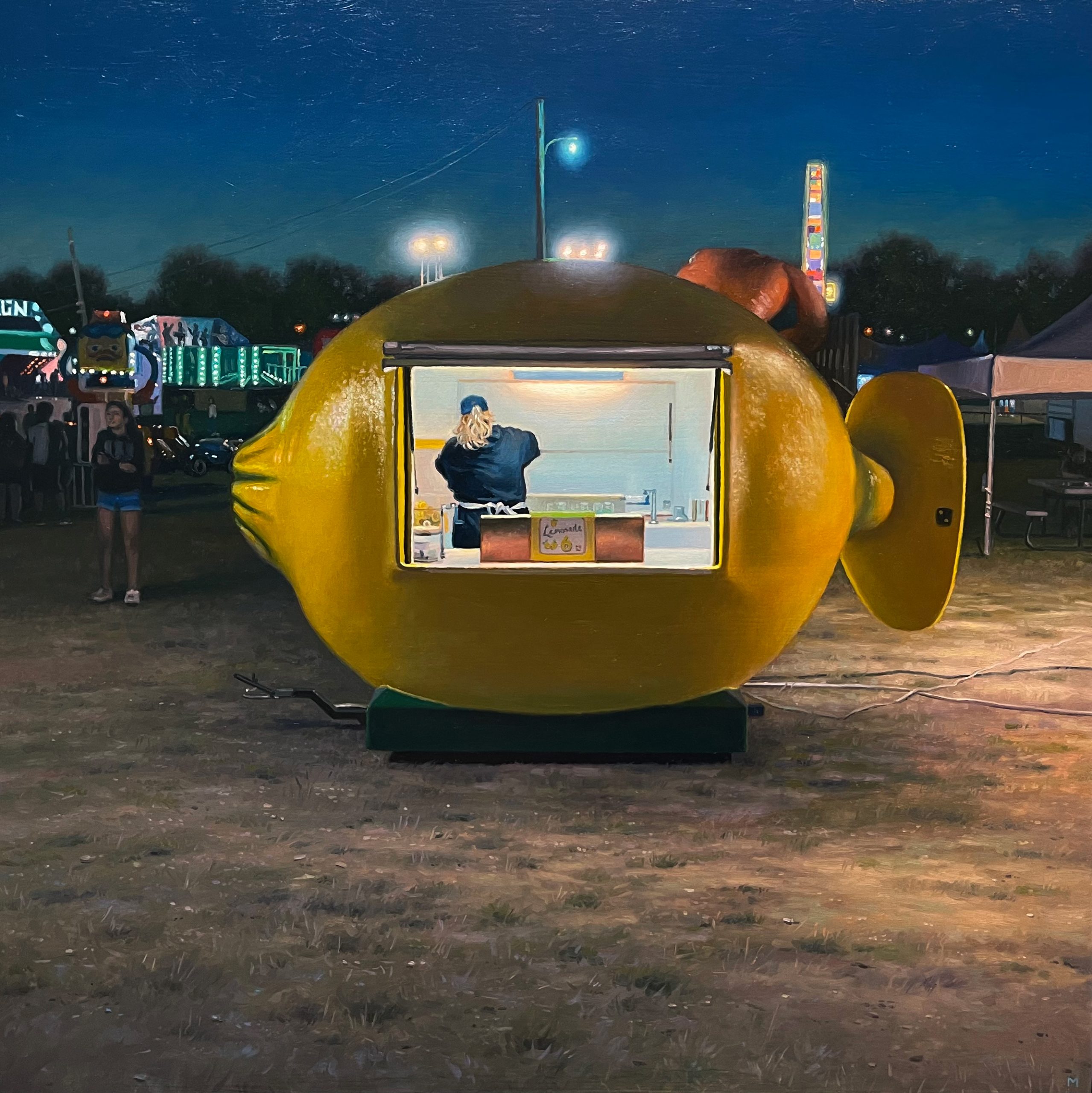
Matthew Cornell, Lemonade, 2023. Oil on Panel, 12 x 12 in.
Yet in my daughter’s imagination, the idea had taken root. We finally got the thing set up on a Sunday afternoon. We’d gone to the grocery and bought the powder mix, the plastic cocktail cups, and the plastic drink dispenser. My daughter observed that her toy hotdog stand (a gift from Santa) could easily be converted to sell lemonade given the proper signage. I discovered a half-used crossing-guard-yellow poster board that we decorated with sharpies and over which we pasted a cartoon lemon saying, “Squeeze the Day.”
Ah, but what about your working capital, you may be thinking; how will you manage the transactions? As I helped my daughter get set up, I could only imagine the hassle of dealing with the money. Either we charge fifty cents per cup and get no customers (who carries change?), overcharge for a dollar a cup, or try explaining a Venmo transaction to passersby. In any case, I assumed we’d be slightly annoying our neighbors. No, the point of this in my mind — to the extent that there was a point — was to fill my daughter’s imagination with the joy of making an idea manifest. The joy would be in the doing of the thing. And so we decided to give the lemonade away. We wrote a big “$0” in chisel-tip black sharpie on the front poster.
Now, let me tell you, free lemonade surprises people. It is a break from the script. A curiosity. To the plaintive, “I don’t have any money, I’m sorry,” my four-year-old shouted back, “That’s OK, it’s free!!” She received an assortment of replies. My dad said, “Entrepreneurship 101: always charge something.” A few people said, “I’ll go get money and come back,” which left us both a little confused. One woman passing swiftly with a dog took a moment to lean in and ask my daughter directly, “Hasn’t your dad taught you about profit margins?” before continuing on. But something else happened too. People perked up. “Oh,” they said. “Oh, okay, sure. I would love some.” Slightly confused assent — that’s how I’d describe the reaction.
A group of runners slowed enough to each take a swig, then continued on, hollering thank yous over their shoulders. Walkers stopped to have a drink and chat. A few friends pulled their cars over so their kids could come say hello and drink lemonade on their way home. An Amazon truck stopped in the middle of the street, and two workers hopped out, took full cups, and graciously left us a ten-dollar tip despite our protests.
We spoke with people we typically only wave to, met neighbors we hadn’t met. We even got the chance to speak with one neighbor, newly widowed, whom we hadn’t seen in weeks. She stood outside with us while the sun set and told us about her late husband and the fifty years of marriage they’d shared together. She told us she enjoyed the landscaping we’d done, taking down an overgrown stand of barrier plants and opening up the front yard, and that our girls seemed to bring new energy to the house. She told us how much we would love living here, and how much she and her husband had enjoyed living on the street that was now our street too.







This was absolutely beautiful! I laughed at the laminated Venmo sign (love that they thought of everything) and teared up at the Amazon driver’s guesture. I’m even brainstorming myself about maybe this could be a way to meet and baffle my neighbors. And also, I did wonder if that act was making it harder on those in the neighborhood trying to earn a little money. What a beautiful story. Glad I stopped by long enough to check it out and read it. Blessings and peace, Sejana
I loved this 🥲🥰❤️!!!
What an inspirational “ Lemonade Stand”!!!
Thank you Dr. Blankenship ❤️