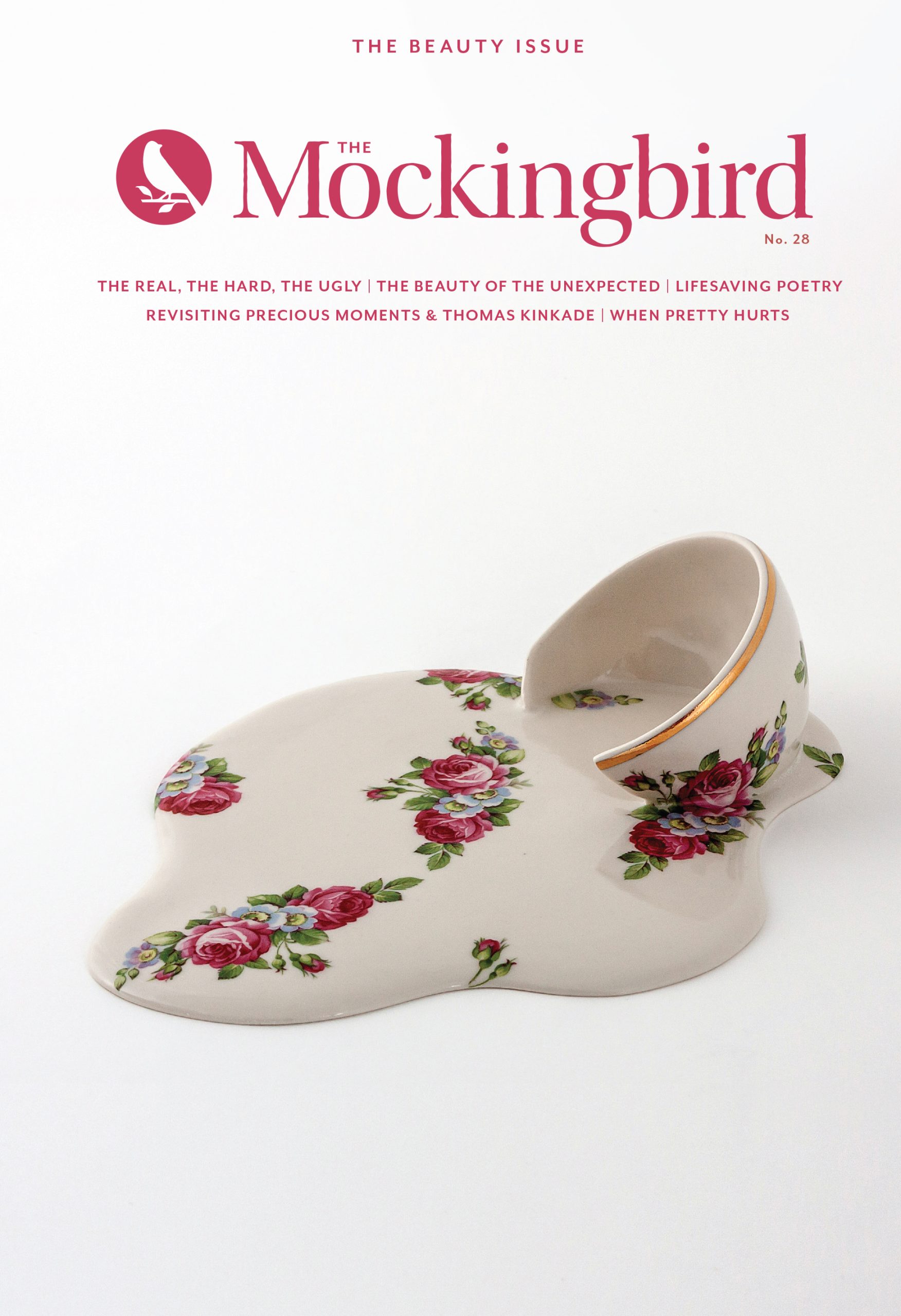
This essay appears in Issue 28 of The Mockingbird magazine, now available to order.
The beauty in unexpected places:
The headquarters of the two largest banks in Hawaii sit across from one another downtown. In the lobby of one you’ll find rotating art exhibits of paintings and sculptures from a local museum of contemporary art. In the other, a large video takes up one entire wall. It shows a man drawing and then painstakingly building a koa wood model of an ocean-going canoe. The finished canoe resides in a nearby glass case.
The beauty of what I’ve forgotten:
In the un-beautiful, tedious work of emptying my kitchen cabinets for a treatment to exterminate termites, I find, cocooned in red tissue paper and bubble wrap, a stunning cup that had been given to me by the potter who made it. Its dun surface seems suffused with fire, with one flame enlivening the outside, and a reddish glow within. I find a place for it on my crowded desk, and ponder the folly of “preserving” beautiful things by keeping them out of view.
The beauty of the useless statement:
The “hello, beautiful” I offer as a prayer every morning, looking east toward the sunrise, often even before the night sky has begun its shift to red and gold.
The beauty of fairy terns (manu-o-ku) in flight:
One of the few native birds that has adapted well to urban Honolulu, they gracefully soar and swoop above the city, usually in groups of two or more. And the beauty of the way people protect them: a blue band placed around a tree trunk in Honolulu means that manu-o-ku are hatching their eggs and the tree must not be disturbed. Queens Hospital once delayed a multimillion-dollar construction project to accommodate these birds and their young.
The beauty of what I often fail to see:
Walking in the open-air courtyard of my apartment building, I take a long look at the white anthuriums, the red ginger flowers, the bright scarlet bougainvillea, and the yellow hibiscus, a variety called “Hula Girl,” its blooms so huge and bright that they seem to be saying “Hello.”
The beauty of an infant’s smile, on recognizing another human face:
It doesn’t matter what human — it’s an acknowledgement of the beauty of all people.
The beauty of a young child’s insight and love:
A first grader takes the hand of her school chaplain and says, “God looks good on you.”
The beauty of what Barbara Mahany has termed “the astonishing beauty of God’s first text”:
A creation that continues to tell a story that we never stop reading.
The fragile social standards of beauty:
Vividly demonstrated in a Twilight Zone episode in which a young woman we would consider beautiful is dismayed when surgery doesn’t make her look like everyone else — people with heavy brows and pig-like snouts.

Rebecca Reeve, Untitled #69, (Marjory’s World), 2022.
The beauty of what we’re told is ugly:
Wilted yellow roses kept by a widow on her bedside table.
The beauty of ephemera:
“All flesh is grass, and all its loveliness is like the flower of the field…
the grass withers, the flower fades, but the word of the Lord endures forever.”
(Isaiah 40 NKJV)
The beauty of photographs of loved ones who are long dead, and of happy infants who are now teenagers:
Reminding us of past joys and signaling joys to come.
The beauty of the plain, unadulterated truth:
An endangered species in our world.
The beauty of a friend’s trust that I will keep a secret:
And the beauty of tending that secret in my heart.
The beauty of apologizing and being forgiven:
And the joy that comes from forgiving others and ourselves.
The beauty of an encounter:
With a friendly stranger, or a friend who you suddenly realize you’ve been underestimating and taking for granted.
The beauty of strangers offering to help you:
And the beauty of being willing to accept it.
The beauty of using your knowledge to inspire others:
And the beauty of knowing that you have much more to learn.
The beauty of hope:
Of being able to see beyond your immediate circumstances, and even in the most difficult times, trusting that something better is in store.