




This interview appears in Issue 26 of Mockingbird’s print magazine, now available.
When Aimee Semple McPherson vanished from Venice Beach, she was 35 years old. It was 1926. By then she had already been married twice, established a widely circulated religious magazine, published two books, fearlessly crossed North America during a global pandemic, become the first woman to hold a radio license, risen as the first female mega-preacher ever, and overseen the construction of the largest church in American history up to that point — achieving almost all of this before women had the right to vote. One of the biggest early figures in Pentecostalism, Aimee began her ministry as an itinerant healer. Across the United States, huge crowds flocked to her. In Dayton, Ohio, security guards had to lock the windows of a church hall she was visiting; in Jim Crow Florida, she held integrated worship services. She was winsome, theatrical, bold, and seemingly unstoppable. When she settled in Los Angeles, her church, Angelus Temple, could seat six thousand.
 After she disappeared, twenty thousand people assembled to mourn her death. And then, as if resurrected, she came back. Scandal ensued. Aimee was taken to trial for fabricating a kidnapping. She found herself caught up in a storm of press, court appearances, and shifting media narratives about her private sexual life, all while she continued to preach the gospel Sunday after Sunday.
In the century since, Aimee has become the subject of lore, documentaries, and films; she was the inspiration for otherworldly characters in HBO’s Perry Mason and Showtime’s Penny Dreadful. Larger than life, Aimee has become hard to see clearly, and even harder to understand. Was she a boundary-breaking feminist icon? Or a hypocritical con-woman?
The writer Claire Hoffman knows a little something about religious celebrity figures. Raised in Iowa, she was a student at the Maharishi School, where she, alongside her family, learned the famed guru’s promises of enlightenment. In her first book, Greetings from Utopia Park: Surviving a Transcendent Childhood (2016), Hoffman details a complicated but ultimately loving relationship to the faith of her childhood. A former staff writer for the Los Angeles Times and Rolling Stone, Hoffman has profiled celebrities including Amy Winehouse, Justin Bieber, and Michael Jackson.
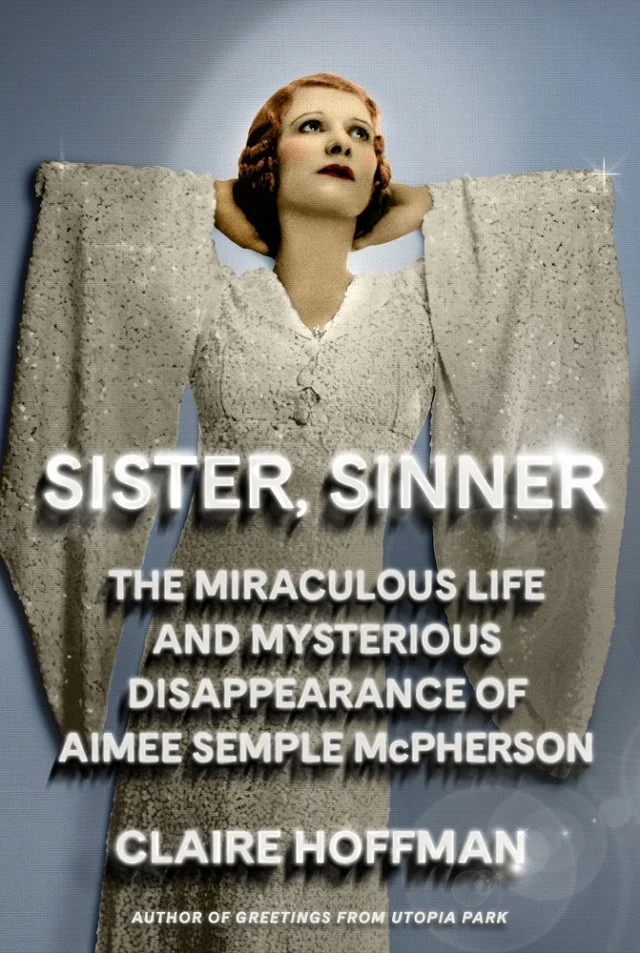
In her newest book Sister, Sinner (available next month), Hoffman regards the life of Aimee Semple McPherson with care and specificity. Taking readers from Canadian tent revivals to Los Angeles courtrooms, Sister, Sinner is a page-turner of a biography. As Hoffman explains, Aimee’s story is a prototype for the age of celebrity. It is the story of what happens when power, charisma, and religion are all mixed together. Most amazingly, it may even be the story of grace, quietly persisting amidst it all.
Mockingbird: Let’s start with a big question, which is why do people today need to know about Aimee?
Claire Hoffman: I think the best way to answer that is to tell you what resonated for me. Aimee was a proto-televangelist. She had the first sex scandal. She was one of the first big female public figures of the 20th century. As she would say over and over again, she was the most famous woman in the world. So when I first heard about her in divinity school, I thought it was odd I had not encountered her earlier.
The way she went through her scandal and what happened afterwards is, I think, a dark mirror of where we are today in terms of public figures, religious figures, female figures. I remember in 2016, I went to see Hillary Clinton speak in Iowa. Being from Iowa, I’m a relatively centrist person, but I was surprised by the incredible vitriol that was being directed at her. The hatred of her felt so extreme. I thought, Oh, we are really rough on our female public figures, you know? So that was one piece of it.
About that same time, I had just finished my first book about the town I grew up in, and a charismatic male Indian guru. As I was promoting the book, I was hearing about other religious movements, and so often those movements were led by men. I thought it would be interesting to see how it might look if a woman had that level of charismatic power. Pentecostalism felt adjacent in some ways to some aspects of the Transcendental Meditation movement that I grew up in — this physical experience of connecting to something bigger.
And Aimee kept coming back to me. Honestly, from my 2016 lens, I thought, Oh, she was probably unfairly maligned and mistreated by the press. Maybe she was falsely accused. Then I started reading more and was like, Uh … I don’t know. Haha. Maybe the story is more complicated.
I thought a lot about grace in writing this. About that concept. Which is an academic concept to me, but it’s interesting when we think about our public figures going through scandal, how they experience that.

Photograph by Lacey Terrell, offSET no.75, Los Angeles.
M: I’m glad that you bring up grace, because that is kind of the big thing that we focus on in this publication!
CH: I don’t think there is anything quite like grace in other religious faiths, you know? I find it really exquisite and complicated and beautiful. It’s something to think about with somebody like Aimee, who gave so much — she essentially lost everything in her pursuit of spreading the gospel. She lost her family, she lost love, she lost marriages. Sometimes, I would say, she even lost herself, but she really believed that it was all for this greater good.
And I don’t always feel that she was extended grace.
M: Especially after she rises to prominence as a celebrity, it seems like there is so little grace in her life. Perhaps one thing we could talk about is the danger of celebrity and this tenuous relationship between grace and power.
CH: Like why there was such a thirst for blood, so to speak? I mean, I do think there’s a gendered aspect to it — it has to do with her being female.
But number one, it has to do with her being famous. Part of being famous is projecting a publicly digestible image, which is essentially simplified and doesn’t represent the complexity of being a human.
With Aimee, there was this point during her trial when she said, “Either I am a good woman, or I am the most terrible, unspeakable person in the whole world. There is no half-way ground in a situation like this.” Which … I disagree with.
M: I was really struck by Aimee’s relationship to the speakeasy owner, Tex Guinan (who Aimee was trying to convert). At some point Tex says, She and I are both sinners — the only difference between us is that I’m not blaming her for it.
That’s not quite grace, but it’s close — the withholding of judgment.
I felt that your approach to this book was noticeably nonjudgmental. Aimee’s life is so messy, but you never issued any moral verdicts.
CH: Part of that is me trying to be a good journalist, trying to be thoughtful about how I’m writing about religion and religious experience.
And part of it is me being a middle-aged mother, where I’m like, Dude, I get it! I’m kind of always failing. Sadly maybe, my life is not as dramatic as Aimee’s, but I certainly have messiness. A lot of the women I know and love also have messiness and have made bad choices. That doesn’t mean they’re not trying.

Issue 26 of The Mockingbird is now available!
I mean, I read other books about Aimee before deciding to do my own, and I found their judgment rubbed me wrong. Contemporaneous writings about her were scathing, mocking, and dismissive. A lot of that was about dismissing her audience, as people who’d been duped. And a lot of the critiques of how she acted as a woman in the public eye — those don’t age well, right?
There were some well-researched books about her from the 90s, but they were almost apologetic, like, they gave biological or psychological explanations for why people spoke in tongues. Like, dear reader, you may think these people are crazy, but actually a scientific study shows that you can have this biological reaction. Which I find also does not age well and is not a very enlightened way to engage with religion.
All that said, the last third of the book was really hard for me to write. It was sad. But in a weird way, that’s the part that has stayed with me the most—how she changed after the scandal.
I think if people keep accusing you of being something, you can become that something. That was hard for me to see in Aimee, because I really do believe she believed. At times she lost her way. But ultimately her life was about the pursuit of her belief in spreading the gospel.
M: Is it fair to call this a cautionary tale about fame? I wonder if there are any life lessons, especially for pastors or people who share an ambition similar to Aimee’s.
CH: Yeah, and I say this as somebody who grew up with a belief system and still has a lot of connections to that community of believers; I think we distort ourselves when we try to become something idealized.
With Aimee, it was so scandalous that she, as a divorced woman, might enjoy the company of a man. She was trying to live up to some ideal, whether social or religious, that didn’t allow her to be a human. And I think that pushed her to extreme behavior.
I saw this in my own spiritual community: people who were really striving to be the best version of the ideal, and human behavior can get pretty weird when that happens.
M: Yeah, in both of your books there is this constant coexistence between the “terrestrial” (to use your word) and the transcendent. I see that even in this title, Sister, Sinner — she’s simultaneously a saint and a sinner.
CH: Well, it was originally called Sister, Sinner, Saint!
M: Ooh, there you go. Can you talk about what that title means for you?
CH: It’s about that false binary — whether for women or for religious figures — when we expect someone to be either a sinner or saint, one or the other, and all the chaos that can come from that expectation. Trying to divide the self into one or the other creates distortion and confusion.
To me, grace is the softness between those two, you know? I mean, I did not grow up Christian, but that’s what I think of it as. It’s the allowance, the letting in of forgiveness and acceptance.
M: You were the first person entrusted by the Foursquare Church with Aimee’s court records, right? That’s pretty amazing. Why do you feel the church was willing to share these with you?
CH: Well, I’m very appreciative. They did redact them. Let me just make that clear; they did not just hand them to me.
I had spent a fair amount of time trying to get them from other places. L.A. County had lost all but twenty pages or so. I looked up the families of every lawyer that was involved in that case, to see if anybody had left any papers behind. I went through a couple of judges who thought they could help.
The story of getting those transcripts is probably the story of my relationship with the archivist, who I just absolutely loved, Steve Zeleny. He had gone to the Foursquare Bible College, and worked as an archivist at NASA, and he is just an incredible wizard. Sometimes my editor would ask me challenging questions, like how many slices of birthday cake were at Aimee’s 35th birthday celebration? So I was lucky to have Steve for stuff like that.
M: Didn’t she have like a 400-pound birthday cake?
CH: Yeah. And then there was a huge Christmas present that her mother popped out of, which I also really love. I was like, Could a mother-daughter relationship get more complicated? Hey, we had a big fight, but now Mom’s back and she’s going to pop out of a present.
M: Based on my experience, that does feel quintessentially Pentecostal — the showmanship. I definitely see the lineage here.
CH: Aimee really is a parent of Pentecostalism. I mean, there are other founders, but I’ve compared her role to Elvis and the blues: she was at this crucial intersection of things. Because she looked a certain way, she was able to translate this fringe spiritual movement and bring it to the masses through her particular art. Or as one of my friends said, she was doing white lady TikTok stuff. Do you know what I mean? She was able to distill Pentecostalism in a way that was palatable for a largely white middle-class working-class audience.
M: I did appreciate in the book — despite all of the shady stuff Aimee got into — that you also give time to her objective service and positive impact.
CH: She was a complicated lady, as many of us are.
Honestly, if you’re interested in Britney or Kim Kardashian — Aimee’s life was the blueprint, you know? I spent a big part of my career covering big pop culture people and big pop culture meltdowns. What Aimee went through, and how she was changed afterwards, feels like this blueprint for the celebrities of the next hundred years. She ended up in a conservatorship. It’s very Britney.
M: I wanted to ask about your work at Rolling Stone, covering these other celebrities. Have you given much thought to the overlap of these various interests — music and spirituality? I feel they’re cohesive in some way.
CH: I would like to think about that for days honestly. My immediate answer is that, to me Aimee was a true artist. I think there’s something about performers — which she also was — giving their all to an audience. There’s a lot in the book about when Aimee would do healings, and she would literally be cloaked in sweat and have to be carried off the stage after twelve hours. She left it all on the floor, you know? Which reminds me of these musicians who go out there and they don’t have any holdback mode — they give a hundred percent.
There’s a cost to that. To be collapsed on the floor after twelve hours, healing 1,500 people. There are stories from later in her life when she was very thin, and she would have to eat these huge bowls of ice cream to bring her temperature down and calorie-load. You can’t think that doesn’t cost anything.

Illustrations by Melisa Gerecci
I see a real similarity with someone like Amy Winehouse — she didn’t have an ability to call it. That kind of generosity, that level of opening up to an audience, can be corrosive for people. These people have to figure out how to manage that, or be protected from it.
Britney is this other extreme example where she was so young and so commercialized from a young age, it just really distorted her sense of self.
M: Aimee was not quite as young as Britney, but she was very young. As I was reading the book, I kept double checking the dates, like, wait a second …! Her rise was meteoric.
CH: It’s crazy what she went through at such a young age. And you can see the obstacles were monumental, almost unimaginable.
M: Right: the simple facts of her being a female fundamentalist preacher in L.A. in the 20s!
What was the biggest surprise to you as you were researching this absolutely insane story? I mean, the book takes a turn about halfway through and it becomes almost like a thriller.
CH: Oh my gosh, is it a thriller, is it screwball? To be honest, I had to be picky about what I included about the trial. It was just explosive and non-stop and multi-stranded.
After the trial, she was suffering so much mentally and physically. She had consistent mental breakdowns — that’s what she called them. She was hospitalized. She had terrible luck with her relationships and the people that she was working with. She’s a woman living through the Great Depression.
And what’s amazing to see, through all that, is just how much work she was able to do. She fed millions of people during the Great Depression. She expanded the reach of her church, which really helped Los Angeles during a time when the city was absolutely on its knees.
The church became part of L.A.’s civic infrastructure.
And this was during a time when, by all accounts, she was going home pretty sad and lonely and sick. I think that speaks to the power of her faith.
You see it right from the beginning, with her ability to shatter all these barriers and boundaries in place because of her gender and her station in life, as she becomes this unfathomably famous and successful woman. And later, even as she has all these obstacles and scandals and conflicts, she does continue. That is a testament to the power of her belief.
Sister, Sinner is available April 22.








What an incredibly generous take on ASM! I was raised and grew up in the International Church of the Foursquare Gospel and the lore surrounding ASM completely fascinated me, even as a kid. Not until later on did I start asking questions (for which no one in my tribe seemed to have any answers) ultimately reconciling all the strange fruit of my Pentecostal upbringing only after finally discovering grace. Wow. Can’t wait to read this book!
[…] an interview with Mockingbird magazine, Hoffman said that she “thought a lot about grace” while writing her book. Grace, in contemporary internet parlance, often means forgiveness. […]
This book is a good read. Cannot put it down…until my eyes start to close at 2am…and my Kindle falls out of my hand.