




This article is published in the Sickness & Health issue of The Mockingbird magazine, set to hit mailboxes this week.
An issue comprised of meditations, interviews, and poems on sickness and health would be incomplete without an honest exploration of something many of us would never seriously entertain: miraculous healing. The gospels tell us that the sick, the dead, and the downcast knew Christ’s compassion through his miraculous human touch. As church historian Caleb Maskell reminds us in the conversation below, Christ commanded his disciples to bring healing just as he did. The early church was born out of this crucible of affliction met by miracle; and today, healing prayer — the hope of broken bodies transfigured into vessels of praise — enlivens the ministries of many churches globally. As Maskell says, what appears to be a disenchanted world may in fact be something else entirely.
With a Ph.D. in Religion from Princeton, Maskell has taught at Fordham College, Princeton Theological Seminary, and Swarthmore College, and his writing has appeared in Church History, Books and Culture, Pneuma, the Cambridge Dictionary of Christianity, and elsewhere. He co-authored Sinners in the Hands of an Angry God: A Casebook, and co-edited Jonathan Edwards at 300. Maskell is the Associate National Director of Theology and Education for Vineyard USA. We exchanged the following over email.
***

It seems many modern believers, at least in the mainline churches, tend to have an impoverished view of what God can do, or will do, in this world. They don’t have much faith in the idea of faith healing. They see the world as largely disenchanted — no longer inhabited by the very intrusive God of scripture. Do you think that’s true, and if so, what might it look like to break down that barrier in a mainline context?
I love this question, because it cuts right to the heart of the matter — which is whether the practice of healing prayer is possible or smart for regular Christians today.
To address it, we should ask whether there is any evidence that healing actually happens in Christian contexts. Are there good stories? Why would we try to heal people if there are no credible stories of actual healing? The good news here is that for decades now, scholars like Craig Keener, Philip Jenkins, Candy Brown, and others, have been demonstrating that contemporary, majority-world Christianity is overflowing with stories of healing in our day. What’s more, this contemporary majority-world Christian witness is also the historic witness of the Christian church, which features a constant thrum of miracle stories from the time of the earliest churches to the present. Our sense of the disenchantments of modernity notwithstanding, the history of western Christianity is also laden with powerful miracle stories: from the famous healing of Congregationalist Mercy Wheeler in Connecticut during the Great Awakening of the 18th century, to the healings that followed the ministry of Lutheran pastor Johann Christoph Blumhardt in 19th century Germany, to the ministry of Francis and Judith MacNutt, 20th century American Catholics who taught thousands of regular folks to pray for healing in their churches. And these are just the first few names that come to mind. Craig Keener’s magisterial book Miracles literally contains thousands of examples, demonstrating that typical Christianity practices healing everywhere in the world and across all Christian history.
In light of all this, it seems like it is just smart theology and smart sociology for Christians to hold open the possibility that God heals today.
Have you ever witnessed a miraculous healing?
I don’t think of myself as anyone special when it comes to healing prayer. Most of the people that I have prayed for have not been healed, even of small ailments like headaches or flu. I’m also aware that there can be many reasons that people report relief from symptoms when they receive prayer. Sometimes, it just feels better to know that someone is praying for you! That said, a couple of stories do come to mind right away.
A few years ago, at the church in the Philadelphia suburbs where my wife and I were on pastoral staff, one of our parishioners had been diagnosed with stage-4 brain cancer. She asked for prayer the Sunday after she had received her diagnostic scan from her oncologist, who had shown her pictures of the cancer. Naturally, she was desperately concerned, not only for her own life but also for her young children. A small group of us prayed for her, and at her follow-up scan a couple weeks later, there was no sign of the cancer. That was amazingly encouraging!
Another story comes from the life of my friend Tina Colon-Williams. By day, Tina is a Yale-educated immigration lawyer, but by night she works out her second calling as a worship pastor and professional singer-songwriter. Featured on dozens of records, Tina’s calling card is her powerful voice — think Alicia Keys or Norah Jones in a soul-gospel vein. She’s amazing. Which is why, when she mysteriously lost her ability to sing in May 2021, it felt like such a catastrophe. By July 2021, she was not only unable to sing but barely able to talk above a whisper — terrible for every part of her life, from lawyering to music to parenting. Devastated, she went to see a famous ENT doctor in New York City, who diagnosed her with acute hemorrhagic polyps on her vocal cords, the kind that could only be repaired by surgery. Having scheduled the surgery for January 2022, Tina asked groups of her friends to pray for her on several occasions. At one particular gathering in November 2021, Tina noticed that the prayer time felt very powerful, and on December 9, 2021, she went back to the doctor for a pre-op appointment which revealed that the polyps, as well as all the attendant bleeding and inflammation, had completely disappeared. The doctor canceled the surgery and called it miraculous. (I confirmed all this on the phone with Tina today, who was calling me from a recording session in Chicago.)
Finally, my friend Josh Brown directs the program in neuroscience at Indiana University. When he was doing his PhD in brain research at Harvard, he was diagnosed with a glioma, an untreatable brain tumor. As he recently described it in a New York Times article, “There was nothing to do but get ready to die, basically.” Desperate, he began to seek out healing prayer at church and revivals, and within a few months, the tumor just went away. He has been symptom-free for 19 years and, as a literal brain scientist, he has the slides to prove it.
Those are a handful of the more dramatic stories that come to mind right away.
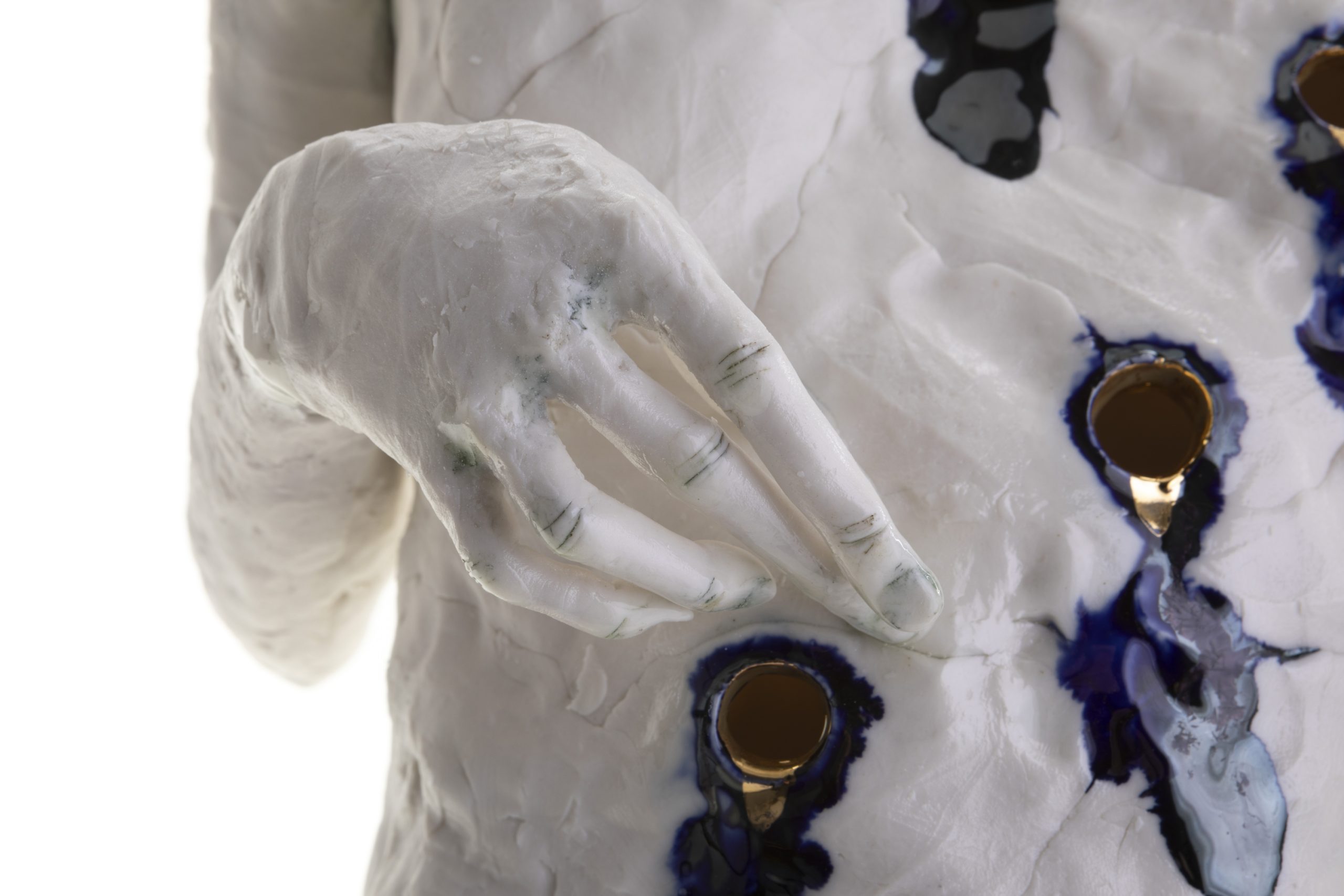
Claire Curneen, Empty Tomb (detail), 2021. Porcelain, 27 3/5 × 11 4/5 × 8 3/10 in.
I remember some years ago one of the so-called New Atheists making a point against faith healing, that we’ve never seen an amputee regrow an arm. What do you make of this claim? Are there certain types of physical healing that seem to be more “likely” than others?
Such a funny question! I have never seen or heard of this kind of miracle either, but I’m curious.
At the end of the day, I’m not at all sure why the absence of regrown amputated arms would be evidence against other forms of healing. There are all kinds of examples of things that never seem to happen. Does that invalidate or trivialize other things that do?
Say we entertain at the theoretical level that healing (maybe) happens. But what would it look like to actually practically try to heal someone? How would anyone actually go about that?
For many of us, only Christian cultural nightmares come to mind when we think about the practice of healing prayer — things that feel more like abuse and manipulation than comfort for the afflicted. We have heard of “healers” telling people to “claim” their healing, saying they are healed — mind over matter — even when they’re not. We have heard of “healers” blaming sick people for not being healed, claiming that they didn’t receive healing due to a lack of personal faith. And so on.
We must have nothing to do with anything like that, as it denies reality and bears no resemblance to the life of Jesus or the life of his disciples. But then, many of us don’t know what to do next. It has been my experience that we need our own stories, not just stories about friends of friends or people in faraway lands. And if we want our own stories, we have to learn how to pray for healing.
Fortunately, my own faith has grown in communities that understand discipleship to be a communal project of shared failure in the attempt to imitate Jesus, for the sake of shared growth and shared stories. There’s a kind of simplicity to a Christian life lived that way, which has a lot of resonance with the way that Jesus made disciples in the gospels and their disciples made disciples, giving rise to the early church.
Jesus commanded his disciples to imitate his relationship to the world around him. Just as Jesus healed the sick, so also did he send his disciples to heal the sick. Were the disciples the same as Jesus? No way. Were they perfect? Far from it. But they tried to do the things their teacher told them to do.
Remember the blind guy in Mark 8 who, after Jesus spits on his eyes, saw “people like trees,” so Jesus “once more put his hands on the man’s eyes”? After the second time he saw everything clearly. I love that story, because it just destroys any illusions we might have about mechanical perfectionism in any of this stuff. What I think Jesus is modeling is healing prayer as a practice that his disciples should try — as a sign to demonstrate the presence of the coming Kingdom of God in the world. Sometimes it will work, and sometimes it won’t. It is God who sovereignly chooses to heal, wholly, or partially, or not at all. But Jesus does call his disciples to try. It doesn’t take an especially gifted person to pray for healing. You don’t have to be super-sanctified or a saint who floats three inches off the ground to try this.
I have a ton of sympathy for folks who are instinctively disenchanted, because most of them have never been in an environment where healing prayer is practiced. In this way, disenchantment becomes a self-fulfilling prophecy, right? As I said earlier, I am a really bad healer. I have only ever seen a handful of people healed, even of small things — a fraction of the people that I have prayed for. But that fraction is a higher number than zero, which, I must admit, is quite inspiring.
The Christian expectation for healing (of oneself and others) can feel like the law; if it doesn’t happen, you can feel like you’ve done something wrong. How do we balance a belief in the miraculous while also recognizing the reality that many people don’t get healed?
This is obviously a huge question. But I think this presses more into the mystery of God’s sovereignty than into questions of law and gospel. The reason is simple: I don’t know how to heal anyone through prayer. All I know is that Jesus instructs his disciples to pray for the healing of all who desire it, and that the results are always mixed. Sometimes people are healed, and sometimes they are not. It seems to me that God chooses who is healed. Thus, healing prayer is less a technique than a petition. This doesn’t make things less difficult or less painful. It just makes them differently painful.
I have a friend who is an Episcopal priest. After seminary she worked as a chaplain in a children’s hospital where she began to practice healing prayer. She told me that the first time she prayed for someone and they were healed, her job got much harder. The reason for this was that it began to raise questions for her about the character of God. Why were some children healed while some others died? Is God’s will so arbitrary? Is God’s love so “random” (to quote noted theologian Jeff Tweedy)?
To be a Christian disciple is to live a life of what Jacques Ellul called “agonistic tension.” Followers of Jesus must never seek to escape the constraints of the world or to create a utopian alternative to reality. Instead, we must stare into the abyss, under the sign of the cross, and pray “Your Kingdom come! Your will be done!”
As a young man, you were involved in an extraordinary charismatic spiritual revival that happened in the mid-90s at the Toronto Airport Vineyard church, now known as the Toronto Blessing. For a short period, something really special was happening in Toronto. Why do you think these kinds of revivals, with all the healings and other miracles, seem to happen in such short, intense bursts? And how do we celebrate them for what they are while not growing discouraged by God’s apparent “selectiveness?”
To be frank, I don’t even have a theory about why God works in these ways. There’s a lot of mystery there. But I do have some thoughts about them!
First, I think that it is objectively the case that God does sometimes choose to move like this, through what you call “short, intense bursts” of dynamic spiritual activity. These moments — revivals, renewals, awakenings, and reformations — are disruptive and often transformational for those who participate in them, as well as for the broader cultures in which they take place.
Second, these extraordinary moments are bounded in strange ways: often geographically, but sometimes also by the ministry of particular leaders, under the aegis of a certain organization, or some other constraint. Who can say why God would choose for that to be the case? Why did people get spiritually renewed in such powerful ways at a small church near the airport in Toronto? Why do people get healed in the Grotto at Lourdes? Why was the preaching of Billy Graham so effective? I don’t know the answers to these kinds of questions. I will say that, as a historian of Christianity who has spent many years studying such events, that there is neither formula nor precondition for them. I have heard some argue that all extraordinary revivals are preceded by intense prayer or deep spiritual hunger or some other work of human effort intended to “contend” for a move of God or “bring heaven to earth.” I simply don’t believe it. There is no formula. There is only God’s kindness and our response.
Third, it is also very important to notice that the fruit of these events is not universally good! Just because God seems to be moving in a unique and intense way in a place or time does not mean that everything happening is good. When I was at the “Toronto Blessing” between September 1995 and June 1996, I saw all kinds of things: good, bad, beautiful, and ugly. That’s just reality!
Big picture: As precious and transformational as moments like that can be, they are not, by themselves, the answer to anything. Instead, rather like healings or other miracles, they are partial signs of the coming kingdom of God, signs of encouragement and upbuilding that deepen our conviction and strengthen our souls for living with courage in the face of whatever the present moment holds.
In a recent article in Christian History magazine, you described the journey pastor John Wimber (1934-1997) took to becoming a champion of healing prayer. He’d been praying constantly for healing, engaging in all manner of healing-oriented spiritual practices, for 10 months — “But no one had been healed. […] Absolutely nothing had worked.” Ultimately, however, his prayers were finally answered when a woman suffering from fever and flu was healed in his presence. Can you talk about the blessing of God’s surprising mercy?
I think that John Wimber’s story is a really instructive one. As a forty-something pastor of a small but growing church in Yorba Linda, CA, Wimber was convinced that praying for the sick was a basic element of obedient Christian discipleship. Some thought he was naïve and quixotic; others thought he was being wonderfully straightforward and “biblical.”
However, all of this is only meaningful in the context of practice, right? If you think that Christian obedience looks like praying for the sick, all you can do is try. So for months, Wimber tried to heal people by praying for them, but nothing was having any effect. He was feeling exceptionally frustrated, even humiliated by God, because his attempts at obedience were just making him look silly. Until the day that someone was actually healed. To hear Wimber tell it, he had almost no faith left. He was in a bad mood. He had done nothing special to prepare. He assumed that the woman would not be healed.
But then she was! God chose to do it. It was not about Wimber’s power or giftedness or strength. It was about God’s mercy to that woman in that moment, and Wimber’s role was to be somewhere between a conduit and a co-creator.
My takeaway from this story is twofold. First, it seems that God heals in God’s mercy and God’s time. As I’ve said, there are big questions of theodicy connected to this, but they are not questions of technique. (Once, when asked how he prepared for a healing prayer meeting, Wimber wryly replied that he drank a Diet Coke.)
Second, I’m very struck by the formation of Wimber’s character as a disciple of Jesus through this process. He had tried and failed over and over and over. Yet he kept trying, not because he was some sort of spiritual giant, but rather because he believed that continuing to try was what simple obedience looked like. And this brought him to the end of himself. It was not until he had exhausted all of his own capabilities that he discovered the faithfulness of God. I don’t presume to understand the mind of God on this stuff, but that outcome in Wimber’s life as a leader suggests the fingerprints of a divine conspiracy.
Subscribe to The Mockingbird today and receive Sickness & Health as your first issue!








A fine article so aptly presenting the openness— to questions, to answers, to pain, to knowing, to not knowing, to TRYING — that so many of us identifying as Christian need more of on our earthly journeys! Thanks.