


In the mountains north of Santa Cruz and south of San Jose, if you could go there, you would find a small village alive with study and prayer. At the crossroads — a Y junction below the hill that rises to the field marked with deer pellets and a perimeter of white oak and undergrowth — you could sweat out laps the way my mother did into a terry cloth bandana. You could cross the street and hike down to the creek among blackberries and redwoods, lean over the rail of the bridge, lose some time. If you came back, out under the tree light, you could check your mail in the room of little boxes glowing with their glass doors and combination locks. You could bump into someone you’d had dinner with the night before, or borrow eggs from the neighbor’s coop, or knock on the door of a side deck and enter for iced tea and a sandwich.

You could, at one time, but no longer. I grew up in this wooded miracle of a neighborhood, meaning that until the age of five I’d come and go, play with friends, and ride my secondhand Big Wheel down the gravel drive to the workout benches on the trail across the road from our house. My school was a quarter mile down the street, and still is, but almost nothing else I remember now remains. I lived in what I think of as a state of being present, what William Wordsworth called “spots of time,” mindfulness we might say, but yes, pre-reflective, buried in realms of imagination those happier moments of childhood can be.
Now, if I take you there, I would have to tell you of the chain-link barrier around the gymnasium and rows of prefab studios, the two-level apartment block for married students, and the pathway to the library and chapel. The humongous FOR SALE sign zip-tied on the bent-out fence I once tucked myself into and snuck behind. Each window pane a dustbin. Every room a warp of time, as though witnessing the aftermath of rapture, as in the rapture. The stopped clock barely twitching its second hand. The notepad and uncapped pen on the desk. A pair of sneakers, one tipped on its side. And still, even these have been razed, replaced.
On the air is a trickling sound of electrically pumped water running through the paved bed of a stream, past what is now a visitor center. The little outdoor amphitheater of wooden benches and a rickety platform that is now a polished set of seats and rails marked “Cathedral” on the map you would be given. That’s if you can fork over the $3,000 for a weekend yoga retreat or writing workshop. All around the new lodge-themed architecture, concrete fire pits and sanded Adirondack chairs huddle, awaiting guests who will likely arrive in black vans or Teslas. These new digs sport pods you can sleep in and cubbies you can tuck your linen jammies into before you pull your little curtain closed. You might want to join the organic cooking masterclasses in the garden kitchen or practice a tree pose in the labyrinth spread out where my sister and I used to pick those blackberries.
What once was Bethany Bible College is now a multiversity — whatever that is. The campus I loved, the first home I truly remember, has been leveled and bulldozed into a luxurious retreat for the uber wealthy of Silicon Valley. The place is owned by a group called the 1440 Foundation.
I’ll admit, some of this sounds serene, if you don’t feel the blood-letting price point, if you don’t count the felled sequoias, and, probably, if you don’t actually live in one of the houses that remains in the ascetic residential area butting up against it. Who wouldn’t want a new-build escape from time boasting log beams and glass facades? Where did those logs come from, though? And how much electricity is powering that fountain out front? I can hear my footsteps on the wooden bridge, weather-treated and perfect. I can feel the asparagus smoothie warming in my hand. But what I want is to walk through the trees to the creek and hear nothing but that water flow and then the rise of my mother’s voice from the screen door calling me back home.
When I say my home has been leveled, that’s not entirely accurate. The house remains. The last time I stood in front of it, which I’ve done three times in my adult years, cars crowded the drive, and a pack of chihuahuas huddled in the big box window between the glass and inside curtain. The mailbox, or a mailbox, still on its post where I first read “US Mail” and asked my dad how the postal worker would know the mail belonged to “us.” The roof where I threw my action figures. The gravel lot with the exercise benches, where my dad and I parked the VW van and camped with the sliding door open, looking at the clear night sky, asking him if the lights were holes where heaven leaked out. Now there’d be no sense of heaven on that forest street, the brilliance of the parking lot lamps eliding moon and star light, only the devil’s spick and span illusory gleam.
The word home haunts. Like the word family. And is it freeing to learn that family, familia, was a place? A Roman estate, a working household of kin and (yes) slaves. A situation, “a stay against confusion” (to borrow Robert Frost’s understanding of good poems). But what if home didn’t stay? I’ve lost more homes than one, though I know I’m not alone when I list the many times my family moved. But in casual conversation, when the notion of origins enters, I’m all thumbs, befuddled to pull together any explanation of why we moved from California to Arizona to Missouri to California to Virginia to Nevada to California to Missouri. My father was on a vision quest, I say. I say this now because it is the rationale I’ve therapeutically been able to conjure. We were peripatetic, driving our Buick from town to town, state to state, as though God were always more present elsewhere, and we could chase him. When my dad got the call to go to a new place, it was usually a phone call. A friend would say the Spirit’s really moving here, we’d go there for a while. He’d preach, bodies on the floor, hands in air, the band vamping. Or he’d do a life group, a small group, a kinship group, an apartment or a living room of people gathered around him listening into the night about what Paul really meant, about roots and Koine Greek and Aramaic. The whole world seemingly filled with Platonic light, and I’m asleep in the corner or on a bed of coats, my mother scooping me into the backseat afterward.
Or my dad wanted to change seminaries.
Or we were broke, so we exodused to live in my grandma’s house.
Or my aunt’s house.
Or we crashed with friends.
One year, my bedroom was a coat closet. I had a dresser in there with posters on the wall. After dinner, I’d gather some blankets and lay them out on the sofa and go to sleep. I was in seventh grade and homeschooled, again.
Searching for an analogue, I say, “Imagine Jeff ‘The Dude’ Lebowski goes to seminary.” That we were following the Spirit, I can no longer say without skepticism. And each time I wondered, if we were moving for God, why was it so painful? Why was God having us move? What, or who, got things wrong so that they needed to change? I told myself, as I was trained to, that the pains of moving were the pains of dying to my flesh, that I needed to be ready and willing to give up everything for the sake of the call (ring, ring), and find my identity not in the things of this world. I often reflect these days on how strong the message of dying to myself had been, before I ever had the chance to find or build or have a self that needed (needed?) to die. Each desire apparently wicked, including the desire for a home. The unshirkable guilt of dreaming to belong. I’ve learned to call much from that time by the word repression, and to piece together a map of our moving — a new spiritual geography to name what was lost — and, I hope, let go. Sometimes what holds us deeply, holds our wounds so desperately open, is the lack of a name for what we lost. Or what was taken.
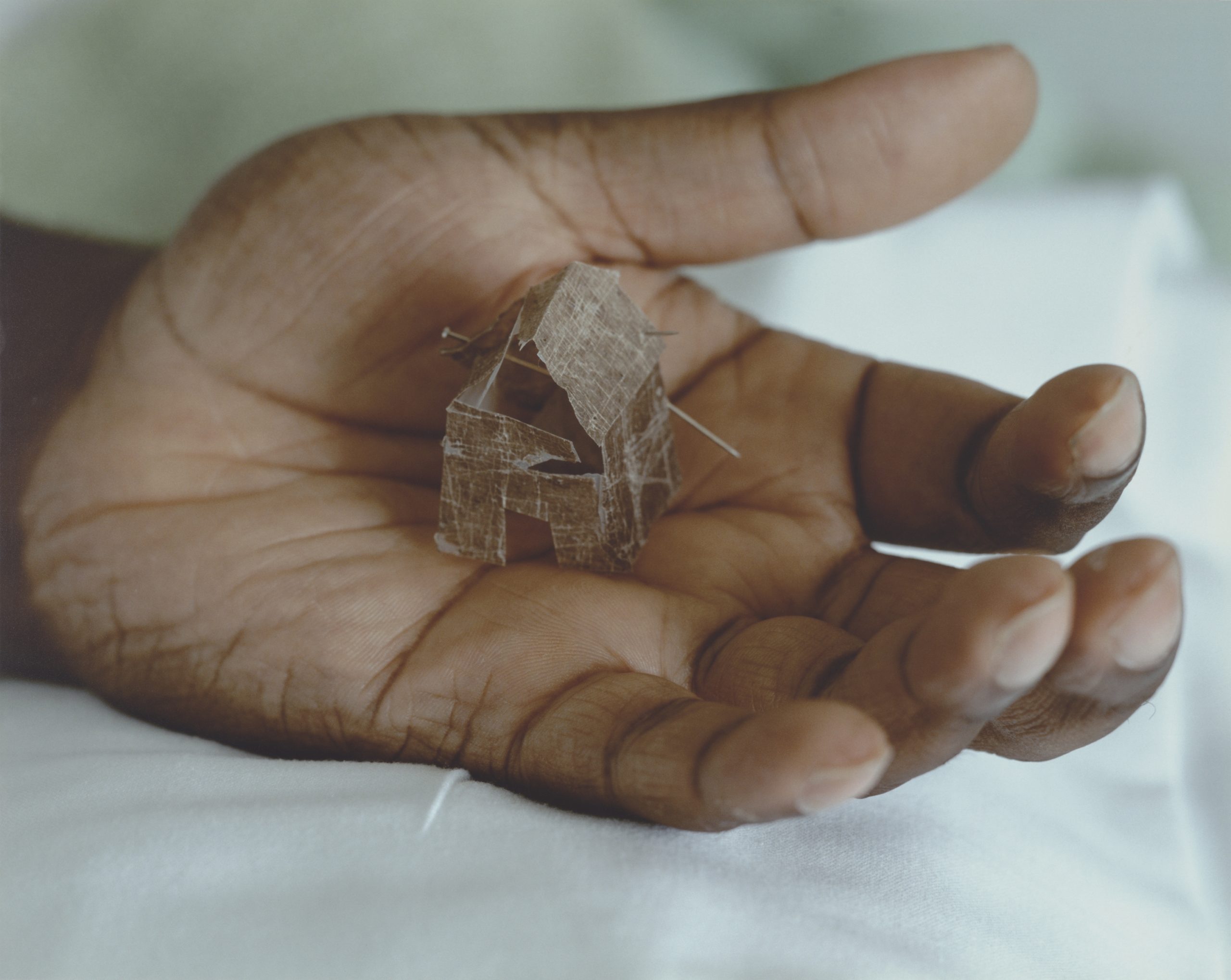
Donald Rodney, In the House of My Father, 1997. Photograph on aluminum, 48 x 60 in. Collection: Tate Collection, Arts Council Collection, National Museum Wales, Birmingham Museum and Art Gallery. Photo: Andra Nelkie. © The Estate of Donald Rodney
My wife and I went back one October. We had met up with friends in the Bay Area and hired a car to drive south to Scotts Valley. A few years previous, on our honeymoon, we’d made a similar trek and saw the fence and signage I’d witnessed for the first time a few years before on a cross-country road trip with a friend. I’d expected the same, and was prepared to have a look around, show her the sites a bit more. This time, as we passed my old kindergarten and turned the corner, we encountered instead a new sign: “1440 Multiversity.” Genuinely guffawing at the brand, I did not realize it was the name for the home I knew.
Passing my old house, we drove around Bethany Loop, stunned. Almost as soon as we parallel parked in the lot beside what I had known as an apartment building, a man approached. Windows down, he asked if he could help and I asked what place this was. He was clearly managerial, diplomatic, like the cameras were on somewhere. Likely they were. I told him I used to live here, I was visiting on an artist’s grant to research home and write some poems, I was shocked at this transformation, and could we have a look around. He invited us to check in at the front desk, give his name, and we’d get lanyards. Lanyards meant we were visitors. Visitors meant we weren’t trespassers. Not guilty.
Walking around this site dedicated to post-secular mindfulness and psychic renewal, the peace I once felt there as a boy was now tempered by the fact of our departure, our journeying through the fringes of a religious culture bent upon perfection, steeped in holiness, rightness, of knowing the only true home for redeemed souls lay in realms of glory that await the faithful. Not here. To get there you had to be good. And that should cost you. I remember my father once saying to me that if we were persecuted, if a gun were held to my head, if the heathens said he must deny Christ or they would pull the trigger, that he would let them, since he knew where I would go, and that when he died he would not sit before the judgment seat and know that he’d reneged.
How could he imagine this? And even more, why tell his only child? I had already been trained to feel my desires were wicked — desires for a father, for a new kind of father, for a home. What else could I feel but guilty that he might have to choose between his love of God and his love for his son? At least I knew where I stood. And shouldn’t I have felt the honor within this hypothesis of following in Christ’s footsteps? To have the father turn his back, to take the hit. This was the subtext, or pretext. And I was guilty of wanting things otherwise. And my guilt was an iron rod plunged through my kidneys.
The subject of guilt is seemingly endless, each life an archive of traumas, each body a box to store what we may not (yet) articulate. And guilt in religion, in Christianity, in evangelicalism? Take a number, take a seat. We know the body remembers. We want to attend to our breath. We pray to belong and be at peace where our feet are.
Still, when I think of home, I’m reverie and pine, needles steeped in sunlight on the forest floor, the clanging gongs of raccoons dumpster-diving on the deck, the light from chrome spokes of the hubcaps slowly crunching gravel out front through the big window as my father rolls the Buick up the driveway.
I usually write poems. Or try. Or wait out long painful periods of silence in between the gifts poems can be. Maybe because that’s how my brain works (obsessed with sound and associations), how the broken pieces are allowed to sit together, the way the language of a given faith takes on its music in my ear. One of my teachers says, “Put the problem in the poem.” Don’t clean it up into what you think a poem ought to be in order to make it. Poem, we remember, from the Greek for “made.” A made thing. A making. Don’t, I add, wait for resolution. Can we make our way back home? If we are asking, then we probably have our answer. And why do we want to return to what we left? Because we may have something left to say.
If we could go there.