




This essay appears in Issue 28 of The Mockingbird magazine, now available to order.
My friend and I were walking to class, our lunch conversation spilling over into the seminary courtyard. We were talking about art and faith and churches and why was it that art seemed so bad in sanctuaries and didn’t congregations have taste anymore? We were full from burgers, and full of opinions, unsoftened by experience. We were sounding off on imagined groups who, if they just lifted themselves to Our Knowledge of Theology and Art, would transcend all sorts of barriers. A professor walking in front of us stopped abruptly, whipped around and, holding his satchel to his waist, leaned into our faces and said, “Don’t ever talk like this again — you have the privilege of space and time to study these things. Most people can’t afford that!” We walked to class in stunned silence. I sat near the back row, mulling over that moment, feeling distracted and starting to wonder what else my opinions had blinded me to.
That courtyard moment has stayed with me over this past decade. It came to mind recently as I stepped into the bright afternoon light outside a Saint Paul movie theater. I had just seen Art for Everybody, a documentary about Thomas Kinkade, and new details of the artist’s life confronted me and my own critical opinions of his work. I’ve known of the “Painter of Light” since I was a teenager, carefully averting my eyes in the Christian bookstore to keep from seeing the fluorescent cottage scenes, scoffing at the mall-goers ducking into his darkly lit galleries. He held a symbolic role in my teenage years, a creative leader whose paintings evoked a blend of art and faith that frustrated me. I shadowboxed him often. When he died from an overdose in 2012, estranged from his family and living in a mansion with a girlfriend, I remember reading the news reports and feeling vindicated. “See? This is where Christian kitsch can lead! It hollows you out, falsifies what’s real. He was an artist living a lie!”
But then there was this documentary and the news that came with it. Thomas had a vault — a padlocked room hidden deep in his mansion containing hundreds of surreal paintings. Art that didn’t match his light-soaked brand. The paintings are dark, literally — lots of drab grays and deep blues — and dark in subject matter too. In one landscape, he paints an abandoned overgrown factory as a heavy black storm approaches. In a self-portrait, Thomas paints himself standing alone in a room, uplit like in a horror movie, and staring blankly back at the canvas with red paint dripping down his shirt.
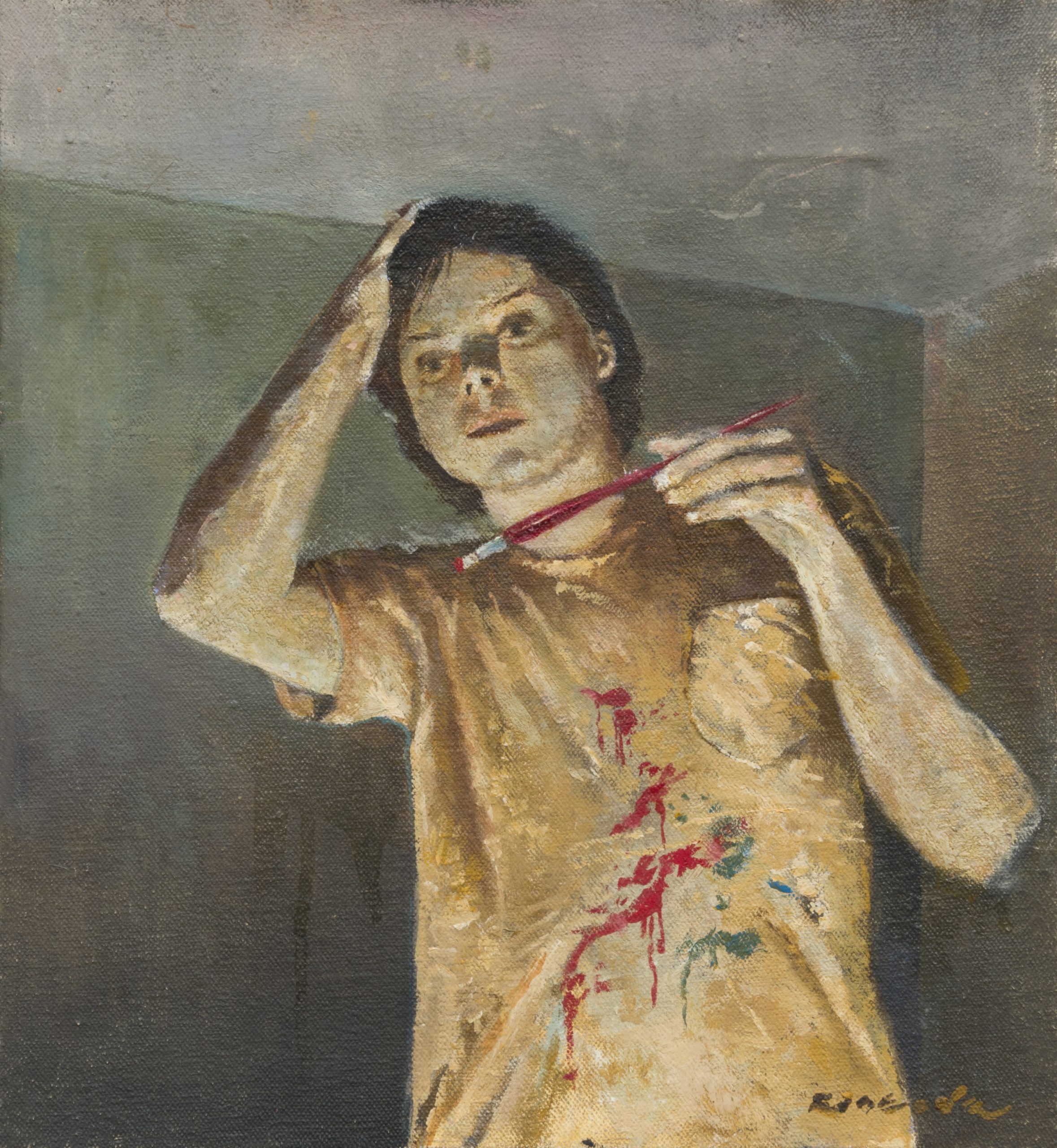
Thomas Kinkade, Untitled (Self-portrait with a Paint Stained Shirt), c. 1980. Oil on canvas.
An easy interpretation of all of this could focus on the artist himself, seeing the vault as yet one more example of the corrosive nature of kitsch or ’90s evangelical culture wars — see how even the artist is damaged? Another might focus on his fans, arguing that the artist pulled the wool over their eyes, inflicting shallow nostalgia on people who shared in the delusion. To be sure, the images we make form the structure of our imaginations, giving us a vision of the world we want to live in and the choices we might make to arrive there. The Painter of Light’s sentimental world has no suffering or pain or injustice or darkness. While that imaginary world is alluring, it’s also constricting and incomplete. There was no room for the artist’s whole self, and it clearly wrecked his life. It might not wreck his viewers in such a dramatic way, but there’s something soul-numbing to landscapes like this. We’re lulled into hazy light at the expense of the real world.
But still, over the years, it’s been too easy to just blame the artist, blame the paintings, blame the ’90s Christian subculture. Blame, blame, blame. Blaming (and dismissing) the artist was easy; Director Miranda Yousef’s empathetic touch invites a kinder and wiser approach. Now I felt confronted by the film to do some self-examination, in the same way that professor confronted us in the courtyard. The more I learned, the more I felt kinship with the artist and the social pressures he faced to be a “Good Christian Leader.” My harsh opinions about kitsch softened into more complicated questions: Why does an artist hide vital parts of himself for the sake of success? What happens when we curate branded versions of ourselves? Why do we continue to see this cycle of Christian leaders wrecking their lives? How can we imagine new social landscapes?
Thomas wasn’t lying, per se. He was holding back; editing out the parts of himself that were “off-brand.” As an artist trained to make movie backdrops, Thomas found subject matter and a style that easily fit into the background of living room walls across the country, next to cabin decor and scripture inscribed on driftwood. There’s a rustic American sensibility here, and his paintings reach audiences that might not ever set foot in the rarefied air of an art gallery. But once he found success, the nostalgic cottages started to take over, crowding out more difficult and personal subject matter from his own life — like growing up with his single mother in a trailer park. How many artists or leaders also feel this way? You figure out what works, so you keep doing it. Project the good, hide the bad. But when success comes, the pressure to conform only grows stronger. Deviating, or showing vulnerability, becomes a greater and greater risk. The distance between selves grows, and it’s even harder to catch when we aren’t fully aware we’re doing it.
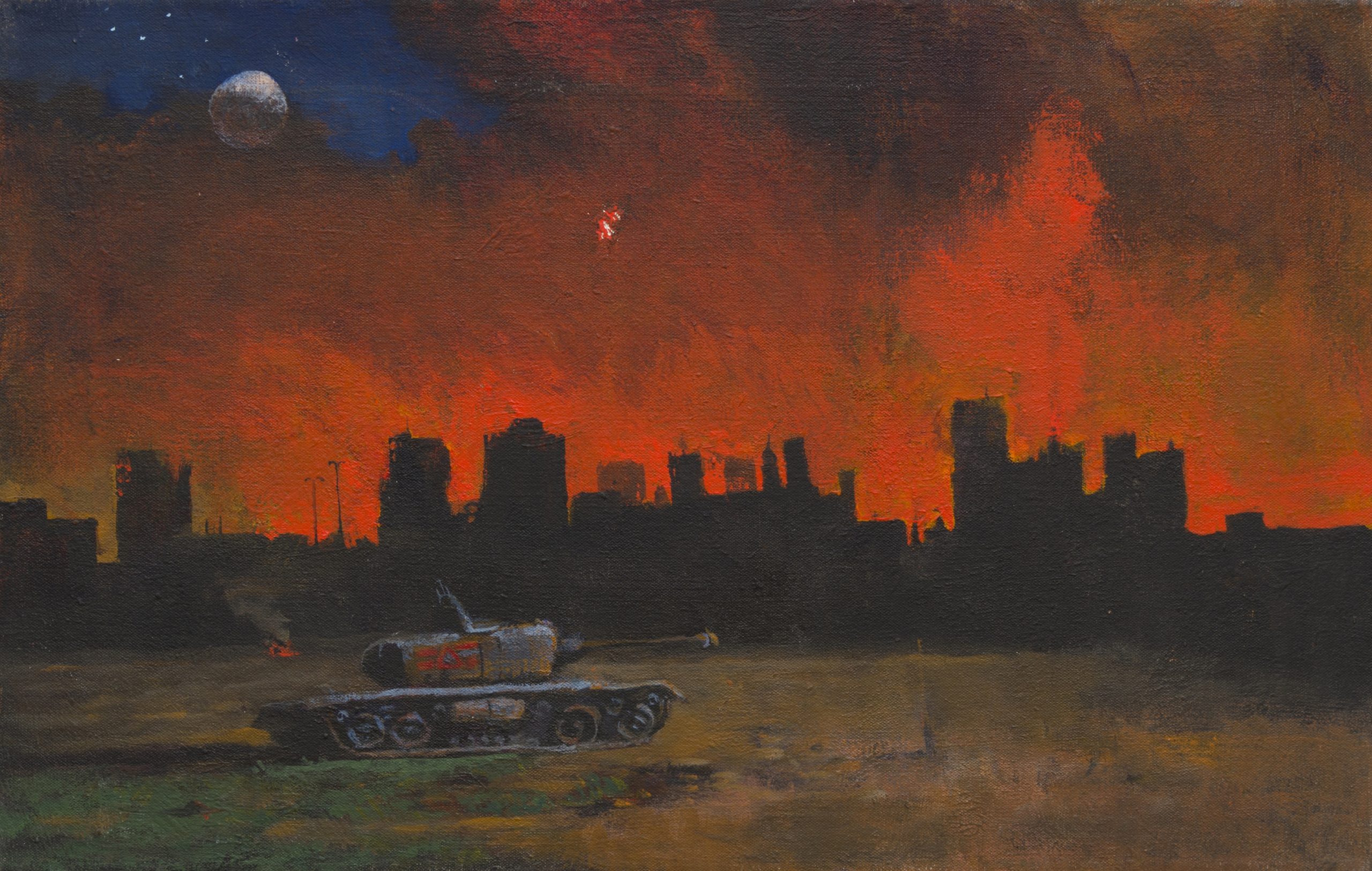
Thomas Kinkade, Untitled (City with Red Sky), 1979. Oil on board.
Growing up, I was a model leader. I led congregational singing during chapel at my high school and college. I started a praise band. I said yes ma’am and no ma’am, I wore khaki pants and tucked in my button-down shirts. If you leaf through my high school yearbook, you’ll see me on the “Senior Superlatives” page holding a mop and bucket. It says Most Service-Oriented. I was the “Good Christian Man.” Somewhere along the way, though, I would drift into perfectionistic feedback loops. People expected me to be good, I was good at being good, so I kept trying really hard to be good. Really, really hard. To the point that making mistakes felt like anathema. I didn’t understand what was going on — why did trying so hard to be good and virtuous and selfless feel so bad? An early depression settled into my bones.
The Zen teacher Charlotte Joko Beck describes the self as spokes on a spinning wheel — each spoke another strategy we use (consciously or unconsciously) to find safety and validation and keep ourselves from dealing with a core belief. I don’t know yours, but finish the sentence “I’m unlovable unless I …” and you might get close. For me? As I grew early into a young Christian leader, I made my own vault, where I kept my aggression and anguish and desire. Thomas’s strategy brought him extraordinary success. A small Nashville youth group and a national network of galleries are different in scale, but similar in their social shape. Eventually, trying really hard to be good becomes too difficult, and if we’re lucky, we get time and space to open the door and figure out how to bring our worlds back together. Thomas wasn’t so lucky.
The Painter of Light built a national brand, hired more workers, and made lots of people lots of money. There were book deals and decor deals and housing developments and TV programs … it was all so lucrative. How could you stop? At the height of his career, the scale was too big for a single artist to make paintings on an easel, so he and his team started manufacturing them. Thomas would make a new painting, and then his team used state-of-the-art technology to print limited edition “canvas transfers” where hired artisans hand-painted only a few highlights. He signed the copies using ink mingled with his own blood, a gesture toward authentic “fine art.” Buyers didn’t seem to mind, and all of it added to a cult of celebrity around the artist, even though the objects for sale were increasingly distant from his own hands. In interviews Thomas compared himself to Andy Warhol, the pop artist who famously brought rapid production into the artworld through screen prints. Yet you get the sense he was trying to justify himself — and that the distance between the artist and artwork and brand started to stretch to a breaking point. Around the same time, his drinking and gambling became more and more of a problem, threatening to tear the business down. When his growing media business expanded galleries too quickly, they coerced franchisees into buying too many canvas transfers, leading to waves of lawsuits and ruined lives.
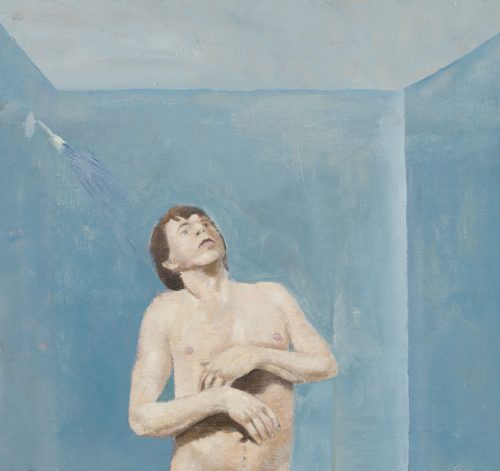
Thomas Kinkade, Untitled (Self-portrait in Shower), c. 1978. Oil on canvas.
As one staff member tells it in Billion Dollar Painter, after his business started falling apart, Thomas would often spend time in front of one of his favorite paintings, Maxfield Parrish’s “Pied Piper,” a mural behind a hotel bar in San Francisco. The image shows a musician dancing and playing panpipes, beckoning a community down from a castle and toward a verdant field. He must have seen himself in the Pied Piper, a Christian artist solely responsible for bringing his community to a better world. It seems noble. But to see yourself in such mythic and isolated proportions damages everything — the person, the art, the community.
When I was in seminary, I was in a student group focused on building community around the arts. When I had a chance to lead the group, a friend at the time took me out to coffee and asked if I’d be interested in co-leading. I turned him down. I don’t remember the reasons I shared, but I can tell you the reason that mattered to me then, even if I couldn’t consciously name it. I wanted to be the mythic leader, guiding the group through my own ability. It was the same vision of success I’d imagined for myself in high-school: service-oriented, self-sacrificing, and independent. It seemed good, until it wasn’t.
Once, the student group put on a week-long arts festival, and I took it very seriously. I met with donors, found partnerships with local arts organizations, and worked with the group to plan events. But somewhere along the way, self-celebration took over. I remember a video crew interviewing me outside, the camera spotlight on me while inside the students kept planning logistics alone. Finally it all fell apart: the pressure of graduate work, planning a festival, and the pressure I put on myself to be a good Christian leader all became too much. I had a mental breakdown. I quit my job, shaved my head, stopped eating and barely slept, and started driving around Los Angeles telling people about a “New Renaissance in American Culture” until, thankfully, I crashed on my couch and slept almost a whole weekend straight.
Somewhere along the way, I had lost touch with myself, with others, and with life itself. It was confusing and painful. Life-altering, to say the least. I survived it thanks to the community around me, which meant I’ve now had the gift of time to reckon with this, and to try to understand what led to so much pain. Sometimes I tell people, “I’ve had the gift of failing early,” and I mean it. As family and friends and a therapist helped bring my feet back onto the ground, I started walking in a different direction. I started to reckon with my own mental health. And I realized that if I didn’t untangle my self-conception, the social pressures I felt, and my own delusions about leadership, the result could be lethal.
I wish Thomas had found that kind of time and space to open the doors and windows and let some air into his creative life. In the documentary, it’s heartbreaking to watch his life implode. His business is falling apart, his family is estranged, and there he is wearing skull rings and dying his hair and riding motorcycles and trying to stay a few drinks ahead of the pain.
Thomas Kinkade rarely painted interior scenes. Instead we’re outside cottage after cottage, looking in at a golden haze of light. Almost all the doors are shut. The homes all blur together, evoking domestic scenes at a distance. Garden paintings swarm with pastel flowers. And while there’s often a path leading to the horizon, there’s rarely a single person in sight. At the time, all this seemed like expressions of faith and “family values.” But knowing more of Thomas’ own struggles and about the vault he kept, I have to wonder what was actually going on in these paintings: How lonely must he have felt?
“To be living is to be handed a precious white canvas upon which each of us can create a painting of great depth and meaning,” Kinkade writes in his book Simpler Times. “A painting that can be full of joy and peace. The beautiful painting of our lives. And if your perspective is true, the whole canvas will be beautiful.” His art brought him great fame and wealth and influence — things he kept pursuing until they hollowed him out, wrecking lives along the way. And while we may not be painting imaginary landscapes, we still live in that same world with the same incentives, one that celebrates self-editing and constant curation, scaling personal brands at all costs — pressures that are even more constant today. But it’s not the whole picture, not then or now.
Now that I’m nearing middle age, I look around at my friends and family, and I do see joy and peace — and a lot more, too: lush apartment gardens and homes caught in wildfires, affairs and second weddings, dissertations defended and unemployment, bright new infants and stillbirths, thick photo albums and letters from jail, picnic reunions and lost friendships, ordinations and porch talks on the death of God, published stories and stories yet to be written, days of grief and days of wonder. One whole canvas, light and dark, larger than any gilded frame can hold.








Wonderful, wonderful article. I come from such a similar place the author. Oh that we’d find ways to express the commingled reality of beauty and sorrow as Jesus did.
Wow, this is really fantastic and fascinating. Thank you Michael. Cannot wait to watch the doc.
Michael, thank you first for writing through so much of your life- the tension of the paradoxes and here, the compassion for the anguished painter of light and dark. I look forward to seeing the documentary. I’m glad to know you even though I rarely see you, I always enjoy your insight. Peace,
Author, thanks for writing this. I enjoyed reading it and will watch the documentary. People are afraid to express themselves and I think the art world would be a different place if everyone felt confident enough to pick up a pencil-brush-mouse-hunk of clay and just let it flow. I guess we can all encourage each other to do that as there is an infinite amount of creativity inside each human. Maybe it’s only being kept in by thin cellophane than can be lifted with a kind whisper and a nudge.
No words.
Profound.
The human condition.
My heart aches for him and all the waste.
He needed real people who could love him for who he was. Interesting that a “Christian artist” was not offered grace and the love of Christ.
[…] 1. Michael Wright: Lessons From the Hidden Vault of Thomas Kinkade: The Dark Side of the “Painter of … […]
[…] Lessons From the Hidden Vault of Thomas Kinkade. Michael Wright covers the perplexing case of Thomas Kinkade. “I’ve known of the ‘Painter of Light’ since I was a teenager, carefully averting my eyes in the Christian bookstore to keep from seeing the fluorescent cottage scenes, scoffing at the mall-goers ducking into his darkly lit galleries. He held a symbolic role in my teenage years, a creative leader whose paintings evoked a blend of art and faith that frustrated me. I shadowboxed him often. When he died from an overdose in 2012, estranged from his family and living in a mansion with a girlfriend, I remember reading the news reports and feeling vindicated. ‘See? This is where Christian kitsch can lead! It hollows you out, falsifies what’s real. He was an artist living a lie!’” […]
Everyone is offered the grace and love of Christ, by Christ. Kinkade surely knew this, and made different choices. We either walk with Him, or we don’t. Based on this writer’s interpretation, it seems Kinkade chose to chase wealth. The writer’s foray into failure seemed to stem from choosing self over Him. One doesn’t have to be a “creative” to ruin one’s life by chasing the wrong things. Such outcomes are always tragic, but they are not a mystery.
I always had a similar mocking view of Kinkade, especially as I used to spend long moments gazing at the works of the true “Painter of Light”, J. M. W. Turner, in Art Galleries. I would recommend Sky Jethani’s book on van Gogh, Divine Commodity, to help people understand a haunted Christian painter better.
As a former Thomas Kinkade art dealer with several galleries I picked up on the ugly reality of the TK organization. Being in business for almost 50 years I can truthfully say that the Kinkade Company was the most difficult supplier I have ever dealt with and there have been hundreds. I was in way to deep to get out until he passed and I was able to sell everything to the bare walls. The time I was around him at events, dealer meetings, etc., I realized he had no regard for his dealers or even his collectors. I would really like to see the movie, does anyone know where to currently stream it? There are many stories I could recount that would make his collectors gasp with shock. He truly threw it all away and his dark side took over. I am still sad and get knots in my stomach thinking about how I trusted this man and the company. Bad decision.
What a poignant, beautiful piece of writing. Thank you.
A tortured soul.
A talented painter.
Money and fame did him in
It’s a terrible shame he could not combine his real self and the persona people expected.
The Painter of Light stuff always made me look the other way. Reading this extremely well written piece, I understand him.