




The story of how Christianity first became a national religion is both enigmatic and strange. History tells of a runaway virgin, Hripsime, martyred because she spurned Armenia’s evil king, Tiridates the Great. The king was subsequently turned into a wild boar through divine justice, and his people were tormented with afflictions. But his sister had visions that Gregory the Illuminator (257–331 CE), whom the king had seen as a threat and imprisoned in a deep pit for thirteen years, was his only hope for recovery. Gregory, who had miraculously survived his ordeal, was pulled from the pit to cure Tiridates, who repented and converted to Christianity.

Gregory baptized the royal family, began the conversion of Armenia to Christianity in 301 by royal decree, and became patron saint and the first head of the Armenian Apostolic Church. Awash in the new faith, ensuing centuries witnessed these mountainous lands of the South Caucasus erupt with spectacular monastery complexes ascending cliffs and skirting gorges.
My first visit to Armenia was over ten years ago. But for many years prior to this I listened enviously to family, friends, and others longingly recount the marvels they discovered, and the powerful sense of belonging they felt as they stood on the soil of our motherland. When the opportunity for a family trip to Armenia arrived, my wife and I spent months preparing for an extended summer visit. My plan: experience every place I’d heard people talk about and more. A competitive desire not to be outdone by other travelers had seized me. I began planning an itinerary that would include both Armenia’s popular destinations and some lesser-known wonders. In the final weeks leading up to our trip, my wife packed gifts for her extended family in Armenia while I packed our agenda to ensure no site would be missed.
We arrived as planned on the edge of a blistering Armenian summer in the capital city of Yerevan. Once situated, we began to arrange all-day bus trips into surrounding as well as distant villages, where the landscape would transport us to a nearly forgotten time of noble kings, great heroes, and holy men. (Armenian history records many figures who were simultaneously all of these.) On long, perilous drives over broken pavement, we’d sway and bounce in our seats as ancient monuments peeked around slopes to greet us, and valleys peppered with wildflowers unfurled to reveal the architectural riches nestled in their rocky crevices.
These tours were ambitious. There was so much to learn and so little time at each stop. Each time we would arrive at our destination, I’d hurry off on my own to explore the area, knowing that if I stuck with the tour I would only experience a small fraction of each place. As others in the group would gather with our guide for a history lesson, I would be busy scrutinizing the wonderful structures and ruins scattered amidst the open fields and rocky outcrops. Immersing myself in the grandeur of these monuments, I sought to etch them into my memory, resolving to delve deeper into their histories once I had the resources at hand. In the meantime, I would depend on mental snapshots before having to depart — always frustratingly early — with the group.
But as we traversed the network of popular destinations laid out by Armenia’s impressive tourist industry, my desire to understand the churches, monasteries, fortresses, and monuments as I encountered them was continually frustrated. The lack of accessible and reliable facts about each structure or place (texts, drawings, maps) made for huge gaps in my comprehension. And the limitations of tour guides — who lacked the specialized knowledge my questions required, restricted how much I could learn on the road. My powers of imagination were challenged time and again as I would patch together observations and limited information from others in my attempts to recreate an obscure past.
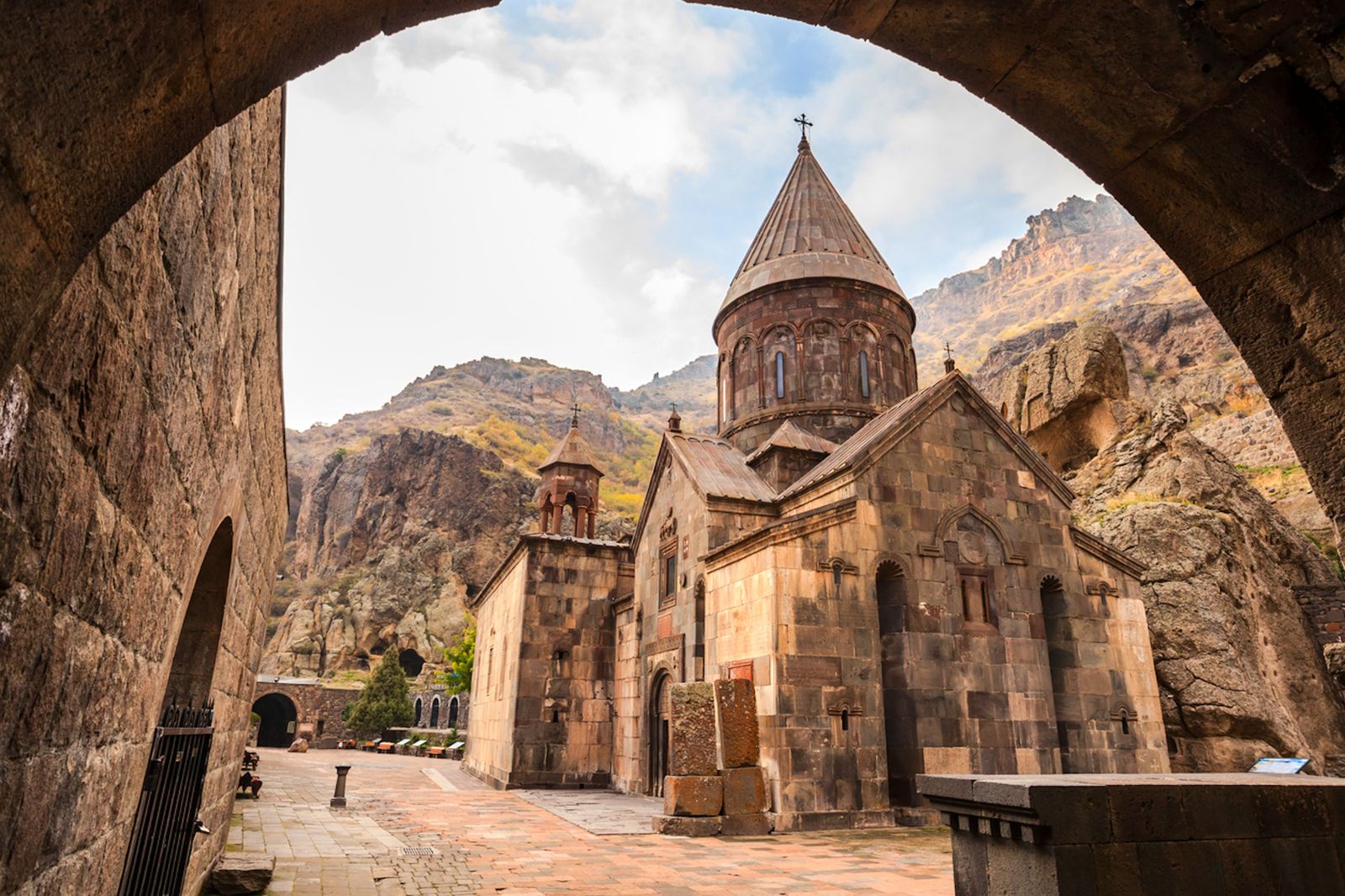
One place was particularly impenetrable to a mind searching for historical and architectural clarity. It’s a monastery that lies about an hour east of Yerevan, in the province of Kotayk. According to tradition, it was founded by St. Gregory at the site of a sacred spring in the recesses of a cave. Venerated in ancient times by the pagan inhabitants who lived nearby, the spring became part of the small cave chapel that St. Gregory first established at this location. Evolving into a monastic community, Ayvirank (which in Armenian means “cave monastery”) was destroyed by Arab invaders in the 8th and 9th centuries. But by the 12th century, a new monastery had replaced it. As it flourished into a great religious and cultural center, it would eventually be named Geghardavank (“monastery of the spear”) after the Holy Lance that pierced the side of Christ at the Crucifixion. The relic is said to have been brought to Armenia by the apostle Thaddeus and stored at the monastery, where it was visible to pilgrims for five hundred years.
Situated at the entrance of the Azat Valley, Geghard is protected by a defensive wall surrounding all but its northern side, which is situated against towering cliffs that both shield and integrate the architectural ensemble with the natural environment. Cut into solid rock, the more than twenty structures including churches, chapels, vestries, and tombs exude sanctity within their raw surroundings. I recall feeling both wonder and disorientation as I attentively navigated the monastery’s unpredictable passageways. Everything in the half-light was bathed in grandeur.
We were fortunate to arrive at Geghard when a choir was singing a hymn deep within a stone chapel, an ancient musical custom. The acoustics there are extraordinary, and when individual or combined voices sing sacred music, the effect is otherworldly. Armenian chants such as those heard at Geghard predate Gregorian chant. It’s been said that the members of royal families who are entombed in the earthen floors enjoy the benefit of being surrounded by music for eternity.
In the cool interior spaces of the monastery, protected from the stifling heat of the Armenian wilderness, I experienced a new kind of piety. Carvings in the ageless stone of Geghard’s walls, ceilings, columns, and archways testify to a deep faith rooted in God’s creation. I stood in awe before ornate geometric patterns, searched to identify the various animal and vegetal motifs, and dropped my head back, mouth agape, to gaze at spectacular domed ceilings. It’s hard to imagine the commitment necessary for such a feat of artistry and engineering. Yet nature and human expression were seamless there. Recalling my visit years later, I can’t imagine a better example of co-creating with God than carving architecture out of the earth. As with the numerous khachkars (cross-stones) embedded throughout the monastery, the immense weight of stone is belied by the fragile beauty of human artistry.
Art and architectural history teach one to be a detective: to sleuth out what’s hidden in an image, object, or structure through careful attention and methodical analysis. The great mystery detectives in literature, film, and television possess a special intuition and thrive in the unknown; they have strong observational skills, are highly attentive to details, and continually think outside the box. But my own skills in this area were thwarted even after my eyes became accustomed to the monastery’s dimly lit chambers. It strikes me then, and it still does, that even if I possessed the comprehensive understanding of a specialist in Armenian iconography, even that would not instill a sense of certainty about what I was beholding. The monastery’s surfaces seemed to enliven the images I knew from history books into figures ethereal and otherworldly.
As I cautiously wandered along the uneven ground of its hallowed spaces, scrutinizing its ornamentation and marveling at the sophistication of its design, I was re-enchanted by the mystery of faith. Exploration of the monastery heightened my senses, sharpened my attention, and kept me off balance. The holy shimmering I felt in Geghard’s darkness was unlike anything I had ever encountered in the versions of Christianity I knew. And though I had experienced the mystery of the Divine Liturgy in Armenian churches back home on innumerable occasions, my immersion in the monastery’s unique beauty brought the sacramental forms of the Armenian tradition to life in a new way.
The monastery’s integration with nature — so complete that it’s often hard to see where building ends and rocks begin — invites one to meditate on the sacred nature of both the earth and the creative acts of humankind. Its architecture and iconography lend it historical and cultural specificity, which emphasizes how divine presence reveals itself in the particulars of God’s creation or in the things we produce through our God-given aptitude for creative transformation of the natural world.
This immanence of God is what I found lacking in churches back home. Modern and familiar, they typically lack the inscrutability that factored so prominently in my experience at Geghard. Thinking back to that time in the silence of the earth when I found myself in a timeless and spacious dimension, I’m reminded that great art and architecture can unexpectedly defamiliarize the commonplace. At Geghard, my worn-out ideas about Christianity were washed and reborn in the experience of a faraway place. But this example also demonstrates how the divine may be more readily perceived when we’ve lost balance. In surrender to the unknown, we expand. This begins with an invitation, and the aesthetic qualities of a religious tradition can summon us to the edge of what we know, inducing us to step through a portal to the divine.
Whether in the scent of candles, the chilled air, the texture of stone, the echo of voices, or the adjustment of my vision to dark spaces, I felt the depth of my ancestors’ faith. The spirituality of Geghard is embodied in its material qualities; following the Orthodox view, which echoes the nature of Christ. Just as Christ took on human form and dwelled among us, Geghard’s materiality reminds the visitor of divinity in the physical realm. And that redemption involves the transformation and sanctification of the material world, emphasizing the inherent value and purpose of all created matter.
In calling forth an expansive vision of faith through its conception and design, the monastery promotes a state of unitive awareness. Visitors are beckoned to connect with the cosmic Christ. I think of the design of the cross-stones scattered throughout Geghard and embedded in its walls. In each, the centrally placed Cross is a transmitter of divine life linked together with the bounty of the earth in the form of interlaced vegetal and geometric motifs. In an analogous way, the spaces of the monastery situate the individual as coextensive with a timeless natural order suffused with God’s presence. Built space functions as the catalyst for a transformative encounter.
The beauty of all the ancient monasteries of Armenia, not only Geghard, is emblematic of Armenian Christianity itself. But Geghard is unique. Opening like a womb in the earth, its miraculous nature takes hold of the imagination, just like the story of St. Gregory’s acts of faith. The treasure of relics eventually stored up at the monastery — most notably the lance brought by Thaddeus — links back to the introduction of Christianity and evangelization of Armenia by both Thaddeus himself and the apostle Bartholomew. And from them to the work of Jesus’s ministry itself.
Legend adds to Geghard’s multifaceted identity. Years after my visit I learned the tale of a brother and sister from a noble family who wanted to build a temple and live in the gorge. I imagined how it all might have played out. The prayers of these pious siblings, their search for signs from God, how they came to plant a hoe in the ground of a mountain peak to mark the spot on which they would build, and the assistance of a holy virgin to construct what would become the monastery centuries later. Geghard points like the holy lance to the body of Christ — towards an abundance which disorients and frees us through love.








Such a beautiful piece. Thank you!
Thank you for reading, and for your kind words Ken!