




This essay appears in Issue 28 of The Mockingbird magazine, now available to order.
Most people think of poetry, to the extent they think of it at all, as an esoteric art form; words arranged so as to be intentionally challenging. That the poet’s goal is to be hard to understand, to try to communicate something profound by being opaque.
I don’t think this perception is entirely wrong. Sometimes I encounter a poem and cannot fathom what the meaning could possibly be, what thought or feeling the poet was trying to capture and convey.

And yet I also agree with the 19th-century English essayist William Hazlitt who said, “Poetry is … the most vivid form of expression that can be given to our conception of anything,” and that “wherever there is a sense of beauty … there is poetry in its birth.”
One of my earliest memories is of poetry in its birth. This is not to say I was precocious (I wasn’t), or that I possess some special insight (I don’t), but I remember so clearly sitting at the old wooden desk in the window alcove of my childhood bedroom looking out at the rustling red and orange leaves of a towering oak tree and thinking something like “Acorns have to fall from their place.”
I’ve revisited this image in my mind so many times. I’ve tried to write it into a poem or two but never have in a way that quite captures the moment. There was some inkling in my mind about the fact that acorns had a place and that their place was impermanent. That they could only move in one direction when they were released from their branches. Was I thinking about gravity, the laws of nature? Was I encountering some feeling about inevitability and transformation? Is it possible I was thinking existentially even then? It’s likely I have just imparted meaning on this simple memory, but I know that sitting at that desk, I half dreamed, half thought that I would one day be a poet.
It is perhaps unsurprising then that the first subject I loved in school was Shakespeare. I knew in ninth grade I wanted to be an English major. There was something about the meter and the rhyme of poetry that made me feel as if I was on to something — that even if I couldn’t exactly explain it, there was some depth of meaning there to be discovered. What teenager can’t at least grasp at the longing in Juliet’s bittersweet salutation? “Good night, good night! Parting is such sweet sorrow / That I shall say good night till it be morrow.”
I had a version of that experience in middle school, staying up all night on the phone caught in that cutesy argument with a crush: “No, you hang up!” But Shakespeare’s language — probably infused with the opulence of Baz Luhrmann’s interpretation, which was still popular at the time — gave that feeling such heft.
In my third year of college, in a class called Rhetoric & Poetry, the task was not just to understand poetic devices and their effect but to suss out the persuasive logic at play as well. As Professor Jost would ask us each class, “What argument is the poem making?” This way of thinking felt incongruous with my understanding of what poetry aims to do. It seemed like an overly pragmatic approach, like asking of a painting, “Yes, it’s beautiful, but what problem does it solve?”
As we worked through the modes of persuasion in each poem we read, I came to understand my professor’s question to mean something closer to: What is the line of reasoning here? What is the poet saying is true about the world?
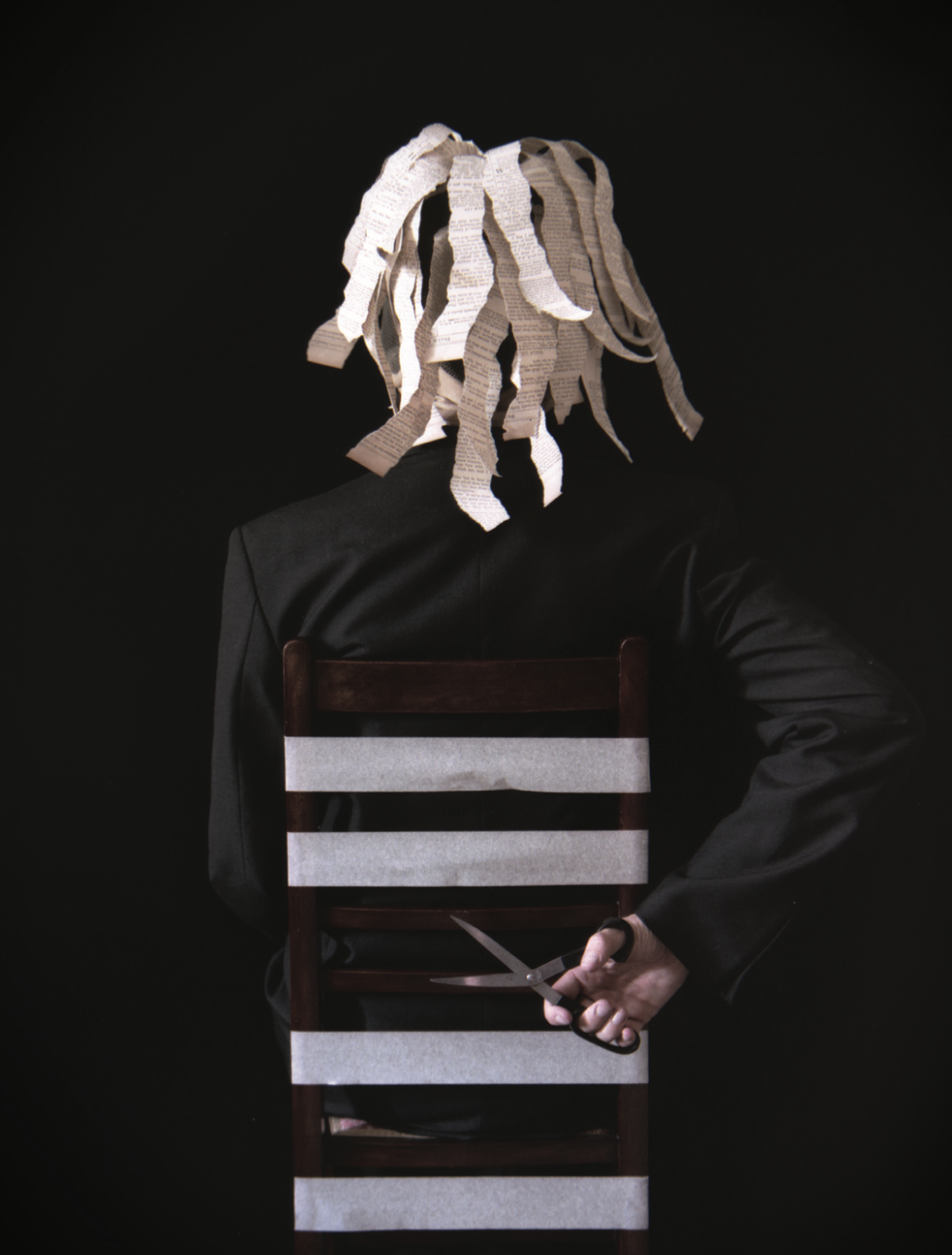
Louise Fago-Ruskin. The Catchers, 2008. C-type print.
Only then did I really begin to appreciate the emotional freight a poem can carry. In learning to pry at the language, I began to see how meaning can emerge and evolve. How a metaphor can add specificity by abstraction; how strange it is that a thing can be likened truer than reality.
At the time, this remained an academic exercise for me. I was exploring what I thought might be in the poem and waiting for a professor to let me know whether I was right. But there were lines that stayed with me long after the assigned reading. Lines that I had memorized, that would pop into my stream of consciousness based on some feeling or experience. I have since understood that the essential task of reading a poem is not necessarily to get it “right” but to respond to it — possibly in a way that no one ever has before, because it meets you precisely where you are — in the midst of life’s mysteries and challenges.
***
This knowledge became essential to me when, for a brief period in my early 20s, I wanted to die. I wasn’t exactly suicidal, not in a clinical sense. I didn’t have a plan; I didn’t imagine harming myself. And yet, I did consistently have this thought: “This would all be easier if I just wasn’t here.” Call that what you will.
The simple fact is, I was heartbroken. My girlfriend at the time had called it quits (for the final time), and I was unmoored. The loss of this relationship totally reshaped my understanding of the trajectory I had thought I was on. Letter-pressed into my memory of that break-up is this piece of a poem:
Oh heart green acre sown with salt
by the departing occupier.
It’s the first two lines of “An Upward Look” by James Merrill. Salting the earth, a traditional act of destruction by a conquering force, assures one thing: nothing new will grow here.
I had first read the poem years prior, but rereading it then, I felt the weight of the words in a way I never had before. I found that I could identify with the lover at the center of the poem who finds himself “colder and wiser,” who hauls himself out of his grim state to find the world simply going along with its business as if nothing has happened.
I knew then I would leave New York City, but I had no idea what path lay before me. I was walking down a one-way corridor. It was winter of 2008. It was dark and cold in downtown Manhattan. I was drinking too much. I was depressed. And I had this thought like a drumbeat in the back of my mind: This would all be easier if I just wasn’t here.
And in that thought, another poem:
I felt a Funeral, in my Brain,
And Mourners to and fro
Kept treading – treading – till it seemed
That Sense was breaking through
The opening lines of Emily Dickinson’s poem “#280.” The meter, the repetition, they convey how a throbbing migraine might feel — Dickinson is believed to have had them — but to me, they also express something true about intrusive thoughts. The challenge of shaking a feeling, the experience of retreading conversations, the belief that if I could just think about something the “right” way, some new insight or understanding might arrive. And yet, somehow always finding myself at my wits’ end: This would all be easier if I just wasn’t here.
***
I don’t recall how I encountered it, but into that dark place, “Let it go — the” by E.E. Cummings took hold:
Let it go — the
smashed word broken
open vow or
the oath cracked length
wise — let it go it
was sworn to
go
It’s a short poem, only three stanzas of equal length. Each builds on the last and broadens the scope of surrender: “let them go,” begins the second stanza, and the third, “let all go.” But the final line acts as a foil. After the penultimate directive line, “all things — let all go dear,” comes a hopeful twist: “so comes love.”
This poem became an incantation for me. I would read it occasionally throughout the workday in the Notes app on my phone, hunched over a sandwich at my desk repeating the lines, the verses becoming well worn in my mind like river stones.
That habit of return, the familiarity of the words themselves a comfort — I didn’t know it at the time, but this poem was teaching me to pray before I knew who I was praying to. I was not a believer then, but I was in conversation.
***
I have revisited Cummings’ poem many times over the years. I still love it, though it no longer holds me in the same electrified grasp that it did in my early twenties. How much of that was the language meeting the moment in my life? How much was it the assurance that letting go — as awful and scary as it can be — could lead to love? In recent years, I’ve begun to wonder whether it was the implicit knowledge that the poem had been written by another human. That I had found a message in a bottle from a fellow sufferer who was saying, in effect, you can survive this.
These questions have become more pressing as generative A.I. becomes ever more adept at mimicking thought, hastening the so-called decline of the humanities (and of the English major in particular). Of what use is reading and writing when education is focused primarily on making people predictably employable? Of what use is poetry in a world where anyone can parse a poem’s “meaning” at the click of a button? Or simply prompt a poem into existence?
Not long ago, I heard a brief talk given for a non-profit’s president who was stepping down at the end of his term. The remarks were thoughtful and heartfelt, but just before the speaker finished, he said he had a poem for the occasion. He described it as “written by ChatGPT, prompted by me.” I don’t remember any of the content of the poem, and I’m not sure it would be useful to relay it. What I remember is looking around at the audience and wondering what others thought about it. What exactly were we listening to? Did this gesture have any meaning?
***
I am not a poet, and yet it is poetry I have attempted to make in painful moments. When my best friend’s brother died in a car wreck, I wrote a sestina. When my mom was diagnosed with breast cancer, I wrote a lyric poem. When my friend Barry was going through his final treatments for glioblastoma, I wrote a haiku sequence. The point is not whether the sestina was any good, or the haiku an artful representation of the form, but that each offered a way of trying to make sense. When I could not write a sentence, much less speak one, I could appeal to a line, an image, perhaps a verse.
When my sister and her now-husband asked me to officiate their wedding, in my delight I immediately thought of a poem about marriage that I had long ago committed to memory, and I later read it at the ceremony. And I have frequently turned to verse for birthdays and anniversaries with my wife to try to express the ineffable.
Says the Bard:
With mirth and laughter let old wrinkles come.
This line from The Merchant of Venice is spoken by Gratiano, who is trying to tell Antonio that sadness and seriousness are not to be confused with wisdom. It was on the birthday card I gave my wife for her 30th birthday. A decade on, its simple argument (ever more relevant at 40) still feels right to me — that aging doesn’t have to be an insult, and that it is simply a privilege and a joy to be able to grow older together.
Here’s another line from later in that scene that puts mortality at the forefront. Antonio, in speaking of death, says, “There is no readiness, only punctuality.” Oof.
Now if you will, observe in your mind what happens to your understanding of that line when I tell you it is actually not Shakespeare at all, but the product of an A.I. model.[1]
It’s still an interesting line, perhaps, but what may have been clever in it curdles into creepiness once you know that what produced so incisive a line about the human predicament was not a human at all. It seems to me that the depth of meaning in any writing, especially writing meant to appeal to our sense of beauty, or to what it means to be human, is informed by the mortal investment that went into it, by the fact that it was expressed by an embodied creature struggling — just like me — with what to make of being here.
***
Does it matter if what we read was written by A.I. instead of a human being? It depends on what we think we’re reading and what we think it’s doing to/for us. A.I. writing that is purely instrumental seems less troubling, but a personal essay produced by A.I. is what? Simply untrue? After all, there is nothing personal on the other side of it. A.I. generated poetry would be untrue in the same way. And un-beautiful, by extension. “Beauty is truth, truth beauty,” said Keats.
Ah yes, you may be thinking, the ramblings of a nostalgic English major.
But regardless of how “intelligent” A.I. gets, regardless of how employable our degrees make us or how productive our economies become, the daily challenge will remain: how to be human in the world. How to love, how to grieve, how to celebrate, how to pray. ChatGPT can give us information about all of this, but if you’ve ever been heartbroken, depressed, or unsure where to go or what to do, then you know you need more than mere information. I’m reminded of William Carlos Williams’ assertion in “Asphodel, That Greeny Flower”:
It is difficult
to get the news from poems
yet men die miserably every day
for lack
of what is found there.
***
One of my favorite poems is “A Measuring Worm,” by the Pulitzer Prize-winning (Episcopalian!) poet Richard Wilbur. It’s a short poem, only 15 lines. I imagine Wilbur at his desk staring out the window — poetry at its birth — but instead of writing, he’s just sitting there watching a caterpillar crawl up the screen. He wonders whether the caterpillar can imagine the transformation that’s in store for him, but just as he has the thought, he knows he’s caught in the same inexorable march:
Although he doesn’t know it
He will soon have wings,And I, too, don’t know
Toward what undreamt condition
Inch by inch I go.
How sure the caterpillar must have been that it was a caterpillar and would remain so. How easy it is to become certain in our certainties, committed to our ways of seeing. Can we fathom an oak from an acorn? Can we fathom a transformation, a resurrection?
“Poetry is,” Audre Lorde said, “the way we help give name to the nameless so it can be thought.” When we apply words to the mysteries of existence, we call it poetry. A poem is not exactly an answer to the mystery but a container for it; it can give shape to new ways of thinking, new ways of feeling, new ways of understanding what it is to be human — even as understanding is not always available to us. Some of life’s mysteries, its truths, are so big we can only paw at them with metaphor, or simply sit before them in awe, trying to write a verse.








Someone able to ‘define’ poetry so ineffably well is most certainly a poet!
This is a beautiful article that came into my life with perfect timing. I spent my working life as an English teacher and a psychologist. Now I see everything I worked at and for devalued by AI. “Students” don’t need to learn to think analytically or to develop an individual writing style. Counseling is being conducted “mechanically.” I’m out of the loop, but I fear that young people will lose the abilities to think critically and to respond to others with empathy. This article gave me some hope simply by presenting my thoughts from a human point of view.
Linda Cifelli – Did you teach English at Scotch Plains High School?