




It’s been 40 years since instant replay review first entered American professional sports. Adopted by the NFL in 1986, a designated replay official would watch the game and buzz in if there was “clear and obvious” evidence that the call on the field had been incorrect.
At the time, instant replay clips had been a feature of TV broadcasts for decades. With the benefit of slow motion and well-positioned cameras, fans at home could plainly see whether a player had stepped out of bounds or caught the ball. This enhanced the viewing experience, giving viewers multiple angles to review what happened on the field. It seemed obvious that officials would benefit from what the fans themselves could see.
What’s wrong with getting the call right? If only it were that simple. The usual criticisms of video review revolve around how it disrupts the game, but no one asks whether it’s good for the sport itself — or for us.
When the major sports leagues added instant replay review to their rulebooks, it irreversibly altered how even casual fans understood the game. Now everyone stared at the same footage on a glowing screen and drew their own conclusions. Rather than getting it right, replay review flattened the playing field. Referees became spectators, and fans became referees with even lower tolerance for mistakes. Every millimeter was subject to increased interpretive scrutiny by millions of fans. Rules that were continually tweaked to provide greater clarity actually widened the contested territory, so much so that referees are now a regular feature of TV broadcasts.
In the name of objectivity, video replay turns athletic contests into legal battles.
During the first knockout round of the FIFA World Cup, USA’s striker Folarin Balogun stepped on the foot of Bosnia-Herzegovina’s Tarik Muharemović. It might as well have been a land mine. From that point on, the lawyers took over the tournament. The original call on the field was overturned upon further review. That review then itself overturned upon further review by FIFA. This reversal of the reversal of the original call was then appealed by the Belgian team, which led to a dismissal of the appeal of the reversal of the reversal of the original call.
The whole incident reminded me of a short parable from Dr. Seuss’ Did I Ever Tell You How Lucky You Are? that describes the town of Hawtch-Hawtch. The town has but one bee for pollination, so a Hawtch-Hawtcher is employed to watch the bee to motivate it to work harder. When this fails, a second townsperson was brought in to watch the first bee-watcher, which leads to a third watching the second, a fourth watching the third, a fifth watching the fourth … until the whole town stands in one long line watching each other.
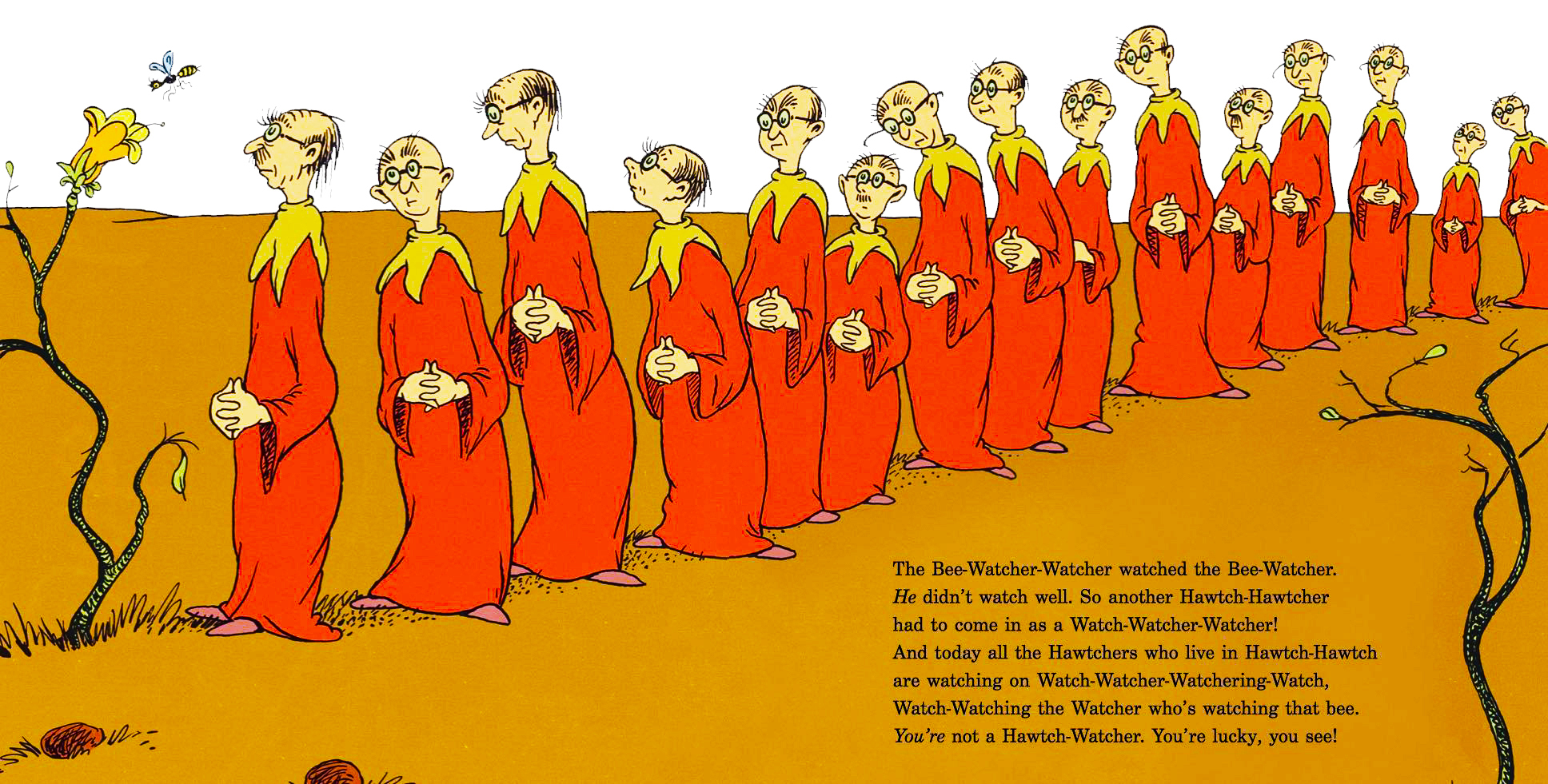
If the first referee fails, then you add another one. If that one fails, you add a third referee who watches the second … until there’s nothing left but referees.
Whether this FIFA courtroom drama is humorous or corrupt or crazy probably depends on which team you are rooting for, but it perfectly illustrates the problem. Video review promises that there’ll never be another missed call, that if there were enough systems of judgment to filter out human frailty, then perfection is possible.
We believe this implicitly as gospel — most especially with other people. From the safe distance of supposed objectivity, we can see clearly how other people have failed and how to get them back on track. If quarterly performance reviews don’t do the trick, then perhaps monthly or weekly ones will. You constantly remind your spouse of their responsibilities (and failures) with the hopes that they will actually listen to you this time. When that fails, you buy them a Fitbit and add a slew of reminders to their calendar. If your child keeps coming home after curfew, then firmer penalties are needed. Perhaps you even install a VAR tracking system that monitors their location or browser activity. You turn the screws ever tighter and tighter, raising your voice louder with sharper threats until your desires are fulfilled.
In sports or life in general, using the law to stamp out error only compounds the issue. It also makes you lose sight of why the rules are there to begin with.
I can vividly remember what it was like to watch ice hockey during the 1996–97 season. If the puck went into the net while an opposing player’s skate was in the blue paint of goalie’s crease, the goal didn’t count. That season, literally every time there was a goal it seemed possible that it would be disallowed on video review and taken off the scoresheet for a “crease violation.” The puck would go into the net, the red light turned on, but I withheld celebration or disappointment until video confirmation came.
The rule was implemented to ensure the safety of goaltenders. It had been on the books for several years at that point, but that was the first year the NHL approved video review of the play. The system was flawless in its execution, and the number of disallowed goals dramatically spiked. The number of goaltender injuries, however, remained largely unchanged. The right calls were made, but to negligible effect. The NHL abandoned the crease violation rule within three years. Everyone applauded the decision, even a few goalies.
VAR and video review probably aren’t going away any time soon, but I think we’re better off without it. A world without the exacting standards of perfectionism is one that patiently suffers human weakness rather than correcting it. It’s a world that understands that mistakes will happen, but they are simply part of the game. It’s more enjoyable to be a fan that takes the inevitable gaffes of others in stride than to be a judge who demands they never happen again.








Here, here! 🥂👏👏👏
What a wonderful, thoughtful reflection Todd. Too bad sport doesn’t actually exist any more. Games are only probability generators for ubiquitous gambling. And gamblers DEFINITELY want to referee any potential loss. Whether gamblers or not, we are all consigned to be Hawtch-Watchers unless we are the few bees still out there!
Hi Todd, thanks for your article. There is little doubt in my mind that as we have become less relational as people we strive harder to perfect and control others and their actions. I sense the decline in tolerance for error in myself and therefore in others. A bit sad really. Every blessing in your writing and take time for rest. Cheers Stephen
Todd,
Great thoughts as usual. But unfortunately there is no turning back. Gambling is too entrenched in all sports. When large amounts of money are on the line, the “right call” now has little to do with sportsmanship, but rather a definitive decision that will allow money to change hands to the “right” party.
An interesting corollary: in our terribly litigious society (that is another subject) this is the one event that the lawyers can’t screw up. A bets a bet.
Well written and interesting!
I wonder if the problems that you highlight here, while real, are more of an issue of the lack of cultivating the virtues of charity and humility, rather than a deeper embrace of perfection. Or maybe its a bit of a chicken and egg situation. But I would say the law (Law) has the function of puching people towards a better way of life as well as the convicting function.