




A few years ago, the magazine Wired ran a fascinating article by Max Levy that caught my attention. A neuroscientist studying rat behavior placed two rats in a cage. One roams freely while the other is restrained in a small clear box. The free rat is said to feel the restrained rat’s distress and works to release them. The researcher believes that rats feel empathy toward other rats. Levy concluded that the experiment “gives a peek at why people behave the way they do, and what it might take to make us kinder to strangers.”
All hail the noble rat?
Never once in my life have I seen a rat and paused to consider its superior ethical system. Not when I’ve seen them at the subway station. Not when I’ve seen pet rats behind glass in a store. And certainly not when I’ve seen one scurry across the kitchen counter. There are some people who find rats to be very sweet, gentle animals; that rats are actually quite cute and get a bad rap because we’ve wrongly blamed them for the black death that wiped out a third of Europe during the Middle Ages. But there is a reason why he’s Mickey Mouse and not Mickey Rat. I think it has to do with their size and their terrifying tail.
The rat study — and especially the media coverage surrounding it — reveals how lost we can be when it comes to thinking about the shape of our lives. Are we really looking to rats to shape our ethics?
If the old narratives of meaning and direction have come to be viewed as outdated, oppressive, or misguided, in our DIY world we are left to grasp for whatever might give our lives a measure of meaning, whether it be an Instagram influencer, a paperback of inspirational quotes, or a noble rat who frees his friend from a cage. But rats can’t tell you how to live your life any more than an ant colony can set public policy. In two years, that wellness influencer will just be a salesman for vitamin supplements. In five years, no one will remember the title of that book that seemed so life-changing at the time.
Life, we are often told, is what we make of it. The freedom of the open road with no map to tell you where to go. Should one pursue success? Or making your mark on this world? What about having the best things? Or family, friends … All of these and many more options are on the table. For some, the open road is adventure, a grand journey with a pretty view. That’s what the car commercials all say nowadays. But that is a fairytale told by those making a virtue out of necessity, a tacit admission that there is no real meaning to be had other than the passing enjoyment of moments strung together like pearls on the string of memory.
Either way, we are incessantly told that we must make something of ourselves, that our lives must matter, that we must be whoever we want to be, that we must make our own way amid infinite possibilities. This freedom, however, comes with a cost. The writer Freddie DeBoer recently put it this way:
Be anything, says the motivational Instagram account! Define success for yourself, says the best-selling self-help book! Chart your own path, says your mother in a text message! That all might sound liberating, but it’s actually exhausting; when nothing is prescribed, everything is a choice, and every choice is a referendum on your worth.
On a journey of infinite possibility and infinite judgment, it is easy to feel lost, to believe there is no good option. No matter how you define what matters to you or what’s worth living for, the alternatives not pursued or the unchosen failures along the way readily metastasize into regret. Perhaps you should have been a lawyer; at least then you’d have wealth to salve the misery. Perhaps you should have not gone to law school and married that guy; though you’d be poor, at least you’d be happy.
It would be tempting to observe the postmodern malaise and posit Christianity as the best roadmap to navigate the ethical void. Indeed, many Christians take this route. Jesus’ teachings are certainly countercultural and far more incisive than whatever can be inferred from a noble rat. But the roadmap of legalism — no matter the form — is always a dead end.
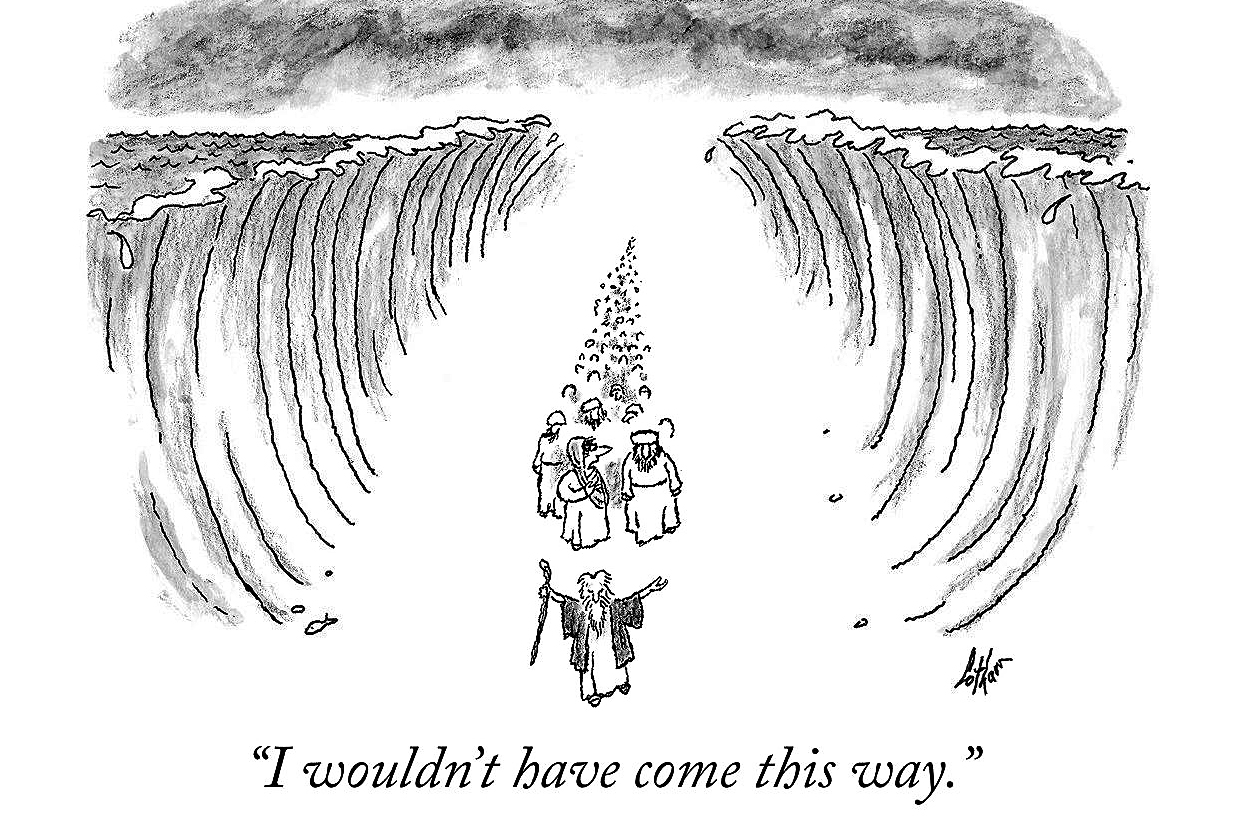
However important ethics may be, when applied to the question of meaning and significance, its medicine becomes a poison. Knowing the good you should do is not the same as knowing why you are to do the good — to say nothing about the inconvenient trouble of mustering the desire for the good. You can follow the roadmap of the law to a T and find yourself burnt out and disillusioned. You can be a good parent, student, or employee while simultaneously hating it all and wondering whether it’s worth the effort.
And despite what many Christians might think or preach, Christianity is ill-suited to answer every ethical question we might ask of it. The moral roadmap it offers is painfully imprecise and practically useless. To the legalists, real Christian freedom can look like the dizzying freedom of post modernity. It might tell you to head north, but it doesn’t stipulate turn-by-turn navigation.
Christianity doesn’t offer a roadmap but a person. When Jesus tells his disciples in the Gospel of John that he’s about to exit stage left, they are understandably troubled. Don’t worry, he assures them, he’s going to prepare a place for them with room for everyone. When you get there, everything will be great. The disciples immediately recognize a problem. The destination is determined, but they don’t know the way.
Jesus’ response is characteristically profound: “I am the way, the truth, and the life.” The what, why, and how of living. The roadmap, the reason you travel, and the one who animates your steps to take you far beyond the edges of the maps we cling to. Jesus understands that in the midst of lostness and despair and anxiety, what we really need is something — someone — that immovably stands alongside us in the ebbs and flows of circumstance. That the cure for lostness is not a roadmap, but belonging.
You cannot feel lost if you are held.
Jesus doesn’t give you a roadmap. He gives you his very life. He offers not judgment but mercy. If life is a journey, we do not travel alone. Though we meander on the way, the destination is guaranteed.








A great line: “a tacit admission that there is no real meaning to be had other than the passing enjoyment of moments strung together like pearls on the string of memory.” Agreed about how it’s a stretch to see rats as exemplars.
Heck yes. Loved this.