




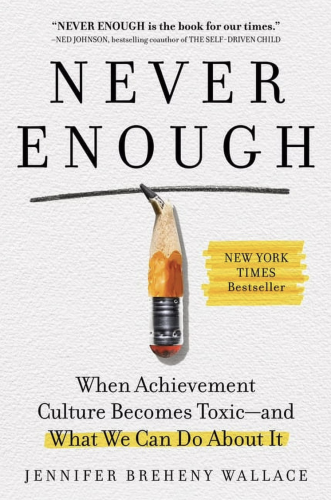
I first “met” Jennifer Breheny Wallace when I spied the wearied and stubby broken pencil that punctuates the cover of her 2023 book, Never Enough: When Achievement Culture Becomes Toxic — and What We Can Do About It. At the time, I felt as if I were at ground zero for the very culture she had researched and written about. I was teaching Senior English at an affluent high school known for not just its high AP test scores and consistently impressive US News & World Report rankings but also for its multiple football state titles in recent years. The school is a powerhouse through and through, and my students bore the weight of immense pressure, pressure that often found its way into my daily interactions with them, for good or ill.
Throughout my fifteen years in the secondary English classroom, I watched the pressure to perform steadily tighten its grip on my students. Failure was not simply undesirable; it was unthinkable. The stakes felt sky high. Every essay, every test, every grade entered into Skyward imagined as one more stepping stone (or stumbling block) on the path to the right college, the right future, the right life.
The result, sadly and paradoxically, was that my students became absolutely terrified to take risks, especially in their writing. But risk is the lifeblood of good writing — trying an argument that might fall apart, reaching for language that might not quite land — but fear makes everything smaller. And don’t even get me started on how this same fear propelled them to cheat or share test answers during passing periods or submit an essay with their name on it, 90% of which was written by ChatGPT.
Over time, this fear sometimes wedged itself between me and my students. Instead of being a partner in their learning and development as writers and critical thinkers, I could feel myself becoming the perceived gatekeeper: the one holding the grade, the one standing between them and their straight-A transcript, maybe even between them and Harvard. I did what I could to loosen that knot. Sometimes I handed back essays without numerical grades at all — only my marginal comments and the rubric — asking students to read the feedback closely and assess their own work before I ever revealed the number I had recorded. The exercise was meant to slow the whole process down, to show them that their writing wasn’t being judged on a whim or based on whether I “liked” them that day (lol). But even then, the larger culture of achievement hummed too loudly in the background.
Wallace’s work in Never Enough helped me see that my students weren’t inventing this pressure out of thin air. I was able to access a little more empathy for them and for their parents. Because parents were often operating from a place that felt like pure fight-or-flight, convinced that big love — like maternal or paternal love — meant helping their child become the best they could possibly be. As one mother admitted in an interview to Wallace, “I thought it was my job as a mother to help my child be the best he could be.” Totally understandable instinct! But somewhere along the way, encouragement can quietly slide into expectation, and expectation into a weight that crushes everyone involved. I can’t help but hear faint Christian echoes here, too.
When a journey of faith becomes a path of spiritual optimization, when we try to stare down our shortcomings and resolve to finally shape up, the whole thing collapses under the pressure. The invitation of the gospel, like the invitation Wallace gestures toward in her writing, is something far gentler: to lay down the exhausting project of proving ourselves and remember that our place at the table was never one we had to earn in the first place.
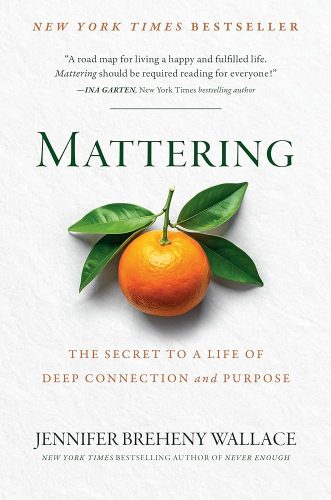
If Never Enough reads like a kind of cultural diagnosis — naming the way achievement culture hollows out our sense of worth — then Wallace’s newest work turns toward the remedy, the antidote: mattering. In Mattering: The Secret to a Life of Deep Connection and Purpose, Wallace expands her audience beyond parents to burned-out employees who feel like a “cog on a wheel,” to CEOs who continue to see disengagement and quiet quitting, to anyone who feels replaceable in a system that perhaps once promised purpose. Wallace describes mattering as the sense that we are valued by others and that we add value to the world. (And in a delightful bit of Mbird serendipity, Wallace even quotes John Zahl’s Grace in Addiction.) Wondrously, once the pressure to engender our own mattering lifts and we experience the way our very existence adds beauty to the lives around us, love has a way of flowing outward all on its own. The beloved become people who love.
One of the most powerful components of Wallace’s new book is the collection of anecdotal narratives, illustrations, and interviews she has conducted as part of her research. In her chapter “Everyone Needs (to be) a Cornerman,” Wallace shares the story of Rehan Staton, a sanitation worker turned Harvard Law graduate, who was able to move through immense hardship and suffering because of the “cornermen” in the ring with him, those to whom he mattered simply because he existed. But at one moment of particular stress in Rehan’s educational journey, he developed a mysterious illness, and his struggling health and inability to study for the LSAT necessitated particular support from his cousin Dominic. Beautifully, when “Rehan ran out of money and could no longer afford food … Dominic spent his last seven dollars buying Rehan a box of organic strawberries. ‘Why organic?’ Rehan asked in gratitude and awe.” Dominic’s reply? He was “worried the pesticides could cause Rehan to have a reaction.” While this illustration of superabundant grace and sacrifice lands amidst a chapter on receiving and giving help between fellow sufferers, all I see is the blood-red color of the strawberries, a holy fruit of new and unending life. Shed for you.
Wallace includes this story as an illustration of how mattering grows in the soil of support and care. Moments like this remind us that the antidote to achievement culture is not simply lowering expectations or telling people to relax. The better antidote is a deep understanding, a core, if you will (thanks, Jenny — can I call you that?), that says, “You matter simply because you are here,” a core strengthened by the steady presence of people around us who insist, through word and deed, that our worth does not rise and fall with our performance.
Perhaps Wallace’s work resonates so widely because it names something many of us already feel: a deep weariness in our spirits and bodies, a human need that too often goes unmet. It’s precisely why we could not be more thrilled to welcome Jennifer Breheny Wallace to the stage at our upcoming NYC conference, April 23–25. Her work sits squarely in the space we most care about: that place where the crushing pressure of modern life meets the surprising and wondrous freedom of grace.
As I think about this place that Wallace’s work occupies, the face of one of my former seniors comes to mind, a gal who also occasionally babysat for our family. I remember one sobering moment in my classroom when, after really not performing well on a test (probably Macbeth — that one was hard), she approached my desk and said apologetically, “I hope you’ll still want me to watch the kids!” The thought that a near-failing grade on a test might jeopardize her standing in my life — that she might somehow matter less to me because she made an academic oopsies — just made me so sad. Somewhere along the way, she had absorbed the message that performance determined her value, that a red mark on a page could quietly downgrade her place at the table.
Moments like that were part of what made the longer arc of teaching increasingly difficult for me; over time it all simply became too much to hold. The deeper I waded into the meat grinder of achievement culture, the harder it became to watch students I loved continue to believe that they were only as good as the last grade entered into Skyward. Wallace’s works name that quiet tragedy with clarity and compassion: In a world that screams we’re never enough, it is a gift to matter to someone before we achieve anything at all.








A beautiful article. Thank you!
Chef’s kiss for the clarity and power of what you shared. (And I don’t even cook.)
I am sharing this wisdom with my son and his wife, who just had a baby girl last month. Thank you for linking our cultural stance to the gospel message. Awesome article!
So well said. Thank you, Emily! As a parent in the school district where you taught I can echo your observations completely. The line that separates “best for our child” and suffocating pressure is so thin and is crossed so quickly in a world like this one that you have to actively push against it to prevent it from happening. It’s in the air like pollen except you can’t see it. So many kids start at the line just by existing in this ecosphere. I so appreciate your observations and I can’t wait to read Jennifer’s new book and to hear her at the conference!