




God save the child who rings that bell.
-Grateful Dead, “Franklin’s Tower”
The bell is the tradition, and clapping is also the tradition. When someone finishes their cancer treatment, they ring the bell that’s on the wall by the nurses’ station — and when they do, the rest of us clap. That’s the rule.
It’s a wonderful sound, the bell. When it rings out, the room wakes up, and joy fills an otherwise muted space. I’ve heard people whistle, and I’ve heard a few “Way to go!” shouts too. I’ve seen other patients, those without personal ties to the bell ringer, get out of their chairs and volunteer to take their pictures, squeezing all the nurses into the frame. Sometimes there are balloons and baskets of muffins and homemade cookies. It’s a blessing to be there when it all happens.
I clap too. Chemotherapy is no joke, no matter how many rounds you’re gifted with. The first couple aren’t that bad, but the ones that follow hit harder, and they get worse over time. I know this to be true — because my cancer won’t go away. I’ve been in a chemo regimen since the fall of 2020. I’m well past the point of adding up the rounds and keeping score. Hope is not lost, though; I do still carry around a strong sense of hope. The longer I’m here, the more time there is for medical advances and breakthroughs, and if I’ve had a singular prayer in all this, it’s been that right there. No one should have to go through any of this, so when someone finishes their assigned treatment schedule, I am quite happy for them, and genuinely so. If I’m sitting close enough to the bell, I’ll say something like, “Way to go. You did it. Go and do things you’ve always wanted to do.”
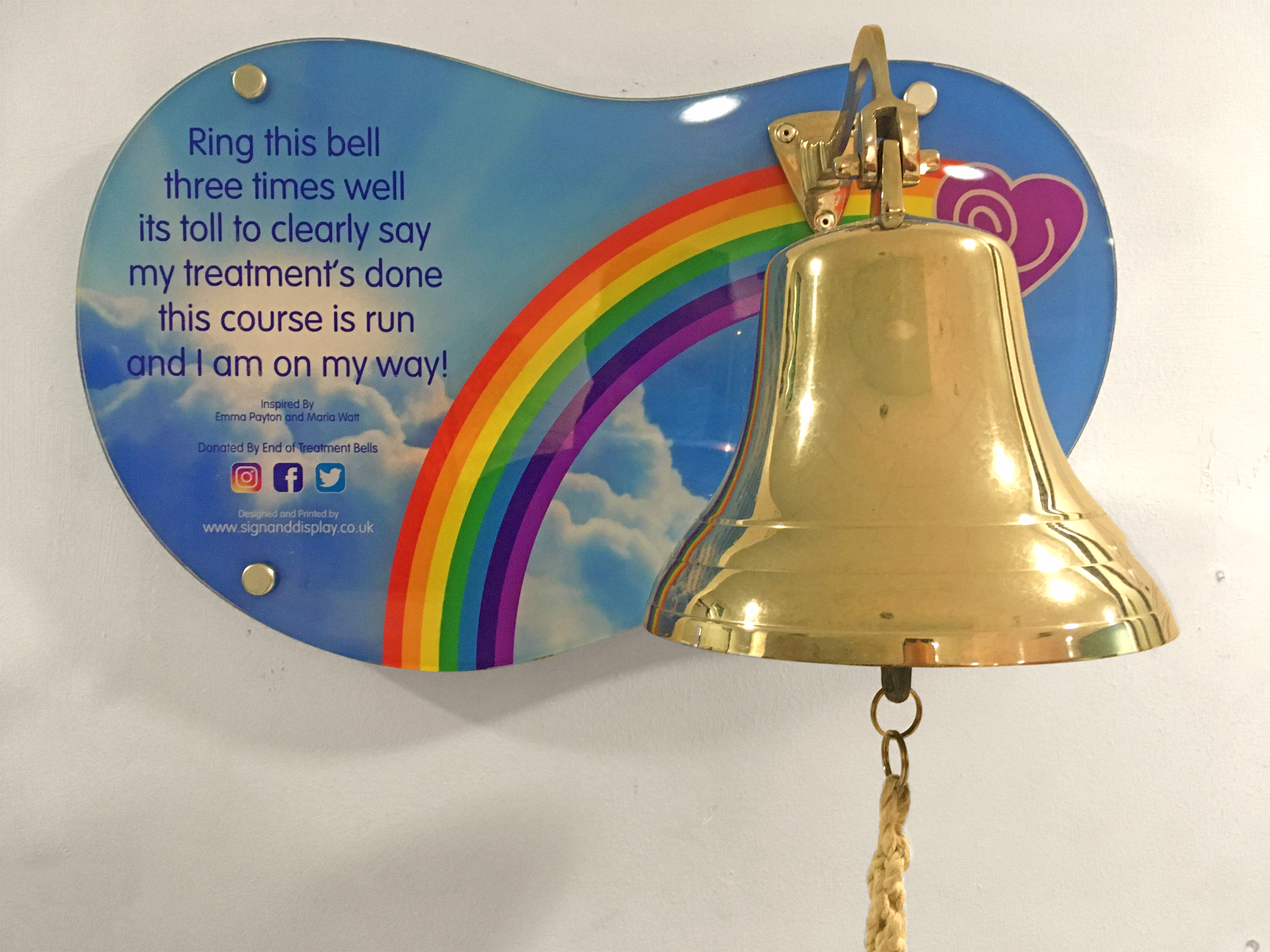
The Apostle Paul once said, “Rejoice with those who rejoice” (Rom 12:15), and that’s what happening in these moments. We’re all rejoicing at someone else’s liberation from cancer, and when we do, there’s a bit of hope that enters our own story, that maybe we’ll be in that same place one day. Maybe we’ll get to ring that bell. I really want to ring that bell.
Then there are the days I don’t clap at all. I’m not in the mood. There are days I’m so fed up with having cancer and so drained from the stress-inducing conversations with my oncologist, that I stumble into the chemo lab, find my chair, and socially disappear. Most of the time I scroll through things on my phone or stare at the TV on the wall that never has the sound on. In such a state, these celebrations can be jarring, if not offensive. Bells are loud and so is clapping, even louder when I don’t see any of it coming. These can be uneasy sounds too, because they’re not about me and my journey through this valley — they’re tied to someone else’s triumph. These are the days I don’t look up at all. I don’t clap or anything. I just keep reading what I’m scrolling, scrolling what I’m reading. Some days my thoughts are unfair, and the voice in my head will say things like “They’ll be back. When the cancer returns, they’ll be back.”
Recurrence is so common that a lot of surgeons have stopped saying, “I think we got it all.” I was told that everything was gone and that we had “good margins” and all the other things they say when they’re fairly sure the whole thing was a success. It’s too risky, if not deceiving, to assure someone they’re free and in the clear, and that’s why some have stopped using that language. I have memories of leaving the hospital after my surgery and feeling so alive, so free, and so grateful for everything and everyone in my life. Cancer, and the surgery to get it out of your body, is one long near-death experience. And if you wake up from surgery and the doctors are happy, you feel good, you feel alive, very alive.
When I was told that mine had come back and that it wasn’t anything they could fix with surgery, I didn’t feel alive anymore — I felt demoted and less-than and cheated on. I had rung that bell too, remember?[1] But my cancer’s return made it all feel like a joke, and I felt more stupid than angry.
I’ve been messing around lately with what Paul said about rejoicing with those who rejoice. I’ve been hammering out what he could have meant and how big of an ask this is, especially for people whose lives are marked by suffering and sadness and ongoing trouble.
As a pastor I hear a lot of reports from people who have lived through their own medical scares, who were set free by a good report or a successful surgery or even just a second opinion. People will come up to me, people who know that I am still getting chemo, and they’ll share with me some success story about their own health and of how good God has been to them. The learning curve on hearing other people’s good news when I’m trying to avoid any kind of bad news has been hard. What do I do when they’re crying because they’re so happy? What do I say? How do I say it? I do know that there’s a grace to entering someone’s joy with them, especially when I’m more inclined to raise my first at God and say things about fairness and justice and to ask God “When do I get mine?” But when I do celebrate the wins of others, when I do — in spite of my own unresolved troubles — rejoice with those who rejoice, there’s a grace there.
Theologically I’m learning that when I drum up the energy to smile or clap or to rise in the presence of someone else’s joy, I remember how these moments are small sketches of the world to come, the world that God is making. When I participate, I am also rehearsing, I’m practicing heaven on earth. And that even in my own condition, I have room for another’s joy, I just need to look for it. As Walter Brueggemann has said in many places and in many ways, “The job of the church is the remember the future.” There’s a joy in that, a certain kind of joy that is a posture of resistance in the face of all the brokenness of our world. Maybe this is one of the reasons we practice this?
Perhaps our rejoicing — when there is no apparent reason to do so — is a proclamation of sorts that our celebrations are part of the language of heaven, and when we laugh or dance or sing songs of joy, what’s really going on is signposting. We’re pointing to the coming world. Church is many things, and practice is one of them. Church is practice. We’re practicing heaven, rehearsing and learning our lines, building a nature and a tendency around life-giving things like joy and rejoicing, even when it’s hard.
Rejoice with those who rejoice. (Rom 12:15)
Derek Sweatman is the pastor of Atlanta Christian Church, Atlanta, GA. He also has a Substack called “The Forgettable Church.”
[1] I’ve actually rung the bell twice. The first time was after my original treatment cycle back before my surgery. The second time was because I asked to. It had been a long day in the chemo lab and there were problems with my port that delayed my treatment for hours, and by the time I was finished, the sun had set, and it was just me and a few nurses left in the lab. So I asked if I could ring the bell when I left, just something funny to do as a joke about being there so damn long. They said “Of course!” and they clapped and whistled when it rang out. It’s a good memory.








It may have one good ring, baby, you can’t tell.
I was waiting on you, Luke. Right on time.
Hey Derek-
I’m a palliative care nurse practitioner in an oncology practice. I see a lot of people with your similar story- cancer for years and years. It’s a hard road. I don’t really have anything to say except that being on the provider end, I am in a season of being mad at God on your behalf- because of all the suffering I see. It’s not fair! And we feel it too. You’re not alone in the feeling of injustice and you’re not alone when you try to let go of it for a second to be happy for someone’s very real (and perhaps very momentary) victory. Hang in there. Hope they have a good blanket warmer where you are.