




My daughter and I saw the roots before we saw the tree. Coming around a bend in the trail, a wall of red Virginia clay blocked any light from the west, the roots of the western oak peeking out from the dirt, full intact and reaching from the edge of our feet towards the canopy above. Taller than my husband’s head, the roots narrowed and twisted into a vertical wall in front of us. As we climbed beyond this woven surface of dirt and rock, we saw the once-majestic trunk lying defeated on the mud below. Like the weeds I pull from our vegetable garden and leave on the pathway to dry out and die, the tree appeared to have been lifted by some giant hand and laid on its side. As if some colossal gardener thought this tree was in the way of others, taking up too much space, and maybe she needed to thin the crop a bit.
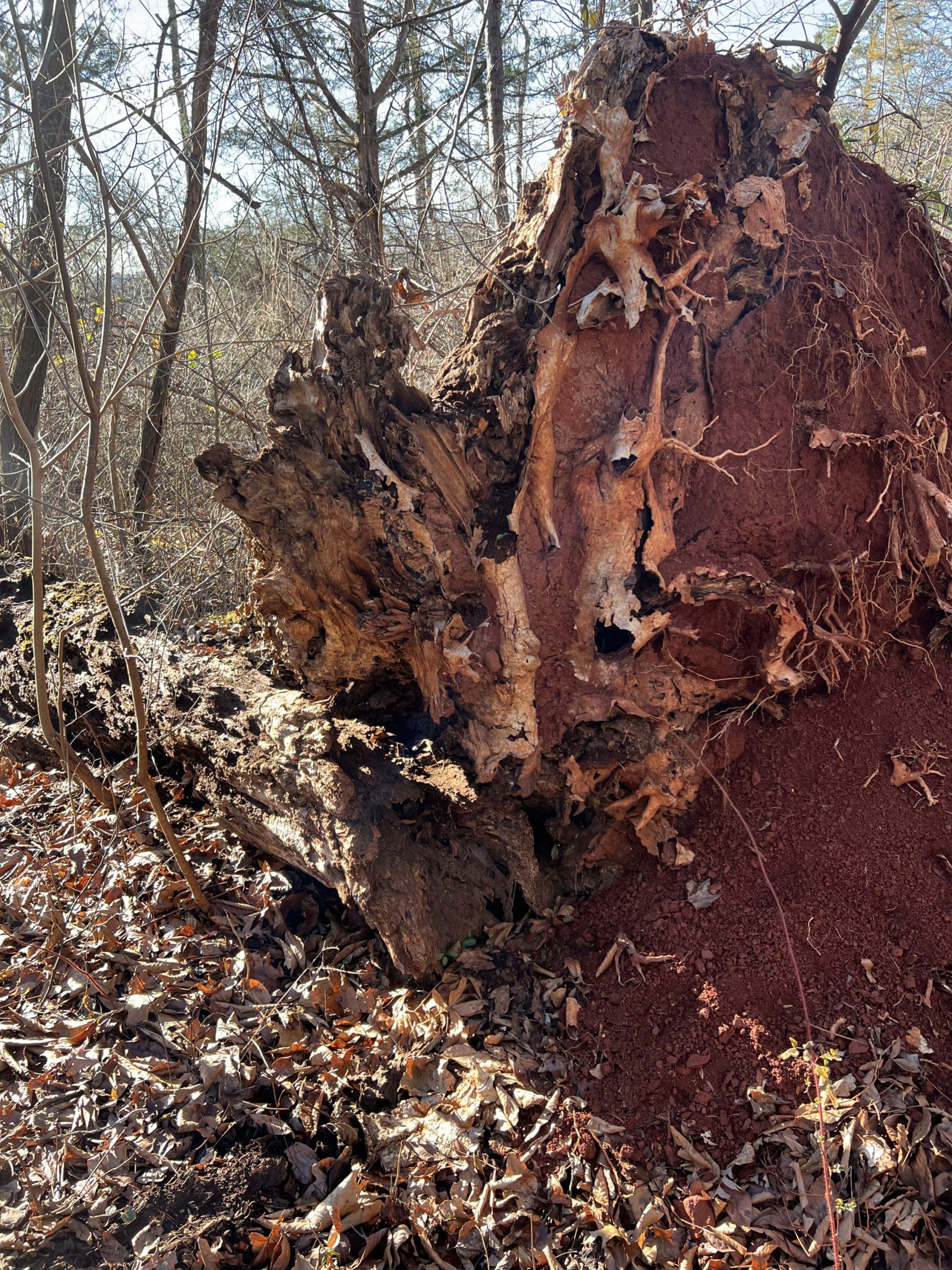 Roots are amazing. On their downward path from the surface, roots can break through rock as they search for the deeper water reserves. These downward, tangled lattices are the first part of the tree to grow. Not the leaves, not even the stem. The very first thing a seed sets free are these unseen tendrils, which immediately goes to work, diving and stretching, seeking water and nutrients, even if it has to go through rock to find them.
I live in a forest, surrounded by green in the spring and summer, then glorious reds and oranges in the fall until about November, when the leaves begin to drop and the gray of winter sets in. For three or four months, I look out into a forest of beige trunks and rotting leaves. The trees appear to be dead and done.
Carl Whitcomb, a horticulture professor at Oklahoma State University, studied tree and shrub root growth for decades. In experiment after experiment, he discovered that, as the leaves fall from the trees, the roots grow more. Most of the root growth, over 80%, occurs in the autumn, even as above ground, the trees appear to be dying. But what happens in the darkness of the soil is in fact a burst of life and growth.
Lent is like an autumn, removing dead leaves of distractions to increase the life under the surface, to root us to the source of life itself. In John 15, Jesus uses a similar metaphor. ““I am the true vine, and my Father is the gardener. He cuts off every branch in me that bears no fruit, while every branch that does bear fruit he prunes so that it will be even more fruitful.”
For the past few years, I have given up NPR for Lent. Nerd alert, I know. But for me, silence causes me to reflect on what voices I listen to, what I spend my free time thinking about, where my mind wanders when it is not distracted by mindless talk. Most of the time, my mind is full of banality. Did I remember to start the dryer? I would like a sandwich for lunch. Remember the time I couldn’t find my keys. But, if I sit with my own thoughts for long, I recognize other voices I listen to: voices of shame, voices of judgment, of myself and others, or malicious thoughts towards people I don’t like.
When I don’t spend the day listening to other people speak, even just for twenty minutes in the car, it is remarkable how much more aware of myself I am — the good and the bad. I’m not recommending everyone give up NPR, but for me, I find that silence leads to reflection which leads to remembering that I desperately need a Savior who loves me enough to die for all of my sin.
Lent is a downward descent to look at our need. Every year, we give up coping mechanisms, little or large distractions, common cravings to spend six weeks growing downward. Without these often unconscious crutches, even the slightest bit of depravation and discomfort exposes the fragility of our daily equilibrium. It is anything but an exercise in self-righteous holiness. As Edna Jong once wrote, “Lent is not a tediously long brooding over sin. Lent is a journey that could be called the upward descent, but I prefer to call it a downward ascent. It ends before the cross, where we stand in the white light of a new beginning.”
Perhaps, we like the trees in my back yard appear to be downtrodden and dying. Perhaps we are. But as G.K. Chesterton wrote, “I have found only one religion that dares to go down with me into the depths of myself.” The journey of Lent is not one of punishment or deprivation but of returning to the white light of a new beginning, remembering God’s mercy, whether we are distracted or not, is new every morning.








A creative and poignant and moving reflection on the hard work of Lent–and its sometimes hidden beauties.
Jane – I LOVE the idea that the tree is growing most when it appears to be dying above ground. Amen! Thanks! And I LOVE the Chesterton quote.